
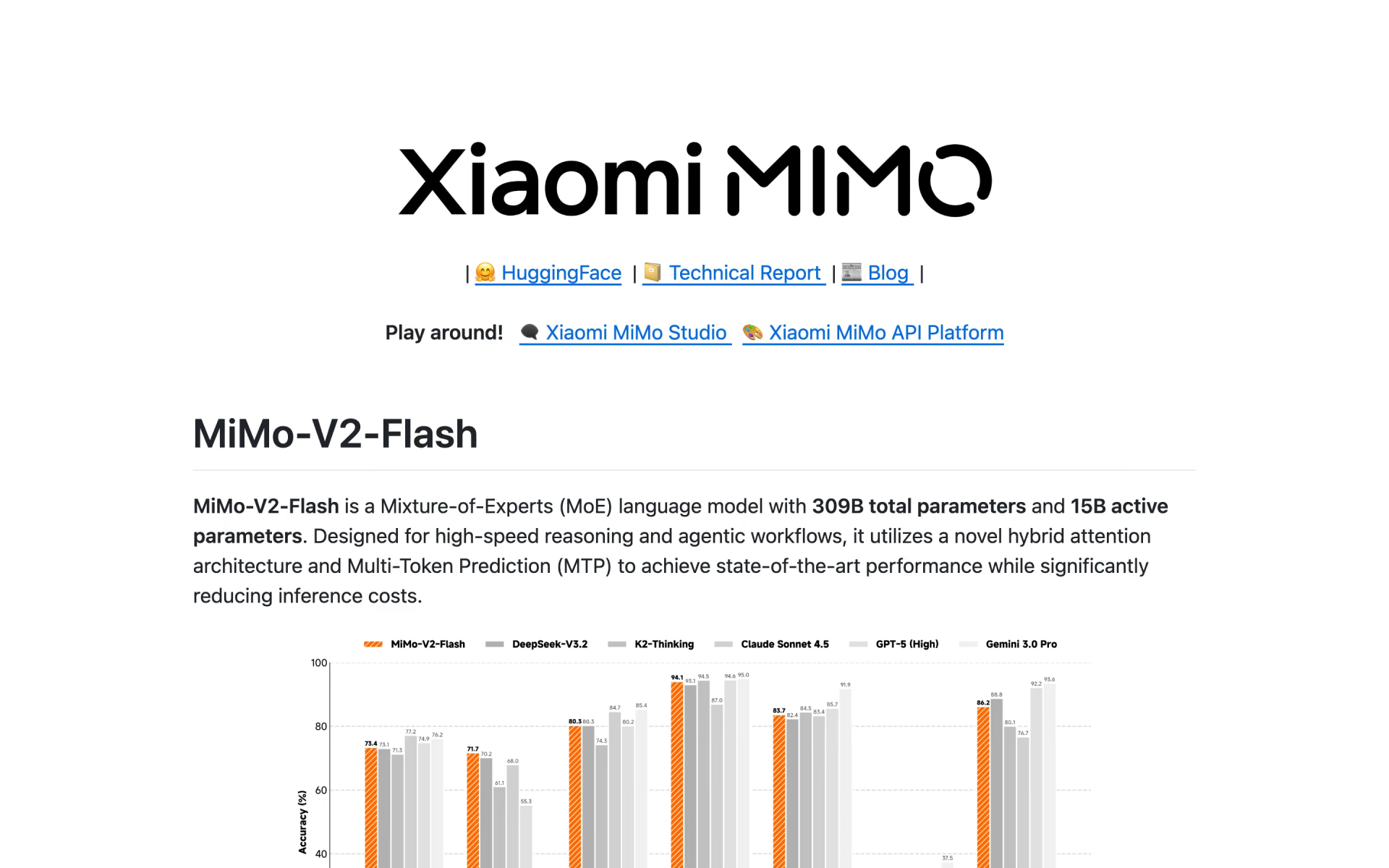
What is MiMo-V2-Flash?
MiMo-V2-Flash is a Mixture-of-Experts language model from Xiaomi's MiMo team, with 309B total and 15B active parameters. It mixes sliding-window and global attention at 5 to 1 to cut memory use on contexts up to 256K tokens, and uses multi-token prediction to speed up output. It reads and writes text, and can think first or answer at once.
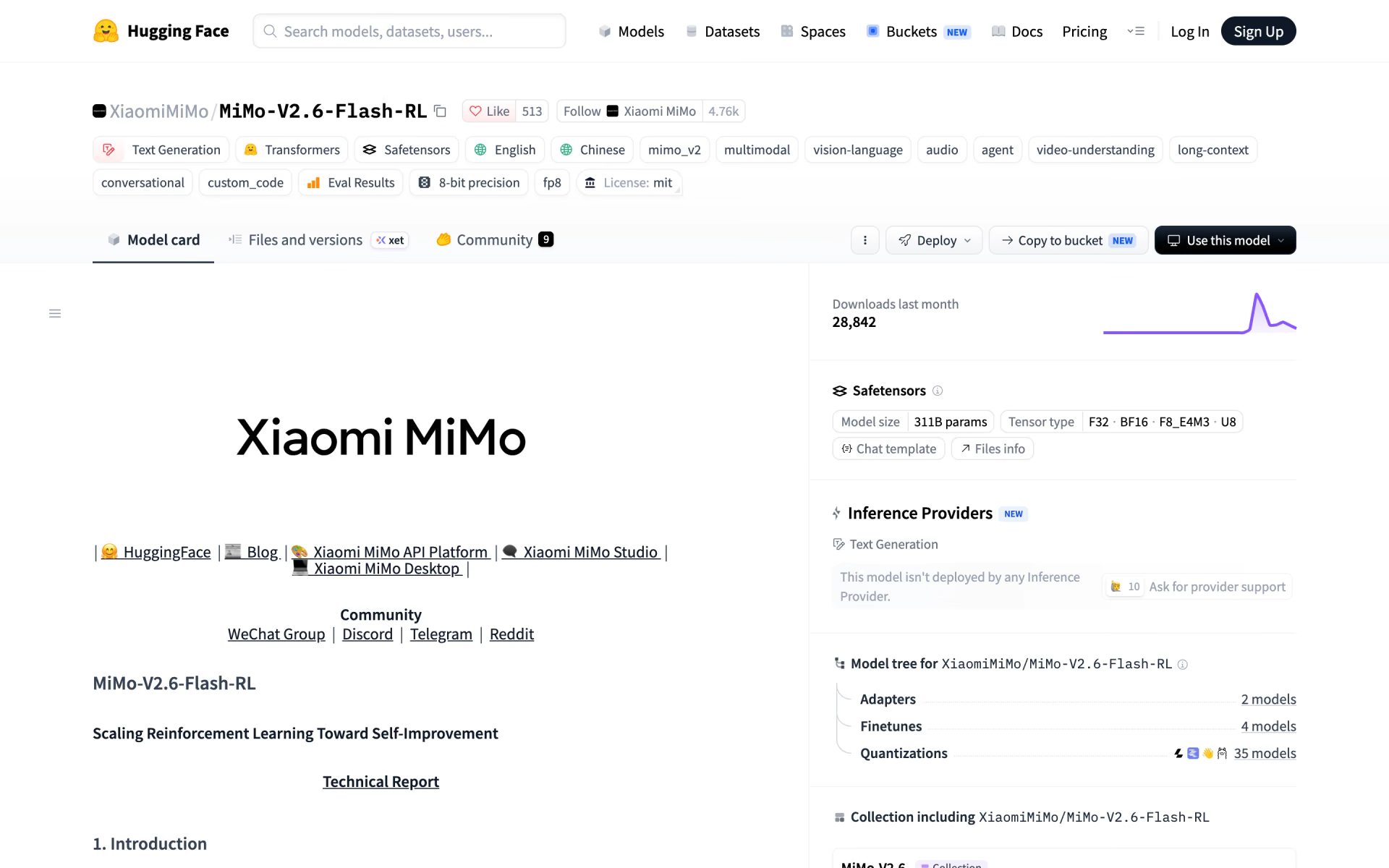
It is now a legacy model. Xiaomi removed it from its API after routing its requests to MiMo-V2.5, and its current flash model is MiMo-V2.6-Flash, the same size with a 1M context and image, video and audio input. The original weights stay on Hugging Face under the MIT licence.
Is MiMo-V2-Flash still available?
Only as a download: Xiaomi retired it from its API, but the MIT-licensed weights are still on Hugging Face.
- API
- Retired. Requests were first routed to mimo-v2.5, and the old model name now returns an error.
- Weights
- Still free on Hugging Face under the MIT licence, as the original release without the later API updates.
- Successor
- MiMo-V2.6-Flash: the same 309B size, a 1M context, image, video and audio input, open weights and an API.
- In between
- MiMo-V2.5 added vision and audio on the V2-Flash design, and Xiaomi is now retiring it from the API too.
Who is MiMo-V2-Flash best for?
MiMo-V2-Flash is best for teams that want to self-host a free, MIT-licensed coding and agent model on their own GPU servers, or that already built on it.
Self-hosted coding agents
It scored 73.4% on SWE-Bench Verified in Xiaomi's tests, and Xiaomi says it works with Claude Code, Cursor and Cline.
Teams with a GPU server
Xiaomi publishes an SGLang setup for the FP8 weights with multi-token prediction switched on, sized for an eight-GPU node.
Research on efficient models
The base model, the multi-token prediction layers and a technical report are all public, under permissive licences.
Projects already built on it
Fine-tunes and evals that depend on this exact model can keep running from the weights now that the API name is gone.
What's included with MiMo-V2-Flash?
Switchable thinking, hybrid attention for long contexts, multi-token prediction for faster output, tool calling, and published base and draft weights.
- Switchable thinking
- Turn thinking on for harder problems or off for instant answers.
- Hybrid attention
- Five sliding-window layers with a 128-token window for every global layer cut KV-cache storage by nearly six times.
- Multi-token prediction
- A three-layer draft module proposes tokens the model checks in parallel, for a 2.0 to 2.6x speedup in Xiaomi's measurements.
- Base and draft weights
- MiMo-V2-Flash-Base and the multi-token prediction weights are published alongside the main model.
- Tool calling
- Calls tools in thinking mode, as long as each request sends back the earlier reasoning content.
- CPU offloading
- Xiaomi's KTransformers guide moves experts to the CPU and reports up to 35.7 tokens per second on four RTX 5090 cards.
How much does MiMo-V2-Flash cost?
MiMo-V2-Flash is free to download under the MIT licence; Xiaomi no longer sells it on its API, where its successor mimo-v2.6-flash costs $0.14 / $0.28 per million input / output tokens.
- Download from Hugging Face, base model included
- Code on GitHub under Apache 2.0
- Runs on SGLang or KTransformers
Xiaomi no longer sells MiMo-V2-Flash on its API, and requests that use the old model name now return an error. Its current flash model, mimo-v2.6-flash, costs $0.14 per million input tokens and $0.28 per million output tokens on Xiaomi's pay-as-you-go API at its overseas US dollar rates, or half that through the Batch API. Full pricing on huggingface.co. We checked these prices on .
How do readers rate MiMo-V2-Flash?
No one has rated MiMo-V2-Flash yet. Be the first.
Sign in to rate. One rating per account.
MiMo-V2-Flash pros and cons
It is free, openly licensed and strong for its size on Xiaomi's coding tests, but it is off the API, large to host, and the released version is weaker at tool calls than later API builds.
Pros
- Free for commercial use under the MIT licence, with the base model and draft layers published too.
- Users who self-host it call it fast and strong for its size, helped by only 15B active parameters.
- Several users rate it well for coding and data work: it passed private coding tests, built apps from loose specs and turned long documents into structured JSON.
- In Xiaomi's tests it scores 80.6% on LiveCodeBench-v6 and 73.4% on SWE-Bench Verified, level with DeepSeek-V3.2 Thinking on the second.
Cons
- Legacy: Xiaomi's API no longer serves it, and MiMo-V2.6-Flash keeps the same size while adding a 1M context and image, video and audio input.
- The download is the original release, which Xiaomi's changelog puts at a 44% tool-call success rate in thinking mode; the fixes that lifted it to 97% went only to the API, and users reported unreliable tool calls and instruction following.
- Users report repetition loops, and answers that fall apart on prompts of around 30K tokens.
- At 309B parameters it is out of reach for most home hardware, users say, even in heavily compressed versions.
Is MiMo-V2-Flash open source?
Yes. MiMo-V2-Flash's code is public under the MIT licence, so you can run it on your own server.
On GitHub
1,400stars
- Last commit
- 29 Oct
- Repository age
- 11 months
- Licence
- MIT
- Self-hosted
- Yes
- Repository
- XiaomiMiMo/MiMo-V2-Flash
What are the best MiMo-V2-Flash alternatives?
MiMo-V2-Flash is an open source alternative to Claude Sonnet 4.6, Kimi K2.5 and GPT-5.2. DeepSeek-V3.2 does the same job and is open source too.
 Claude Sonnet 4.6Paid
Anthropic's legacy Sonnet model with a 1M-token context, at $3 and $15 per million tokens.
 Kimi K2.5Free
Moonshot's open multimodal model for visual coding and agent swarms of up to 100 sub-agents.
 GPT-5.2Paid
API-only GPT-5.2 with a 400K context and reasoning controls.
 DeepSeek-V3.2Open Source
DeepSeek's open, MIT-licensed reasoning model for agents, with thinking during tool calls.
 Step-3.5-FlashOpen Source
Choose it when you want a similar open model that its maker still serves: 196B parameters, a 256K context, Apache 2.0 weights, and $0.10 / $0.30 per million tokens on StepFun's API.
 DeepSeek V4.1 FlashOpen Source
Choose it when you need image input and a 1M-token context under an MIT licence, with a hosted API from $0.15 / $0.60 per million tokens off-peak.
Questions about MiMo-V2-Flash
What is MiMo-V2-Flash?
MiMo-V2-Flash is Xiaomi's 309B-parameter open-weight model for coding, reasoning and agents, now retired from Xiaomi's API but still free to download under the MIT licence.
Who is MiMo-V2-Flash for?
MiMo-V2-Flash is best for teams that want to self-host a free, MIT-licensed coding and agent model on their own GPU servers, or that already built on it.
Is MiMo-V2-Flash free?
Yes. The weights are free on Hugging Face under the MIT licence, which allows commercial use, and the code is under Apache 2.0. You pay only for the hardware to run it, since Xiaomi no longer offers it on a paid API.
Is MiMo-V2-Flash open source?
Yes. MiMo-V2-Flash's code is public under the MIT licence, so you can run it on your own server.
What are the best MiMo-V2-Flash alternatives?
The closest alternatives on Recaply are Claude Sonnet 4.6, Kimi K2.5, GPT-5.2, DeepSeek-V3.2, Step-3.5-Flash and DeepSeek V4.1 Flash.
Where can I try MiMo-V2-Flash?
On its official website, github.com.
Can I still call mimo-v2-flash on Xiaomi's API?
No. Xiaomi first routed mimo-v2-flash requests to mimo-v2.5 and then retired the name, so calls that use it now return an error. Switch to mimo-v2.6-flash, since mimo-v2.5 is being retired as well.
What hardware do I need to run MiMo-V2-Flash?
A lot. Xiaomi's SGLang example serves the FP8 weights across eight GPUs. For a smaller budget, its KTransformers guide offloads experts to the CPU and reports up to 35.7 tokens per second on four RTX 5090 cards with two AMD EPYC 9355 processors.
MiMo-V2-Flash or MiMo-V2.6-Flash: which should I use?
MiMo-V2.6-Flash for almost everything. It has the same 309B size with 15B active, a 1M context instead of 256K, image, video and audio input, and the same MIT licence. Keep V2-Flash only when your tests or fine-tunes depend on it.
Our verdict
MiMo-V2-Flash is worth downloading only if you need this exact model; for anything new, start with MiMo-V2.6-Flash.
The MIT weights are free and did well on Xiaomi's coding tests, but Xiaomi has retired it from its API, and its successor keeps the same size while adding a 1M context and image, video and audio input.
- Skip it for
- Anyone without a multi-GPU server, and anyone who wants a hosted API.
- Check first
- Test tool calls and long prompts on the released weights, since Xiaomi's later fixes never reached the download.
 MiMo-V2.6-Flash

 MiMo-V2.6-Pro
 Qwen3.8-Flash
 Nemotron 3 Nano Omni
 Step 3.7 Flash
 Gemini 3.7 Flash