
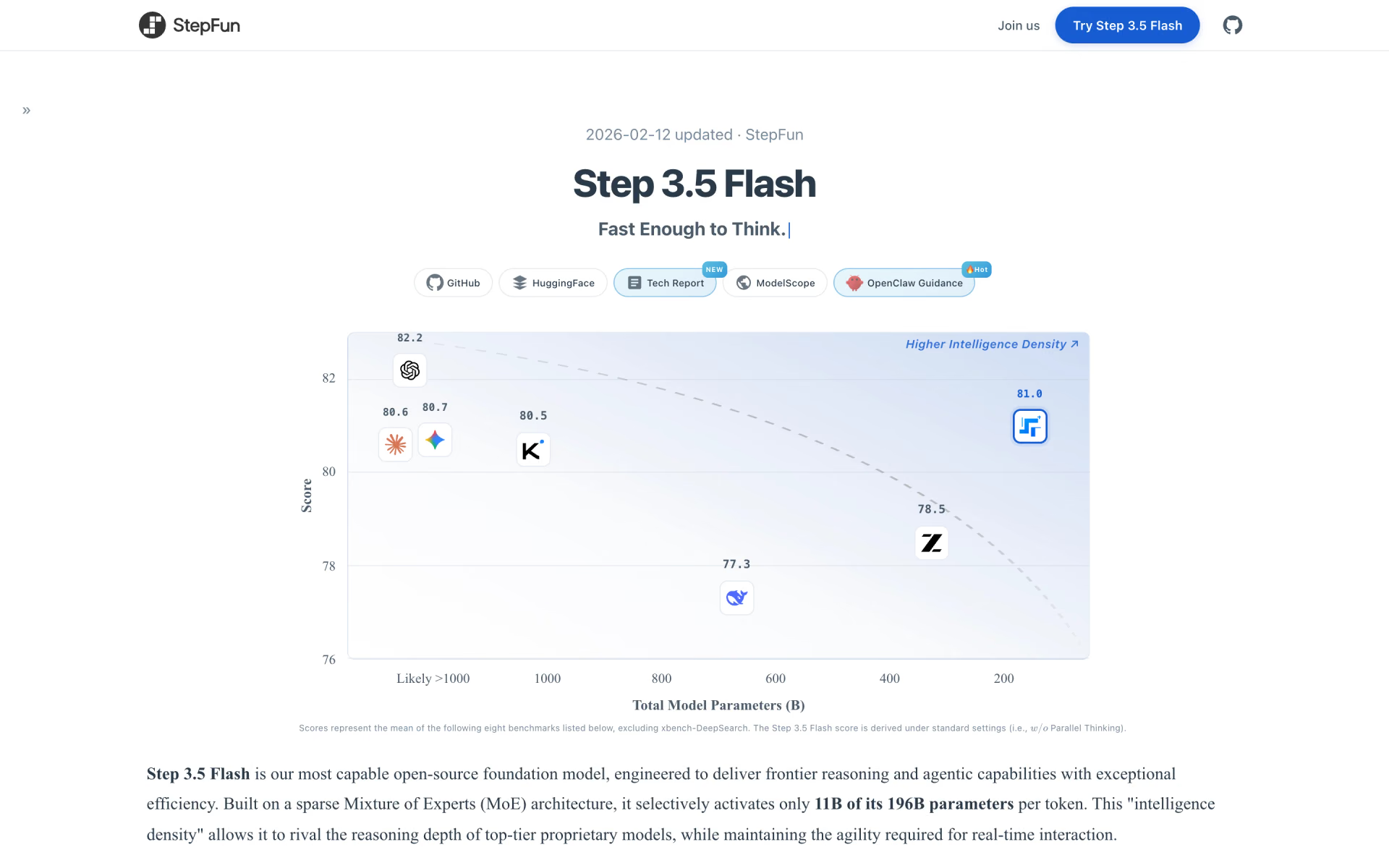
What is Step-3.5-Flash?
Step-3.5-Flash is a mixture-of-experts model with 196B parameters, of which only 11B work on each token, so it serves quickly and cheaply. It reads and writes text, holds 256K tokens of context and calls tools through an OpenAI-compatible API. The weights are free under Apache 2.0, and the 4-bit build needs about 120 GB of memory.
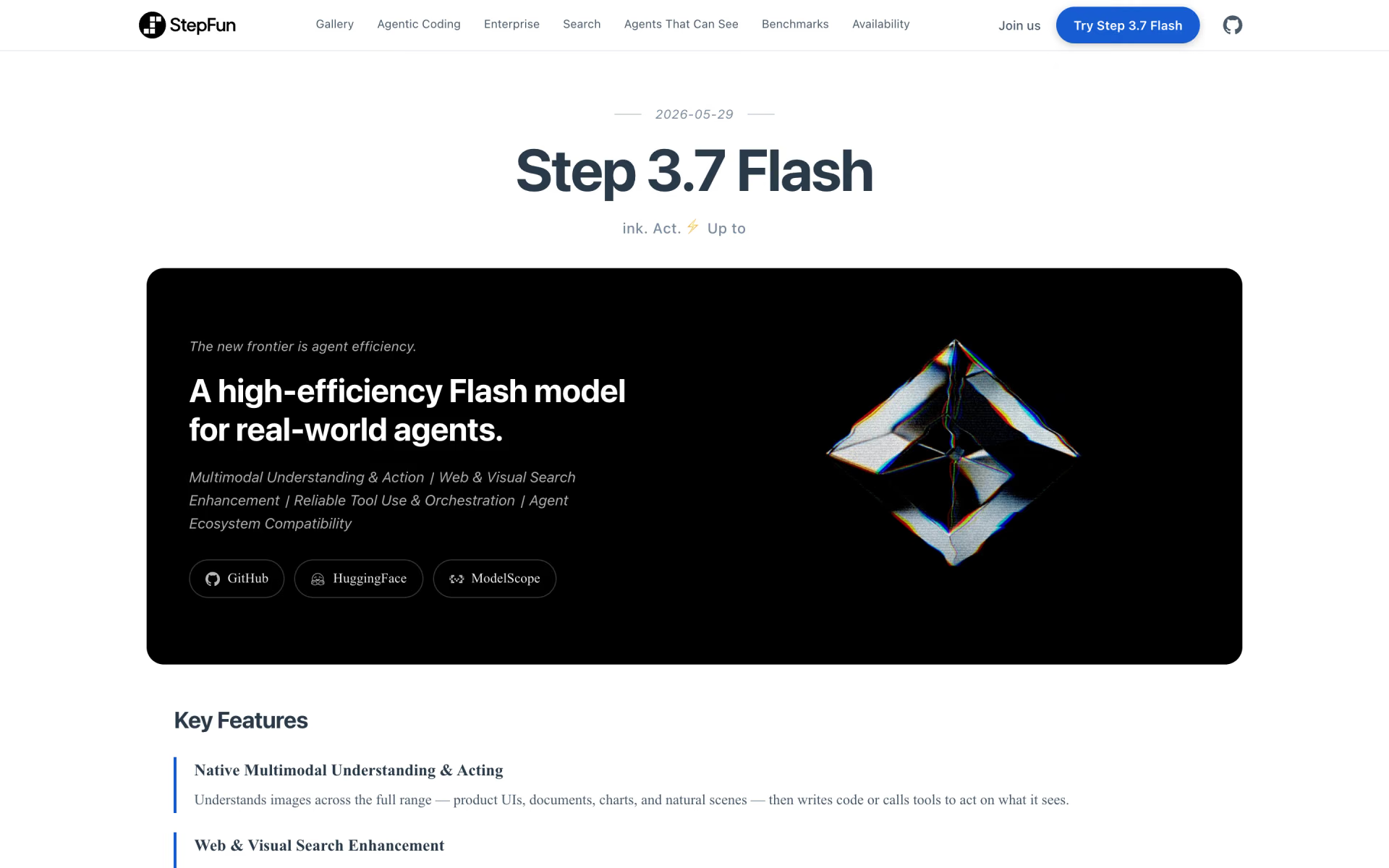
StepFun still serves it, next to an agent-tuned step-3.5-flash-2603 version at the same price. Its newer Step 3.7 Flash builds on it with image and video input at a higher token price.
Step-3.5-Flash or Step 3.7 Flash?
Step 3.7 Flash builds on Step-3.5-Flash and adds image and video input; Step-3.5-Flash stays the cheaper pick for text-only coding and agent work.
- Input
- Step-3.5-Flash reads text only; Step 3.7 Flash also understands images and video.
- Price
- $0.10 / $0.30 per million tokens against $0.20 / $1.15 for Step 3.7 Flash, nearly four times as much for output.
- Size and context
- Both activate 11B parameters per token (196B against 198B in total), and both hold 256K tokens.
- Weights
- Both are open under Apache 2.0 on Hugging Face, and both are in every Step Plan tier.
Who is Step-3.5-Flash best for?
Step-3.5-Flash is best for developers who want a low-cost open-weight model for coding agents and tool calling, through StepFun's API or on a 128 GB machine of their own.
Coding agents
StepFun reports 74.4% on SWE-bench Verified, and its Step Plan connects the model to Claude Code, Cursor, OpenClaw and similar tools.
High-volume agent calls
Only 11B of its 196B parameters are active per token, and StepFun quotes 100 to 300 tokens a second in typical use.
Long codebases and documents
A 256K-token context holds large repositories or long reports in a single request.
Running a model yourself
The 4-bit weights need about 120 GB of memory, so a 128 GB Mac Studio, NVIDIA DGX Spark or AMD Ryzen AI Max+ 395 machine can run it.
What's included with Step-3.5-Flash?
Apache 2.0 weights, serving through vLLM, SGLang and llama.cpp, fast multi-token decoding, an agent-tuned version and a Step Plan for coding tools.
- Open weights
- Apache 2.0 weights on Hugging Face and ModelScope, with FP8 and GGUF builds plus the base and mid-training checkpoints.
- Runs on common servers
- StepFun documents vLLM, SGLang, Hugging Face Transformers and llama.cpp, with a tool-call parser for agent use.
- Multi-token prediction
- It predicts three tokens at a time, which StepFun says gives 100 to 300 tokens a second and up to 350 on single-stream coding.
- Agent-tuned 2603 version
- Same price, fewer tokens per task, and a low reasoning setting through the reasoning_effort field.
- Step Plan for coding tools
- Monthly credits that work in Claude Code, Cursor, OpenClaw and Trae, from $6.99 a month.
How much does Step-3.5-Flash cost?
Step-3.5-Flash costs $0.10 per million input tokens and $0.30 per million output tokens on StepFun's API, Step Plan subscriptions start at $6.99 a month, and the open weights are free to download.
- Cached input at $0.02 per million tokens
- 256K-token context, OpenAI-compatible API
- Rate limits rise with total top-ups
- 400M Step Plan credits a month
- Use in Claude Code, Cursor, OpenClaw and other tools
- Also covers Step 3.7 Flash and Step 5 Preview
- 1,600M Step Plan credits a month
- Priority API rates
- Priority technical support
- 8,000M Step Plan credits a month
- Priority API rates
- Priority technical support
Flash Max costs $99 a month for 40,000M credits. Paid quarterly, Mini, Plus, Pro and Max cost $18.99, $26.99, $79 and $269; paid yearly, $69.99, $95.99, $289 and $989. StepFun values about 7M credits at $1 of model use; credits arrive monthly, expire at month end, and booster packs cost $6.99 for 400M or $9.99 for 1,600M. The agent-tuned step-3.5-flash-2603 costs the same per token. The weights are free under the Apache 2.0 licence on Hugging Face and ModelScope. Full pricing on platform.stepfun.ai. We checked these prices on .
How do readers rate Step-3.5-Flash?
No one has rated Step-3.5-Flash yet. Be the first.
Sign in to rate. One rating per account.
Step-3.5-Flash pros and cons
It is cheap, fast and strong for its size, but it spends many tokens thinking, knows less than larger models and reads text only.
Pros
- Local users call it one of the strongest models that fits on a 128 GB machine, and several say it loses little when run at 4-bit.
- Very cheap for what it does: one public OpenClaw benchmark ranked it first for cost-effectiveness, and developers say it covers most of their everyday coding.
- Fast in use: StepFun quotes 100 to 300 tokens a second, and users mention quick iteration and good speeds on Macs.
- StepFun released the weights under Apache 2.0, along with the base and mid-training checkpoints.
Cons
- It overthinks: users say it spends many tokens reasoning before it acts, early builds could loop, and StepFun itself lists long outputs and repetitive reasoning as known issues.
- It knows less than larger models: testers saw made-up answers on factual lookups, and StepFun warns of mixed-language replies in long, specialised chats.
- Text only: for image or video input you need Step 3.7 Flash, which costs $0.20 / $1.15 per million tokens.
- Running it yourself takes about 120 GB of memory even at 4-bit.
Is Step-3.5-Flash open source?
Yes. Step-3.5-Flash's code is public under the Apache 2.0 licence, so you can run it on your own server.
On GitHub
2,091stars
- Last commit
- 3 Apr
- Repository age
- 9 months
- Licence
- Apache 2.0
- Self-hosted
- Yes
- Repository
- stepfun-ai/Step-3.5-Flash
What are the best Step-3.5-Flash alternatives?
Step-3.5-Flash is an open source alternative to MiniMax M2.5 and Gemini 3.8 Flash. DeepSeek-V3.2, DeepSeek V4.1 Flash and MiMo-V2.6-Flash do the same job and are open source too.
 MiniMax M2.5Free
MiniMax's open-weight coding and agent model, at $0.30 per million input tokens.
 Gemini 3.8 FlashFree
Google's Gemini 3.8 Flash for coding, reasoning and agents.
 DeepSeek-V3.2Open Source
DeepSeek's open, MIT-licensed reasoning model for agents, with thinking during tool calls.
 DeepSeek V4.1 FlashOpen Source
Choose it when you need image input or a 1M-token context; its API costs $0.30 / $1.20 per million tokens at peak hours and half that off-peak.
 MiMo-V2.6-FlashOpen Source
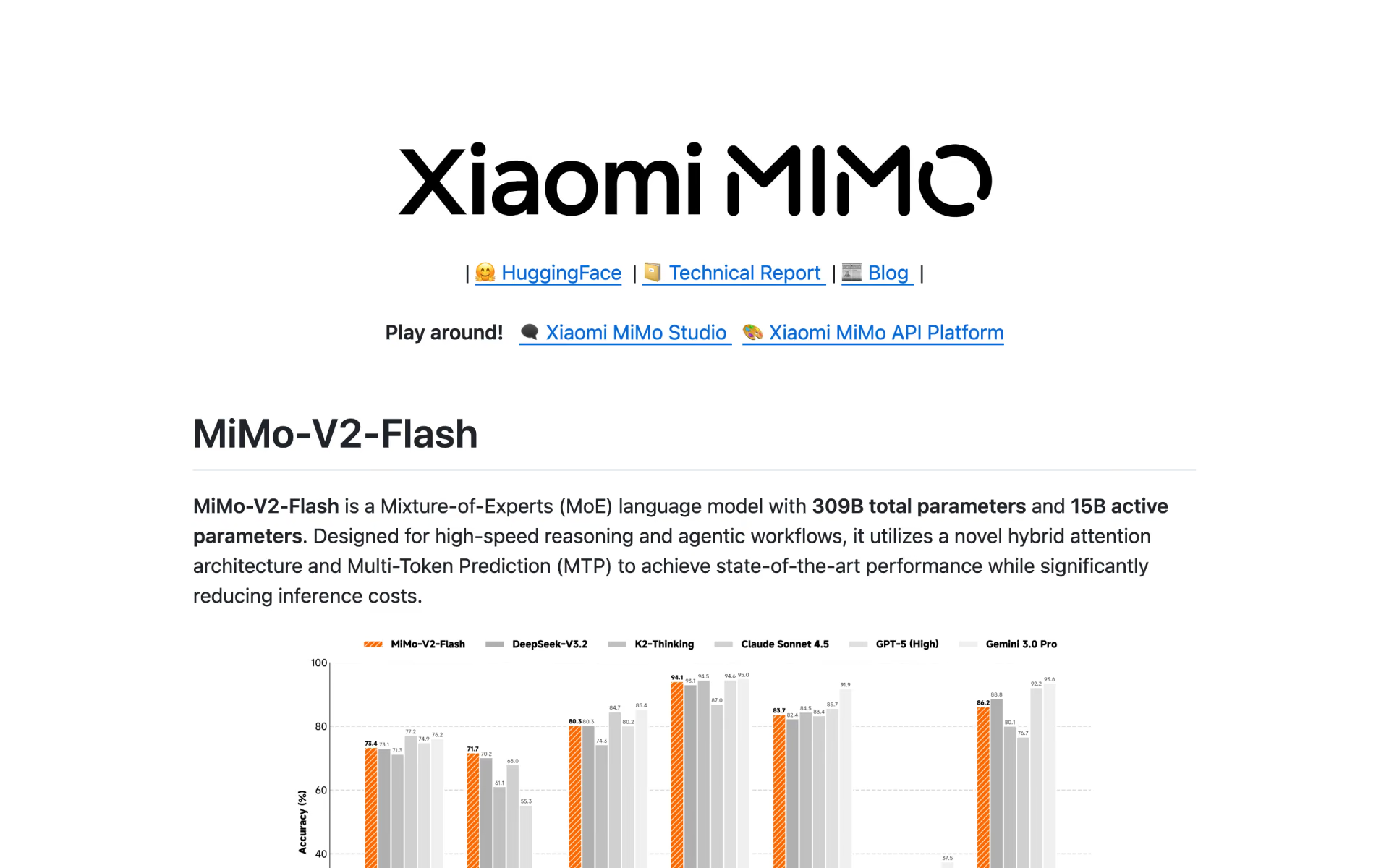
Xiaomi's 309B open omnimodal model for coding and agents, MIT license.
 Laguna S 2.1Open Source
Choose it when you want a 1M-token context on a smaller model: 118B parameters with 8B active, a free OpenRouter endpoint, and a 1M-context endpoint at $0.10 / $0.20.
Questions about Step-3.5-Flash
What is step-3.5-flash-2603?
It is an agent-tuned version of Step-3.5-Flash for frequent agent calls. StepFun says it uses tokens more efficiently, runs faster, works better with coding tools and adds a low reasoning setting through reasoning_effort, at the same $0.10 / $0.30 price.
Who is Step-3.5-Flash for?
Step-3.5-Flash is best for developers who want a low-cost open-weight model for coding agents and tool calling, through StepFun's API or on a 128 GB machine of their own.
Is Step-3.5-Flash free?
The model weights are free: StepFun publishes Step-3.5-Flash under the Apache 2.0 licence on Hugging Face and ModelScope, so you can run it on your own hardware. StepFun's hosted API is paid, at $0.10 per million input tokens and $0.30 per million output tokens.
How much does Step-3.5-Flash cost?
Step-3.5-Flash's paid plans are API, pay as you go at $0.10 / $0.30 per million input / output tokens, Flash Mini at $6.99 per month, Flash Plus at $9.99 per month and Flash Pro at $29 per month.
Is Step-3.5-Flash open source?
Yes. Step-3.5-Flash's code is public under the Apache 2.0 licence, so you can run it on your own server.
What are the best Step-3.5-Flash alternatives?
The closest alternatives on Recaply are MiniMax M2.5, Gemini 3.8 Flash, DeepSeek-V3.2, DeepSeek V4.1 Flash, MiMo-V2.6-Flash and Laguna S 2.1.
Where can I try Step-3.5-Flash?
On its official website, static.stepfun.com.
Can I run Step-3.5-Flash on a Mac?
Yes, on a large one. StepFun's 4-bit GGUF file is 111.5 GB and needs about 7 GB more to run, so it asks for at least 120 GB of memory and recommends 128 GB of unified memory, such as a Mac Studio.
Can I use Step-3.5-Flash in Claude Code?
Yes. StepFun's Step Plan gives Claude Code its own Anthropic-style base URL, and StepFun publishes setup guides for Claude Code, Codex, OpenClaw and Cline. You can also call the model with a pay-as-you-go StepFun API key.
Our verdict
Step-3.5-Flash is one of the best-value open models for coding agents, if you can live with long reasoning.
At $0.10 / $0.30 per million tokens it costs a small fraction of frontier APIs, StepFun reports 74.4% on SWE-bench Verified, and users rank it among the strongest models that fit on a 128 GB machine.
- Skip it for
- Work that needs images, deep world knowledge or short, predictable answers.
- Check first
- Count how many reasoning tokens it spends on your own tasks before you commit.
 Step 3.7 Flash

 Step 5 Preview
 MiMo-V2-Flash
 Qwen3.8-Flash

 Step3-VL-10B
 Gemini 3.7 Flash