
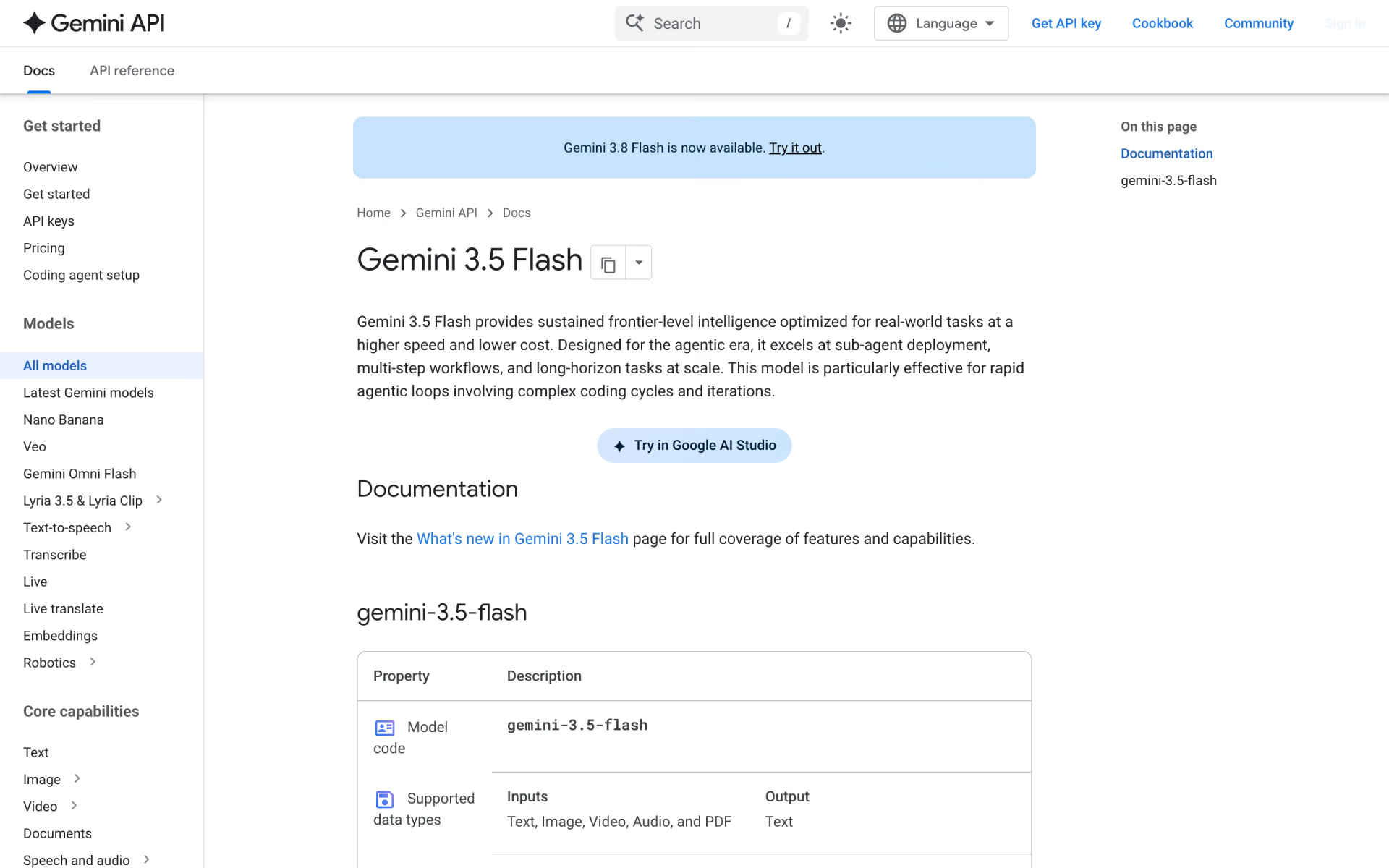
What is Gemini 3.5 Flash?
Gemini 3.5 Flash was the first Gemini 3.5 model, built on Gemini 3 Flash for quick agent loops, sub-agents and iterative coding. It reads text, images, video, audio and PDFs across a 1M-token context and writes only text, up to 65,536 tokens, with four thinking levels that default to medium. It is available only as a hosted model, through the Gemini API, Google AI Studio and Gemini Enterprise Agent Platform.
It is still stable, with no shutdown date, but Google now calls it its legacy Flash model. Gemini 3.6, 3.7 and 3.8 Flash have followed, and they charge $7.50 per million output tokens against its $9.
Is Gemini 3.5 Flash still available?
Yes. It is a stable model with no shutdown date, but Google now calls it its legacy Flash model and points new projects to Gemini 3.8 Flash.
- Status
- Stable on the Gemini API, with no shutdown date announced.
- Successors
- Gemini 3.6, 3.7 and 3.8 Flash, all listed above it on Google's pricing page.
- Price gap
- The newer Flash models charge $7.50 per million output tokens against its $9, with the same $1.50 input.
- Gemini app
- It launched as the app's default model; Google has since brought Gemini 3.6 Flash to all app users.
Who is Gemini 3.5 Flash best for?
Gemini 3.5 Flash is best for fast agent loops and sub-agents, long documents and media in one prompt, bulk jobs on Batch or Flex, and free prototyping on the Gemini API.
Sub-agents and agent loops
Google built it for quick multi-step loops and sub-agent work, with function calling, code execution and structured output built in.
Long documents and media
One prompt can hold text, images, video, audio and PDFs up to about 1M tokens.
Bulk jobs that can wait
Batch and Flex requests cost half the Standard rate, $0.75 in and $4.50 out per million tokens.
Prototyping for free
The free tier covers input and output tokens in Google AI Studio and the API, if you accept that Google may use your prompts to improve its products.
What's included with Gemini 3.5 Flash?
Four thinking levels, built-in tools with Search grounding, computer use in preview, context caching, Batch, Flex and Priority tiers, and reasoning that carries across turns.
- Thinking levels
- Minimal, low, medium and high trade reasoning depth against speed and cost; medium is the default.
- Built-in tools
- Function calling, code execution, Google Search and Maps grounding, URL context, file search and structured output.
- Computer use (preview)
- It can operate a browser or desktop through Google's computer use tool, which is still in preview.
- Context caching
- Cached input costs $0.15 per million tokens, plus $1 per million tokens per hour of storage.
- Batch, Flex and Priority
- Batch and Flex halve the price for work that can wait, and Priority costs 1.8 times the Standard rate with its own rate limits.
- Thought preservation
- Its reasoning carries across the turns of a conversation automatically, which helps multi-step debugging but can raise token use.
What changed from Gemini 3 Flash?
More capable and stable, but three times the price and a lower default thinking level.
- Price
- $1.50 / $9 per million tokens, against $0.50 / $3 for Gemini 3 Flash Preview.
- Status
- Generally available and stable, where Gemini 3 Flash stayed a preview.
- Thinking
- The default level dropped from high to medium, and reasoning now carries across turns.
- Scores
- Terminal-Bench 2.1 rose from 58.0% to 76.2% and MCP Atlas from 62.0% to 83.6% in Google's tests.
How much does Gemini 3.5 Flash cost?
Gemini 3.5 Flash is free on the Gemini API's rate-limited free tier, and on the paid tier it costs $1.50 per million input tokens and $9.00 per million output tokens, or half that through Batch or Flex.
- Free input and output tokens at lower rate limits
- Prompts and responses are used to improve Google's products
- No Search or Maps grounding
- Half the Standard rate, for work that can wait
- Cached input $0.075 on Batch, $0.08 on Flex
- Output price includes thinking tokens
- Cached input $0.15, plus $1.00 per million tokens per hour of storage
- 5,000 Google Search grounding requests a month free, then $14 per 1,000
- Cached input $0.27
- Its own rate limits, 0.3x the Standard limits by default
Prices are for the Gemini Developer API in US dollars, and output prices include thinking tokens. Moving to the paid tier means linking a billing account and prepaying at least $5 of credit; paid prompts are not used to improve Google's products. Grounding with Google Maps also gives 5,000 free prompts a month, then $14 per 1,000. Google AI Studio itself is free to use, and prices on Gemini Enterprise Agent Platform can differ. Full pricing on ai.google.dev. We checked these prices on .
How do readers rate Gemini 3.5 Flash?
No one has rated Gemini 3.5 Flash yet. Be the first.
Sign in to rate. One rating per account.
Gemini 3.5 Flash pros and cons
It is fast, multimodal and free to try, but it costs more than both the Gemini 3 Flash before it and the newer Flash models after it, and it can burn through tokens.
Pros
- Users on Hacker News and Reddit call it very fast and strong at hands-on implementation for a Flash model; one found code optimizations that Gemini 3.1 Pro missed.
- It beat Gemini 3.1 Pro on Google's agent and coding tests: 76.2% on Terminal-Bench 2.1 against 70.3%, and 83.6% on MCP Atlas against 78.2%.
- A free API tier with no end date covers input and output tokens, so you can build and test before paying.
- One prompt can mix text, images, video, audio and PDFs across a 1M-token context.
Cons
- It costs three times what Gemini 3 Flash Preview does ($0.50 / $3.00), a jump that many Hacker News and Reddit users complained about.
- Google now labels it legacy, and the newer 3.6, 3.7 and 3.8 Flash models charge $7.50 per million output tokens against its $9.
- It can burn through tokens and tool calls: users describe it checking and retrying a lot, and one SQL agent ran about 10 times more queries than on Gemini 3 Flash.
- Some developers found it worse than Gemini 3 Flash at careful coding, including one whose 37-item bug list it declared done after tackling only 7 items, 3 of them wrongly.
What are the best Gemini 3.5 Flash alternatives?
Five tools on Recaply do Gemini 3.5 Flash's job. DeepSeek V4.1 Flash, Bonsai 27B and Step-Audio-R1 are open source, so you can run them on your own server.
 Gemini 3.8 FlashFree
Choose Gemini 3.8 Flash for anything new; it is Google's strongest Flash model, with the same 1M context and free tier, and it costs $1.50 / $7.50 per million tokens against $9 output for 3.5 Flash.
 GPT-5.4 mini & nanoPaid
Choose it when you work on OpenAI's API and want half the token price; GPT-5.4 mini costs $0.75 / $4.50 with up to 128K output tokens, but it has a 400K context, no audio or video input and no free tier.
 DeepSeek V4.1 FlashOpen Source
Choose it when cost matters most; it charges $0.30 / $1.20 per million tokens at peak hours and half that off-peak, with a 1M context and up to 384K output, though it lists image input but not audio or video.
 Bonsai 27BOpen Source
Choose it when you want a 27B model compressed to 1-bit or ternary weights that runs locally on modest hardware.
 Step-Audio-R1Open Source
Choose it when audio understanding must run on your own servers instead of sending recordings to Google.
Questions about Gemini 3.5 Flash
What is Gemini 3.5 Flash?
Gemini 3.5 Flash is Google's fast multimodal model for agent loops, sub-agents and coding on the Gemini API, free on a rate-limited tier and $1.50 / $9 per million tokens paid.
Who is Gemini 3.5 Flash for?
Gemini 3.5 Flash is best for fast agent loops and sub-agents, long documents and media in one prompt, bulk jobs on Batch or Flex, and free prototyping on the Gemini API.
Is Gemini 3.5 Flash free?
Yes, within limits. The Gemini API's free tier charges nothing for Gemini 3.5 Flash input and output tokens, at lower rate limits and with your prompts used to improve Google's products. Paid use costs $1.50 per million input tokens and $9.00 per million output tokens.
How much does Gemini 3.5 Flash cost?
Gemini 3.5 Flash's paid plans are Batch or Flex at $0.75 / $4.50 per million input / output tokens, Standard at $1.50 / $9.00 per million input / output tokens and Priority at $2.70 / $16.20 per million input / output tokens.
Is there an open source alternative to Gemini 3.5 Flash?
Yes. DeepSeek V4.1 Flash, Bonsai 27B and Step-Audio-R1 are open source tools that do the same job, so you can run your own.
What are the best Gemini 3.5 Flash alternatives?
The closest alternatives on Recaply are Gemini 3.8 Flash, GPT-5.4 mini & nano, DeepSeek V4.1 Flash, Bonsai 27B and Step-Audio-R1.
Where can I try Gemini 3.5 Flash?
On its official website, ai.google.dev.
Gemini 3.5 Flash vs Gemini 3.1 Pro: which is better?
On Google's own tests, 3.5 Flash leads 3.1 Pro on agentic coding and tool use, such as 76.2% against 70.3% on Terminal-Bench 2.1, while 3.1 Pro leads on reasoning tests like ARC-AGI-2 and Humanity's Last Exam. 3.1 Pro costs $2 / $12 per million tokens for prompts up to 200K tokens and has no free tier.
Does Google train on my Gemini 3.5 Flash prompts?
On the free tier, yes: Google says prompts and responses are used to improve its products. On the paid tier they are not, so use a paid key for anything private or confidential.
Can Gemini 3.5 Flash generate images or audio?
No. It takes text, images, video, audio and PDFs as input but writes only text, and it does not work with the Live API. Google offers separate models for images (Nano Banana), speech (Gemini 3.8 Flash TTS) and real-time voice (Gemini 3.8 Live).
Our verdict
Gemini 3.5 Flash is still a capable, fast model, but there is little reason to start a new project on it.
Google now calls it legacy, and the newer 3.8 Flash has the same limits and free tier with cheaper output, while 3.5 Flash already cost three times the Gemini 3 Flash it replaced.
- Skip it for
- New builds, which should start on Gemini 3.8 Flash, and cost-sensitive bulk work, where Flash-Lite or DeepSeek cost far less.
- Check first
- If you already run it, test Gemini 3.8 Flash on the same prompts; a lower output bill may be one model ID away.

 Gemini 3.1 Flash-Lite
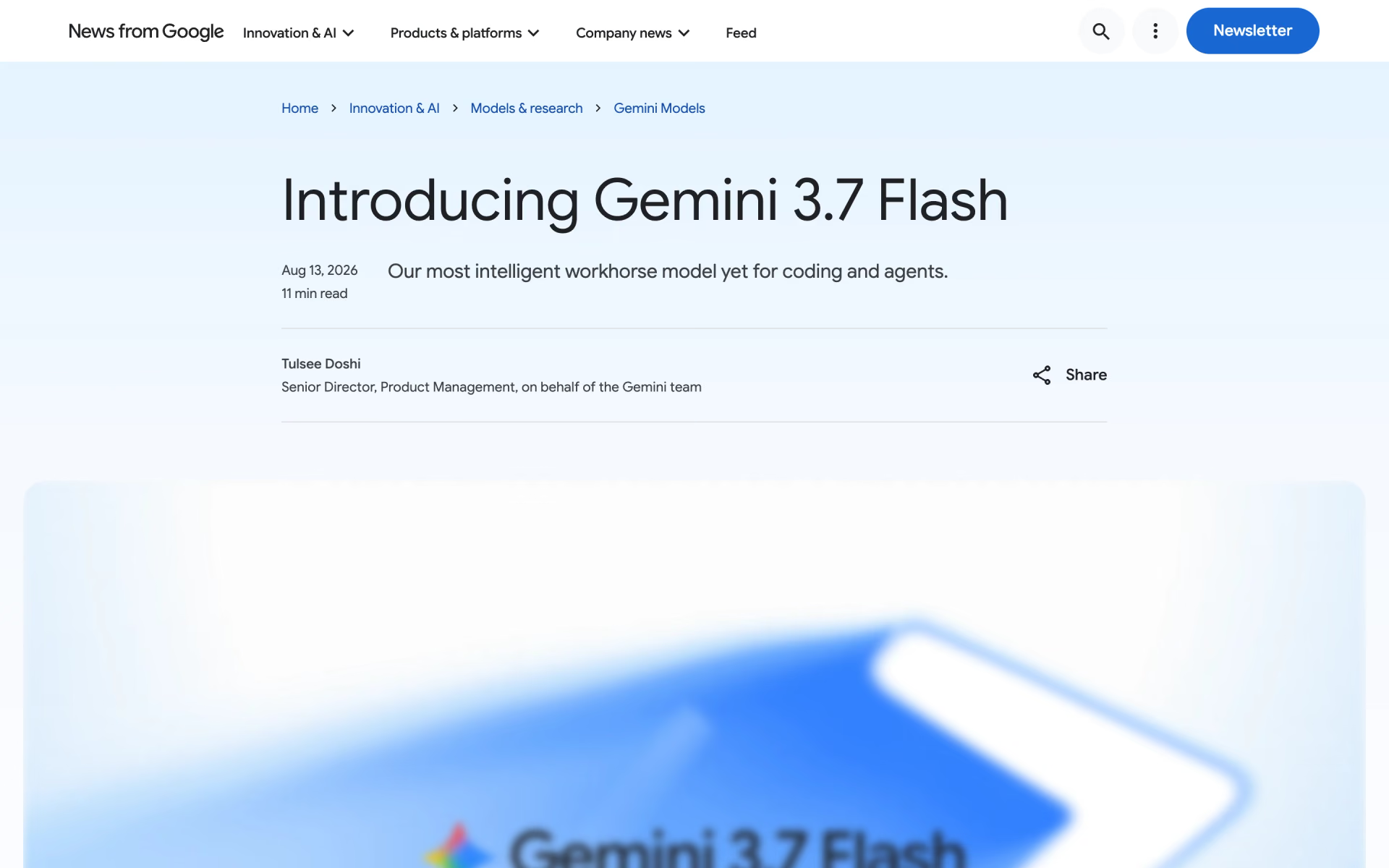
 Gemini 3.7 Flash

 Gemini 3.5 Flash-Lite
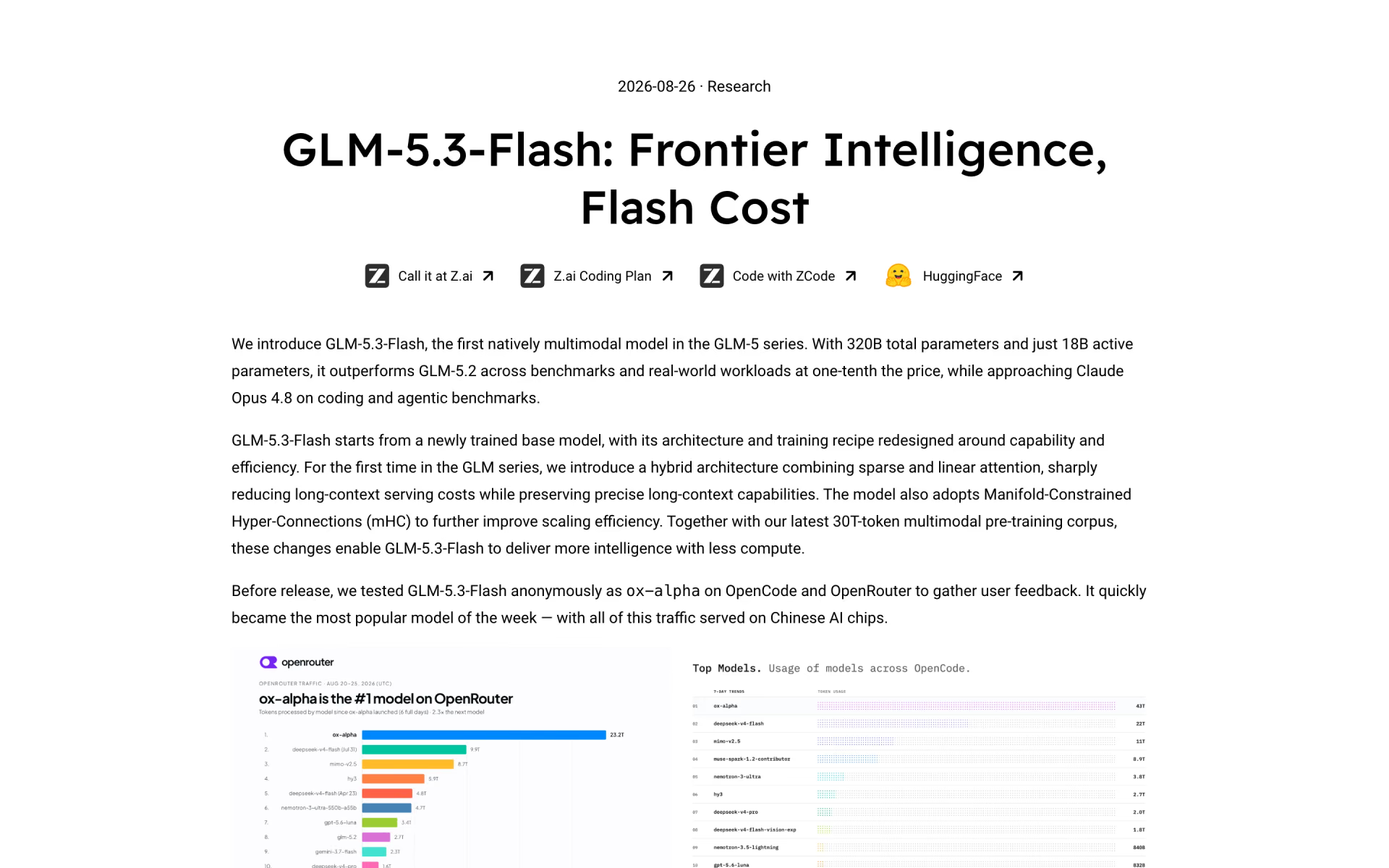
 GLM-5.3-Flash
 Gemini 4 Argon
 Qwen3.8-Flash