
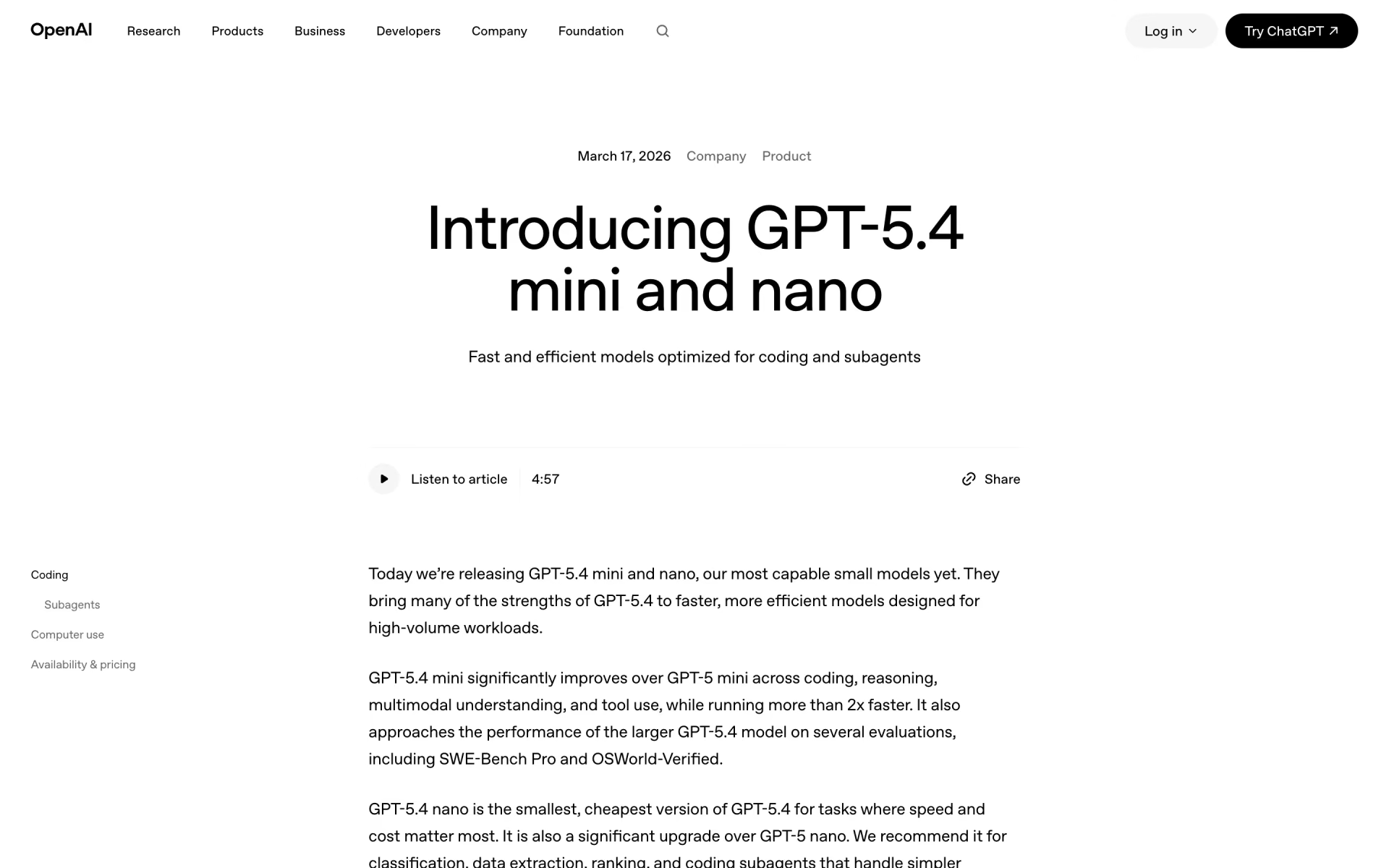
What is GPT-5.4 mini & nano?
Both models read text and images, write text, and share a 400K-token context window with up to 272K tokens of input and 128K of output; their knowledge stops at August 2025. Mini is the stronger of the two and adds OpenAI's computer use and tool search tools. Nano drops both and is meant for narrow jobs with fixed outputs such as labels or short JSON.
They are still sold on the API, but OpenAI has moved on. GPT-6 Luna costs $0.10 / $0.50 per million tokens with a 1.05M-token context, and in Codex OpenAI replaced mini with Luna for ChatGPT sign-ins.
Are GPT-5.4 mini and nano still available?
Yes on the OpenAI API, where neither is listed for shutdown, but OpenAI no longer features them.
- OpenAI API
- Both are still sold at $0.75 / $4.50 and $0.20 / $1.25 per million tokens.
- Codex
- Mini was retired for ChatGPT sign-ins and replaced by GPT-6 Luna; Codex with an API key still offers it.
- Newer small models
- GPT-6 Luna costs $0.10 / $0.50 and GPT-5.6 Luna $0.20 / $1.20, both with a 1.05M-token context and computer use.
Who is GPT-5.4 mini & nano best for?
GPT-5.4 mini & nano is best for subagents under a bigger model, high-volume sorting and extraction, low-cost computer use with mini, and apps already tuned for these snapshots.
Subagents under a bigger model
Mini is OpenAI's pick for subagents, and developers report good results when a larger model writes the plan and mini carries it out.
Sorting and extracting at scale
Nano is built for classification, data extraction and ranking, where $0.20 per million input tokens, or $0.10 through Batch, keeps big jobs cheap.
Low-cost computer use
Mini supports the computer use tool in the Responses API at under a third of GPT-5.4's per-token price.
Apps already tuned for them
Both models have pinned snapshots, so their behaviour stays steady while you test a newer small model.
What's included with GPT-5.4 mini & nano?
GPT-5.4 mini & nano offer five reasoning levels, OpenAI's hosted tools, compaction, and half-price Batch and Flex; mini adds computer use, tool search and Fast mode.
- Reasoning effort
- Five levels from none to xhigh; none is the default, and OpenAI suggests raising it step by step when a task needs more thinking.
- Hosted tools
- Web search, file search, code interpreter, image generation, hosted shell, apply patch, skills and MCP on both models in the Responses API.
- Computer use and tool search
- Mini only; nano supports neither.
- Compaction
- Both support compaction, which shrinks long agent sessions so they can keep going.
- Batch and Flex
- Half-price processing for work that can wait; Flex answers more slowly and does not bill requests it turns away.
- Fast mode
- Mini only, at $1.50 / $9 per million tokens for faster, steadier responses.
How much does GPT-5.4 mini & nano cost?
GPT-5.4 mini & nano are paid per token on the OpenAI API: nano costs $0.20 per million input tokens and $1.25 per million output tokens, mini costs $0.75 and $4.50, and Batch or Flex halves both.
- Cached input $0.02
- Batch or Flex: $0.10 / $0.625
- Built for classification, extraction and ranking
- Cached input $0.075
- Batch or Flex: $0.375 / $2.25; Fast mode: $1.50 / $9
- Adds computer use for agents
Both models have a 400K-token context window with up to 272K tokens of input and 128K of output. Batch returns results within 24 hours; Flex answers slower and may turn requests away without charging. Nano is not offered in Fast mode. Data residency endpoints add 10%, and tools such as web search are billed on top at their own rates. Neither model has a free API tier. Full pricing on developers.openai.com. We checked these prices on .
How do readers rate GPT-5.4 mini & nano?
No one has rated GPT-5.4 mini & nano yet. Be the first.
Sign in to rate. One rating per account.
GPT-5.4 mini & nano pros and cons
GPT-5.4 mini & nano are fast and mini makes a capable subagent, but both cost more than the GPT-5 small models and OpenAI's newer GPT-6 Luna undercuts them.
Pros
- Fast: several developers measured both well ahead of GPT-5 mini on output speed, which suits chat and voice features.
- Mini works well as an implementer or subagent when a larger model writes the plan, and several Codex users ran it for most of their coding that way.
- Mini brings computer use and tool search at 30% of GPT-5.4's price per token.
- Batch or Flex halves both prices, which brings nano to $0.10 / $0.625 per million tokens.
Cons
- They cost more than the GPT-5 small models they followed: mini input went from $0.25 to $0.75 and nano from $0.05 to $0.20, a common complaint.
- OpenAI's own GPT-6 Luna undercuts both at $0.10 / $0.50 per million tokens, with a 1.05M-token context and newer knowledge.
- On complex tasks mini can skip parts of a plan or change things it was not asked to; OpenAI itself says the small models infer fewer missing steps and need explicit prompts.
- Developers who tested nano against the older GPT-5 mini on real workloads found it clearly weaker, despite better benchmark scores.
What are the best GPT-5.4 mini & nano alternatives?
Five tools on Recaply do GPT-5.4 mini & nano's job. DeepSeek V4.1 Flash, 1-bit Bonsai and Holo3.1 are open source, so you can run them on your own server.
 Gemini 3.1 Flash-LiteFree
Choose it when you want a free tier to start and a 1M-token context; paid use costs $0.25 / $1.50 per million tokens, between nano and mini.
 DeepSeek V4.1 FlashOpen Source
Choose it when price per token matters most; it costs $0.30 / $1.20 per million tokens at peak and half that off-peak, with a 1M-token context.
 GPT-5.4Paid
Choose it when mini keeps missing steps on harder work or you need more than 272K tokens of input; it costs $2.50 / $15 with a 1.05M-token context, and more for prompts past 272K.
 1-bit BonsaiOpen Source
Choose it when you need a small language model that runs offline on a phone or laptop instead of calling OpenAI's API.
 Holo3.1Open Source
Choose it when a small computer-use model must run on your own hardware, with a free API tier for testing.
More open source alternatives
See all

Questions about GPT-5.4 mini & nano
What is GPT-5.4 mini & nano?
GPT-5.4 mini and GPT-5.4 nano are OpenAI's small, fast API models from the GPT-5.4 generation: mini for coding, computer use and subagents, nano for cheap classification and extraction.
Who is GPT-5.4 mini & nano for?
GPT-5.4 mini & nano is best for subagents under a bigger model, high-volume sorting and extraction, low-cost computer use with mini, and apps already tuned for these snapshots.
Is GPT-5.4 mini & nano free?
No. GPT-5.4 mini & nano is a paid tool, from $0.20 / $1.25 per million input / output tokens.
How much does GPT-5.4 mini & nano cost?
GPT-5.4 mini & nano's paid plans are GPT-5.4 nano at $0.20 / $1.25 per million input / output tokens and GPT-5.4 mini at $0.75 / $4.50 per million input / output tokens.
Is there an open source alternative to GPT-5.4 mini & nano?
Yes. DeepSeek V4.1 Flash, 1-bit Bonsai, Holo3.1 and Mellum2 and 1 more are open source tools that do the same job, so you can run your own.
What are the best GPT-5.4 mini & nano alternatives?
The closest alternatives on Recaply are Gemini 3.1 Flash-Lite, DeepSeek V4.1 Flash, GPT-5.4, 1-bit Bonsai and Holo3.1.
Where can I try GPT-5.4 mini & nano?
On its official website, openai.com.
How do GPT-5.4 mini and GPT-5.4 nano differ?
GPT-5.4 mini is the stronger model, aimed at coding, computer use and subagents, at $0.75 / $4.50 per million tokens. GPT-5.4 nano is the cheapest GPT-5.4-class model, at $0.20 / $1.25, for simple high-volume jobs such as classification and extraction, and it lacks the computer use tool.
Should I switch from GPT-5.4 mini to GPT-6 Luna?
For most new work, yes. GPT-6 Luna costs $0.10 / $0.50 per million tokens, has a 1.05M-token context, supports computer use and tool search, and its knowledge runs to May 2026. Keep mini or nano only where your own tests show they still do better.
Is GPT-5.4 mini still in Codex?
Not for ChatGPT sign-ins. OpenAI retired GPT-5.4 mini from Codex for users signed in with ChatGPT and points them to GPT-6 Luna. Codex with your own API key and the OpenAI API itself still offer both models.
What reasoning effort should I use with GPT-5.4 mini or nano?
Both default to none, the fastest setting, which suits labels, lookups and short answers. OpenAI suggests raising effort step by step, starting with medium, when a task needs planning, and several developers run mini at high or xhigh for coding.
Our verdict
GPT-5.4 mini and nano are fast, useful small models that OpenAI has already moved past.
GPT-6 Luna costs less than either, reads more than twice as much context and knows more recent events, while mini's main edge, computer use, is now on Luna too.
- Skip it for
- New projects, which should start on GPT-6 Luna, and jobs with inputs longer than 272K tokens.
- Check first
- If you rely on these snapshots, run your own tests on GPT-6 Luna before you pay mini's higher rate.
 Nemotron 3 Nano Omni

 MiniMax M3
 Qwen3.5 Small

 GPT-6.1 Sol

 GPT-5.2