
What is Bonsai 27B?
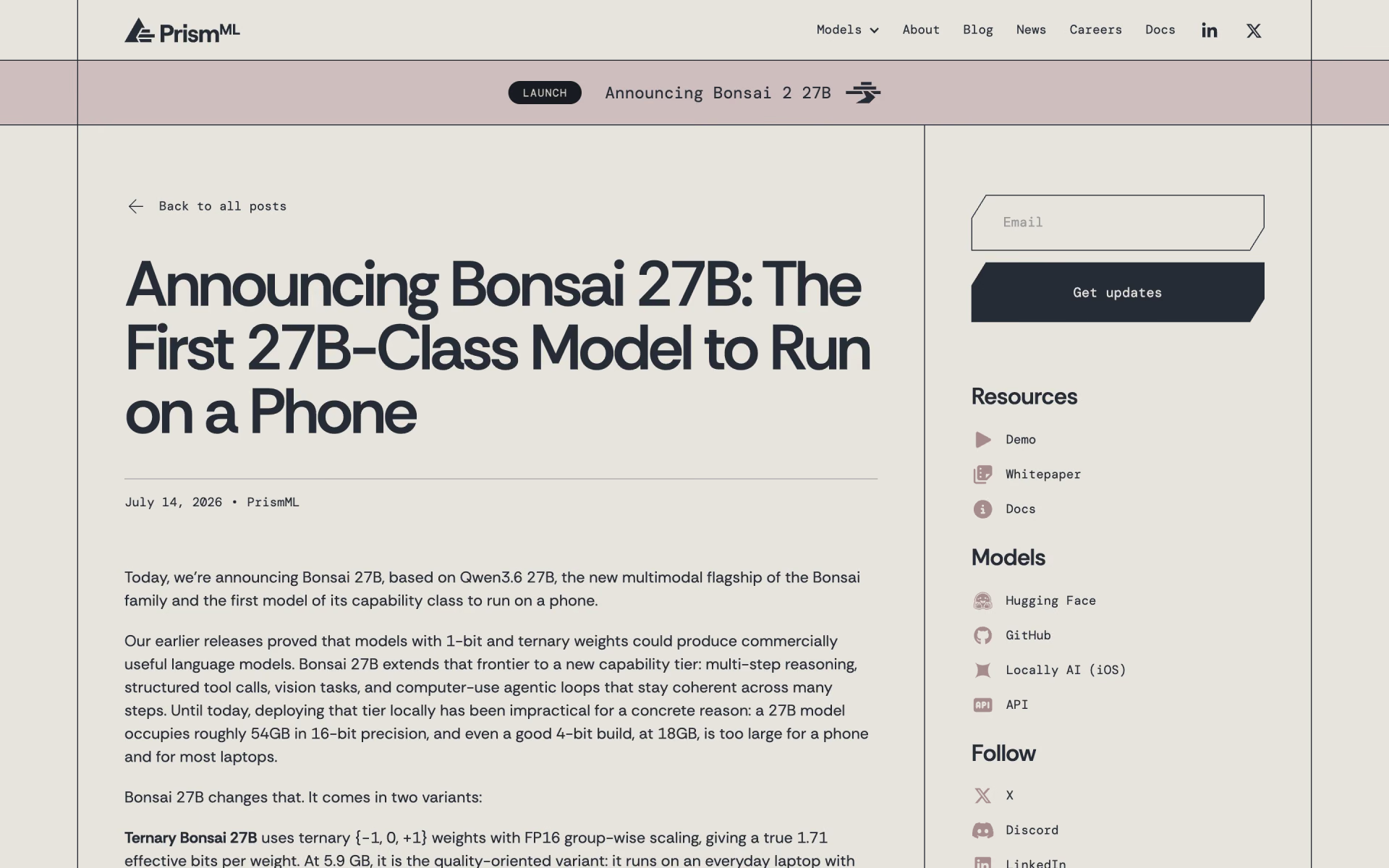
Bonsai 27B takes Qwen3.6 27B and stores its language weights as 1-bit or ternary values instead of 16-bit numbers. The 1-bit build is 3.9 GB against about 54 GB for the original, and the ternary build is about 7.2 GB. Both read text and images, write text, reason before answering by default, and handle a 262K-token context.
PrismML now calls Ternary Bonsai 2 27B, built on Qwen3.8 27B, its flagship and demo default. Bonsai 27B is still listed and free to download, and its 1-bit build remains the family's only 27B model sized for a phone.
How does Bonsai 27B compare with Ternary Bonsai 2 27B?
Ternary Bonsai 2 27B is PrismML's newer flagship, with higher scores in a smaller file, but it has no 1-bit build for phones and needs PrismML's own llama.cpp.
- Base model
- Bonsai 2 builds on Qwen3.8 27B; Bonsai 27B builds on Qwen3.6 27B.
- Scores kept
- Bonsai 2 keeps 98.2% of its base model's average on PrismML's tests, against 95% for ternary Bonsai 27B and 90% for 1-bit.
- Size
- Bonsai 2's smallest file is 5.93 GB, against about 7.2 GB for ternary Bonsai 27B and 3.9 GB for 1-bit.
- Runtime
- Bonsai 2's GGUF files need PrismML's llama.cpp fork; Bonsai 27B's run on mainline llama.cpp.
Who is Bonsai 27B best for?
Bonsai 27B is best for developers who want a 27B-class model with vision and tool calling on a phone or a 16 GB laptop, with no per-token bill and no data leaving the device.
AI on a phone
The 1-bit build is 3.9 GB, fits an iPhone 17 Pro's memory budget, and runs at about 11 tokens a second on an iPhone 17 Pro Max by PrismML's measure.
16 GB laptops
PrismML measured the 1-bit build holding a 100K-token context in 11.6 GB, where a common 4-bit Qwen3.6 27B build needs about 25.6 GB.
Private local agents
Tool calls and multi-step loops run on your own machine, so a long task adds no per-token bill and no data leaves the device.
Screenshots and documents
A 4-bit vision tower reads images, documents and screenshots on the device, and loads only when an image arrives.
What's included with Bonsai 27B?
Two free builds, image input, thinking you can cap, tool calling through a local OpenAI-compatible server, and long context in little memory.
- Two builds
- 1-bit at 3.9 GB for phones and ternary at about 7.2 GB for quality, each in GGUF and MLX formats.
- Image input
- The vision tower ships as a separate file under 1 GB, needed only when you send images.
- Thinking you can cap
- It reasons by default; a per-request token budget limits its thinking or turns it off.
- Tool calling
- Its local server takes a standard OpenAI-style tools array, and PrismML's demo repo shows how to connect MCP servers.
- Long context in little memory
- With a 4-bit KV cache, the 1-bit build's full 262K window peaks at about 9.4 GB, by PrismML's measure.
- Mainline llama.cpp support
- Its 1-bit and ternary GGUF formats are merged into mainline llama.cpp; the 1-bit build on MLX still needs PrismML's fork.
How much does Bonsai 27B cost?
Bonsai 27B is free: PrismML releases both its 1-bit and ternary builds as open weights under the Apache 2.0 license, so the only cost is the hardware you run it on.
- About 7.2 GB on disk, for laptops
- Keeps 95% of the base model's benchmark average
- Up to 134 tokens a second on an RTX 5090
- 3.9 GB, fits an iPhone 17 Pro's memory budget
- Keeps 90% of the base model's benchmark average
- Up to 163 tokens a second on an RTX 5090
Both builds download free from Hugging Face in GGUF and MLX formats and run on Mac, iPhone and iPad through MLX or on NVIDIA GPUs and CPUs through llama.cpp; image input needs an extra vision file of under 1 GB. PrismML's newer Ternary Bonsai 2 27B is free under the same license. Full pricing on prismml.com. We checked these prices on .
How do readers rate Bonsai 27B?
No one has rated Bonsai 27B yet. Be the first.
Sign in to rate. One rating per account.
Bonsai 27B pros and cons
It fits a 27B-class model into 3.9 GB for free, but testers found it slower and weaker at real coding than its benchmark scores suggest.
Pros
- Free under Apache 2.0, so you can use, change and ship it commercially with no per-token bill.
- Early testers ran it on a 16 GB M1 Pro laptop, a base M4 Mac mini and an iPhone 17 Pro, machines that cannot load the full 27B model.
- Several testers found its everyday and technical answers close to the full Qwen3.6 27B at a fraction of the memory.
- Its GGUF files run on mainline llama.cpp, while PrismML's newer Ternary Bonsai 2 27B still needs PrismML's own build.
Cons
- Weak at real coding: PrismML says long, multi-file agentic coding is not yet a target, and testers report loops, broken files and better results from 4-bit Qwen3.6 27B or Gemma 4 12B builds.
- Slower in practice than its headline speeds: testers saw about 24 to 30 tokens a second on M2 and M3 Max Macs and 10 or fewer on desktop CPUs, behind Qwen's 35B-A3B model.
- Setup was fiddly at launch: several people could not load it in LM Studio or Unsloth, and the 1-bit MLX build still needs PrismML's own fork of MLX.
- Vision and instruction following lose the most: PrismML's own table drops vision from 72.6 to 65.2 (ternary) and 59.6 (1-bit), and the newer Ternary Bonsai 2 27B keeps more of its base model in a smaller file.
Is Bonsai 27B open source?
Yes. Bonsai 27B's code is public under the Apache 2.0 licence, so you can run it on your own server.
What are the best Bonsai 27B alternatives?
Bonsai 27B is an open source alternative to Gemini 3.5 Flash and GPT-6 Luna. DeepSeek V4.1 Flash, Step-Audio-R1, MiMo-V2.6-Flash and Nemotron 3.5 Lightning do the same job and are open source too.
 Gemini 3.5 FlashFree
Google's stable Gemini 3.5 Flash for fast multimodal work.
 GPT-6 LunaFree
OpenAI's lowest cost GPT-6 model for focused, high volume tasks.
 DeepSeek V4.1 FlashOpen Source
DeepSeek's small, efficient open model.
 Step-Audio-R1Open Source
StepFun's open audio reasoning model that thinks through speech, sounds and music before answering.
 MiMo-V2.6-FlashOpen Source
Xiaomi's 309B open omnimodal model for coding and agents, MIT license.
 Nemotron 3.5 LightningOpen Source
NVIDIA's open 30B model with 3B active parameters, built for fast agent execution.
Questions about Bonsai 27B
What is Bonsai 27B?
Bonsai 27B is PrismML's free, open-weight compression of Qwen3.6 27B into 1-bit and ternary builds, for developers who want a 27B-class model with vision and tool calling on laptops and phones.
Who is Bonsai 27B for?
Bonsai 27B is best for developers who want a 27B-class model with vision and tool calling on a phone or a 16 GB laptop, with no per-token bill and no data leaving the device.
Is Bonsai 27B free?
Yes. Bonsai 27B has a free Ternary Bonsai 27B plan: about 7.2 GB on disk, for laptops.
Is Bonsai 27B open source?
Yes. Bonsai 27B's code is public under the Apache 2.0 licence, so you can run it on your own server.
What are the best Bonsai 27B alternatives?
The closest alternatives on Recaply are Gemini 3.5 Flash, GPT-6 Luna, DeepSeek V4.1 Flash, Step-Audio-R1, MiMo-V2.6-Flash and Nemotron 3.5 Lightning.
Where can I try Bonsai 27B?
Without installing anything, PrismML lists a hosted demo on Hugging Face, an in-browser version that runs on your own GPU through WebGPU, a Google Colab notebook, and the Locally AI app for iPhone and iPad. The weights are on Hugging Face.
Can I use Bonsai 27B in a commercial product?
Yes. PrismML releases Bonsai 27B under the Apache 2.0 license, which lets you use, change, sell and redistribute the model as long as you keep the license and its notices with it. There is no fee to PrismML.
What hardware do I need to run Bonsai 27B?
The 1-bit build peaks at about 5.2 GB with a 4K-token context and fits an iPhone 17 Pro; the ternary build is about 7.2 GB on disk. Both run on Macs, iPhones and iPads through MLX, and on NVIDIA GPUs and CPUs through llama.cpp.
Is Bonsai 27B good for coding?
For short coding tasks it keeps most of its base model's scores: 86.0 for ternary and 81.9 for 1-bit against 88.7, on PrismML's coding tests. PrismML says long, multi-file agentic coding is not yet a strong target, so test it before building a coding agent on it.
Can I run Bonsai 27B in LM Studio?
Yes, on an Apple Silicon Mac. PrismML's LM Studio guide uses the ternary MLX build and asks for at least 16 GB of unified memory, or 24 GB for long context. On other machines, run the GGUF files with llama.cpp or PrismML's demo scripts.
Our verdict
Bonsai 27B is the pick when a 27B-class model has to fit on a phone or a 16 GB laptop.
Its 1-bit build keeps 90% of Qwen3.6 27B's benchmark average in 3.9 GB, free under Apache 2.0, but testers found it slower and weaker at real coding than those scores suggest.
- Skip it for
- Agentic coding; on a laptop with memory to spare, PrismML's newer Ternary Bonsai 2 27B or a 4-bit Qwen3.6 27B does more.
- Check first
- Run your own tasks on your own hardware first, since its speed depends on having the right low-bit kernels.

 1-bit Bonsai
 Qwen3.5 Small

 Holo3.1

 Gemma 4
 Holo4
 GPT-5.4 mini & nano