
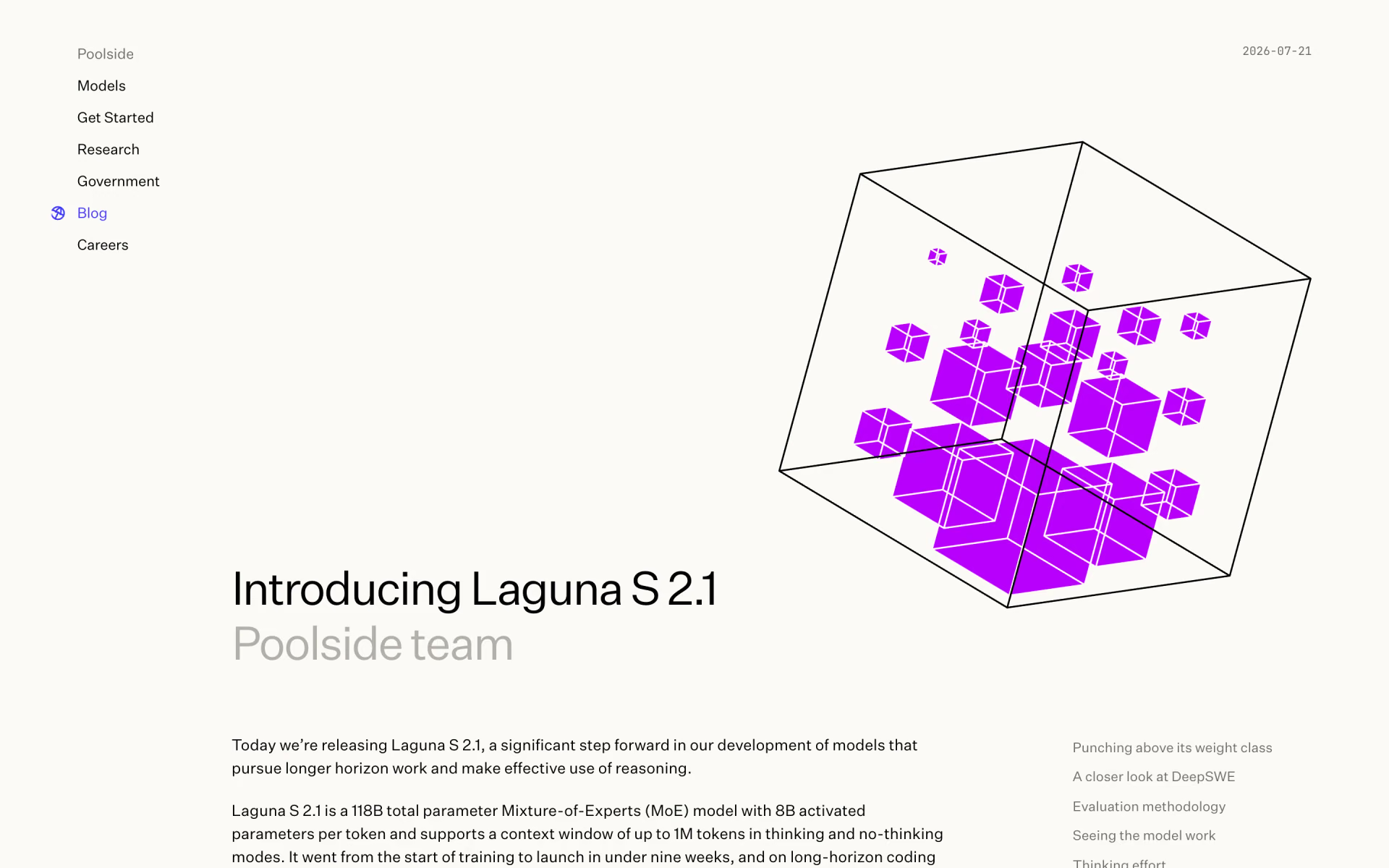
What is Laguna S 2.1?
Laguna S 2.1 is Poolside's strongest model for agentic coding and long, multi-step work, and the one its own agent tools use by default. It is a mixture-of-experts model with 118B parameters, of which 8B work on each token. It reads and writes text only, holds up to 1M tokens of context, and its knowledge stops at November 2025.
On Poolside's own charts, the open models that match its coding scores are several times larger. Laguna S 2.1 fits on a single NVIDIA DGX Spark, so teams can keep code on their own machines, or call it cheaply through OpenRouter. Thinking is either off or at max; there are no finer effort levels yet.
How is Laguna S 2.1 different from Laguna XS 2.1?
S 2.1 is the bigger, stronger sibling: about 3.5 times the parameters, four times the context and roughly double the coding score, but it needs far more memory.
- Size
- 118B parameters with 8B active, against 33B with 3B active for XS 2.1.
- Context
- 1M tokens, against 256K for XS 2.1.
- Hardware
- S 2.1 fits on a single NVIDIA DGX Spark; XS 2.1 runs on a Mac with 36 GB of memory.
- Coding score
- 70.2% on Terminal-Bench 2.1, against 33.4% for XS 2.1 on Poolside's chart.
- Training
- Same pre-training data as XS 2.1; the gains come from scale and new post-training.
Who is Laguna S 2.1 best for?
Laguna S 2.1 is best for developers who want an open coding agent model on their own hardware, long multi-step coding runs, fine-tuning, and cheap hosted agent work.
Coding agents on your own hardware
With 8B of its 118B parameters active per token, it is small enough for a single NVIDIA DGX Spark, so your code can stay on your own machines.
Long coding sessions
A 1M-token context lets an agent keep hundreds of thousands of tokens of working history on hard, multi-step tasks.
Teams that fine-tune models
The OpenMDW-1.1 weights can be post-trained with NVIDIA NeMo AutoModel or Prime Intellect's Prime Lab, and Poolside shares the base model on request.
Low-cost hosted agents
The 1M-context endpoint on OpenRouter costs $0.10 / $0.20 per million tokens, and a free endpoint with a 256K context lets you try it first.
What's included with Laguna S 2.1?
Two thinking modes, weights in every common format, support in the main local servers, an OpenAI-compatible API, agent tool support and a free web chat.
- Thinking on or off
- Max thinking is on by default and lifts its Terminal-Bench 2.1 score from 60.4% to 70.2%; turn it off per request for quicker, cheaper answers.
- Weights in every common format
- BF16, FP8, INT4 and NVFP4 weights, official GGUF and MLX builds, and DFlash draft models for faster decoding.
- Local serving
- vLLM, SGLang, Ollama, llama.cpp, MLX and TensorRT-LLM can all serve it.
- OpenAI-compatible API
- Poolside's own endpoint and OpenRouter take the OpenAI chat completions format, and Baseten and Vercel AI Gateway host it too.
- Agent tool support
- It runs in Poolside's pool terminal agent and works with Cline, Kilo, OpenCode, OpenClaw, Hermes Agent and pi.
- Free web chat
- chat.poolside.ai runs it with web search and basic code execution, and needs no login.
- Published test runs
- Poolside publishes every trajectory from its final benchmark runs, so anyone can check how the scores were reached.
How much does Laguna S 2.1 cost?
Laguna S 2.1 is free to download under OpenMDW-1.1 and free on OpenRouter with a 256K context; the full 1M-context endpoint costs $0.10 per million input tokens and $0.20 per million output tokens.
- OpenMDW-1.1 license, weights on Hugging Face
- BF16, FP8, INT4 and NVFP4 weights, plus GGUF and MLX
- Fits on a single NVIDIA DGX Spark
- 256K-token context window
- Full 1M-token context window
- Cache reads $0.01 per million tokens
- Sold through OpenRouter
Poolside's own API, which its pool terminal agent uses, has no published price. The web chat at chat.poolside.ai is free and needs no login. Laguna S 2.1 is also hosted on Baseten and Vercel AI Gateway, whose prices Poolside does not list, and the base model before post-training is available on request from Poolside. Full pricing on poolside.ai. We checked these prices on .
How do readers rate Laguna S 2.1?
No one has rated Laguna S 2.1 yet. Be the first.
Sign in to rate. One rating per account.
Laguna S 2.1 pros and cons
It brings strong agentic coding to a single machine at a low API price, but early users report reasoning loops, tool-call trouble outside Poolside's own agent, and slow local speeds.
Pros
- Early users run it on single machines with 128GB of memory, such as AMD Strix Halo desktops, Apple M-series Max laptops and DGX Spark, which few models with its coding scores allow.
- Several Hacker News and Reddit testers say it does real coding work well for its size, from landing usable pull requests to replacing Claude, Codex or DeepSeek V4 Flash in their agent setups.
- The 1M-context endpoint costs $0.10 / $0.20 per million tokens, and users compare it with DeepSeek's Flash models on price.
- Testers describe it as persistent: it keeps checking its own work where smaller models give up, which is what Poolside says it trained for.
Cons
- Many early users hit reasoning loops or very long thinking, especially in long sessions or on early quantized builds, and Poolside lists overthinking as a known limit.
- Tool calls can break outside Poolside's own pool agent: Poolside warns it may slip on tool formats in other harnesses, and users report failures with MCP servers in OpenCode and pi.
- Local speed is modest: users on 128GB machines report roughly 10 to 30 tokens per second, fine for background jobs but slow for hands-on agent work.
- Text only, with no image input, and only two thinking settings, off or max.
Is Laguna S 2.1 open source?
Yes. Laguna S 2.1's code is public under the OpenMDW 1.1 licence, so you can run it on your own server.
What are the best Laguna S 2.1 alternatives?
Laguna S 2.1 is an open source alternative to SWE-2 and GPT-5.3-Codex. GLM-4.7 does the same job and is open source too.
 SWE-2Paid
Cognition's new coding model inside Devin.
 GPT-5.3-CodexPaid
OpenAI's agentic coding model with reasoning levels.
 GLM-4.7Open Source
Z.ai's MIT-licensed model for agentic coding with a 200K context.
 DeepSeek V4.1 FlashOpen Source
Choose it when you need image input or longer answers from a first-party API: it reads images, writes up to 384K tokens, and costs $0.30 / $1.20 per million tokens at peak, half that off-peak.
 Qwen3.6-27BOpen Source
Choose it when your machine has far less memory: it is a 27B model that also reads images, under Apache 2.0, with a 262K context you can extend to about 1M.
 Mistral Small 4Open Source
Choose it when you want a model of the same size that reads images: 119B parameters with 6B active, Apache 2.0, and $0.15 / $0.60 per million tokens on Mistral's API.
Questions about Laguna S 2.1
What is Laguna S 2.1?
Laguna S 2.1 is Poolside's open-weight model for agentic coding: 118B parameters with 8B active, a 1M-token context, and free weights that developers can run or fine-tune themselves.
Who is Laguna S 2.1 for?
Laguna S 2.1 is best for developers who want an open coding agent model on their own hardware, long multi-step coding runs, fine-tuning, and cheap hosted agent work.
Is Laguna S 2.1 free?
Yes, in several ways. The weights are free to download under OpenMDW-1.1, OpenRouter has a free endpoint with a 256K context, and chat.poolside.ai needs no login. Only the full 1M-context endpoint is paid, at $0.10 / $0.20 per million tokens.
How much does Laguna S 2.1 cost?
Laguna S 2.1's paid plans are 1M-context endpoint at $0.10 / $0.20 per million input / output tokens.
Is Laguna S 2.1 open source?
Yes. Laguna S 2.1's code is public under the OpenMDW 1.1 licence, so you can run it on your own server.
What are the best Laguna S 2.1 alternatives?
The closest alternatives on Recaply are SWE-2, GPT-5.3-Codex, GLM-4.7, DeepSeek V4.1 Flash, Qwen3.6-27B and Mistral Small 4.
Where can I try Laguna S 2.1?
On its official website, poolside.ai.
Can I run Laguna S 2.1 locally?
Yes. Poolside says it fits on a single NVIDIA DGX Spark and estimates about 192 GB of GPU memory at FP8, while INT4, NVFP4, GGUF and MLX builds need less. vLLM, SGLang, Ollama and llama.cpp can serve it with no usage fees.
Can I use Laguna S 2.1 for commercial work?
Yes. OpenMDW-1.1 is a permissive license: Poolside says you can use and modify the model and build commercial products on it without asking permission. Poolside's acceptable use policy still applies.
Does Laguna S 2.1 understand images?
No. Laguna S 2.1 takes text in and gives text out, and does not accept images or screenshots. For image input in a similar size class, look at Mistral Small 4 or DeepSeek V4.1 Flash.
How do I turn thinking off in Laguna S 2.1?
Set enable_thinking to false in chat_template_kwargs on a request, or make that the server default. In Poolside's pool agent, switch it per session with /thought-level. Poolside recommends keeping thinking on for agentic coding.
Our verdict
Laguna S 2.1 is the open coding model to try if you want strong agent work on hardware you own.
Poolside's published scores put it near open models several times its size, it fits on one DGX Spark, and its hosted endpoint costs $0.10 / $0.20 per million tokens.
- Skip it for
- Work that needs image input, or a model that behaves well in any agent harness without tuning.
- Check first
- Run it on your own harness and longest tasks first, since loops and tool-call errors are the common complaints.
 Qwen3-Coder-Next
 Chroma Context-1
 Kimi K2.7 Code
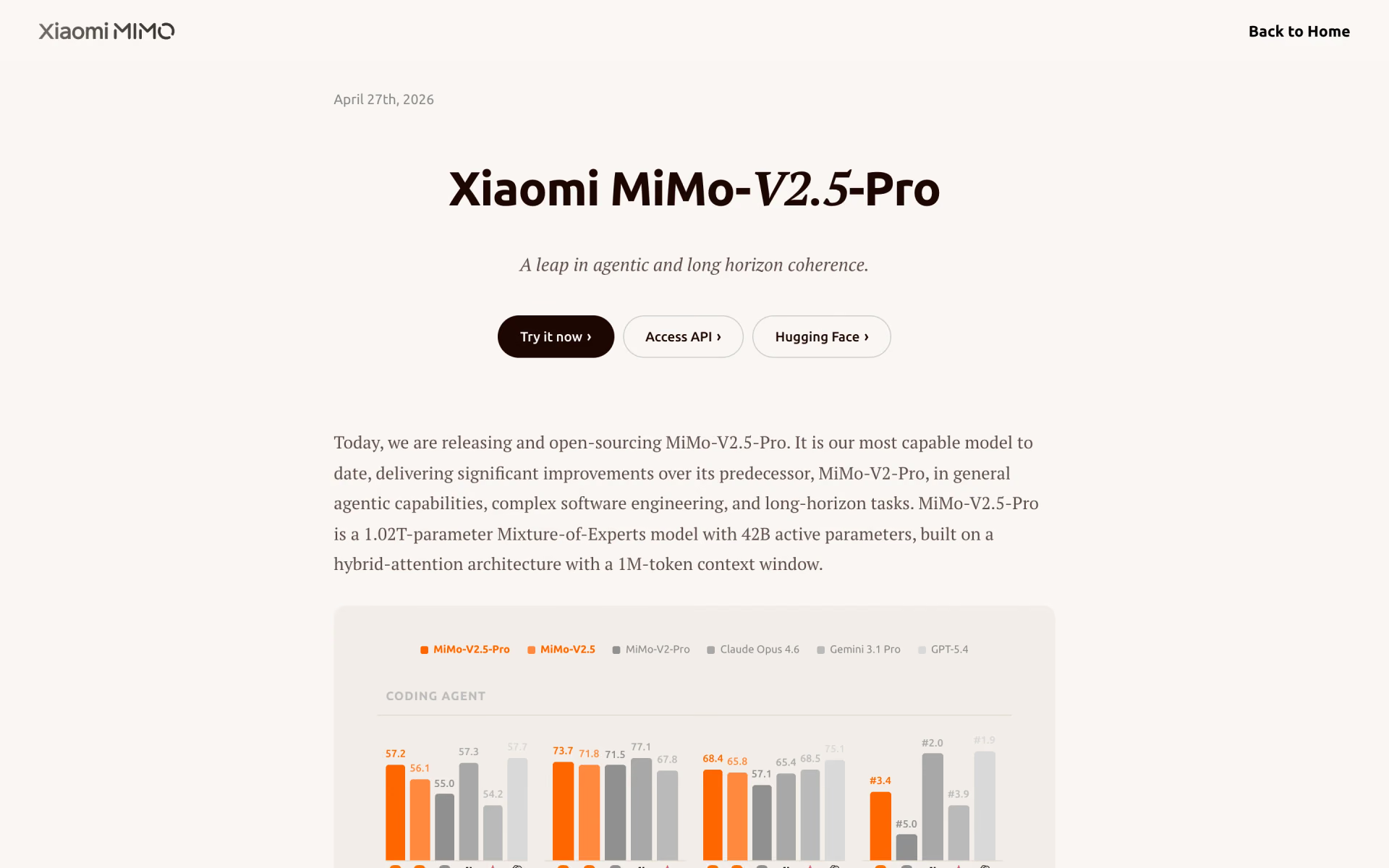
 MiMo-V2.5-Pro
 North Mini Code
 GLM-5.2