
What is GPT-6 Luna?
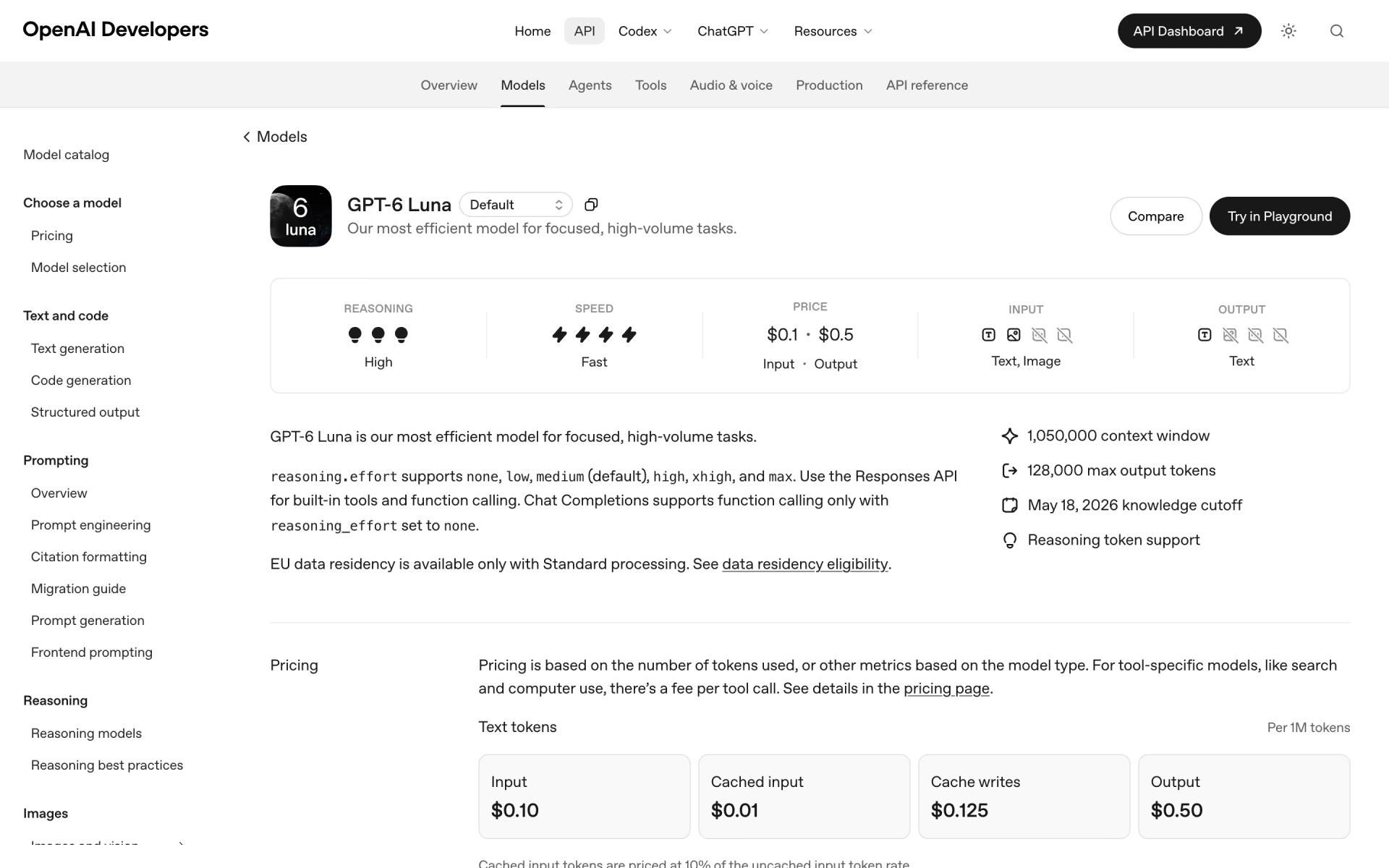
GPT-6 Luna is the smallest and cheapest model in OpenAI's GPT-6 family, below Sol and Astra. OpenAI aims it at clear, repeatable jobs where you know what a good result looks like: extraction, classification, transformation, structured summaries and focused coding. It reads text and images, writes text, and has the same 1.05M-token context and 128K output as Astra; its knowledge stops at May 2026.
It is a current model and succeeds GPT-5.6 Luna at half the token price or less. In ChatGPT it runs in Codex and ChatGPT Work, including on the Free and Go plans in the desktop app, but not in Chat.
What changed from GPT-5.6 Luna?
Mainly price: it costs half as much or less per token, with newer knowledge and GPT-6's API controls.
- Price
- Input fell from $0.20 to $0.10 and output from $1.20 to $0.50 per million tokens; cached input from $0.02 to $0.01.
- Knowledge
- Its knowledge stops at May 2026, against February 2026 for GPT-5.6 Luna.
- API controls
- Mid-turn steering and effort changes that keep the prompt cache are GPT-6 features that GPT-5.6 Luna lacks.
- Quality
- OpenAI says the GPT-6 pair improves coding, factual reliability and communication; early user tests are split.
Who is GPT-6 Luna best for?
GPT-6 Luna is best for high-volume API jobs, subagents and routine coding, free ChatGPT users who want Codex, and anyone stretching a ChatGPT plan's limits.
High-volume API jobs
Classification, extraction and structured summaries cost $0.10 / $0.50 per million tokens, and Batch halves that for work that can wait.
Subagents and routine coding
Many developers let Sol or Astra plan and hand the well-scoped coding to Luna at high or max effort.
Free ChatGPT users who code
ChatGPT Free and Go include it at Standard speed in the desktop app for Codex and ChatGPT Work.
Stretching a ChatGPT plan
OpenAI estimates 350 to 3,000 Luna messages every five hours on Plus, about 20 times its estimate for Sol.
What's included with GPT-6 Luna?
Six effort levels, the full Responses API tool set, mid-turn steering, effort changes that keep the cache, cheaper Batch and Flex processing, and Amazon Bedrock.
- Six effort levels
- Reasoning runs from none to max, with medium as the API default; OpenAI suggests High in ChatGPT and Codex.
- Hosted tools
- Web and file search, code interpreter, a hosted shell, apply patch, skills, computer use, MCP and tool search all work on the Responses API.
- Mid-turn steering
- Over a WebSocket you can send a correction while it works, and the Responses API keeps the work already done.
- Effort changes that keep the cache
- A configuration_update item raises or lowers effort mid-conversation without rewriting the cached prompt.
- Batch, Flex and Fast mode
- Batch and Flex cost $0.05 / $0.25 per million tokens; Fast mode costs double the standard rate.
- Amazon Bedrock
- It is on Bedrock in the us-east-1 region, billed through AWS at OpenAI's own prices in commercial regions.
How much does GPT-6 Luna cost?
GPT-6 Luna costs $0.10 per million input tokens and $0.50 per million output tokens on the OpenAI API, and ChatGPT Free and Go include it in the desktop app at no extra cost.
- GPT-6 Luna at Standard speed in the desktop app
- Codex and ChatGPT Work, as it rolls out
- Cached input $0.01, cache writes $0.125 per million tokens
- Prompts over 272K tokens: $0.20 / $0.75 for the whole request
- Batch and Flex at half price, Fast mode at double
- GPT-6 Luna at Standard speed in the desktop app
- About 350 to 3,000 GPT-6 Luna messages every five hours
- GPT-6 Sol included as well
- Buy ChatGPT credits when you run out
ChatGPT Pro starts at $100 a month with 5x or 20x Plus usage, and Business costs $25 per user per month ($20 billed yearly, for 2 or more users). On the API, data-residency endpoints add 10%, and the free API tier does not include GPT-6 Luna. In ChatGPT, Luna runs in Codex and ChatGPT Work, not Chat; the message counts are OpenAI's estimates, not fixed limits. Full pricing on developers.openai.com. We checked these prices on .
How do readers rate GPT-6 Luna?
No one has rated GPT-6 Luna yet. Be the first.
Sign in to rate. One rating per account.
GPT-6 Luna pros and cons
It is very cheap and good enough for most well-scoped work, but it is no clear step up from GPT-5.6 Luna and can be slower.
Pros
- At $0.10 / $0.50 per million tokens it costs half of GPT-5.6 Luna or less, and developers widely praise it as remarkable value.
- Developers report moving classification and other production jobs to it, and many run it as the coder under a Sol or Astra planner.
- It barely moves ChatGPT usage limits: users on paid plans say their allowance hardly drops even after hours of Luna work.
- Users who moved from GPT-5.6 Luna say its answers are shorter and more to the point.
Cons
- Early user tests show no clear quality gain over GPT-5.6 Luna, and a few people's own benchmarks scored it lower.
- Several users find it slower than GPT-5.6 Luna and say it can use more tokens at the same effort, which eats into the savings.
- It sometimes ignores instructions or takes shortcuts, so users keep a stronger model or a reviewer in the loop.
- Cache reads cost $0.01 per million tokens, more than DeepSeek V4.1 Flash charges, so some users found cache-heavy coding cheaper on DeepSeek.
What are the best GPT-6 Luna alternatives?
Five tools on Recaply do GPT-6 Luna's job. DeepSeek V4.1 Flash, Bonsai 27B and MiMo-V2.6-Flash are open source, so you can run them on your own server.
 GPT-6 SolPaid
Choose it when the task is ambiguous or needs judgment, such as complex code changes or deep research; it costs $2 / $10 per million tokens, 20 times Luna.
 Gemini 3.5 Flash-LiteFree
Choose it when you need video or audio input or a free API tier to test on; paid use costs more, at $0.30 / $2.50 per million tokens.
 DeepSeek V4.1 FlashOpen Source
Choose it when you want MIT-licensed weights you can run yourself, replies up to 384K tokens, or cheaper cache reads on DeepSeek's API.
 Bonsai 27BOpen Source
Choose it when cheap, high-volume text work has to run on your own machine rather than on OpenAI's metered API.
 MiMo-V2.6-FlashOpen Source
Choose it when you want open weights to self-host, or Xiaomi's low-cost pay-as-you-go API, for agent work.
More open source alternatives
See all
Questions about GPT-6 Luna
What is GPT-6 Luna?
GPT-6 Luna is OpenAI's lowest-cost GPT-6 model for focused, high-volume work such as extraction, classification and focused coding, sold on the API and free in the ChatGPT desktop app.
Who is GPT-6 Luna for?
GPT-6 Luna is best for high-volume API jobs, subagents and routine coding, free ChatGPT users who want Codex, and anyone stretching a ChatGPT plan's limits.
Is GPT-6 Luna free?
Yes, in ChatGPT: the Free and Go plans include GPT-6 Luna at Standard speed in the ChatGPT desktop app, for Codex and ChatGPT Work, as it rolls out. The OpenAI API's free tier does not cover it, so API use costs $0.10 / $0.50 per million tokens.
How much does GPT-6 Luna cost?
GPT-6 Luna's paid plans are API at $0.10 / $0.50 per million input / output tokens, ChatGPT Go at $8 per month and ChatGPT Plus at $20 per month.
Is there an open source alternative to GPT-6 Luna?
Yes. DeepSeek V4.1 Flash, Bonsai 27B, MiMo-V2.6-Flash and Nemotron 3.5 Lightning are open source tools that do the same job, so you can run your own.
What are the best GPT-6 Luna alternatives?
The closest alternatives on Recaply are GPT-6 Sol, Gemini 3.5 Flash-Lite, DeepSeek V4.1 Flash, Bonsai 27B and MiMo-V2.6-Flash.
Where can I try GPT-6 Luna?
On its official website, developers.openai.com.
GPT-6 Luna vs GPT-5.6 Luna: which is better?
GPT-6 Luna is cheaper, at $0.10 / $0.50 against $0.20 / $1.20 per million tokens, and its knowledge is newer. Early user tests on quality are split and some found it slower, so compare both on your own tasks before you switch production jobs.
Is GPT-6 Luna good enough for coding?
For focused, well-defined coding, yes: OpenAI lists focused coding among Luna's uses, and many developers run it as the coder under a Sol or Astra planner. For ambiguous or large changes, OpenAI points to GPT-6 Sol instead.
Which reasoning effort should I use with GPT-6 Luna?
OpenAI suggests starting at High in ChatGPT and Codex, while the API defaults to medium. Effort runs from none to max; in ChatGPT, Luna goes up to Max but not Ultra. Higher effort takes longer and uses more tokens.
Our verdict
GPT-6 Luna is the model to try first for bulk, well-defined work on OpenAI's API or in Codex.
It costs $0.10 / $0.50 per million tokens with a 1.05M-token context and the full tool set, though early users see no clear quality gain over GPT-5.6 Luna and some find it slower.
- Skip it for
- Open-ended or ambiguous work, where GPT-6 Sol or Astra fits better.
- Check first
- Run your own evals against GPT-5.6 Luna and watch token use at high effort.
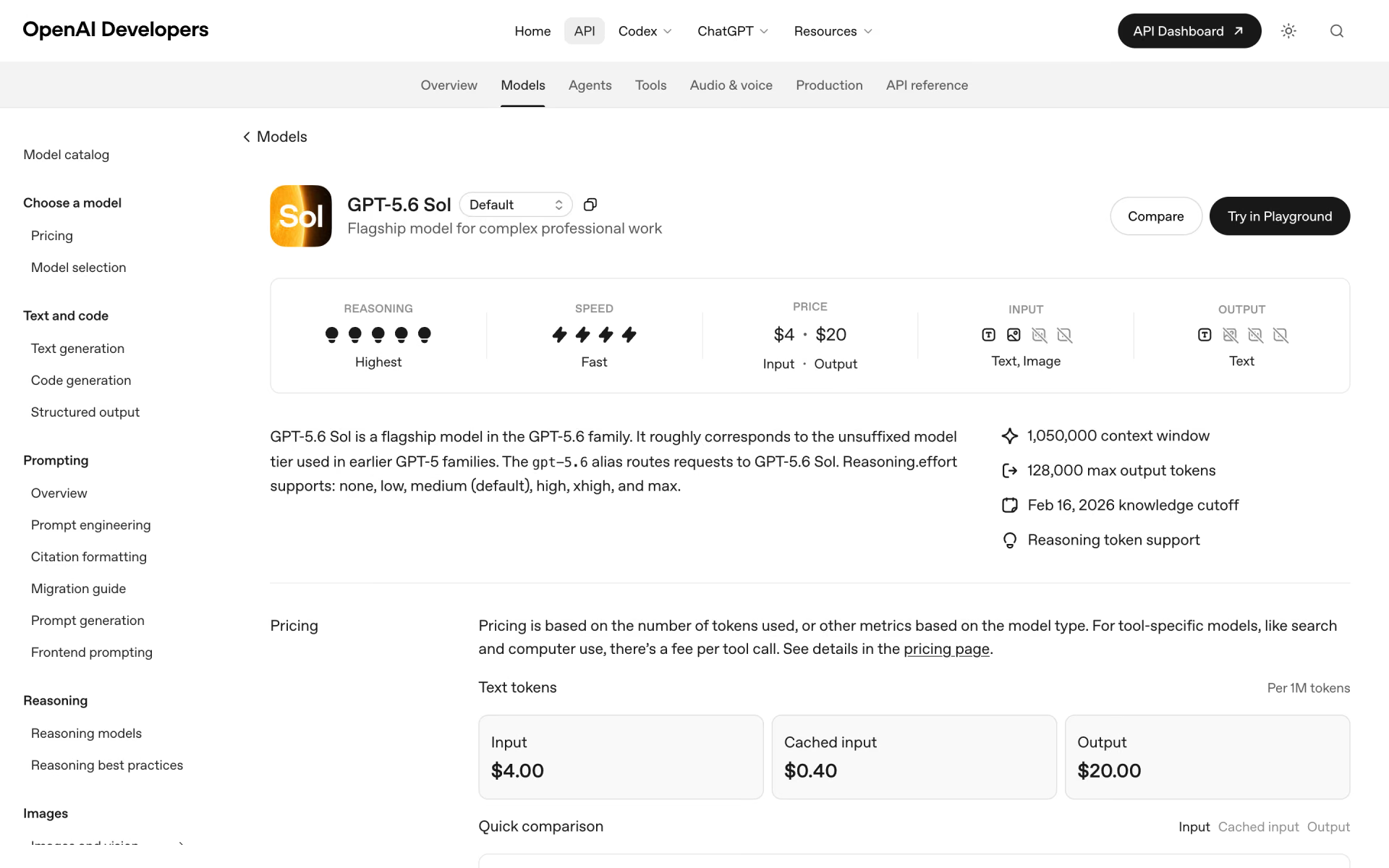
 GPT-5.6
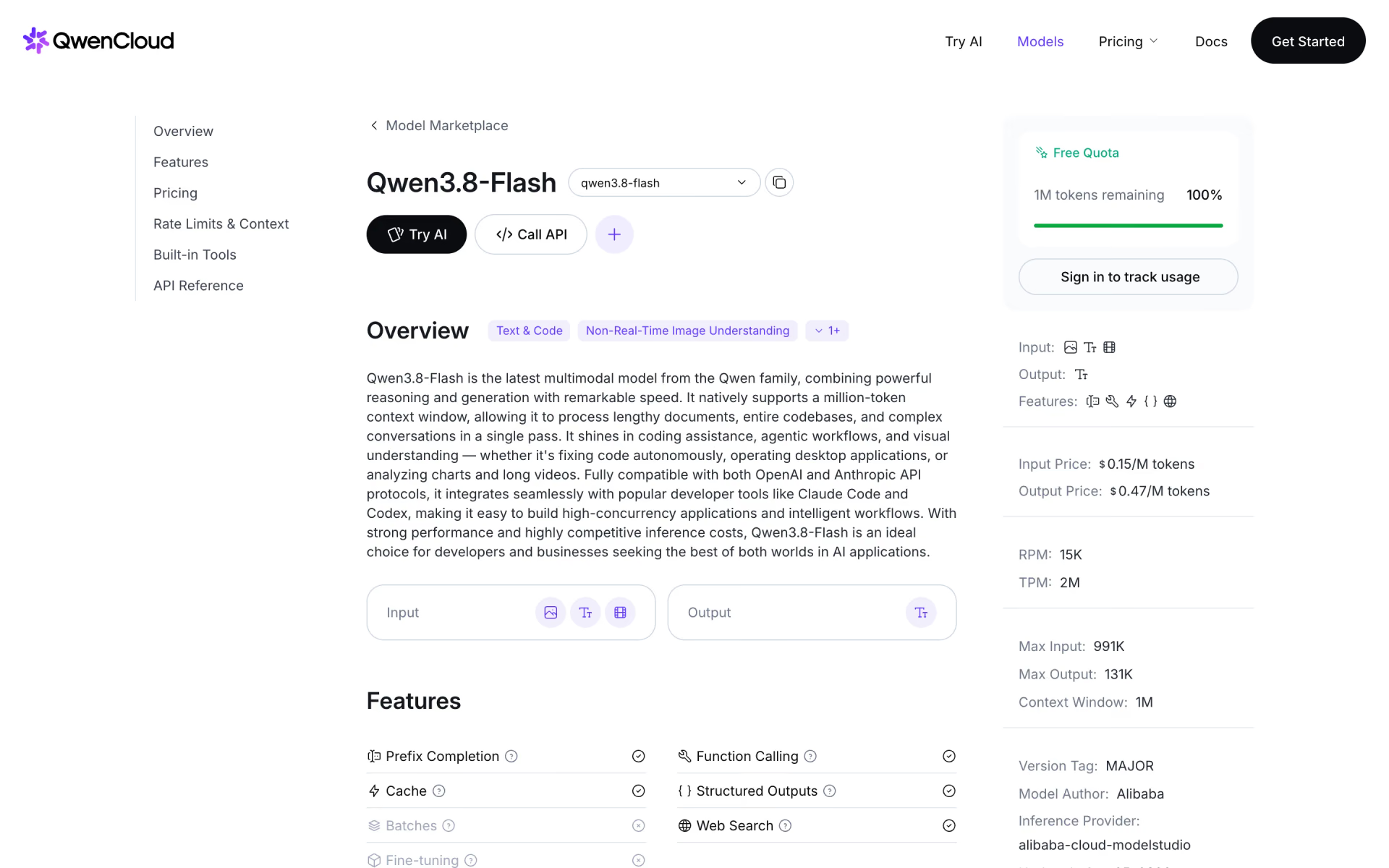
 Qwen3.8-Flash
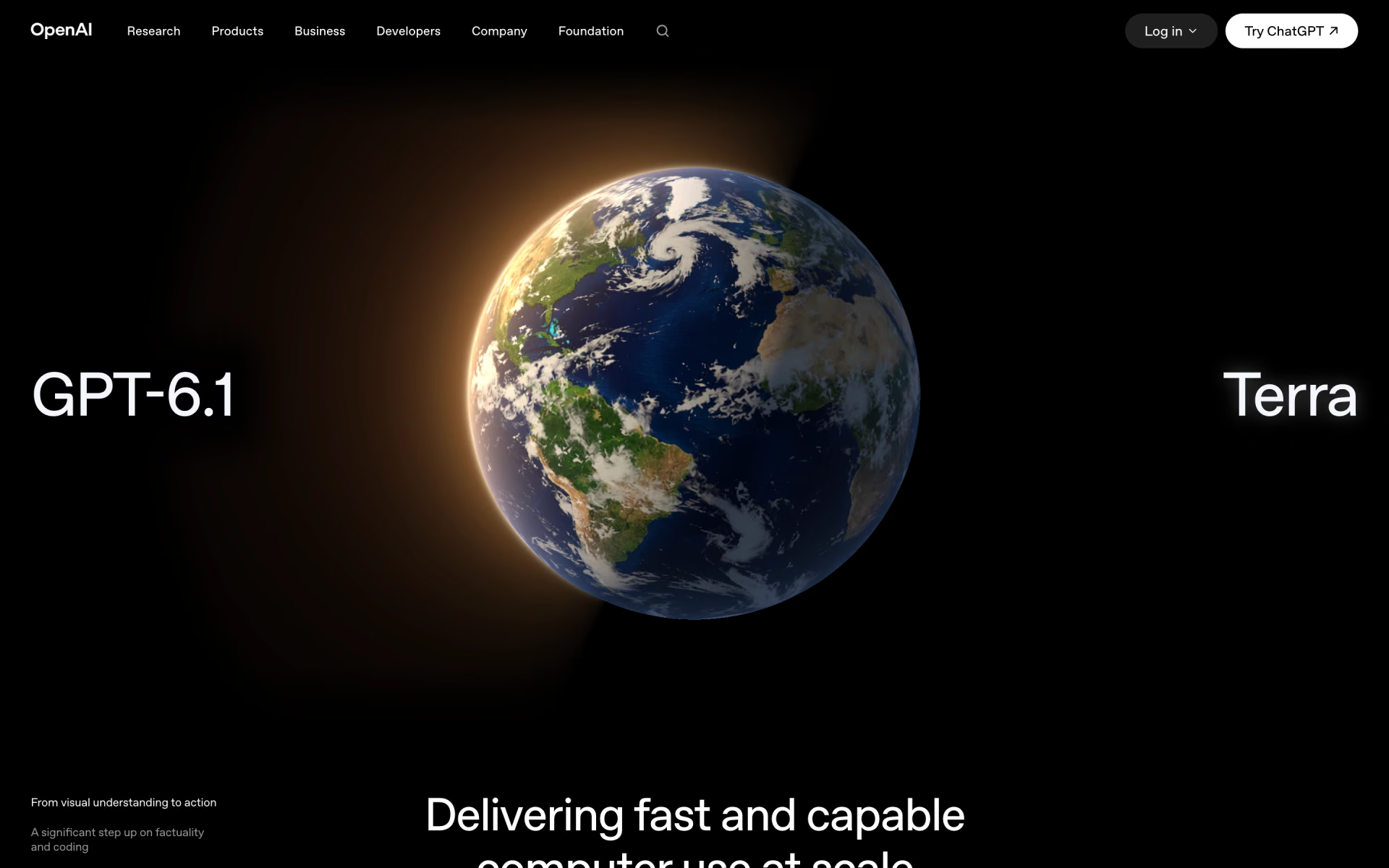
 GPT-6.1 Terra

 GPT-5.4

 GPT-5.5