
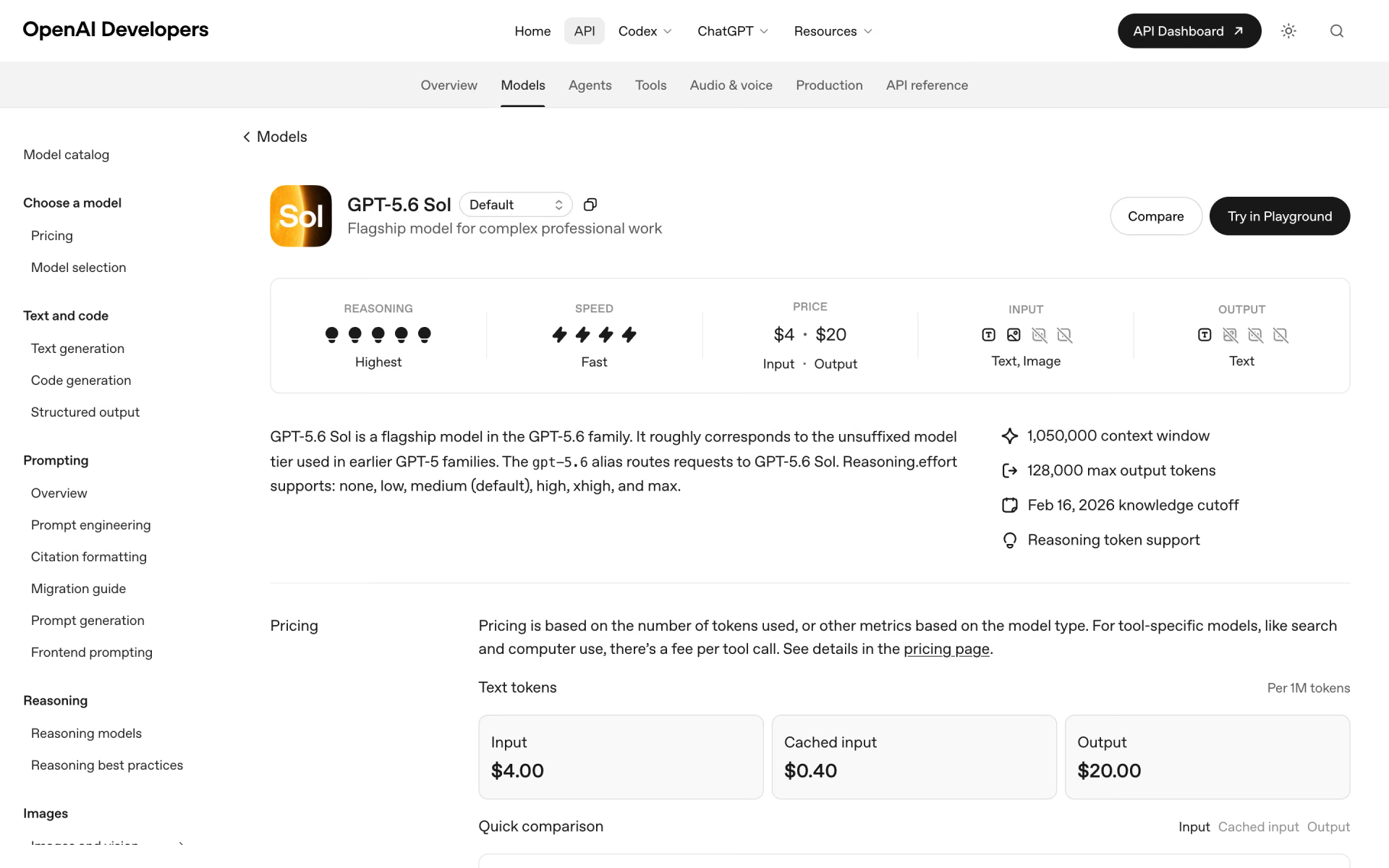
What is GPT-5.6?
GPT-5.6 is the model family OpenAI released before GPT-6, in three sizes: Sol for flagship work, Terra to balance capability and cost, and Luna for cheap, high-volume jobs. All three read text and images, write text, and share a 1.05M-token context with up to 128K tokens of output; their knowledge stops at February 2026. The gpt-5.6 model ID points to Sol.
It is now the previous generation but not retired. OpenAI still sells it on the API with no shutdown date, and it still runs ChatGPT's Chat, while GPT-6 Sol and Luna take over as the recommended models in Codex and ChatGPT Work. There is no GPT-6 Terra.
Is GPT-5.6 still available?
Yes. OpenAI still sells all three sizes on the API with no retirement date, and GPT-5.6 still runs ChatGPT's Chat.
- OpenAI API
- Sol, Terra and Luna are on sale and not on OpenAI's deprecation list; OpenAI names them as replacements for many older models.
- ChatGPT Chat
- Plus and Pro use GPT-5.6 Sol, and Free and Go default to GPT-5.6 Luna.
- Codex and ChatGPT Work
- GPT-6 Sol and Luna are now the recommended models; GPT-5.6 stays available during their rollout, and Codex cloud chats still use GPT-5.6 Sol.
- No GPT-6 Terra
- OpenAI has not released a GPT-6 Terra, so Terra users choose between GPT-6 Sol and GPT-6 Luna.
Who is GPT-5.6 best for?
GPT-5.6 is best for everyday ChatGPT chat, hard debugging and code review on Sol, cheap bulk work on Luna, and apps already tuned for it on the API.
Everyday ChatGPT chat
Plus and Pro users get GPT-5.6 Sol in Chat with a thinking slider, and Free and Go users get GPT-5.6 Luna by default.
Hard debugging and code review
Many developers rate GPT-5.6 Sol highly for finding bugs and working through unusual engineering problems.
Cheap bulk work on Luna
GPT-5.6 Luna costs $0.20 / $1.20 per million tokens, and users say it holds up well at high or max effort.
Apps already tuned for it
Teams with prompts built around GPT-5.6 can keep it on the API, where it is not on OpenAI's deprecation list.
What's included with GPT-5.6?
Three sizes behind one alias, Programmatic Tool Calling, six effort levels with pro mode, explicit prompt caching, a multi-agent beta, Batch, Flex and Fast mode, and Amazon Bedrock.
- Three sizes, one alias
- Sol, Terra and Luna share the same context and tools, and the gpt-5.6 alias sends requests to Sol.
- Programmatic Tool Calling
- The model writes JavaScript that calls your tools and passes results between them in a hosted runtime, with no extra container cost.
- Six effort levels and pro mode
- Reasoning runs from none to max, and pro mode does more work on hard tasks at the normal token rates.
- Explicit prompt caching
- You choose which prompt prefixes to cache; cache writes cost 1.25x the input rate and reads stay discounted.
- Multi-agent beta
- A GPT-5.6 model can run several subagents in parallel through the Responses API and combine their results.
- Batch, Flex and Fast mode
- Batch and Flex cost half; Fast mode runs Sol up to 2.5x faster at double the price.
- Amazon Bedrock
- All three sizes are generally available through Bedrock, billed through AWS.
What changed from GPT-5.5?
New size names, more control over reasoning and tools, and fewer output tokens per task.
- Three sizes
- Sol, Terra and Luna roughly match the full, mini and nano tiers of earlier GPT-5 families.
- Reasoning
- A new max effort level, pro mode on the same model ID, and reasoning carried across turns by default.
- Tools
- Programmatic Tool Calling, explicit prompt caching and a multi-agent beta in the Responses API.
- Output
- OpenAI says it reaches flagship results with fewer output tokens, writes more concisely than GPT-5.5 and builds more polished front ends.
How much does GPT-5.6 cost?
GPT-5.6 costs $0.20 / $1.20 per million input / output tokens for Luna, $2 / $12 for Terra and $5 / $30 for Sol on the OpenAI API; ChatGPT Plus at $20 a month includes GPT-5.6 Sol, and ChatGPT Free uses GPT-5.6 Luna.
- Cached input $0.02, cache writes $0.25 per million tokens
- The lowest-cost GPT-5.6 size
- Cached input $0.20, cache writes $2.50 per million tokens
- Balances capability and cost
- The gpt-5.6 alias routes here
- Cache writes cost 1.25x the input rate
- Pro mode for the hardest tasks
- GPT-5.6 Sol in Chat, with a thinking slider
- About 10 to 100 GPT-5.6 Sol messages every five hours in Codex
On all three sizes, prompts over 272K tokens cost 2x input and 1.5x output for the whole request, Batch and Flex cost half, Fast mode costs double, and data-residency endpoints add 10%; the free API tier does not include GPT-5.6. ChatGPT Free ($0) and Go ($8 a month) use GPT-5.6 Luna as the default chat model. ChatGPT Pro starts at $100 a month, and Business costs $25 per user per month ($20 billed yearly). Full pricing on developers.openai.com. We checked these prices on .
How do readers rate GPT-5.6?
No one has rated GPT-5.6 yet. Be the first.
Sign in to rate. One rating per account.
GPT-5.6 pros and cons
Sol is strong at debugging and review and Luna is a cheap workhorse, but Sol over-engineers, drains Codex limits and now costs more per token than GPT-6.
Pros
- Developers rate GPT-5.6 Sol highly for debugging, code review and hard engineering work, and many found it a clear step up from GPT-5.5.
- Run at high or max effort, GPT-5.6 Luna is a cheap workhorse, and many developers pair a Sol planner with Luna doing the coding.
- Several users describe Sol as concise and good at following instructions, and some still prefer it to GPT-6 Sol for complex work.
- It is free to try in ChatGPT, where GPT-5.6 Luna is the default chat model on the Free and Go plans.
Cons
- GPT-5.6 Sol burns through Codex limits fast, especially at high effort or in Ultra mode on the $20 Plus plan.
- Sol tends to over-engineer, adding reviews, tests and subagents nobody asked for, which costs tokens and time.
- Safety classifiers can pause output for several seconds, and some users hit those checks on harmless GPU and shader code.
- It is now a generation behind: GPT-6 Sol costs $2 / $10 against GPT-5.6 Sol's $5 / $30, and GPT-6 knowledge runs to April and May 2026 against February 2026.
What are the best GPT-5.6 alternatives?
Four tools on Recaply do GPT-5.6's job. LongCat-2.0 is open source, so you can run it on your own server.
 GPT-6 SolPaid
Choose it when you want the newer model at a lower price: $2 / $10 per million tokens against GPT-5.6 Sol's $5 / $30, knowledge through April 2026 and mid-turn steering, though some users still prefer GPT-5.6 Sol on complex work.
 GPT-6 LunaFree
Choose it when you run bulk jobs on GPT-5.6 Luna or Terra: it costs $0.10 / $0.50 per million tokens, half of GPT-5.6 Luna's price or less.
 GPT-6 AstraPaid
Choose it when a task needs OpenAI's strongest model across many steps and tools; it costs $10 / $50 per million tokens.
 LongCat-2.0Open Source
Choose it when long-context agent work needs open weights you control rather than OpenAI's hosted tiers.
Questions about GPT-5.6
What is the difference between GPT-5.6 Sol, Terra and Luna?
They are three sizes of one model family. Sol is the flagship for complex work at $5 / $30 per million tokens, Terra balances capability and cost at $2 / $12, and Luna handles cheap, high-volume jobs at $0.20 / $1.20. All three share a 1.05M-token context.
Who is GPT-5.6 for?
GPT-5.6 is best for everyday ChatGPT chat, hard debugging and code review on Sol, cheap bulk work on Luna, and apps already tuned for it on the API.
Is GPT-5.6 free?
In ChatGPT, yes: GPT-5.6 Luna is the default chat model on the Free and Go plans. GPT-5.6 Sol needs Plus at $20 a month or higher, and the OpenAI API's free tier does not include GPT-5.6, so API use is paid.
How much does GPT-5.6 cost?
GPT-5.6's paid plans are GPT-5.6 Luna at $0.20 / $1.20 per million input / output tokens, GPT-5.6 Terra at $2 / $12 per million input / output tokens, GPT-5.6 Sol at $5 / $30 per million input / output tokens and ChatGPT Plus at $20 per month.
Is there an open source alternative to GPT-5.6?
Yes. LongCat-2.0 is an open source tool that does the same job, so you can run your own.
What are the best GPT-5.6 alternatives?
The closest alternatives on Recaply are GPT-6 Sol, GPT-6 Luna, GPT-6 Astra and LongCat-2.0.
Where can I try GPT-5.6?
On its official website, developers.openai.com.
Should I switch from GPT-5.6 to GPT-6?
For cost, yes: GPT-6 Sol and Luna cost less per token and have newer knowledge. For quality, test first; some developers still prefer GPT-5.6 Sol on complex coding, and GPT-6 Luna showed no clear gain over GPT-5.6 Luna in early user tests.
Why does GPT-5.6 pause for safety checks?
OpenAI runs cyber and biology misuse classifiers as GPT-5.6 writes, and generation can pause for several seconds while they review the output. They sometimes stop legitimate dual-use work; OpenAI suggests sending a safety_identifier for each end user of your app.
What does the gpt-5.6 model ID point to?
The gpt-5.6 alias routes requests to GPT-5.6 Sol, the flagship size. Use gpt-5.6-terra or gpt-5.6-luna for a smaller, cheaper size; when migrating, OpenAI suggests testing your current reasoning setting and one level lower.
Our verdict
GPT-5.6 is still a capable family, but for new API work GPT-6 Sol and Luna are the better buy.
They cost less per token and know more recent events, while GPT-5.6 Sol's strength at debugging and review is why some developers have not switched yet.
- Skip it for
- New API projects, unless your own tests favour GPT-5.6 Sol.
- Check first
- If you keep GPT-5.6 Sol, watch its Codex usage and tell it how much testing and review you want.
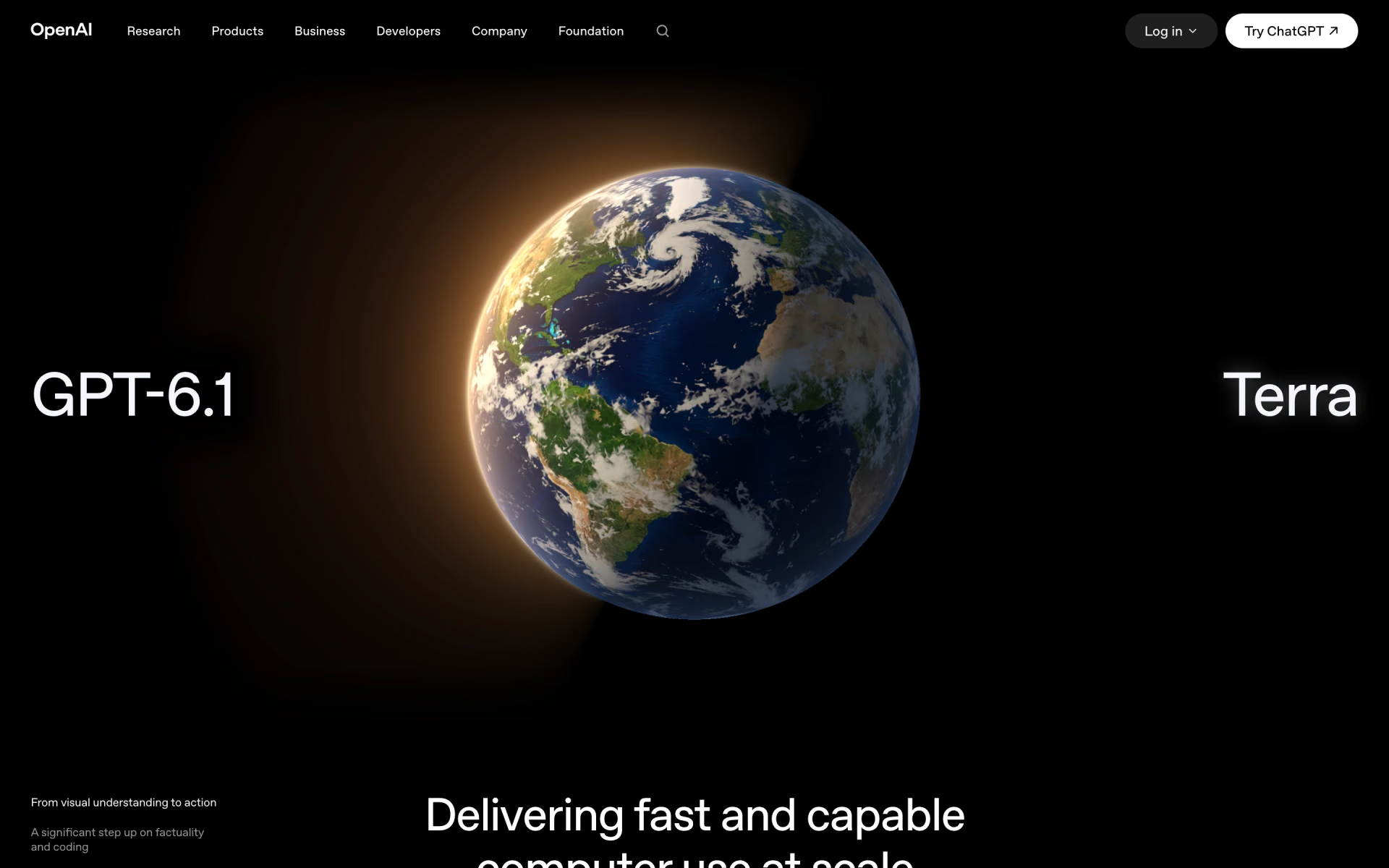

 GPT-5.5

 Amazon Nova

 Nemotron 3

 Gemini 3
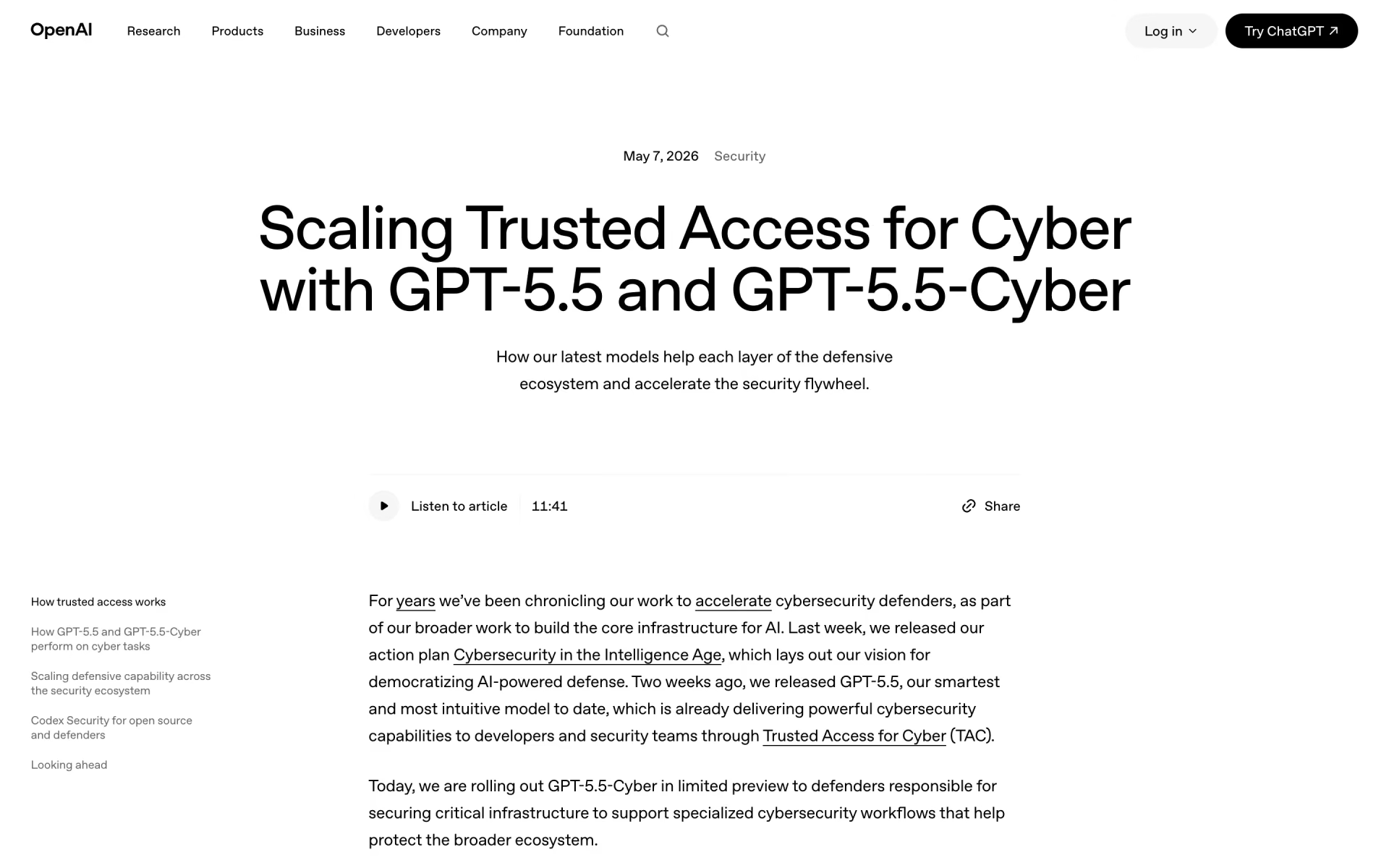
 GPT-5.5-Cyber