
What is GLM-4.7?
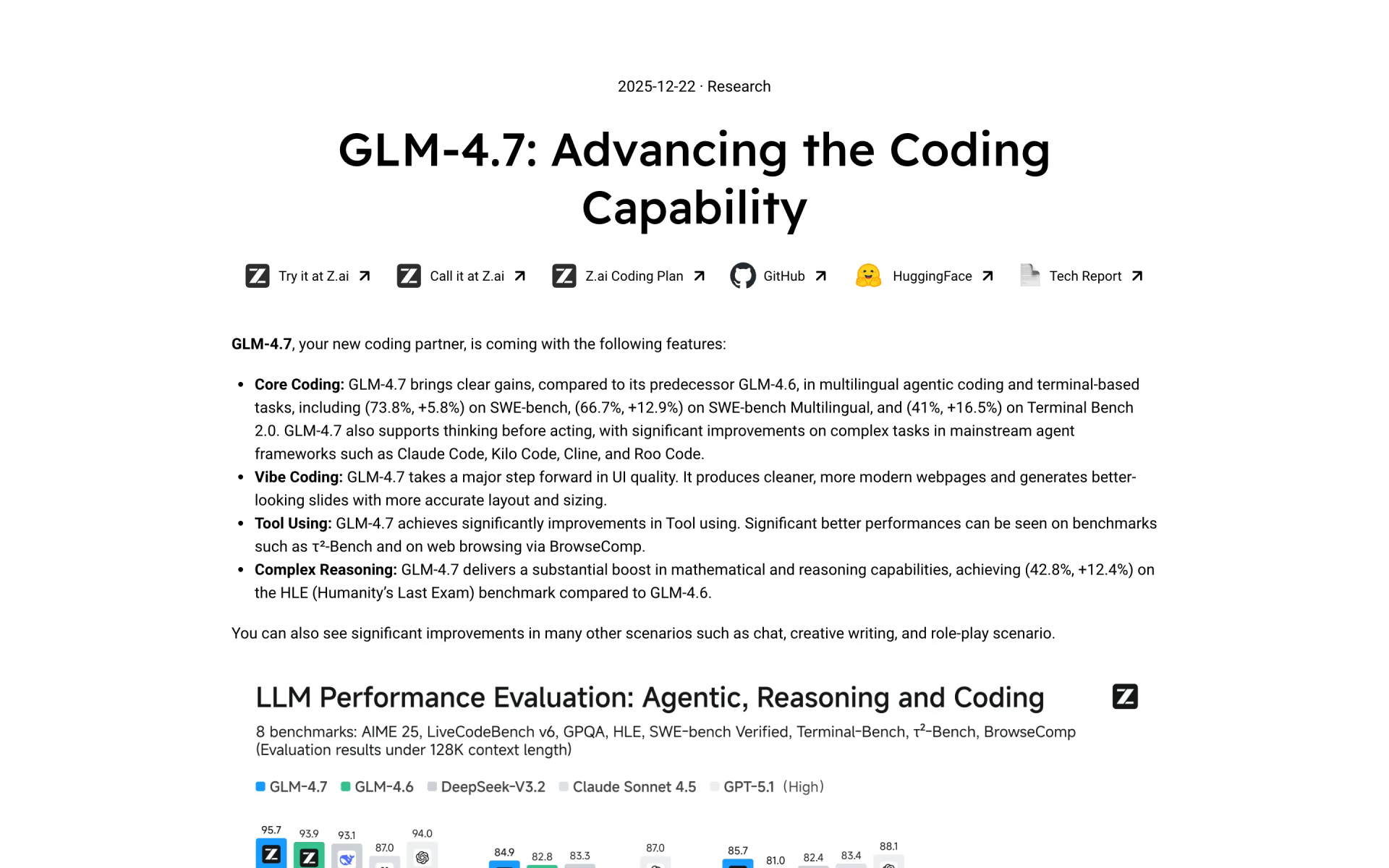
GLM-4.7 is a mixture-of-experts model from Z.ai with 355B parameters, 32B of them active per token, released under the MIT license. It reads and writes text only, works across a 200K-token context with up to 128K tokens of output, and thinks before each reply and tool call. Z.ai tuned it for coding agents such as Claude Code, Cline and Roo Code, and for cleaner web pages and slides than GLM-4.6.
It is no longer Z.ai's current model. The API still serves it, but the GLM Coding Plan now runs GLM-4.7 requests on GLM-5.3-Flash, which costs less and also reads images and video.
Is GLM-4.7 still available?
Yes on Z.ai's API and as open weights, but Z.ai's own chat app and Coding Plan have moved to newer models.
- Z.ai API
- Still listed at $0.6 / $2.2 per million tokens under the model ID glm-4.7, with GLM-4.7-Flash still free.
- GLM Coding Plan
- Requests for GLM-4.7 now run on GLM-5.3-Flash instead.
- Z.ai chat
- The public model picker now offers GLM-5.3-Flash, GLM-5.3 and GLM-5.2 instead.
- Open weights
- Still on Hugging Face and ModelScope under the MIT license.
Who is GLM-4.7 best for?
GLM-4.7 is best for developers who want a mid-priced or self-hosted coding model with tidy front-end output, or a free API model through the lighter GLM-4.7-Flash.
Front-end pages and slides
Z.ai tuned it for cleaner, more modern web pages and better-laid-out slides than GLM-4.6, and users singled out its UI output.
Multi-step agent tasks
It thinks before each reply and tool call and can keep its reasoning across turns, which helps coding agents stay consistent.
Free API experiments
GLM-4.7-Flash, the free version of the series, costs nothing per token on Z.ai's API, including output and caching.
Self-hosting
The weights are on Hugging Face and ModelScope under the MIT license and run on vLLM, SGLang or Transformers; the 30B Flash version fits on one H100.
What's included with GLM-4.7?
Three thinking modes for agent work, three model sizes including a free Flash, the usual API tools, and MIT-licensed weights.
- Interleaved thinking
- The model reasons before every answer and every tool call, which Z.ai says improves instruction following in agents.
- Preserved thinking
- In coding agents it keeps earlier reasoning blocks across turns instead of working things out again, which also raises cache hits.
- Turn-level thinking
- You can switch reasoning off for quick requests and back on for hard ones within the same session.
- Three sizes
- GLM-4.7, the faster GLM-4.7-FlashX and the free GLM-4.7-Flash, all with a 200K context and text-only input.
- Standard API tools
- Function calling, streaming, JSON structured output and context caching on Z.ai's OpenAI-style API.
- Open weights
- BF16 and FP8 weights on Hugging Face and ModelScope, with the model code already in vLLM, SGLang and Transformers.
What changed from GLM-4.6?
Mostly coding and reasoning scores, plus finer control over thinking; the price per token stayed the same.
- Coding
- 73.8% on SWE-bench Verified and 41% on Terminal Bench 2.0 in Z.ai's tests, up 5.8 and 16.5 points.
- Reasoning
- 42.8% on Humanity's Last Exam with tools, up from 30.4%.
- Thinking
- Adds preserved thinking across turns and per-turn on and off control.
- Slides
- Z.ai says slides fit a 16:9 layout 91% of the time, up from 52%.
- Price
- The same $0.6 / $2.2 per million tokens as GLM-4.6 on Z.ai's API.
How much does GLM-4.7 cost?
GLM-4.7 costs $0.6 per million input tokens and $2.2 per million output tokens on Z.ai's API, its lighter GLM-4.7-Flash is free there, and the MIT-licensed weights are free to download.
- Free input, output and caching
- Lighter 30B model with 3B active
- 200K-token context, up to 128K tokens out
- Cached input $0.01 per million tokens
- Lightweight and faster
- 200K-token context
- Cached input $0.11 per million tokens
- 200K-token context, up to 128K tokens out
- Text input only
Prices are in US dollars. The MIT-licensed weights are free to download and run on your own hardware. The GLM Coding Plan (from $18 a month) no longer runs GLM-4.7: it sends GLM-4.7 requests to GLM-5.3-Flash, a newer multimodal model that costs $0.15 / $0.50 per million tokens on the API. Full pricing on docs.z.ai. We checked these prices on .
How do readers rate GLM-4.7?
No one has rated GLM-4.7 yet. Be the first.
Sign in to rate. One rating per account.
GLM-4.7 pros and cons
It is cheap, open and good at front-end work, but it trails Claude-class models on complex code and Z.ai's newer GLM-5.3-Flash now does more for less.
Pros
- Users who run it in Claude Code or OpenCode put it close to Claude Sonnet 4.5 for routine implementation work, and many call it strong value for the price.
- Front-end output is a clear step up from GLM-4.6: users praise its web pages and one-shot UI demos, and Z.ai says slides now fit a 16:9 layout 91% of the time, up from 52%.
- Open MIT weights plus a free GLM-4.7-Flash, which several local users found reliable at chained tool calls once an early llama.cpp looping bug was fixed.
Cons
- Trails Claude Opus and GPT-5-class models on complex backend and architecture work; several users say it makes poor design choices or drifts from instructions unless tasks are small and well planned.
- The full model is hard to self-host: all 355B parameters must sit in memory, and users found Macs and single-GPU rigs too slow for agentic coding.
- Text only with a 200K context, while Z.ai's newer GLM-5.3-Flash reads images and video, holds 1M tokens and costs less per token.
- Some users found it slow on Z.ai's own service, partly because it spends many tokens thinking before it acts.
Is GLM-4.7 open source?
Yes. GLM-4.7's code is public under the MIT licence, so you can run it on your own server.
What are the best GLM-4.7 alternatives?
GLM-4.7 is an open source alternative to MiniMax M2.1, GPT-5.3-Codex and Claude Sonnet 5. Qwen3-Coder-Next, Command A+ and Laguna S 2.1 do the same job and are open source too.
 MiniMax M2.1Free
MiniMax's open-weight coding model tuned for Rust, Java, Go, C++, Kotlin and mobile app work.
 GPT-5.3-CodexPaid
OpenAI's agentic coding model with reasoning levels.
 Claude Sonnet 5Free
Anthropic's Sonnet 5 with a 1M context, at $2 and $10 per million tokens.
 Qwen3-Coder-NextOpen Source
Choose it when you want to self-host on less hardware: it has 80B parameters with 3B active, against GLM-4.7's 355B, a 262K context and an Apache 2.0 license.
 Command A+Open Source
Cohere's open multimodal reasoning model for enterprise agents.
 Laguna S 2.1Open Source
Poolside's 118B open-weight coding model with 8B active parameters and a 1M context.
Questions about GLM-4.7
What is GLM-4.7?
GLM-4.7 is Z.ai's open-weight model for agentic coding, still sold on Z.ai's API and free to download, though Z.ai's own chat app and Coding Plan have moved to newer GLM-5 models.
Who is GLM-4.7 for?
GLM-4.7 is best for developers who want a mid-priced or self-hosted coding model with tidy front-end output, or a free API model through the lighter GLM-4.7-Flash.
Is GLM-4.7 free?
Partly. GLM-4.7's weights are free on Hugging Face under the MIT license, and the lighter GLM-4.7-Flash is free on Z.ai's API, including output and caching. The full GLM-4.7 on the API costs $0.6 per million input tokens and $2.2 per million output tokens.
How much does GLM-4.7 cost?
GLM-4.7's paid plans are GLM-4.7-FlashX at $0.07 / $0.4 per million input / output tokens and GLM-4.7 at $0.6 / $2.2 per million input / output tokens.
Is GLM-4.7 open source?
Yes. GLM-4.7's code is public under the MIT licence, so you can run it on your own server.
What are the best GLM-4.7 alternatives?
The closest alternatives on Recaply are MiniMax M2.1, GPT-5.3-Codex, Claude Sonnet 5, Qwen3-Coder-Next, Command A+ and Laguna S 2.1.
Where can I try GLM-4.7?
On its official website, z.ai.
Can I still use GLM-4.7 on the GLM Coding Plan?
Not directly. The GLM Coding Plan now sends GLM-4.7 requests to GLM-5.3-Flash, a newer multimodal model. To run GLM-4.7 itself, call it through Z.ai's API at $0.6 / $2.2 per million tokens or host the open weights yourself.
Can I run GLM-4.7 on my own computer?
The Flash version, yes; the full model, rarely. GLM-4.7 has 355B parameters with 32B active and needs a multi-GPU server. GLM-4.7-Flash has 30B parameters with 3B active, and Z.ai lists a single H100 as its minimum at full BF16 precision.
Does Z.ai keep my prompts when I use GLM-4.7 through the API?
No, by its own terms. Z.ai's data processing addendum for API customers says it does not store the text you send or the output you get; requests are processed in real time, generally in Singapore.
Our verdict
GLM-4.7 was a good cheap open coding model, but most people should now pick GLM-5.3-Flash instead.
Z.ai's newer Flash model costs less per token, reads images and video, holds five times the context, and has already replaced GLM-4.7 on Z.ai's own Coding Plan.
- Skip it for
- Anyone starting fresh on Z.ai's API or Coding Plan.
- Check first
- If you self-host, check you have server-class GPU memory for 355B parameters, or start with the free GLM-4.7-Flash.
 Composer 2.5
 MiMo-V2.5-Pro
 Kimi K2.7 Code
 Chroma Context-1

 GLM-5.1

 GLM-5.3