
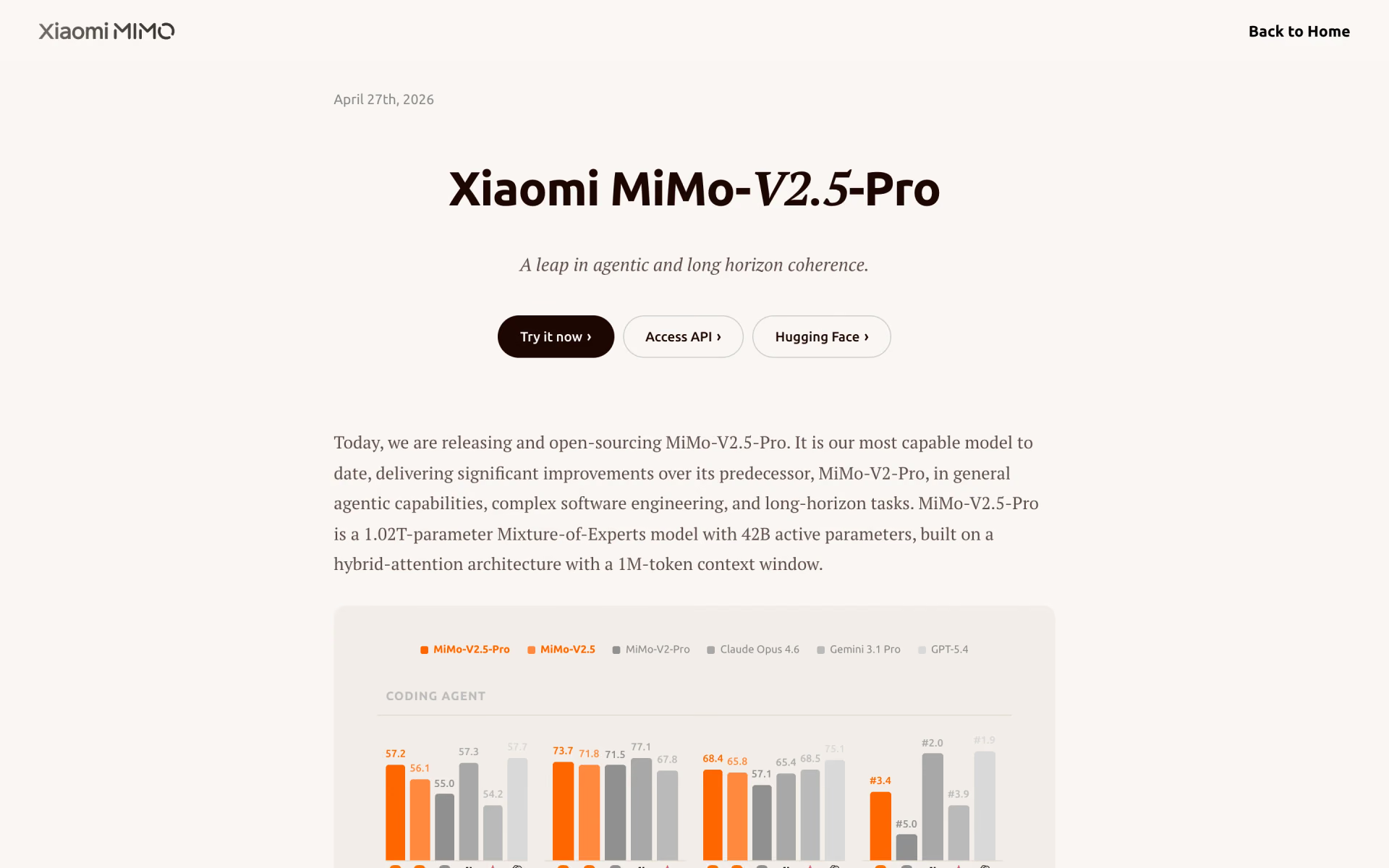
What is MiMo-V2.5-Pro?
MiMo-V2.5-Pro is a mixture-of-experts model with 1.02T parameters, 42B of them active per token, built for agentic coding and tasks that run for hours. Xiaomi reports it can keep going through more than a thousand tool calls with a suitable harness, and its hybrid attention cuts long-context cache memory by nearly seven times.
It is now a legacy model. Xiaomi released MiMo-V2.6-Pro at the same API price, is removing mimo-v2.5-pro from its API and Token Plan with no automatic switch, and says even the cheaper MiMo-V2.6-Flash now beats it. The MIT-licensed weights stay on Hugging Face.
What changed in MiMo-V2.6-Pro?
More capability at the same price: MiMo-V2.6-Pro keeps V2.5-Pro's per-token rates, adds native multimodal input and batch jobs, and is open-sourced too.
- Price
- The same $0.435 / $0.87 per million tokens on the API, and the same Token Plan credits per token.
- Modalities
- The V2.6 series is natively multimodal, reading images, video and audio as well as text.
- Batch jobs
- MiMo-V2.6-Pro supports the Batch API at half price; MiMo-V2.5-Pro does not.
- Speed option
- An UltraSpeed version of V2.6-Pro runs up to 20 times faster, at $4.35 / $8.70 per million tokens.
- Open weights
- Xiaomi released V2.6-Pro and V2.6-Flash weights and a technical report, like V2.5-Pro before them.
Who is MiMo-V2.5-Pro best for?
MiMo-V2.5-Pro is best for teams that want to self-host an MIT-licensed model for long agentic coding runs and very long inputs, and have the GPUs for a 1.02T-parameter model.
Long agent runs
Xiaomi reports it can keep going through tasks of more than a thousand tool calls when paired with a suitable harness.
Very long inputs
A 1M-token context window holds large codebases, long documents or a long agent history in one request.
Self-hosting under a simple license
The MIT-licensed weights come with SGLang and vLLM guides, so teams with enough GPUs can run it on their own servers and keep this exact version.
Token-conscious coding agents
Xiaomi measures about 70K tokens per ClawEval task, 40 to 60% fewer than Claude Opus 4.6, Gemini 3.1 Pro and GPT-5.4 at similar scores.
What's included with MiMo-V2.5-Pro?
A 1M-token context, faster multi-token output, thinking and tool calls on the API, support in the main coding agents, and open weights that include a base model.
- 1M-token context
- Hybrid sliding-window attention keeps long inputs affordable, and Xiaomi's GraphWalks tests show it still working at 1M tokens where MiMo-V2-Pro failed past 128K.
- Multi-token prediction
- Three built-in prediction layers roughly triple output speed, by Xiaomi's measure.
- Thinking and tool calls
- On Xiaomi's API it supports deep thinking, function calling, structured output, streaming and web search.
- Works in coding agents
- Xiaomi invites developers to run it in scaffolds such as Claude Code, OpenCode and Kilo.
- Open weights and a base model
- The MIT release includes MiMo-V2.5-Pro-Base with a 256K context, plus SGLang and vLLM deployment guides.
How much does MiMo-V2.5-Pro cost?
MiMo-V2.5-Pro's weights are free under the MIT license; Xiaomi's API charges $0.435 per million input tokens and $0.87 per million output tokens until it retires the model, the same as MiMo-V2.6-Pro.
- MIT license, weights and tokenizer on Hugging Face
- Base model also released, with a 256K context
- Deployment guides for SGLang and vLLM
- Cache hits $0.0036 per million input tokens
- No batch API for this model
- Being retired, with no automatic switch
- 4.1 billion credits a month
- 300 credits per input token, 600 per output token
- Individual plans only, until the model is retired
Token Plan Standard, Pro and Max cost $16, $50 and $100 a month, and yearly billing is 12% cheaper. MiMo-V2.6-Pro costs the same per token and in plan credits. These are Xiaomi's overseas prices in US dollars; mainland China prices are in yuan. Full pricing on mimo.mi.com. We checked these prices on .
How do readers rate MiMo-V2.5-Pro?
No one has rated MiMo-V2.5-Pro yet. Be the first.
Sign in to rate. One rating per account.
MiMo-V2.5-Pro pros and cons
It was a cheap, capable open model for long coding runs, but Xiaomi is retiring it from its API, its successor costs the same, and self-hosting needs a GPU cluster.
Pros
- Cheap through Xiaomi's API: users point to bills far below Claude's for similar coding work, helped by cached input at $0.0036 per million tokens.
- Users rate it among the strongest open-weight models for agentic coding, and several say it works through long OpenCode, Cline and Claude Code sessions without getting stuck.
- MIT-licensed weights let companies host it themselves for privacy, or keep this exact version running after the API retires it.
- By Xiaomi's measure it uses 40 to 60% fewer tokens per ClawEval task than Claude Opus 4.6, Gemini 3.1 Pro and GPT-5.4 at similar scores.
Cons
- Xiaomi is removing it from its API and Token Plan with no automatic switch, so calls to mimo-v2.5-pro will fail unless you move to MiMo-V2.6-Pro or host it yourself.
- Self-hosting needs data-center hardware: Xiaomi's own SGLang example spreads it across 16 GPUs, and Reddit users conclude the API is far cheaper unless privacy forces you local.
- Tool use is uneven: some developers saw it ignore a custom harness's tool-call format for its own syntax or fail multi-step orchestration in Claude Code, and one found the smaller MiMo-V2.5 better with tools.
- Newer models beat it for the same money or less: Xiaomi says MiMo-V2.6-Flash, at $0.14 / $0.28 per million tokens, outperforms it across the board.
Is MiMo-V2.5-Pro open source?
Yes. MiMo-V2.5-Pro's code is public under the MIT licence, so you can run it on your own server.
What are the best MiMo-V2.5-Pro alternatives?
MiMo-V2.5-Pro is an open source alternative to Grok 4.3.
 Grok 4.3Paid
xAI's fast multimodal API model with a 1M-token context and configurable reasoning.
 Laguna S 2.1Open Source
Choose it when you want an open coding model you can host on one machine: it has 118B parameters to MiMo-V2.5-Pro's 1.02T and fits on a single NVIDIA DGX Spark.
 DeepSeek V4.1 FlashOpen Source
Choose it when you want a cheap API model that is not being retired: it keeps a 1M context, reads images, and costs $0.30 / $1.20 per million tokens at peak, half that off-peak.
 GLM-5.3Free
Choose it when you want a flat monthly price for agentic coding: Z.ai's GLM Coding Plan starts at $18 a month, and its weights are open too.
Questions about MiMo-V2.5-Pro
What is MiMo-V2.5-Pro?
MiMo-V2.5-Pro is Xiaomi's open-weight model for long agentic coding runs, with 1.02T parameters, a 1M-token context and MIT-licensed weights; Xiaomi is now retiring it from its API.
Who is MiMo-V2.5-Pro for?
MiMo-V2.5-Pro is best for teams that want to self-host an MIT-licensed model for long agentic coding runs and very long inputs, and have the GPUs for a 1.02T-parameter model.
Is MiMo-V2.5-Pro free?
Yes. MiMo-V2.5-Pro has a free Open weights plan: MIT license, weights and tokenizer on Hugging Face.
How much does MiMo-V2.5-Pro cost?
MiMo-V2.5-Pro's paid plans are Pay-as-you-go API at $0.435 / $0.87 per million input / output tokens and Token Plan Lite at $6 per month.
Is MiMo-V2.5-Pro open source?
Yes. MiMo-V2.5-Pro's code is public under the MIT licence, so you can run it on your own server.
What are the best MiMo-V2.5-Pro alternatives?
The closest alternatives on Recaply are Grok 4.3, Laguna S 2.1, DeepSeek V4.1 Flash and GLM-5.3.
Where can I try MiMo-V2.5-Pro?
On its official website, mimo.xiaomi.com.
Can I still use MiMo-V2.5-Pro through Xiaomi's API?
Not for long. Xiaomi has announced it is removing mimo-v2.5-pro from its API and Token Plan with no automatic switch, so requests using that name will fail once it goes. MiMo-V2.6-Pro costs the same, and the MIT-licensed weights stay on Hugging Face.
Can I run MiMo-V2.5-Pro locally?
Only with serious hardware. It has 1.02T parameters stored in FP8, and Xiaomi's SGLang example runs it across 16 GPUs with a 1M-token context. For most teams the API, or a smaller open model such as Laguna S 2.1, costs far less.
Can I use MiMo-V2.5-Pro for commercial work?
Yes. The weights are released under the MIT license, which allows commercial use, changes and redistribution as long as the license notice stays with them. Using Xiaomi's API is paid and follows Xiaomi's own terms.
Is MiMo-V2.5-Pro the same as MiMo-V2.5?
No. MiMo-V2.5 is the smaller sibling, with 310B parameters and 15B active, and it reads images, video and audio as well as text. MiMo-V2.5-Pro is the larger model built for the hardest agentic and coding work. Xiaomi is retiring both from its API.
Does MiMo-V2.5-Pro work with Claude Code?
Yes. Xiaomi invites developers to run it in Claude Code, OpenCode and Kilo, and its Token Plan works with Claude Code, OpenCode and OpenClaw. Point the tool at Xiaomi's API with the model name mimo-v2.5-pro until that name is retired, or at your own server.
Our verdict
MiMo-V2.5-Pro was a cheap, capable open model for long coding runs, but new work should start on MiMo-V2.6-Pro.
Xiaomi is retiring it from its API with no automatic switch, sells MiMo-V2.6-Pro at the same price, and says even the cheaper V2.6-Flash now beats it.
- Skip it for
- Any new API integration; call mimo-v2.6-pro instead.
- Check first
- Search your code for the mimo-v2.5-pro model name and switch it before Xiaomi removes the model.
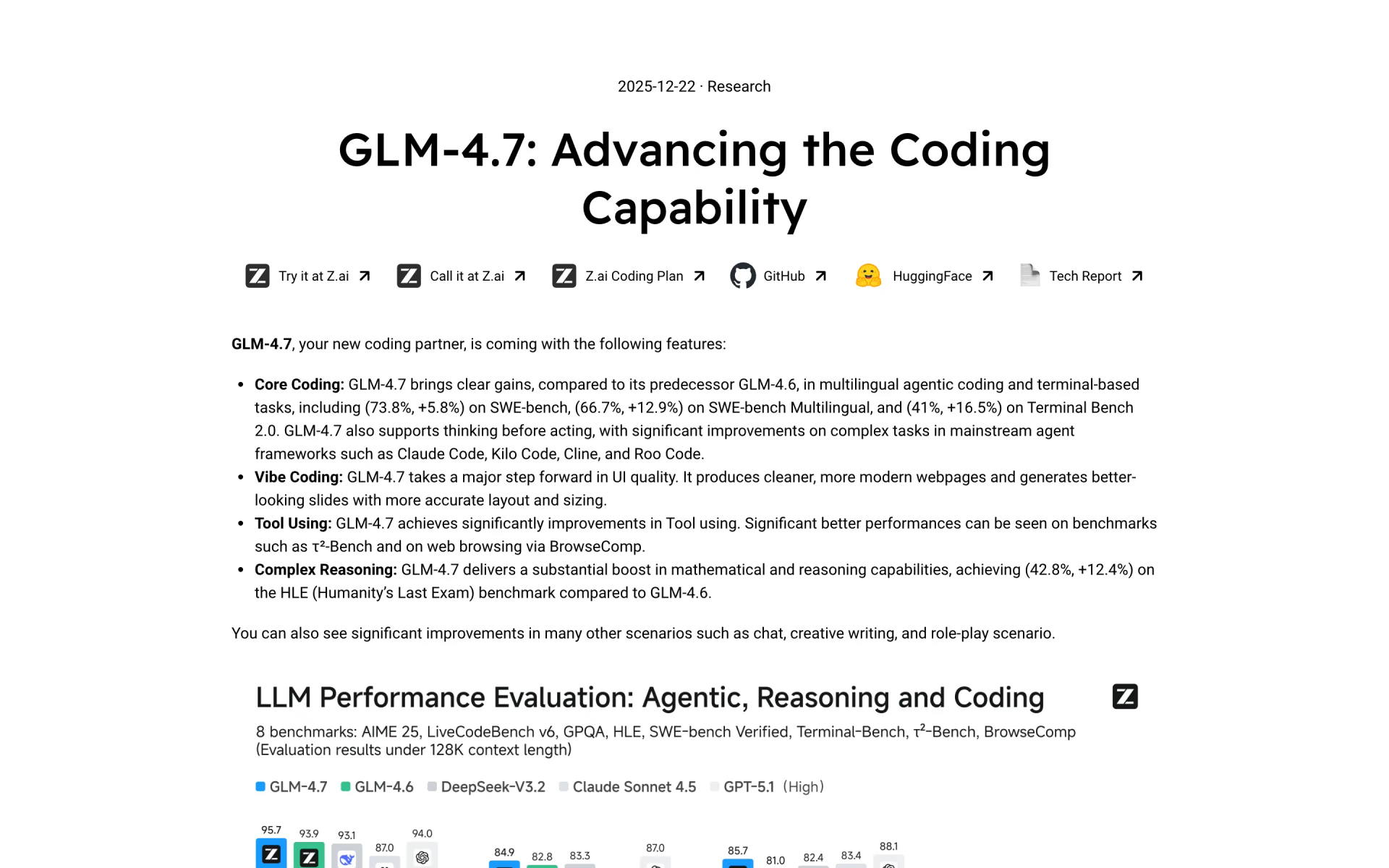
 GLM-4.7
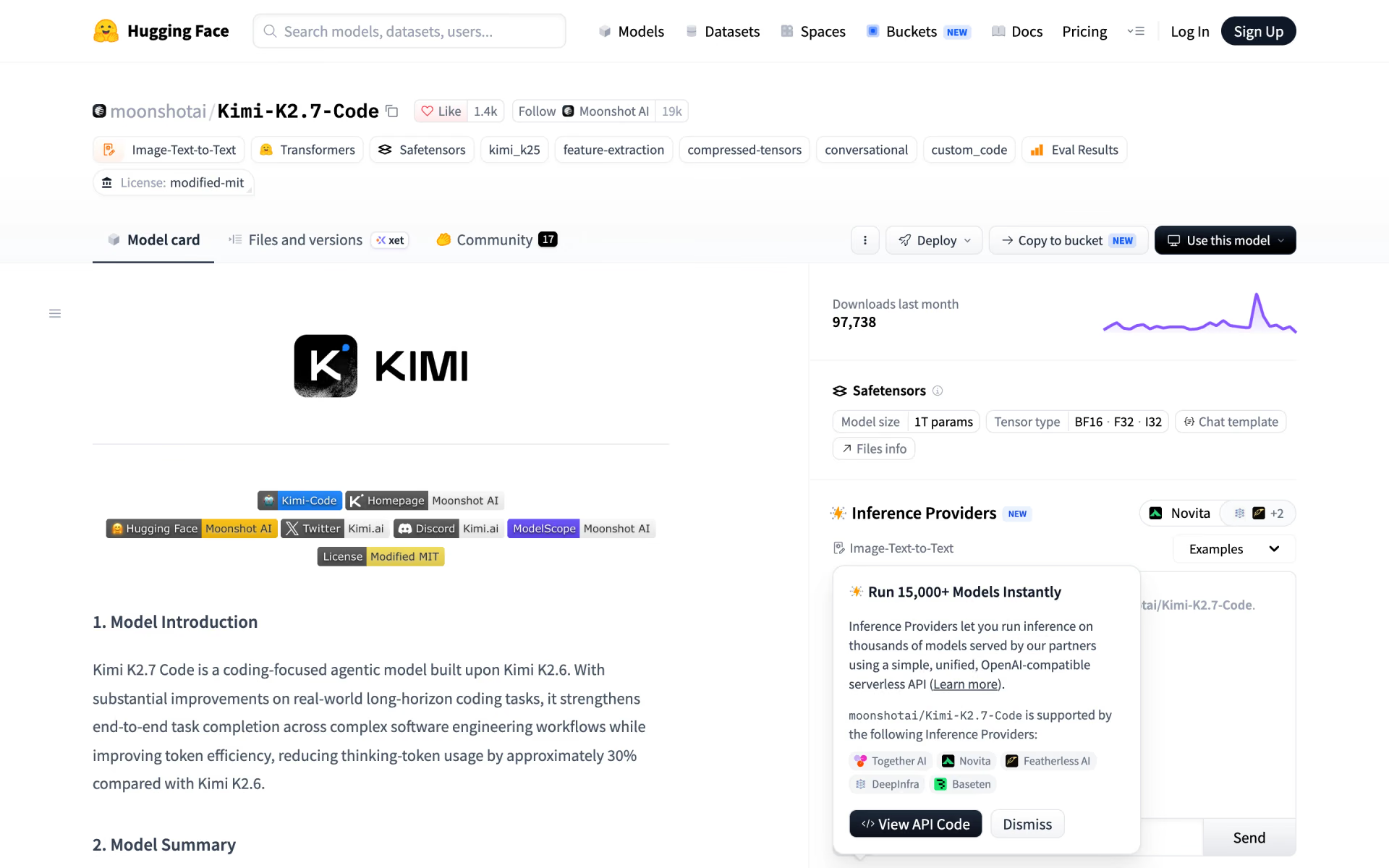
 Kimi K2.7 Code

 GLM-5.1
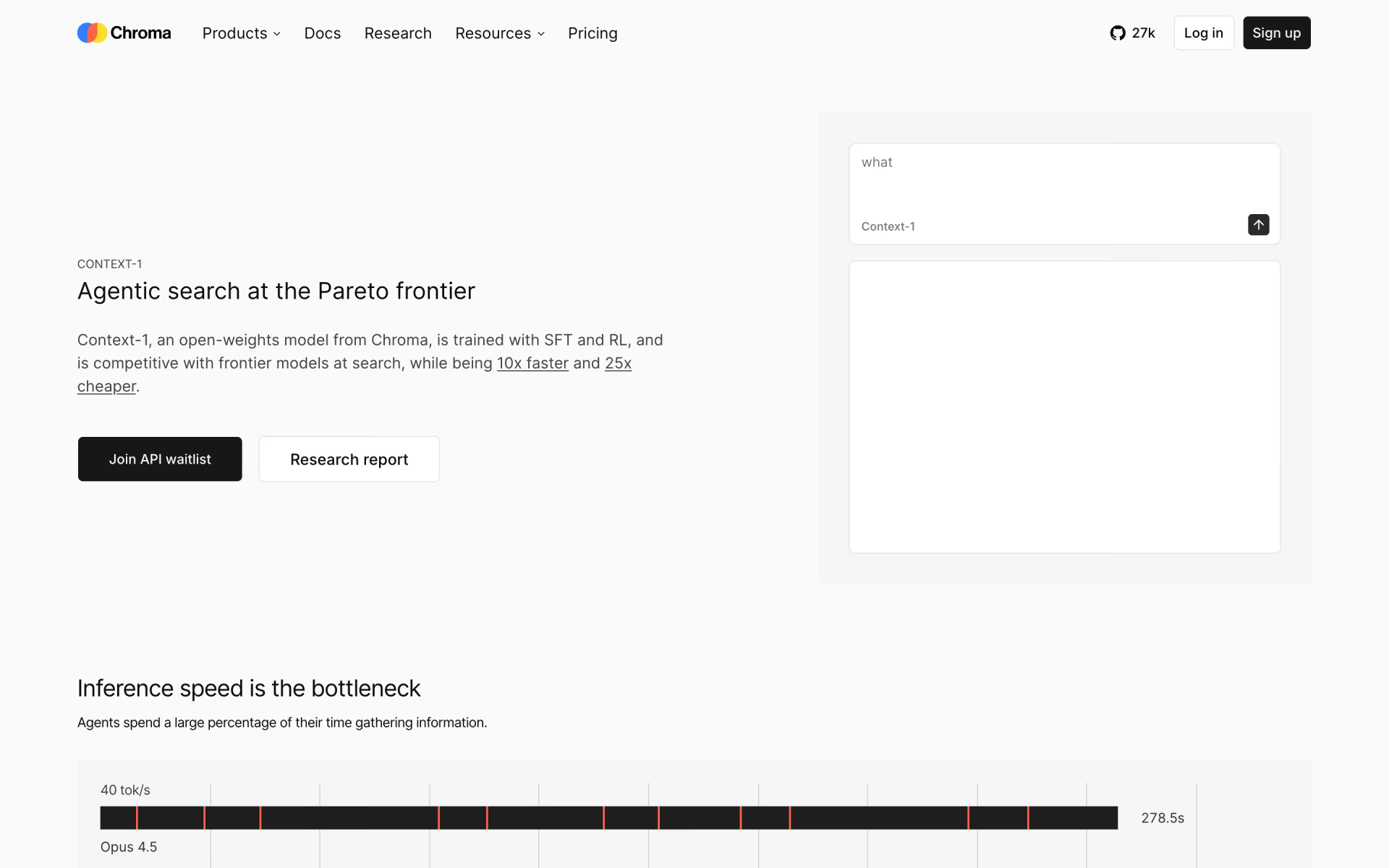
 Chroma Context-1
 NousCoder-14B
 Rnj-1