
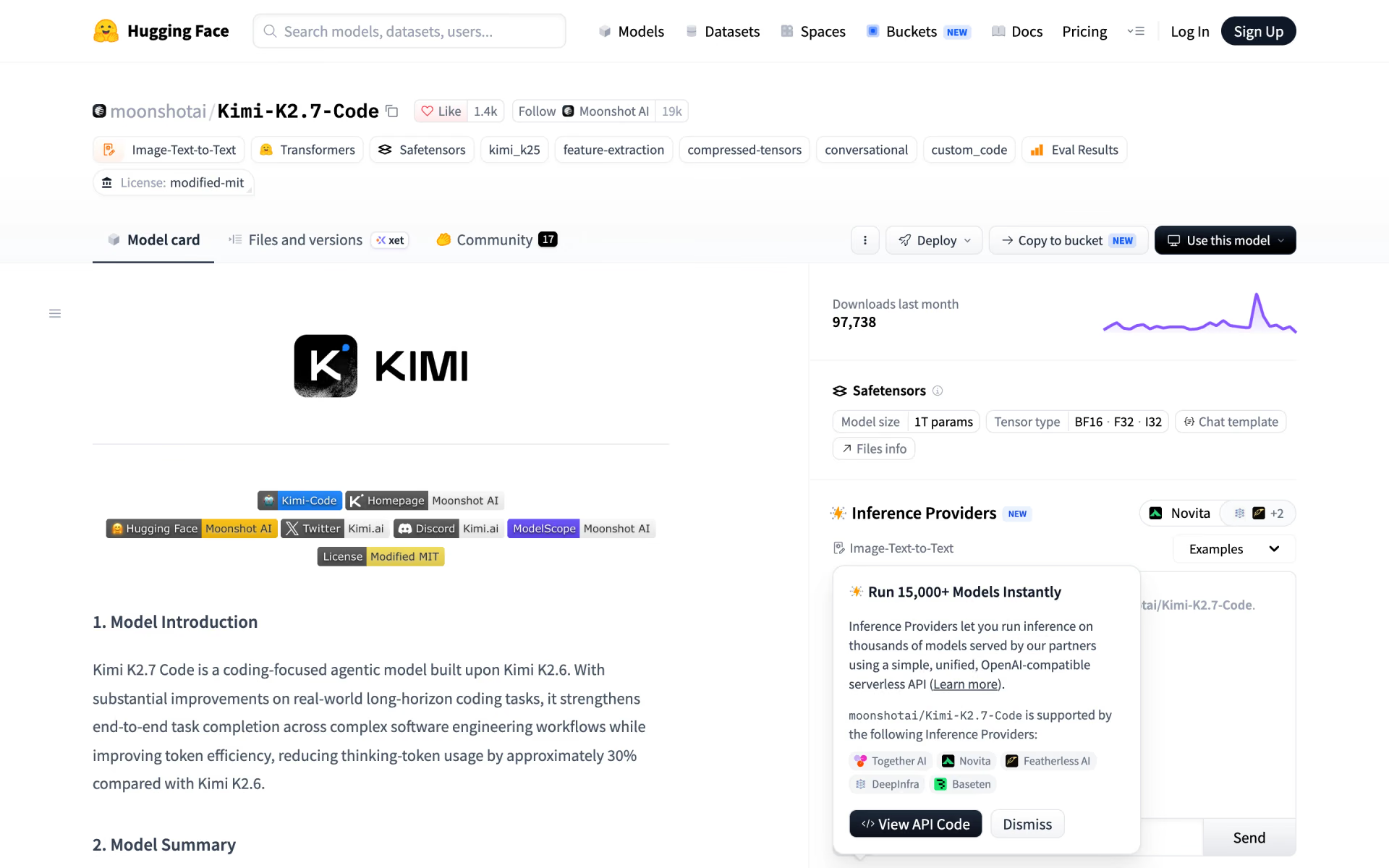
What is Kimi K2.7 Code?
Kimi K2.7 Code is Moonshot AI's coding version of Kimi K2.6: a mixture-of-experts model with 1 trillion parameters, 32B active per token, and a 256K-token context. It reads text, images and video, always thinks before it answers, and handles multi-step tool calls. Moonshot says it finishes long coding tasks more often than K2.6 with about 30% fewer thinking tokens, though its own table still puts it behind GPT-5.5 and Claude Opus 4.8.
The weights are free under a modified MIT licence; the hosted API is paid. It is no longer Moonshot's newest coding model: Kimi Code now defaults to K2.8 Preview, and Kimi K3 is the flagship.
Is Kimi K2.7 Code still available?
Yes on Moonshot's API and as open weights, but Moonshot has moved on: Kimi Code now defaults to K2.8 Preview, and Kimi K3 is the flagship.
- Kimi API
- kimi-k2.7-code and its HighSpeed version are current API models and are not on Moonshot's deprecated list.
- Kimi Code
- Only the HighSpeed version remains, on the Pro plan and above; K2.8 Preview replaced it as the default coding model.
- Open weights
- Still on Hugging Face under the modified MIT licence.
- GitHub Copilot
- GitHub has put it on its retirement list and suggests Kimi K3 instead.
Who is Kimi K2.7 Code best for?
Kimi K2.7 Code is best for developers and teams who want an open-weight model for long, multi-step coding agent work, either through Moonshot's API or on their own GPUs.
Long coding jobs
Moonshot tuned it for long, multi-step software tasks, and says it uses about 30% fewer thinking tokens than Kimi K2.6.
Coding agents that call tools
It handles multi-step tool calls, image and video input and a 256K-token context, through APIs that match OpenAI's and Anthropic's formats.
Teams that self-host
The weights run on vLLM, SGLang or KTransformers, so a team with enough GPUs can keep the model on its own servers.
Fast turnaround
The HighSpeed version is the same model at about 180 output tokens a second, for twice the standard price.
What's included with Kimi K2.7 Code?
Always-on thinking that carries across turns, multi-step tool calls, image and video input, OpenAI- and Anthropic-style APIs, cheap cached and batch rates, and a HighSpeed version.
- Thinking that carries over
- Thinking is always on, and the model keeps its earlier reasoning across turns, which Moonshot says helps in coding agents.
- Multi-step tool calls
- It mixes thinking with tool calls, so it can plan, call a tool, read the result and carry on in one run.
- Image and video input
- A 400M-parameter vision encoder reads screenshots and images; video input is experimental and only on Moonshot's own API.
- OpenAI- and Anthropic-style APIs
- Moonshot's API accepts both formats, and its own guide shows how to plug the model into Claude Code.
- Cheap cached and batch work
- Repeated context costs $0.19 per million tokens on a cache hit, and Batch API jobs cost 60% of the standard rate.
- HighSpeed version
- The same model at about 180 output tokens a second, up to 260 on short prompts, for twice the price.
How much does Kimi K2.7 Code cost?
Kimi K2.7 Code's weights are free to download, and Moonshot's API costs $0.95 per million input tokens and $4 per million output tokens, or $1.90 / $8 for the HighSpeed version.
- Modified MIT licence
- About 595 GB of weights; runs on vLLM, SGLang or KTransformers
- Cache hits $0.19 per million input tokens
- Batch API at 60% of the standard rate
- 262,144-token context window
- Cache hits $0.38 per million input tokens
- About 180 tokens a second, up to 260 on short prompts
- K2.7 Code HighSpeed, which uses quota three times as fast
- Also Kimi K3 and K2.8 Preview, in terminal, desktop and IDE
Batch jobs cost $0.57 / $2.40 per million tokens ($0.114 on a cache hit). The API needs a top-up of at least $1 before first use, and prices exclude tax. Kimi Code Pro is $31 a month billed yearly; the $19 Plus plan does not include K2.7 Code HighSpeed, and standard K2.7 Code is no longer offered in Kimi Code. Full pricing on platform.kimi.ai. We checked these prices on .
How do readers rate Kimi K2.7 Code?
No one has rated Kimi K2.7 Code yet. Be the first.
Sign in to rate. One rating per account.
Kimi K2.7 Code pros and cons
It is cheap, open and clearly better than K2.6, but it trails GPT-5.5 and Claude Opus 4.8, and running it yourself needs data-centre hardware.
Pros
- Costs a fraction of the closed models it is measured against, $0.95 / $4 per million tokens against $5 / $30 for GPT-5.5, and Hacker News users call it good value for the price.
- Open weights under a modified MIT licence mean you are not tied to Moonshot: users run it through other hosts such as Fireworks and Synthetic, or on their own hardware.
- A clear step up from K2.6 on fewer thinking tokens in Moonshot's tests: 62.0 against 50.9 on Kimi Code Bench v2, and 81.1 against 72.8 on MCP Mark Verified, where it also beats Claude Opus 4.8's 76.4.
Cons
- It trails the closed frontier models in Moonshot's own table, behind GPT-5.5 on all six benchmarks and Claude Opus 4.8 on five, and Hacker News users say the gap feels larger in daily use.
- Self-hosting needs data-centre hardware: the weights alone are about 595 GB, and Reddit users running compressed builds call it out of reach at home.
- Hacker News users flag its cache-hit price of $0.19 per million tokens as far above some rival open models, which matters because cached context is most of an agent's bill.
- Thinking cannot be turned off and the context stops at 256K, a quarter of Kimi K3's; some users also say Kimi models drift off track outside Kimi's own CLI.
What are the best Kimi K2.7 Code alternatives?
Three tools on Recaply do Kimi K2.7 Code's job. Qwen3-Coder-Next is open source, so you can run it on your own server.
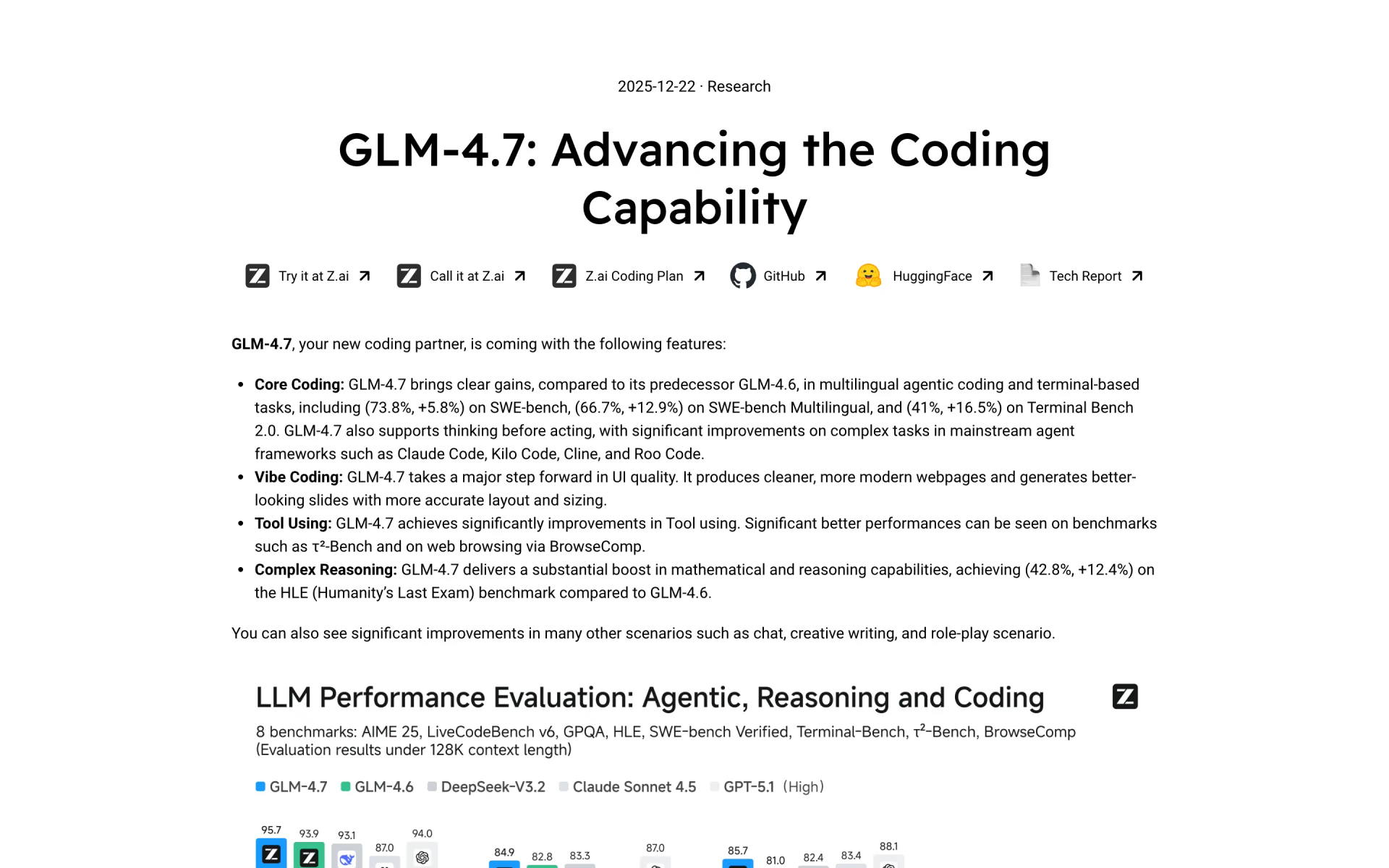
 GLM-5.3Free
Choose it when you need a 1M-token context, about four times Kimi K2.7 Code's, and only send text; Z.ai charges $1.40 / $4.40 per million tokens and also publishes the weights.
 Qwen3-Coder-NextOpen Source
Choose it when you want to self-host on far less hardware: it has 80B parameters with 3B active, a 256K context and an Apache 2.0 licence.
 GPT-5.5Paid
Choose it when quality matters more than price: it leads Kimi K2.7 Code on all six benchmarks in Moonshot's own table, at $5 / $30 per million tokens.
Questions about Kimi K2.7 Code
What is Kimi K2.7 Code?
Kimi K2.7 Code is Moonshot AI's open-weight coding model, tuned from Kimi K2.6 for long agent tasks, with a 256K-token context and an API at $0.95 / $4 per million tokens.
Who is Kimi K2.7 Code for?
Kimi K2.7 Code is best for developers and teams who want an open-weight model for long, multi-step coding agent work, either through Moonshot's API or on their own GPUs.
Is Kimi K2.7 Code free?
Kimi K2.7 Code's weights are free to download under a modified MIT licence, but a model of about 1 trillion parameters needs serious GPU hardware. Moonshot's hosted API is paid, at $0.95 per million input tokens and $4 per million output tokens after a $1 minimum top-up.
How much does Kimi K2.7 Code cost?
Kimi K2.7 Code's paid plans are Kimi API at $0.95 / $4 per million input / output tokens, Kimi API HighSpeed at $1.90 / $8 per million input / output tokens and Kimi Code Pro at $39 per month.
Is there an open source alternative to Kimi K2.7 Code?
Yes. Qwen3-Coder-Next is an open source tool that does the same job, so you can run your own.
What are the best Kimi K2.7 Code alternatives?
The closest alternatives on Recaply are GLM-5.3, Qwen3-Coder-Next and GPT-5.5.
Where can I try Kimi K2.7 Code?
On its official website, huggingface.co.
How does Kimi K2.7 Code differ from Kimi K2.6?
Kimi K2.7 Code is a coding version built on Kimi K2.6 that Moonshot says finishes long coding tasks more often with about 30% fewer thinking tokens. It always thinks before answering, while K2.6 also has a non-thinking mode. Both cost $0.95 per million input and $4 per million output tokens.
Kimi K2.7 Code vs Kimi K3: which should I use?
Kimi K3 for the hardest work: it is Moonshot's most capable model, with 2.8 trillion parameters and a 1M-token context, at $3 / $15 per million tokens. K2.7 Code costs less than a third as much, and Moonshot's own Claude Code guide pairs it with K3 as the Haiku-tier model.
Can I use Kimi K2.7 Code in Claude Code?
Yes. Moonshot's API has an Anthropic-compatible endpoint, and its Claude Code guide sets kimi-k2.7-code as the Haiku-tier model in its example setup. Turn thinking on first: with thinking off, the API rejects K2.7 Code requests with an invalid thinking error.
What hardware do I need to run Kimi K2.7 Code myself?
A lot. The weights are about 595 GB on Hugging Face, already in native INT4, for a model with 1 trillion parameters and 32B active. Moonshot recommends vLLM, SGLang or KTransformers, and the setup is the same as for Kimi K2.5 and K2.6.
Our verdict
Kimi K2.7 Code is a good-value open coding model, but Moonshot's own tools have already moved on to K2.8 Preview and K3.
It clearly beats Kimi K2.6 with fewer thinking tokens and costs a fraction of GPT-5.5, yet it trails GPT-5.5 and Claude Opus 4.8 in Moonshot's own table.
- Skip it for
- Work that needs more than 256K of context, answers without thinking, or the best quality at any price.
- Check first
- Compare its $0.19 cache-hit price with rival APIs before you run long agent loops on it.
 North Mini Code
 GPT-5.3-Codex
 Chroma Context-1
 GLM-4.7
 MiMo-V2.5-Pro
 KAT-Coder-Pro V2