
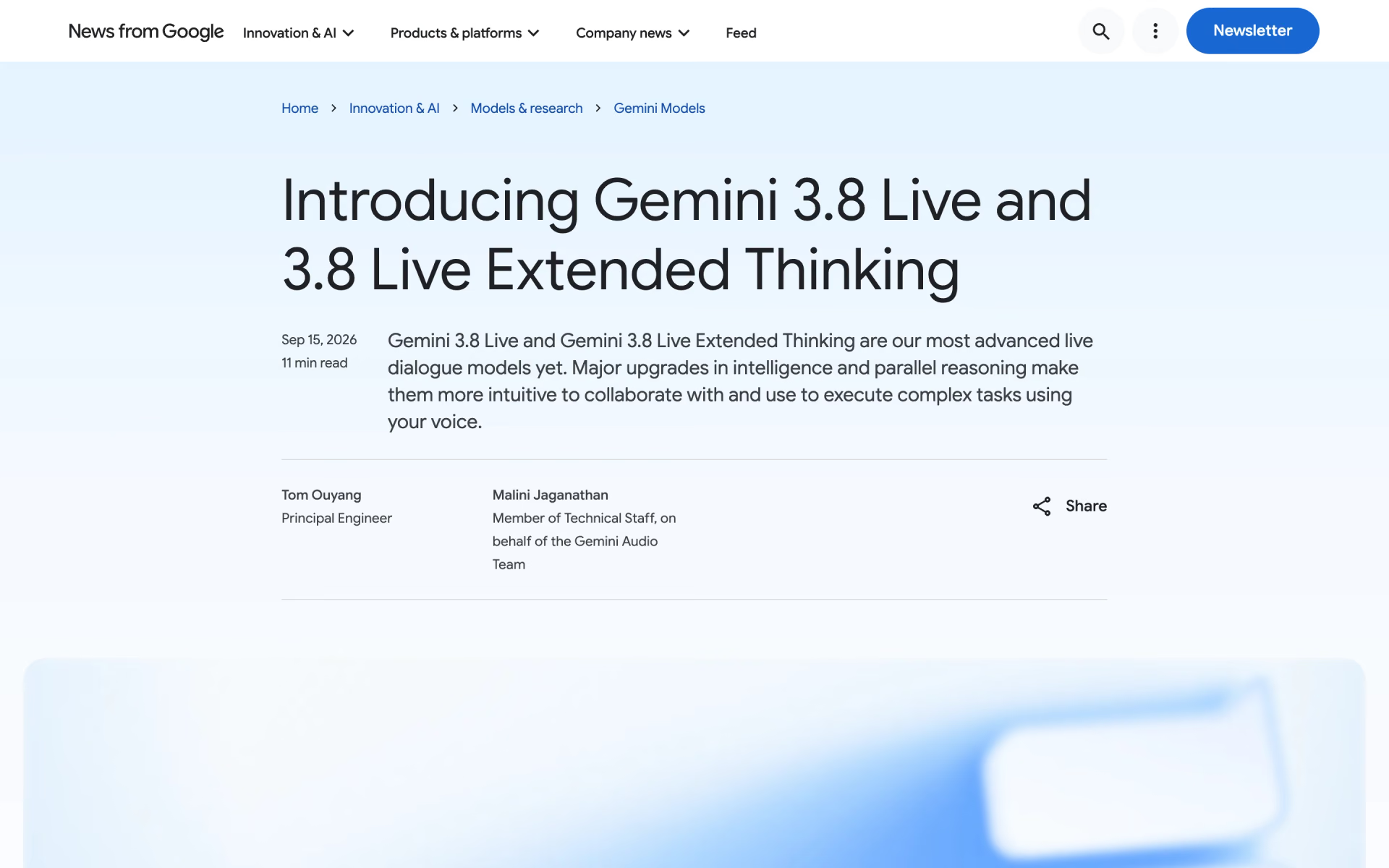
What is Gemini 3.8 Live?
Gemini 3.8 Live is Google's default speech-to-speech model for voice agents, and it replaces Gemini 3.1 Flash Live, which Google now lists as legacy. Built on Gemini 3 Pro, it takes audio, video, images and text over a streaming session and answers in speech, with a 128K-token context; its knowledge stops at January 2025.
It is the fast half of a pair: 3.8 Live Extended Thinking adds background reasoning at the same price. Unlike OpenAI's GPT-Live, which passes reasoning to a separate backend model, Gemini runs tool calls itself while it keeps talking, and it bills by the token rather than by the minute.
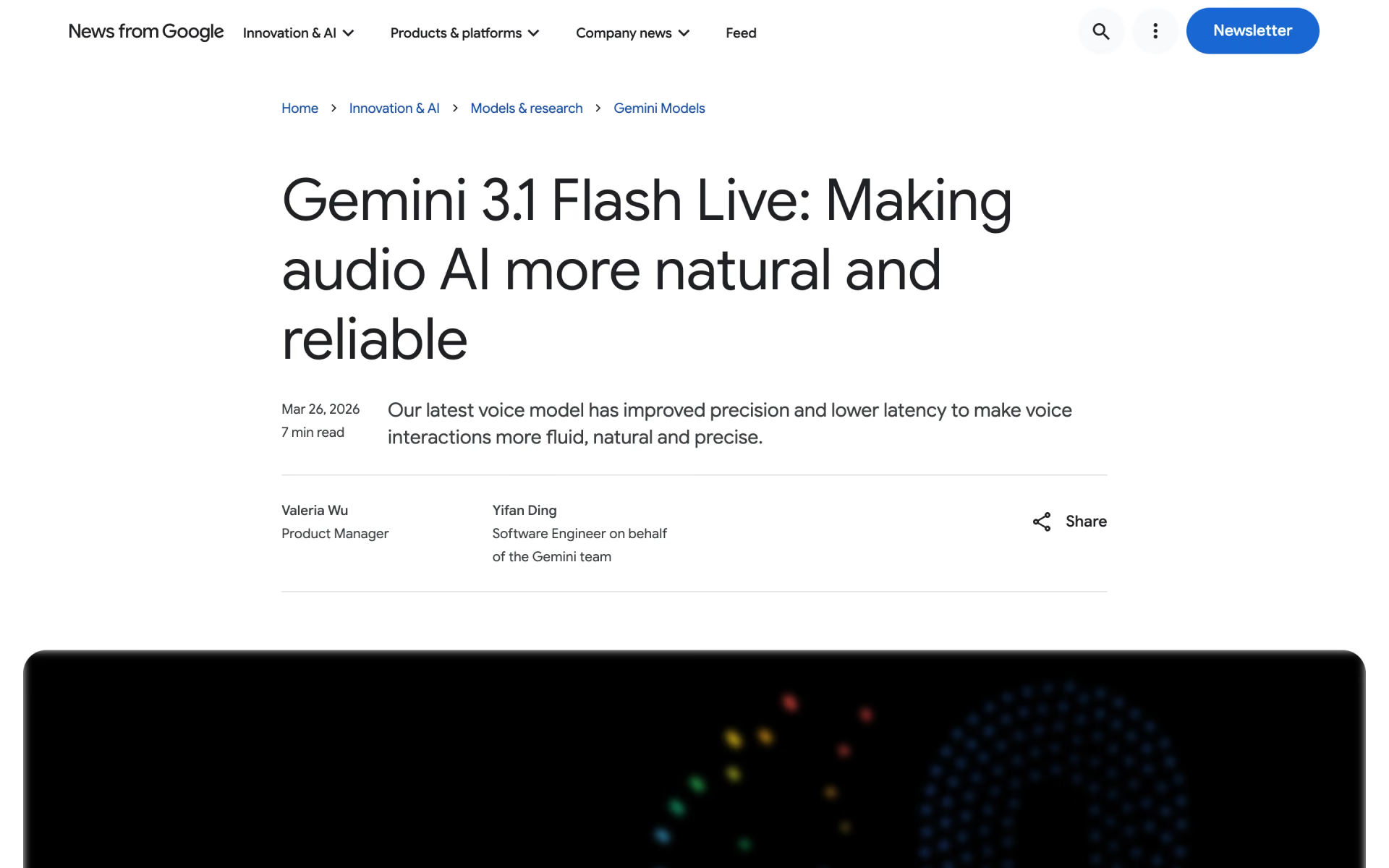
What changed from Gemini 3.1 Flash Live?
It is a stable model rather than a preview, it keeps talking while tools run, and it always listens, at the same price per token.
- Status
- Stable, while Google now lists 3.1 Flash Live as a legacy preview and recommends moving to 3.8 Live.
- Tool calls
- Asynchronous by default, so the conversation carries on while a function runs; 3.1 Flash Live waits for each result before it speaks.
- Thinking
- Built-in reasoning replaces the thinking-level setting, which 3.8 Live no longer accepts.
- Listening
- Proactive audio is always on, so input is billed for the whole time a session listens.
- Price
- The same per-token rates as 3.1 Flash Live.
Who is Gemini 3.8 Live best for?
Gemini 3.8 Live is best for teams building real-time voice agents that need to talk, look at a camera feed and run tools at the same time, especially across many languages or on a tight budget.
Customer service voice agents
It keeps the conversation going while function calls run in the background, and works through platforms such as LiveKit, Pipecat, Agora and Vercel.
Callers in many languages
It detects 97 languages and switches between them mid-conversation without a setting change.
Help with what a camera sees
It reads video and images in near real time, for jobs like guided onboarding or step-by-step troubleshooting.
Harder spoken tasks
The Extended Thinking version reasons while it speaks and narrates progress on multi-step jobs, at the same price per token.
What's included with Gemini 3.8 Live?
Background tool calls, 97 languages, camera and screen input, Google Search grounding, a background-reasoning sibling and video avatars in Gemini Enterprise.
- Background tool calls
- Function calls run asynchronously by default, so it can acknowledge a request and keep talking while the result comes back.
- 97 languages
- It detects the caller's language and switches mid-conversation, and you can limit the languages it speaks through the system instructions.
- Camera and screen input
- Video frames and images stream in alongside audio, so an agent can talk about what the user is showing it.
- Google Search grounding
- Answers can draw on Google Search, with 5,000 free searches a month shared across Gemini 3 models, then $14 per 1,000.
- Extended Thinking sibling
- 3.8 Live Extended Thinking reasons in the background at a low, medium or high setting for multi-step jobs, at the same token prices.
- Live Avatar in Gemini Enterprise
- Enterprises can pair it with a lip-synced video avatar from a preset library; custom avatars need allowlisting.
How much does Gemini 3.8 Live cost?
Gemini 3.8 Live is free on the Gemini API's free tier, and the paid tier costs $3.00 per million audio input tokens and $12.00 per million audio output tokens, about $0.005 and $0.018 a minute.
- Free input and output tokens
- Google Search grounding included
- Prompts and responses used to improve Google's products
- About $0.005 a minute of audio in and $0.018 a minute out
- Text: $0.75 in and $4.50 out per million tokens
- Images and video in: $1.00 per million tokens, about $0.002 a minute
3.8 Live Extended Thinking and 3.1 Flash Live Preview cost the same as 3.8 Live, and output prices include thinking tokens. Google Search grounding includes 5,000 free requests a month shared across Gemini 3 models, then $14 per 1,000. The paid tier starts when you link a billing account and prepay at least $5 in credits, which expire after 12 months. The Live models have no Batch discount, and paid-tier data is not used to improve Google's products. Prices are in US dollars. Full pricing on ai.google.dev. We checked these prices on .
How do readers rate Gemini 3.8 Live?
No one has rated Gemini 3.8 Live yet. Be the first.
Sign in to rate. One rating per account.
Gemini 3.8 Live pros and cons
It is fast, multilingual and cheap per minute, but long sessions cost more than they look, its task accuracy trails the Extended Thinking version, and phone-agent builders are split on its voices.
Pros
- Cheap to run: about $0.005 a minute of audio in and $0.018 out, and Google's own cost table puts it at $0.84 per hour of input audio, the lowest of the voice models it compared.
- Early testers say it replies quickly and stops the moment you interrupt; one team building phone demos measured replies under 200 ms.
- Users praise how it handles strong accents and switches between languages without losing the thread, and Google says it follows 97 of them.
- Scores 89% for conversation experience on ServiceNow's EVA-Bench in Google's table, the highest of the models listed, while tool calls run without pausing the chat.
Cons
- Long sessions cost more than the per-minute rate suggests: every turn re-bills the whole conversation so far, input is billed the whole time it listens, there is no context caching, and sessions end after 15 minutes of audio (2 with video) unless you turn on compression.
- On harder tasks it trails its sibling: Google's own tables give it 30.1% on τ-Voice against 68.6% for 3.8 Live Extended Thinking, and 47% task accuracy on EVA-Bench.
- Not built for phone lines: Google's Live API has no direct SIP connection, and some developers building call agents found its voices robotic or saw extra latency when relaying calls.
- Some early adopters hit bugs, such as the model answering itself in a loop, and one team rolled back to Gemini 3.1 Flash Live.
What are the best Gemini 3.8 Live alternatives?
Four tools on Recaply do Gemini 3.8 Live's job. Chroma 1.0 is open source, so you can run it on your own server.
 GPT-Live-1Paid
Choose it when you want to keep your own agent, from any provider, behind the voice and take calls over direct SIP; it costs a flat $0.05 a minute plus whatever the backend model costs.
 Grok Voice Think Fast 2.0Paid
Choose it when you want SIP phone calls on your own numbers and a flat $0.08 a minute instead of token billing that grows with each turn.
 GPT-Realtime-2Paid
Choose it when you want one model that hears, reasons and calls tools in a single session, with cached input at $0.40 per million tokens; its audio costs far more, at $32 / $64 per million tokens.
 Chroma 1.0Open Source
Choose it when live voice conversations must run on your own servers instead of through Google's Live API.
Questions about Gemini 3.8 Live
What is Gemini 3.8 Live?
Gemini 3.8 Live is Google's speech-to-speech model for real-time voice agents, built for developers who need an assistant that talks, watches a camera feed and runs tools without pausing.
Who is Gemini 3.8 Live for?
Gemini 3.8 Live is best for teams building real-time voice agents that need to talk, look at a camera feed and run tools at the same time, especially across many languages or on a tight budget.
Is Gemini 3.8 Live free?
Yes, Gemini 3.8 Live is free on the Gemini API's free tier within rate limits, and Google may use that data to improve its products. Anyone can also talk to it in Search Live, and 3.8 Live Extended Thinking runs in Gemini Live, which is part of the free Gemini app plan.
How much does Gemini 3.8 Live cost?
Gemini 3.8 Live's paid plans are Paid Tier at $3.00 / $12.00 per million audio tokens in / out.
Is there an open source alternative to Gemini 3.8 Live?
Yes. Chroma 1.0 is an open source tool that does the same job, so you can run your own.
What are the best Gemini 3.8 Live alternatives?
The closest alternatives on Recaply are GPT-Live-1, Grok Voice Think Fast 2.0, GPT-Realtime-2 and Chroma 1.0.
Where can I try Gemini 3.8 Live?
On its official website, blog.google.
How does Gemini 3.8 Live differ from 3.8 Live Extended Thinking?
Gemini 3.8 Live is the default for fast voice agents and answers without reasoning delays. 3.8 Live Extended Thinking reasons in the background for complex, multi-step tasks while it keeps speaking. Both cost the same per token on the Gemini API.
Gemini 3.8 Live vs GPT-Live: which is cheaper?
Per minute, Gemini 3.8 Live usually is: Google charges about $0.005 a minute for audio in and $0.018 out, while OpenAI's GPT-Live 1 charges $0.05 a minute of session time plus the backend model. Gemini's token billing grows as a session gets longer, so compare on your own call lengths.
Can I use Gemini 3.8 Live for phone calls?
Not directly. Google's Live API streams over WebSockets and has no built-in SIP connection, so phone calls go through a partner such as Voximplant. OpenAI's GPT-Live 1 and xAI's Grok voice API both accept SIP calls directly.
Does Google train on my Gemini 3.8 Live conversations?
On the free tier, Google may use prompts and responses to improve its products. On the paid tier it does not. Gemini Enterprise also offers the model with US and EU endpoints and enterprise data controls.
Our verdict
Gemini 3.8 Live, the successor to 3.1 Flash Live, is the low-cost default for real-time voice agents on Google's stack.
It costs a fraction of OpenAI's per-minute rates, answers fast, keeps talking while tools run and switches among 97 languages, though Google's own tables show it trails the Extended Thinking version on harder tasks.
- Skip it for
- Phone-first call centres that need direct SIP, and long sessions where token billing adds up.
- Check first
- Run your longest real conversations through it and price the whole session, not the per-minute rate.
 Gemini 3.1 Flash Live

 GPT-Live
 Gemini 3.8 Flash TTS
 Gemini 3.8 Flash-Lite TTS
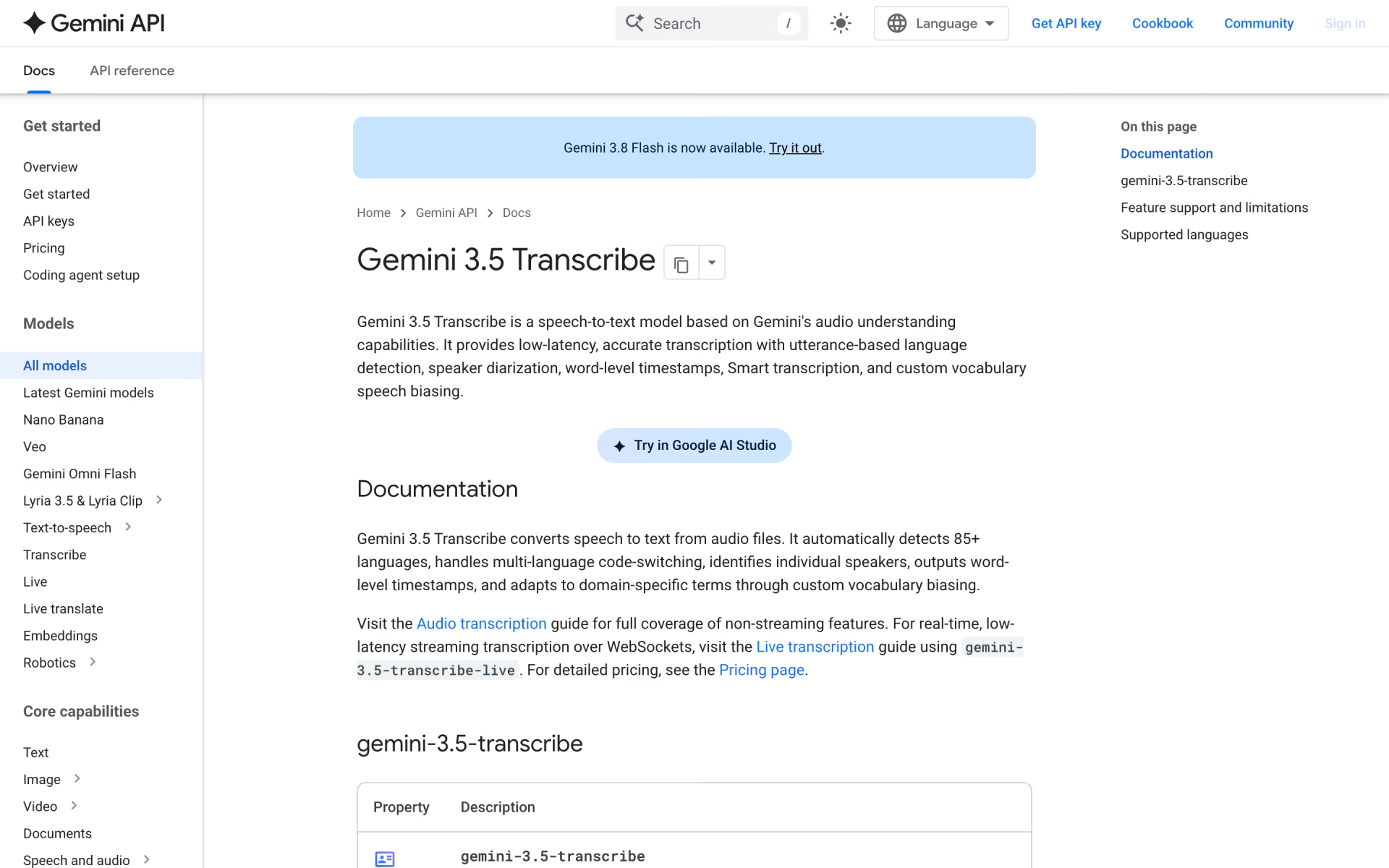
 Gemini 3.5 Transcribe
 Gemini 3.1 Flash TTS