

What is GPT-Realtime-2?
GPT-Realtime-2 is a reasoning model built for live voice. One model listens, thinks before it answers when you allow it, calls functions or remote MCP tools, and replies in speech, with no separate transcription or text-to-speech step. It also takes images, writes up to 32K output tokens, and its knowledge stops at September 2024.
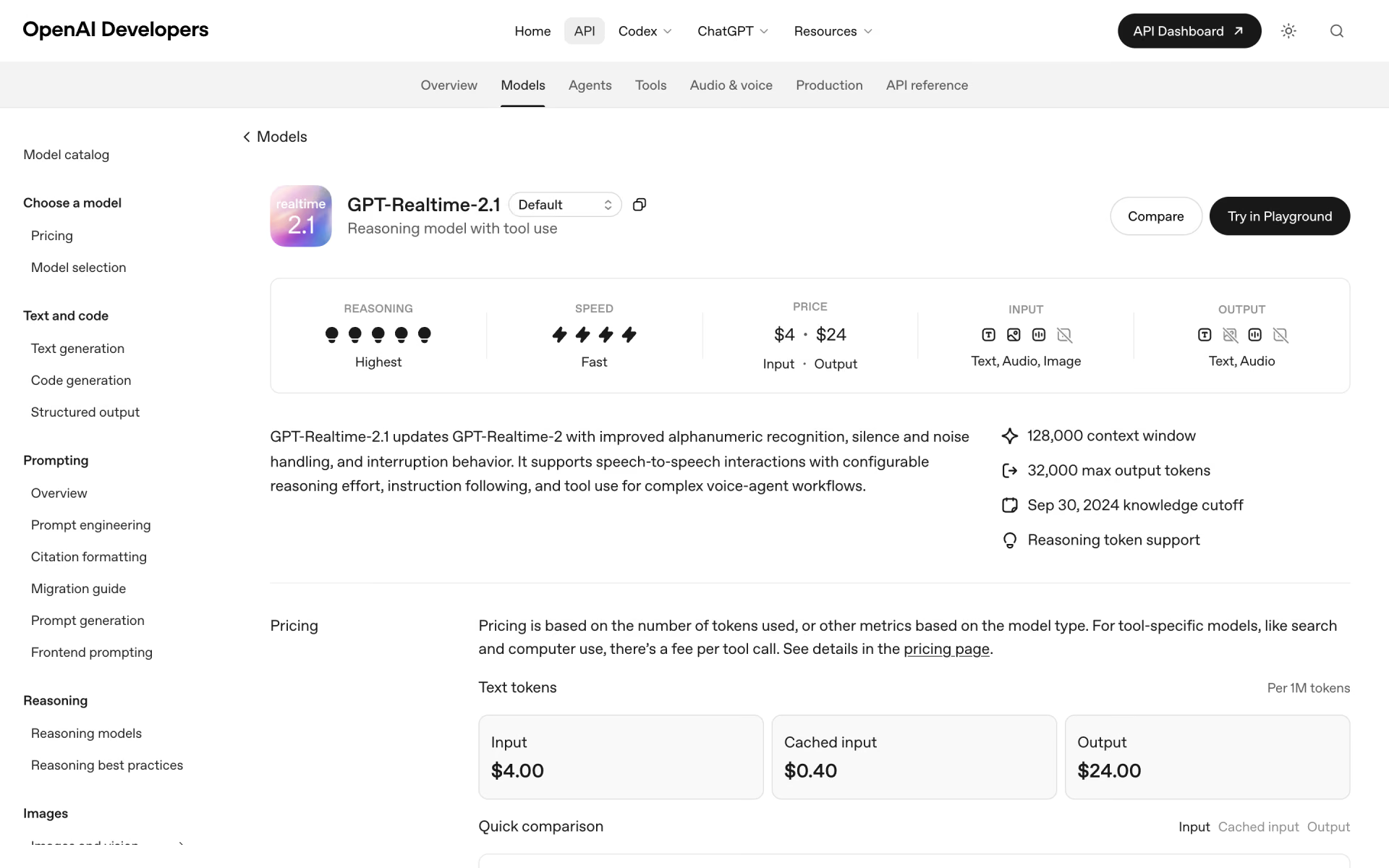
It is still available and OpenAI has not announced a retirement, but it is no longer the pick. GPT-Realtime-2.1 updates it at the same price with better handling of letters, numbers, noise and interruptions, and OpenAI now tells new voice apps to start with GPT-Live.
Is GPT-Realtime-2 still available?
Yes. It still runs on the Realtime API and OpenAI has not announced a retirement, but GPT-Realtime-2.1 has taken its place as the default at the same price.
- Model ID
- gpt-realtime-2 still works; the update is gpt-realtime-2.1, and OpenAI's Realtime quickstart now uses it.
- What 2.1 fixes
- Better recognition of letters and numbers, and better handling of silence, background noise and interruptions.
- Price
- The same: $32 / $64 per million audio tokens and $4 / $24 for text.
- OpenAI's advice
- Start new conversational voice apps on GPT-Live, and use the Realtime API when you need one model for speech, reasoning and tools.
Who is GPT-Realtime-2 best for?
GPT-Realtime-2 suits developers building speech-to-speech agents where one model should listen, reason, call tools and answer aloud, though new projects should start on GPT-Realtime-2.1 or GPT-Live-1.
Voice agents that call tools
One model interprets speech, decides what to do, calls functions and answers aloud, without a separate text pipeline.
Calls that need careful reasoning
Five effort levels trade speed for more careful answers; OpenAI suggests starting at low for support calls.
Voice apps that use images
Callers can share a photo or screenshot in the same session, which GPT-Live-1 cannot take directly.
Apps already built on it
Teams tuned on GPT-Realtime-2 can keep running it, and GPT-Realtime-2.1 uses the same API at the same price when they move.
What's included with GPT-Realtime-2?
Adjustable reasoning, spoken preambles, function and MCP tools, image input, browser, server and phone connections, and automatic prompt caching.
- Adjustable reasoning
- Effort runs from minimal to xhigh; higher levels add delay and output tokens.
- Spoken preambles
- By default it says a short line such as "let me check" before longer thinking or tool calls, and you can tune when it does.
- Function and MCP tools
- Your app can run its own functions, or the Realtime API can call a remote MCP server for you.
- Image input
- Images go in next to audio and text, at $5 per million tokens.
- Browser, server and phone connections
- WebRTC, WebSockets and SIP, plus the Agents SDK's RealtimeAgent for a quick browser start.
- Automatic prompt caching
- Repeated context bills at $0.40 per million tokens, which matters because every reply re-sends the conversation.
What changed from GPT-Realtime-1.5?
It added reasoning: GPT-Realtime-1.5 answers straight away, while GPT-Realtime-2 can think first and handles tools and long calls better.
- Reasoning
- Five effort levels from minimal to xhigh; GPT-Realtime-1.5 is a non-reasoning model.
- Context
- 128K tokens, up from 32K.
- Instructions and tools
- It follows instructions more literally and picks tools more precisely, so older prompts may need tuning.
- Price
- Audio stays at $32 / $64 per million tokens; text output rises from $16 to $24.
How much does GPT-Realtime-2 cost?
GPT-Realtime-2 costs $32 per million audio input tokens and $64 per million audio output tokens on the OpenAI API, with text at $4 / $24, image input at $5 and cached input at $0.40.
- Cached text input $0.40 per million tokens
- Cached image input $0.50 per million tokens
- Images go in only; replies are audio or text
- Cached audio input $0.40 per million tokens
- Caller speech counts 1 token per 100 ms; model speech 1 per 50 ms
GPT-Realtime-2 runs only on the Realtime API and is not on the free API tier. Each reply re-sends the whole conversation as input, so later turns cost more, and higher reasoning effort adds output tokens. OpenAI's pricing page now leads with GPT-Realtime-2.1 at the same prices; GPT-Realtime-2.1 mini costs $10 / $20 per million audio tokens. Full pricing on developers.openai.com. We checked these prices on .
How do readers rate GPT-Realtime-2?
No one has rated GPT-Realtime-2 yet. Be the first.
Sign in to rate. One rating per account.
GPT-Realtime-2 pros and cons
It handles tools and loaded context well in one model, but costs climb on long calls and GPT-Realtime-2.1 now does the same job better at the same price.
Pros
- Developers testing it in real apps say it handles follow-up questions, loaded context and tool results without sounding generic.
- One model does the listening, thinking and speaking, so testers find interruptions feel natural and mid-call language switches work without a separate routing layer.
- Teams that moved to GPT-Live-1 say Realtime was steadier for strict flows, where a confirmed answer has to trigger the right tool every time.
- Its 128K-token context, four times that of earlier Realtime models, leaves room for long calls and large system prompts.
Cons
- Costs climb fast and are hard to predict: every reply re-sends the conversation, and one developer on the same prices measured about $5 a day for a very active user.
- GPT-Realtime-2.1 costs the same and improves its handling of letters and numbers, silence, background noise and interruptions, so there is little reason to start on this version.
- Its knowledge stops at September 2024, and a Realtime session ends after 60 minutes.
- It follows instructions more literally than earlier Realtime models, so older prompts often need rework, and with tool choice left on auto it can call tools it does not need.
What are the best GPT-Realtime-2 alternatives?
GPT-Live-1 for the most natural conversation, Gemini 3.8 Live for much lower audio prices, and Grok Voice Think Fast 2.0 for a flat per-minute rate.
 GPT-Live-1Paid
Choose it when natural turn-taking matters more than one-model simplicity; it bills $0.05 a minute plus your backend, and OpenAI now recommends it for new voice apps.
 Gemini 3.8 LiveFree
Choose it when price matters most: its paid audio costs $3 / $12 per million tokens against $32 / $64 here, there is a free tier, and it also takes video.
 Grok Voice Think Fast 2.0Paid
Choose it when you want a flat $0.08 a minute instead of token billing, with web search, X search and MCP tools built in.
Questions about GPT-Realtime-2
What is GPT-Realtime-2?
GPT-Realtime-2 is OpenAI's speech-to-speech model for voice agents: one model hears the caller, reasons at a level you set, calls tools and answers aloud, billed per token on the Realtime API.
Who is GPT-Realtime-2 for?
GPT-Realtime-2 suits developers building speech-to-speech agents where one model should listen, reason, call tools and answer aloud, though new projects should start on GPT-Realtime-2.1 or GPT-Live-1.
Is GPT-Realtime-2 free?
No. GPT-Realtime-2 is a paid tool, from $4 / $24 per million input / output tokens.
How much does GPT-Realtime-2 cost?
GPT-Realtime-2's paid plans are Text at $4 / $24 per million input / output tokens, Image input at $5 per million input tokens and Audio at $32 / $64 per million input / output tokens.
What are the best GPT-Realtime-2 alternatives?
The closest alternatives on Recaply are GPT-Live-1, Gemini 3.8 Live and Grok Voice Think Fast 2.0.
Where can I try GPT-Realtime-2?
On its official website, openai.com.
Should I use GPT-Realtime-2 or GPT-Live-1?
Use GPT-Realtime-2, or better its 2.1 update, when one model should handle speech, reasoning and tool calls in a single session, or when callers share images. OpenAI points new apps to GPT-Live-1, which keeps talking while a separate backend does the work and bills $0.05 a minute.
How are GPT-Realtime-2's audio tokens counted?
Caller speech counts as one token per 100 milliseconds and the model's speech as one token per 50 milliseconds. Every reply re-sends the whole conversation as input, so long calls cost more per turn unless the cached rate of $0.40 per million tokens applies.
Can GPT-Realtime-2 see images?
Yes. It takes images alongside audio and text in the same session, at $5 per million input tokens, and discusses them in speech or text. It reads images but cannot create them.
Does GPT-Realtime-2 work on phone calls?
Yes. The Realtime API accepts phone calls over SIP from your telephony provider, alongside WebRTC for browsers and WebSockets for servers, and a server-side connection can receive keypad presses from the caller.
Our verdict
GPT-Realtime-2 still works well for one-model voice agents, but there is little reason to pick it over GPT-Realtime-2.1 today.
It reasons, calls tools and takes images in one session, and developers say it handles live context well; 2.1 does the same for the same price with better handling of numbers, noise and interruptions.
- Skip it for
- New projects, which should start on GPT-Realtime-2.1, or on GPT-Live-1 as OpenAI now advises.
- Check first
- Model your cost on real call lengths, since every reply re-sends the conversation and the bill grows with each turn.
 GPT-Realtime-2.1

 Scribe v2 Realtime
 Eleven Realtime

 GPT-Live
 Gemini 3.1 Flash Live

 Eleven v3