
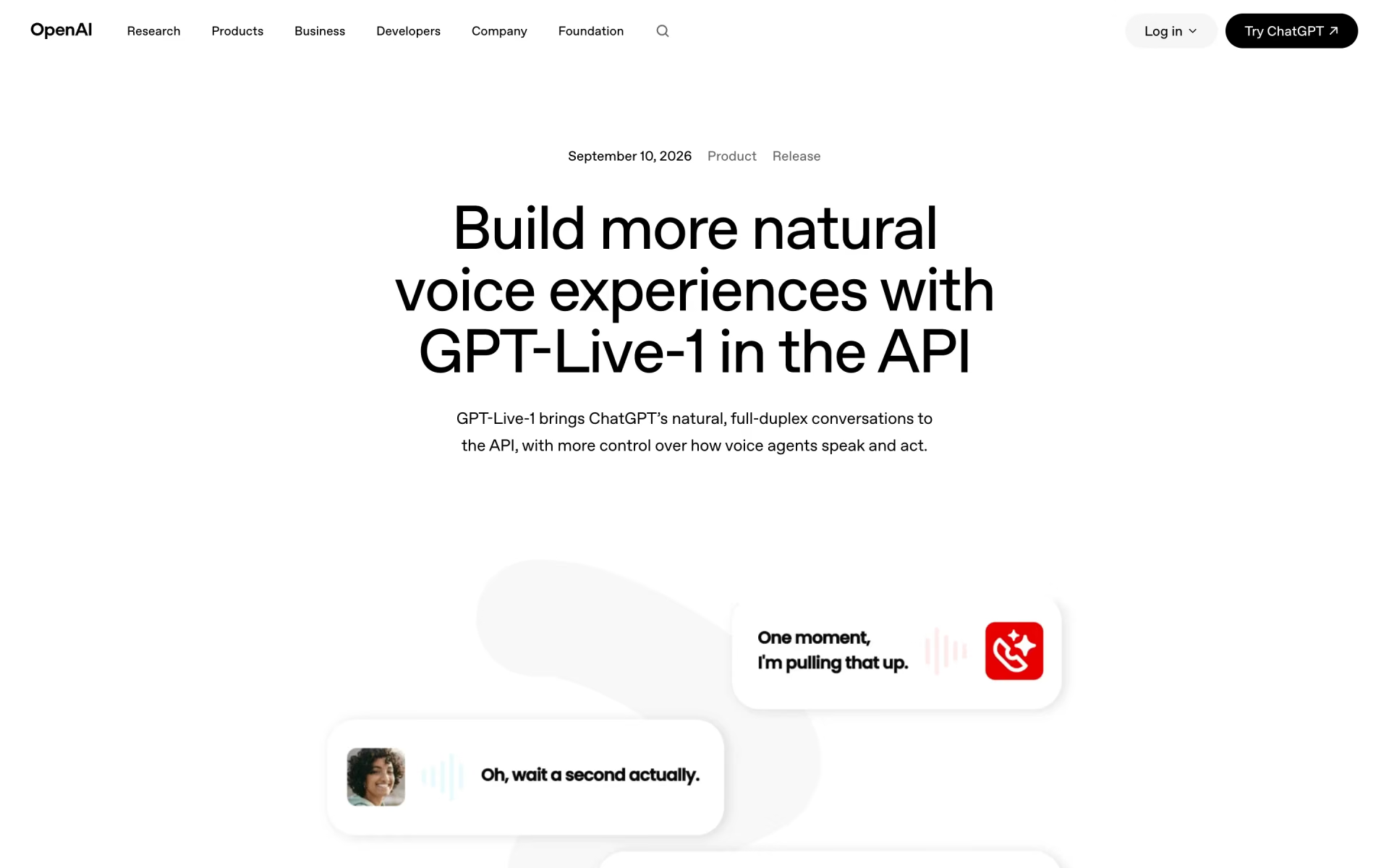
What is GPT-Live-1?
GPT-Live-1 brings GPT-Live, the model behind ChatGPT Voice, to the OpenAI API. It only runs the conversation: it listens while it speaks, makes short listening sounds, stops when interrupted, and passes anything that needs reasoning or tools to a backend. OpenAI can run that backend on a model you pick, or your app can route the work to any model, agent or service, including another company's.
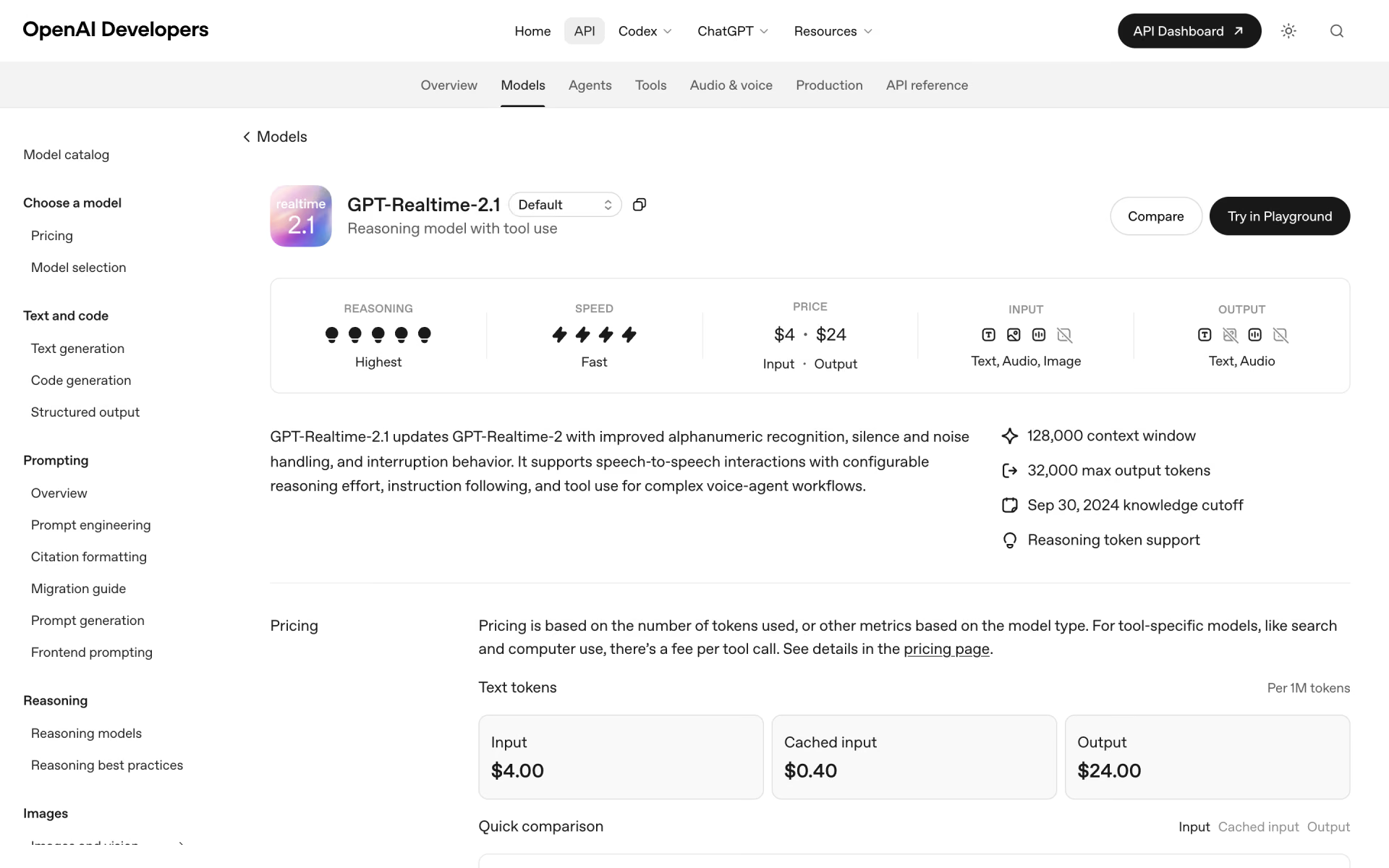
OpenAI now points new voice apps here first. The older route, GPT-Realtime-2, is one model that hears, thinks, calls tools and speaks, billed by the token; GPT-Live-1 splits voice from reasoning and bills the voice part by the minute.
How is GPT-Live-1 different from GPT-Realtime-2?
GPT-Live-1 only runs the conversation and hands the thinking to a separate backend; GPT-Realtime-2 does everything in one model.
- Design
- GPT-Live-1 splits voice from reasoning; GPT-Realtime-2 hears, reasons, calls tools and speaks as one model.
- Billing
- $0.05 per minute for the voice plus backend tokens, against $32 / $64 per million audio tokens with the conversation re-sent each turn.
- Inputs
- GPT-Live-1 takes audio and text; GPT-Realtime-2 also takes images.
- Turn-taking
- GPT-Live-1 decides when to speak on its own; Realtime also lets your app commit turns and trigger replies.
- Moving over
- Session setup, events and tool handling all change, so a Realtime integration does not work as is.
Who is GPT-Live-1 best for?
GPT-Live-1 suits developers who already have a text agent and want a natural voice front end for it, such as support lines, phone agents and booking assistants.
Voice on top of an existing agent
Client delegation connects any model, agent or service you already run, so your business rules and tools stay where they are.
Customer service calls
It keeps the caller company while the backend checks something like an order status, and takes in corrections mid-task.
Phone agents
Direct SIP plus partner guides for LiveKit, Twilio, Telnyx and Daily/Pipecat connect it to real phone lines.
Teams that want a predictable voice bill
The voice side costs a flat $0.05 a minute, so the bill follows call length rather than tokens re-sent every turn.
What's included with GPT-Live-1?
Full-duplex talk, a backend run by OpenAI or by you, updates while work runs, browser, server and phone connections, a 128K context and 12 extra voices.
- Full-duplex conversation
- It listens while it talks, uses short listening sounds and yields when the caller cuts in, with no turn-detection code on your side.
- Two ways to run the backend
- OpenAI can call a Responses model with your function tools and web search, or your app can take each handoff and use any model or service.
- Updates while work runs
- Your app can pass it results to say aloud or facts to keep in mind, up to 500 tokens at a time, while the backend is still busy.
- Browser, server and phone connections
- WebRTC for browsers, WebSockets for servers and SIP for phone calls, plus a second server connection for monitoring and guardrails.
- Long sessions
- A 128K-token context that summarizes older turns in the background and keeps your original instructions.
- Voices
- A default voice plus 12 extra GPT-Live voices, ten English with regional accents and two Brazilian Portuguese, and approved custom voices.
How does GPT-Live-1 work?
Write two prompts
A short one tells GPT-Live-1 how to sound and when to hand off; the detailed business rules go to the backend.
Pick who runs the backend
Responses delegation has OpenAI call a model such as GPT-6 Luna for you; client delegation sends each handoff to your own agent.
Connect the audio
Your server creates the session, then a browser, server or phone line streams audio over WebRTC, WebSockets or SIP.
Close and read usage
Closing the session stops the per-second clock and returns the final voice time; backend tokens are counted separately.
How much does GPT-Live-1 cost?
GPT-Live-1 costs $0.05 per minute of voice session on the OpenAI API, billed by the second, and the backend model and tools it hands work to are billed separately at their normal rates.
- Billed per second, never rounded up to a whole minute
- Backend model and tool calls billed at their own rates
- Not on the free API tier; 25 sessions at once on Tier 1
The clock runs for the whole open session, silence included, and a WebRTC session bills 15 seconds while it starts, credited once it runs. With Responses delegation, OpenAI bills the backend at that model's API rate: GPT-6 Luna, its suggested starting point, costs $0.10 / $0.50 per million input / output tokens, and web search is $10 per 1,000 calls. Concurrent sessions rise with usage tier, up to 500 at Tier 5. Full pricing on developers.openai.com. We checked these prices on .
How do readers rate GPT-Live-1?
No one has rated GPT-Live-1 yet. Be the first.
Sign in to rate. One rating per account.
GPT-Live-1 pros and cons
Developers find it the most natural-sounding voice model they have tried and like that it works with any backend, but handoffs, early interruptions and exact codes still need testing before production.
Pros
- Developers who have put it on real calls say it is the most natural-sounding voice model they have used, with turn-taking, interruptions and listening sounds handled without their own voice-detection code.
- Works in front of any backend, so teams keep their own agent, rules and tools; one developer runs it with Claude doing the thinking.
- Answers come from a full text model rather than a cut-down voice model, which users say fixes the vague replies of older voice modes.
- A flat per-minute voice price is easier to budget than Realtime's token billing, where every turn re-sends the conversation.
Cons
- Handoffs are not yet dependable in strict flows: developers report it asking again for details a caller already confirmed, or saying it will check and never calling the backend, and requests routed through a backend agent can take tens of seconds.
- Some users find it cuts in too early, with "hmm" sounds or replies while they are still talking; you tune this only through the prompt, not a setting.
- Exact codes and other languages trip it up: one phone-agent team heard it add a letter to a claim number, and others report misheard learners and replies in the wrong language.
- Moving from the Realtime API is a rebuild, not a model swap; the voice model takes no images, and you pay for every second a session stays open, silence included.
What are the best GPT-Live-1 alternatives?
GPT-Realtime-2 for one-model voice agents with image input, Gemini 3.8 Live for the lowest cost and a free tier, and Grok Voice Think Fast 2.0 for tools built into the voice model.
 GPT-Realtime-2Paid
Choose it when one model should hear, reason, call tools and speak in the same session, or when callers need to share images; it bills per token, at $32 / $64 per million audio tokens.
 Gemini 3.8 LiveFree
Choose it when cost comes first: Google has a free tier, paid audio works out to about $0.005 a minute in and $0.018 out, and it takes video and has Google Search built in.
 Grok Voice Think Fast 2.0Paid
Choose it when you want reasoning and built-in web, X and MCP tools inside the voice model itself, at a flat $0.08 a minute.
Questions about GPT-Live-1
What is GPT-Live-1?
GPT-Live-1 is OpenAI's full-duplex voice model for developers: it listens and talks at the same time and hands reasoning and tool calls to a backend model or agent you choose.
Who is GPT-Live-1 for?
GPT-Live-1 suits developers who already have a text agent and want a natural voice front end for it, such as support lines, phone agents and booking assistants.
Is GPT-Live-1 free?
No. GPT-Live-1 is a paid tool, from $0.05 per minute of voice session.
How much does GPT-Live-1 cost?
GPT-Live-1's paid plans are API at $0.05 per minute of voice session.
What are the best GPT-Live-1 alternatives?
The closest alternatives on Recaply are GPT-Realtime-2, Gemini 3.8 Live and Grok Voice Think Fast 2.0.
Where can I try GPT-Live-1?
On its official website, openai.com.
What else do I pay for besides GPT-Live-1's per-minute rate?
The backend. GPT-Live-1's $0.05 a minute covers only the voice session. With Responses delegation, the backend model's tokens and tools such as web search are billed at their standard API prices; with client delegation, you pay whatever your own model or service costs.
Is GPT-Live-1 the same as ChatGPT Voice?
They share a model family but are sold separately. ChatGPT Voice in the ChatGPT desktop app runs on GPT-Live and comes with paid ChatGPT plans. GPT-Live-1 is the developer version on the OpenAI API, billed per minute to an API account.
Can GPT-Live-1 see images?
No. The voice model takes only audio and text. To let a caller discuss a photo or screen, send the image to a vision-capable backend model, which passes the relevant details back to GPT-Live-1 as text.
Which languages does GPT-Live-1 speak?
OpenAI does not publish a language list for it. You set the language in the prompt, and the extra voices cover English with several regional accents plus Brazilian Portuguese, so test your own languages, names and numbers before launch.
Our verdict
GPT-Live-1 is the voice layer to try first if you already have a text agent and want callers to talk to it naturally.
It handles turn-taking and interruptions on its own, works with any backend, and bills a flat $0.05 a minute for the voice side, which is simpler to budget than per-token audio.
- Skip it for
- Strict scripted calls that must capture exact codes and confirmations every time, until your own tests show the handoffs hold up.
- Check first
- Run your real call scripts through it, including corrections and spelled-out IDs, before moving production traffic from Realtime.

 GPT-Live
 Gemini 3.1 Flash Live

 Chroma 1.0
 GPT-Realtime-2.1

 AssemblyAI-TTS-1

 Scribe v2 Realtime