
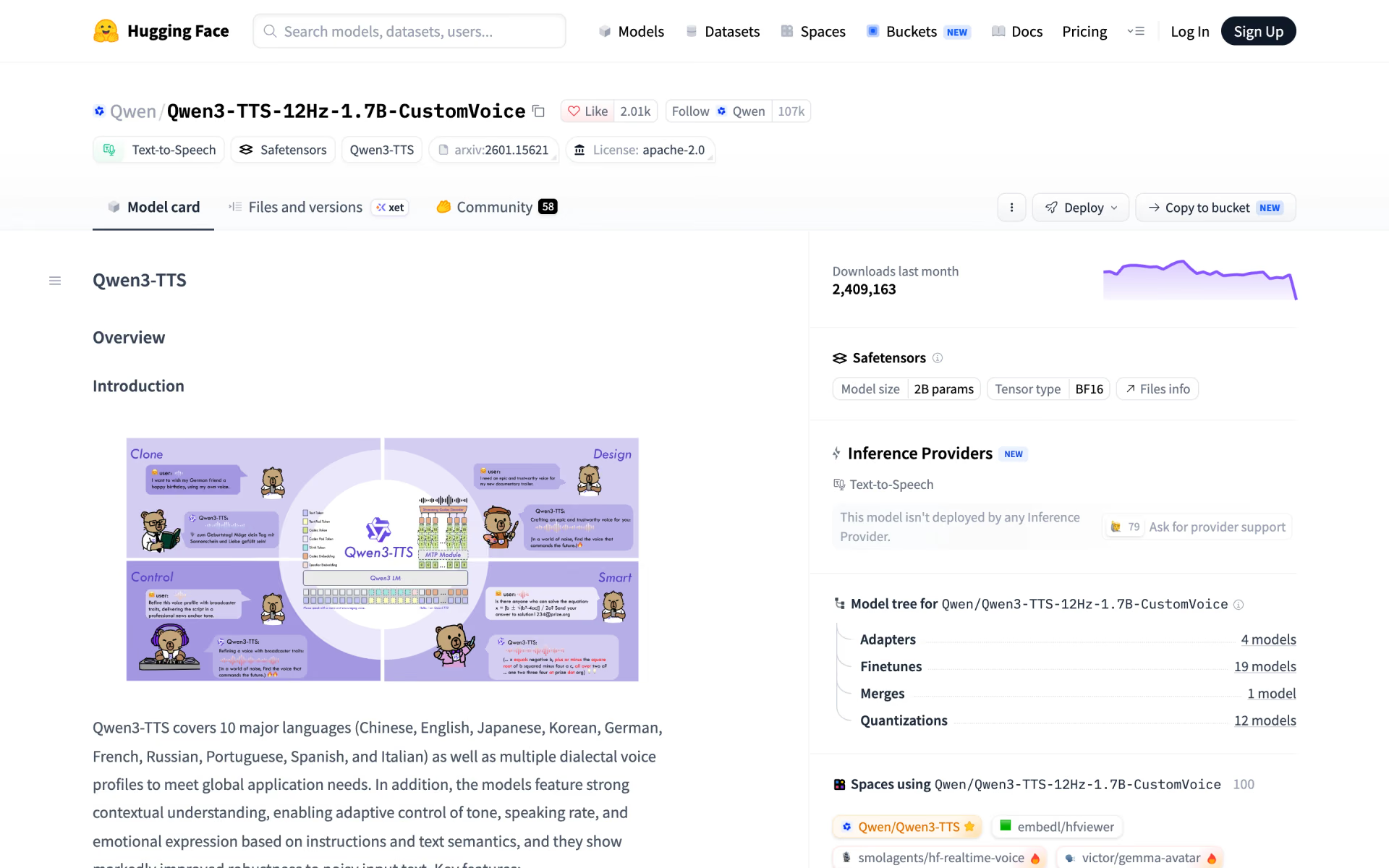
What is Qwen3-TTS CustomVoice 1.7B?
Qwen3-TTS CustomVoice 1.7B is one of five open Qwen3-TTS models from Alibaba's Qwen team, trained on over 5 million hours of speech. It speaks with nine fixed voices and takes a short instruction such as "Very happy." to change emotion, tone and pace. It does not clone voices: the Base models do that, and VoiceDesign builds a voice from a description. It is still the current release; Qwen has published no newer open text-to-speech model.
Compared with hosted voices such as ElevenLabs, you trade convenience for control: the weights are free for commercial use, but you run the GPU. Alibaba also hosts Qwen3-TTS on Model Studio, billed per character.
How does CustomVoice differ from the other Qwen3-TTS models?
CustomVoice gives you fixed voices you can direct; the other open Qwen3-TTS models either clone a voice or design one from a description.
- CustomVoice 1.7B
- Nine preset voices, with emotion and tone set by instruction.
- CustomVoice 0.6B
- The same nine voices in a smaller model, without instruction control.
- VoiceDesign 1.7B
- Creates a new voice from a written description of how it should sound.
- Base 1.7B and 0.6B
- Clone a voice from a 3-second clip, and the only versions Qwen's fine-tuning script supports.
Who is Qwen3-TTS CustomVoice 1.7B best for?
Qwen3-TTS CustomVoice 1.7B is best for developers who want an open text-to-speech model with ready-made voices they can direct in plain language, running on their own hardware in 10 languages.
Self-hosted voice apps
The weights run on your own hardware under the Apache 2.0 licence, so speech costs nothing per character.
Multilingual narration
One model reads 10 languages, and its preset voices include Beijing and Sichuan dialect speakers alongside English, Japanese and Korean ones.
Expressive read-outs
A short instruction such as "Very happy." changes the emotion, tone and rhythm of a preset voice without training a new one.
Commercial products on open weights
Apache 2.0 allows commercial use, which open rivals such as Mistral's Voxtral TTS weights do not.
What's included with Qwen3-TTS CustomVoice 1.7B?
Nine preset voices, plain-language instruction control, streaming output, batch generation, a local web demo and a hosted API option.
- Nine preset voices
- Vivian, Serena, Uncle_Fu, Dylan, Eric, Ryan, Aiden, Ono_Anna and Sohee, and each can speak all 10 languages.
- Instruction control
- A plain-language instruction per line sets emotion, tone and rhythm, which the smaller 0.6B CustomVoice model cannot do.
- Streaming output
- One model handles streaming and non-streaming speech, and Qwen says the first audio can follow a single character of text.
- Batch generation
- Pass lists of lines, languages, voices and instructions to generate many clips in one call.
- Local web demo
- The qwen-tts package includes a browser demo for trying voices and instructions without writing code.
- Hosted API option
- Alibaba's Model Studio serves Qwen3-TTS with eight of the same named voices, over plain requests or a live WebSocket.
How much does Qwen3-TTS CustomVoice 1.7B cost?
Qwen3-TTS CustomVoice 1.7B is free to download and run under the Apache 2.0 licence, and Alibaba's hosted Qwen3-TTS API costs from $0.10 per 10,000 characters of input text.
- Apache 2.0 licence on Hugging Face and ModelScope
- 9 preset voices, 10 languages
- Runs on your own GPU
- Hosted Qwen3-TTS with preset system voices
- Output audio is not billed
- 110,000 free characters for new Singapore accounts
- Adds control of tone, speed and emotion by instruction
- Instructions in Chinese or English, up to 1,600 tokens
- 10,000 free characters for new Singapore accounts
- Streams text in and audio out over a WebSocket
- Instruction control for live voice apps
- 110,000 free characters for new Singapore accounts
The API plans are Alibaba's hosted Qwen3-TTS on Model Studio, which the model card points to; its 48 system voices include eight of this model's nine (all but Uncle_Fu), and Alibaba does not say which checkpoint it runs. Qwen3-TTS-Flash-Realtime without instructions costs $0.13 per 10,000 characters. API prices are for the Singapore (international) region; there is no US region. Each Chinese character, Japanese kanji or Korean hanja counts as 2 characters and every other character as 1. Free characters are for new Singapore accounts and last 90 days. Full pricing on alibabacloud.com. We checked these prices on .
How do readers rate Qwen3-TTS CustomVoice 1.7B?
No one has rated Qwen3-TTS CustomVoice 1.7B yet. Be the first.
Sign in to rate. One rating per account.
Qwen3-TTS CustomVoice 1.7B pros and cons
It is free for commercial use and easy to direct, but the reference code is slow, assumes an NVIDIA GPU, and some listeners find its English voices over-acted.
Pros
- Free for commercial use under Apache 2.0, where Mistral's open Voxtral TTS weights are licensed for non-commercial use only.
- Easy to direct: Qwen's InstructTTSEval scores put it far ahead of GPT-4o-mini-tts in Chinese (83.0 against 54.9) and slightly ahead in English (77.3 against 76.4).
- Many testers on Hacker News and Reddit call the Qwen3-TTS voices natural, and some say they sound better than ElevenLabs or much indie voice acting.
- Runs on one consumer GPU: testers report about 6 GB of VRAM for the 1.7B demo and working setups on an RTX 4090 and Apple Silicon Macs.
Cons
- The official Python code is slow: testers report speech slower than real time on RTX 4090 and 5090 cards with low GPU use, and minutes per short clip on a CPU, so many turn to faster community forks.
- Setup assumes an NVIDIA GPU with CUDA and FlashAttention; Mac and AMD users report extra work or failed runs.
- Several listeners say the English voices sound over-acted, like anime dubbing, and others find the delivery flat or rushed, with few pauses between sentences.
- Only nine fixed voices and no cloning: your own voice needs the Base model, and Qwen's fine-tuning script works only on the Base models.
Is Qwen3-TTS CustomVoice 1.7B open source?
Yes. Qwen3-TTS CustomVoice 1.7B's code is public under the Apache 2.0 licence, so you can run it on your own server.
What are the best Qwen3-TTS CustomVoice 1.7B alternatives?
Qwen3-TTS CustomVoice 1.7B is an open source alternative to TADA by Hume AI and Gemini 3.8 Flash TTS. Chatterbox Turbo does the same job and is open source too.
 TADA by Hume AIFree
Hume's open speech model with one-to-one text-acoustic alignment.
 Gemini 3.8 Flash TTSFree
Google's Gemini text to speech model for expressive voices in 130 languages.
 Chatterbox TurboOpen Source
Choose it when you only need English and want zero-shot voice cloning and tags like [laugh] in a smaller 350M-parameter model, also free for commercial use under MIT.
 Voxtral TTSFree
Choose it when you want 20 preset voices plus cloning on a hosted API at $0.016 per 1,000 characters; its open weights are for non-commercial use only (CC BY-NC 4.0).
 Eleven v3Free
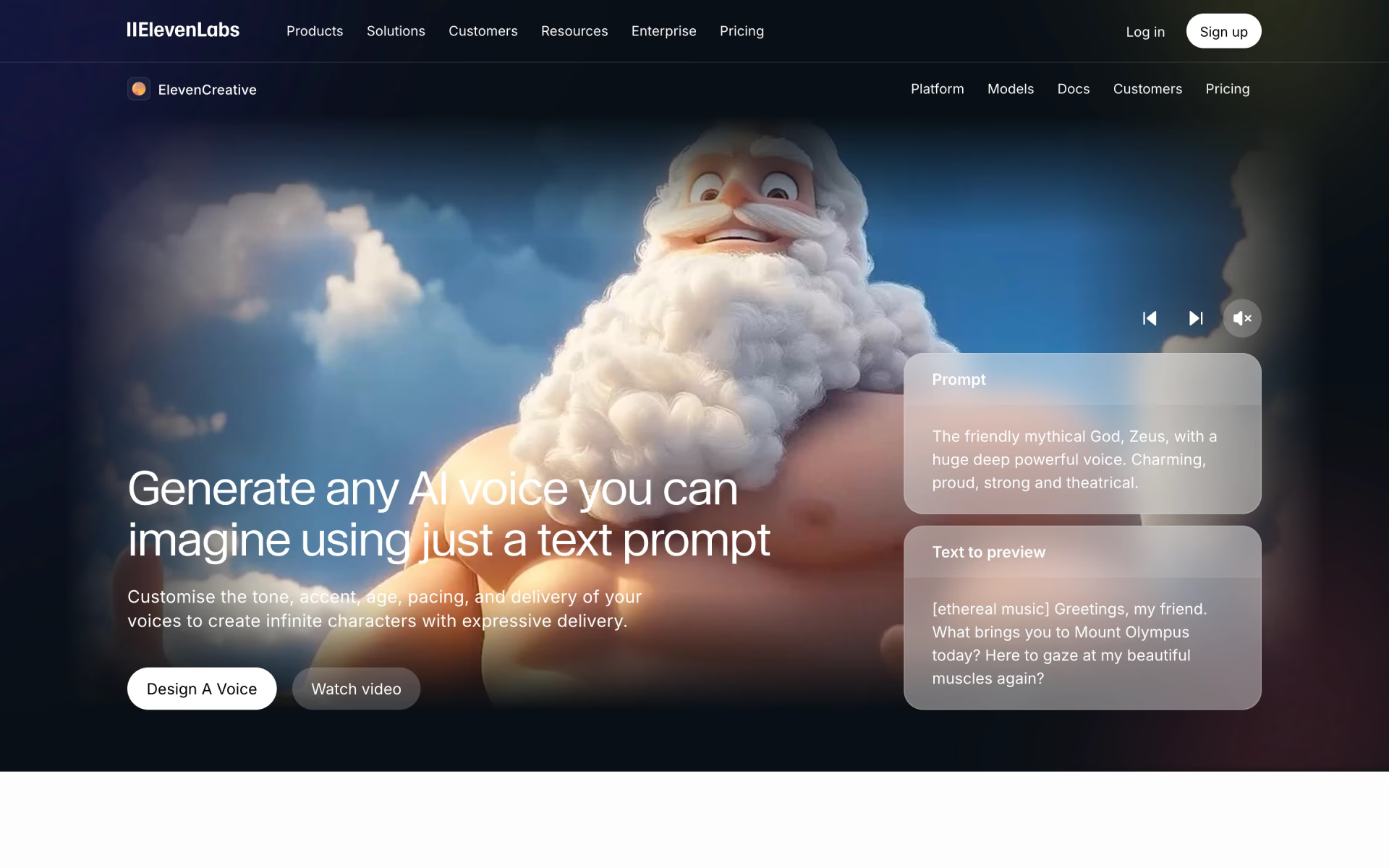
Choose it when you would rather not run a GPU and want expressive speech in 70+ languages; it costs $0.08 per 1,000 characters on the API, with 10,000 free characters a month.
Questions about Qwen3-TTS CustomVoice 1.7B
What is Qwen3-TTS CustomVoice 1.7B?
Qwen3-TTS CustomVoice 1.7B is the Qwen team's open-weight text-to-speech model with nine preset voices in 10 languages, whose emotion and tone you set with plain-language instructions.
Who is Qwen3-TTS CustomVoice 1.7B for?
Qwen3-TTS CustomVoice 1.7B is best for developers who want an open text-to-speech model with ready-made voices they can direct in plain language, running on their own hardware in 10 languages.
Is Qwen3-TTS CustomVoice 1.7B free?
Yes. Qwen publishes the Qwen3-TTS CustomVoice 1.7B weights under the Apache 2.0 licence, so running it on your own GPU costs nothing beyond hardware. Alibaba's hosted Qwen3-TTS API is separate and bills from $0.10 per 10,000 characters after a free allowance for new Singapore accounts.
How much does Qwen3-TTS CustomVoice 1.7B cost?
Qwen3-TTS CustomVoice 1.7B's paid plans are Qwen3-TTS-Flash API at $0.1 per 10,000 characters, Qwen3-TTS-Instruct-Flash API at $0.115 per 10,000 characters and Qwen3-TTS-Instruct-Flash-Realtime API at $0.143 per 10,000 characters.
Is Qwen3-TTS CustomVoice 1.7B open source?
Yes. Qwen3-TTS CustomVoice 1.7B's code is public under the Apache 2.0 licence, so you can run it on your own server.
What are the best Qwen3-TTS CustomVoice 1.7B alternatives?
The closest alternatives on Recaply are TADA by Hume AI, Gemini 3.8 Flash TTS, Chatterbox Turbo, Voxtral TTS and Eleven v3.
Where can I try Qwen3-TTS CustomVoice 1.7B?
On its official website, huggingface.co.
Which voices and languages does Qwen3-TTS CustomVoice 1.7B support?
Qwen3-TTS CustomVoice 1.7B has 9 preset voices (Vivian, Serena, Uncle_Fu, Dylan, Eric, Ryan, Aiden, Ono_Anna and Sohee) and speaks Chinese, English, Japanese, Korean, German, French, Russian, Portuguese, Spanish and Italian. Any voice can use any of these languages, though Qwen suggests each voice's native language for the best quality.
Can Qwen3-TTS CustomVoice 1.7B clone my voice?
No. Qwen3-TTS CustomVoice 1.7B only speaks with its nine built-in voices. Cloning from a 3-second clip is the job of the Qwen3-TTS Base models, and Qwen's fine-tuning script, which trains a single-speaker voice from your recordings, also starts from a Base model.
Can I use Qwen3-TTS CustomVoice 1.7B commercially?
Yes. Qwen releases the Qwen3-TTS models and tokenizers under the Apache 2.0 licence, which permits commercial use. That sets it apart from Mistral's Voxtral TTS, whose open weights carry a non-commercial CC BY-NC 4.0 licence.
What hardware does Qwen3-TTS CustomVoice 1.7B need?
Qwen does not publish a minimum. The model has about 1.9 billion parameters stored in BF16, roughly 3.8 GB of weights, and Qwen's guide targets NVIDIA GPUs and recommends FlashAttention 2 to cut GPU memory use.
Our verdict
Qwen3-TTS CustomVoice 1.7B is the open TTS model to try first if you want ready-made voices you can direct and ship commercially.
It is free under Apache 2.0, covers 10 languages with nine voices, and Qwen's own tests put its instruction following well ahead of GPT-4o-mini-tts.
- Skip it for
- Anyone who needs their own cloned voice, English-only projects that want a smaller, faster model, or teams without an NVIDIA GPU.
- Check first
- Time it on your own GPU before you promise live speech; testers find the reference code slower than real time.
 Qwen3-TTS
 Voxtral 3
 ElevenLabs Voice Design V3
 Seed Audio 1.0
 Cohere Transcribe
 MisoTTS