What is Chatterbox Turbo?
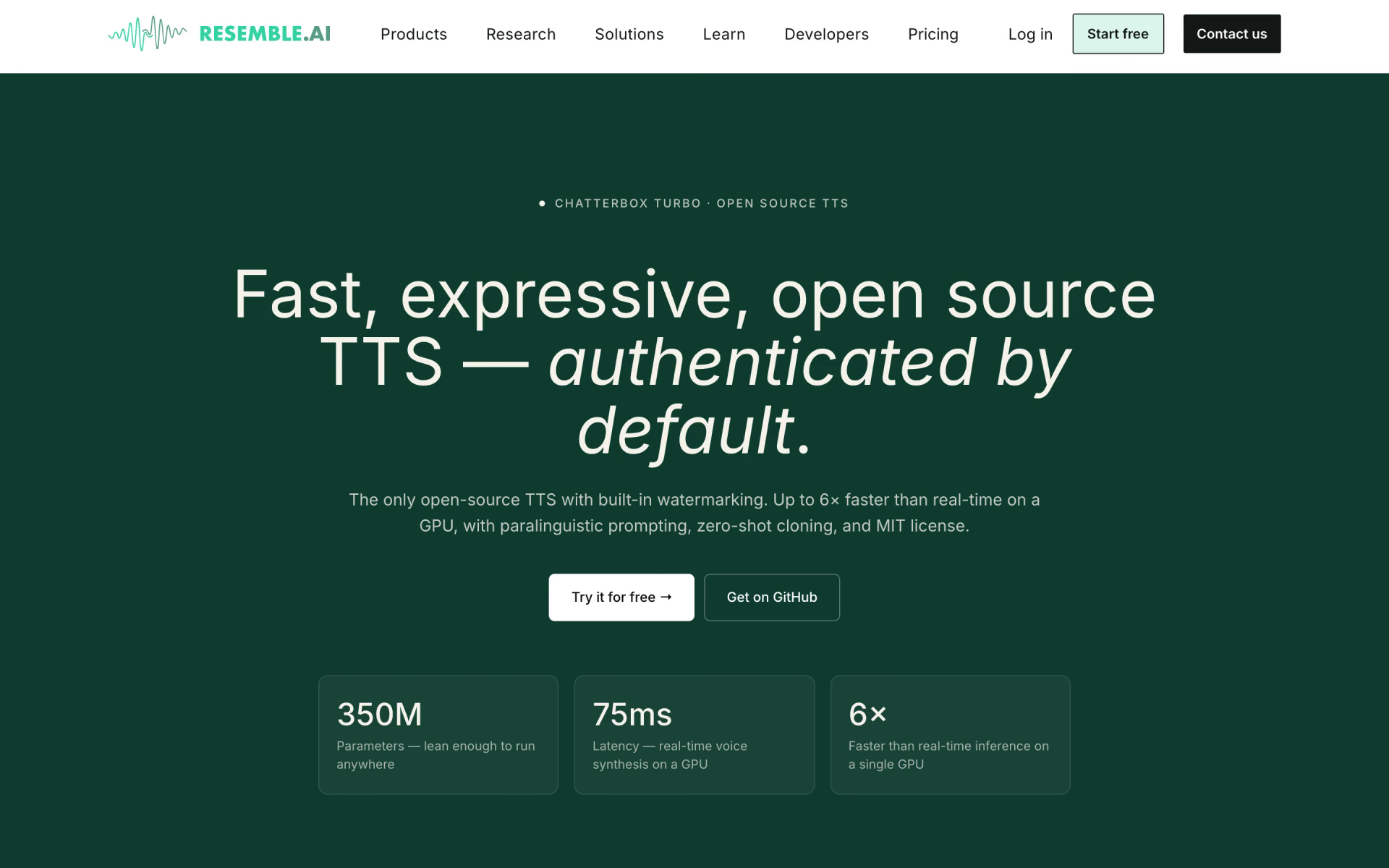
Chatterbox Turbo is the model Resemble AI recommends for low-latency English voice agents in its open-source Chatterbox family. It reads text aloud in a voice cloned from a short reference clip and performs tags such as [laugh] or [sigh] in that voice. Resemble cut it to 350M parameters and its decoder from 10 steps to one, so it needs less compute than the 500M original.
It is still current: the newer Chatterbox Multilingual V3 covers 23 languages and the smaller Chatterbox Nano targets CPUs, but neither replaces it. You run it yourself from GitHub and Hugging Face; Resemble's pricing page now lists only its deepfake detection plans.
How does Chatterbox Turbo compare with other Chatterbox models?
Turbo is the one for fast English speech; Resemble also offers a smaller English model for CPUs and a larger one for 23 languages.
- Chatterbox Turbo
- 350M parameters, English only, with tags such as [laugh], built for low-latency voice agents.
- Chatterbox Nano
- 110M parameters, English only, the same design as Turbo, and 3 times faster than real time on 8 CPU cores.
- Chatterbox Multilingual V3
- 500M parameters and 23 languages; Resemble's pick for cloning one voice across languages.
- Original Chatterbox
- 500M parameters, English, with the CFG and exaggeration settings that Turbo ignores.
Who is Chatterbox Turbo best for?
Chatterbox Turbo is best for developers building English voice agents or short, expressive voice lines who want a self-hosted model with voice cloning and no per-character fees.
Low-latency voice agents
Resemble built it for English agents, with about 75ms latency and up to 6 times real-time speed on one GPU.
Cloning a voice without training
A reference clip of just over 5 seconds is enough, with no fine-tuning run.
Short, expressive lines
Tags like [laugh], [chuckle] and [sigh] are voiced in the cloned voice, which suits agent replies and app or game dialogue of a few sentences.
Teams that must trace AI audio
Every file from the standard package carries an inaudible PerTh watermark that Resemble's perth library can detect later, even after MP3 compression.
What's included with Chatterbox Turbo?
Voice cloning from a short clip, tags for laughs and sighs, a one-step decoder for speed, a built-in watermark, and PyTorch or ONNX weights.
- Zero-shot voice cloning
- Pass a reference clip longer than 5 seconds when you generate; no training run is needed.
- Paralinguistic tags
- Tags such as [laugh], [chuckle], [sigh], [cough] and [gasp] are voiced in the cloned voice with no audio editing.
- One-step decoder
- Resemble cut the decoder, previously the bottleneck, from 10 steps to one.
- PerTh watermark
- The standard package marks every file with an inaudible watermark that Resemble's perth library detects, even after MP3 compression.
- PyTorch and ONNX weights
- Both are on Hugging Face under MIT with no sign-up gate, and the code installs with pip install chatterbox-tts.
How does Chatterbox Turbo work?
Install
Run pip install chatterbox-tts; Resemble tested the code on Python 3.11.
Load Turbo
Load ChatterboxTurboTTS on a CUDA GPU; the weights download from Hugging Face on first run.
Add text and a voice
Pass your text with any tags, plus a reference clip longer than 5 seconds if you want to clone a voice.
Split long scripts
Keep each call to about 300 characters, the limit on Resemble's own demo, and join the clips afterwards.
How much does Chatterbox Turbo cost?
Chatterbox Turbo is free: Resemble AI releases its code and weights under the MIT licence, so the only cost is the hardware you run it on.
- 350M parameters, English only
- Clones a voice from about 5 seconds of audio
- Every output carries Resemble's PerTh watermark
The code is on GitHub (resemble-ai/chatterbox) and installs with pip; the weights download from Hugging Face with no sign-up gate. The MIT licence allows commercial use, including in closed-source products. Resemble also runs a hosted playground at app.resemble.ai that you can try for free, but its pricing page now lists only deepfake detection plans and gives no text-to-speech rates. A smaller 110M Chatterbox Nano runs on a CPU. Full pricing on resemble.ai. We checked these prices on .
How do readers rate Chatterbox Turbo?
No one has rated Chatterbox Turbo yet. Be the first.
Sign in to rate. One rating per account.
Chatterbox Turbo pros and cons
Chatterbox Turbo is fast, free for commercial use and easy to direct with tags, but long passages fall apart unless you split them, and several users found its clones less faithful than rivals'.
Pros
- Free for commercial use: the MIT licence covers closed-source products, and there are no per-character fees.
- Fast: Resemble measures about 75ms latency, and Reddit users who tested it against other open models single out its speed.
- Tags like [laugh] and [chuckle] add realism that users on Hacker News and Reddit point to, and they come out in the cloned voice.
- Light enough for personal machines: people on Hacker News run it on MacBooks through community ports such as mlx-audio.
Cons
- Long passages break down: several users report garbled or skipped words past roughly 300 characters or 30 seconds of audio, and Resemble's own demo caps input at 300 characters, so scripts must be split.
- Clone quality is mixed: several Reddit users found its copies less faithful to the reference than the original Chatterbox or rival open models.
- Turbo ignores the emotion exaggeration and CFG settings of the original Chatterbox, according to its own code, even though Resemble's Turbo page lists emotion control; users say delivery can sound flat without them.
- English only; for other languages you need the larger Chatterbox Multilingual V3.
Is Chatterbox Turbo open source?
Yes. Chatterbox Turbo's code is public under the MIT licence, so you can run it on your own server.
On GitHub
27,777stars
- Last commit
- 4 Nov
- Repository age
- 1 years
- Latest release
- 13 Jun 2025
- Licence
- MIT
- Self-hosted
- Yes
- Repository
- resemble-ai/chatterbox
What are the best Chatterbox Turbo alternatives?
Chatterbox Turbo is an open source alternative to MisoTTS, TADA by Hume AI, Gemini 3.8 Flash-Lite TTS and Voxtral TTS. ZONOS2 and Qwen3-TTS CustomVoice 1.7B do the same job and are open source too.
 MisoTTSFree
Miso Labs' open-weights 8B text-to-speech model for building expressive English voice agents.
 TADA by Hume AIFree
Hume's open speech model with one-to-one text-acoustic alignment.
 Gemini 3.8 Flash-Lite TTSFree
Google's faster, cheaper Gemini text to speech model for voice agents at scale.
 Voxtral TTSFree
Choose it when you need cloning in languages beyond English or long passages through an API: it covers 9 languages at $0.016 per 1,000 characters, though its open weights are for non-commercial use only.
 ZONOS2Open Source
Zyphra's open-source text-to-speech model with zero-shot voice cloning for real-time apps in many languages.
 Qwen3-TTS CustomVoice 1.7BOpen Source
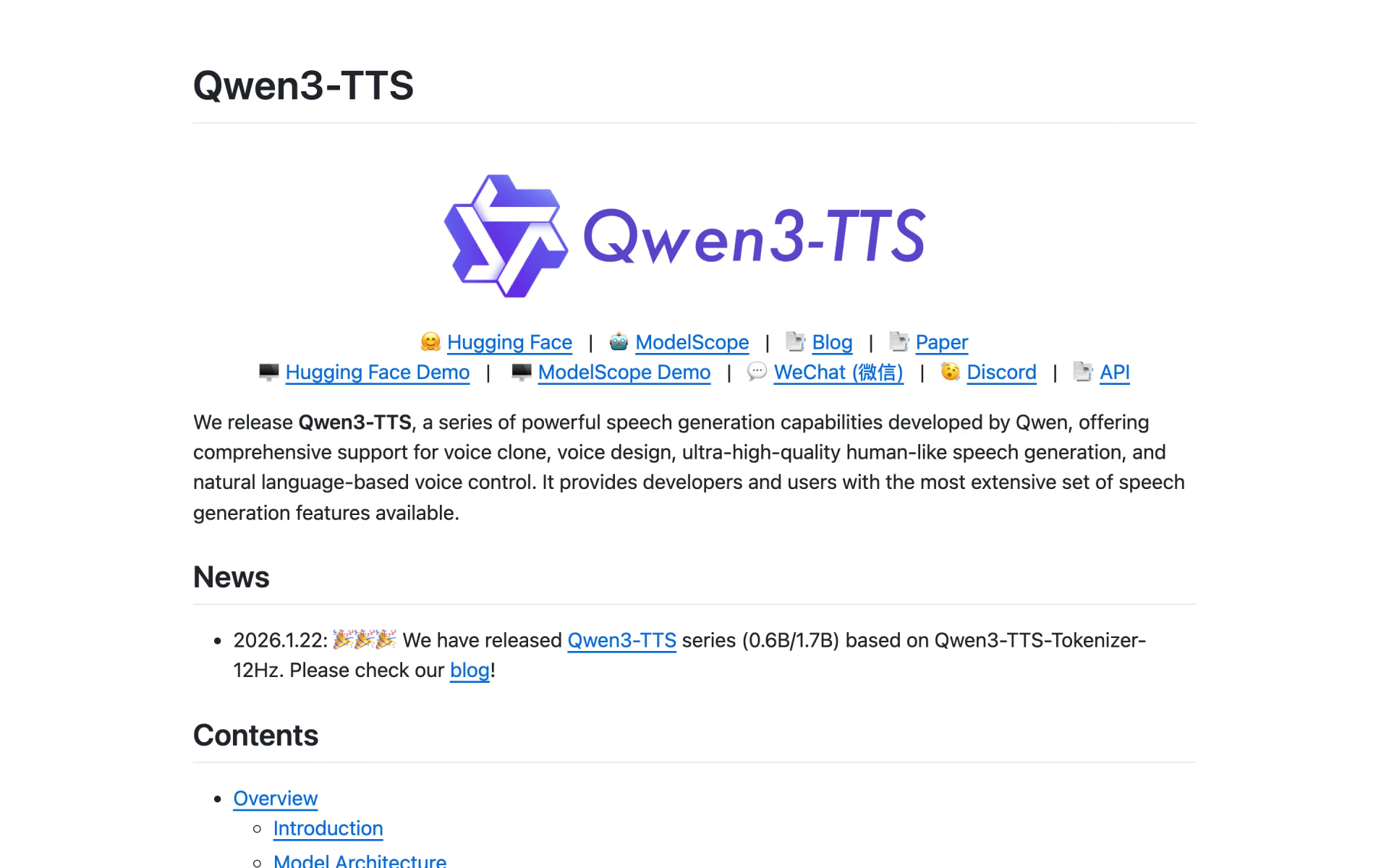
Choose it when you need an open model in 10 languages under Apache 2.0 and its nine preset voices will do instead of cloning.
Questions about Chatterbox Turbo
What is Chatterbox Turbo?
Chatterbox Turbo is Resemble AI's free, MIT-licensed text-to-speech model for English, built for low-latency voice agents, with voice cloning from a few seconds of audio and tags for laughs and sighs.
Who is Chatterbox Turbo for?
Chatterbox Turbo is best for developers building English voice agents or short, expressive voice lines who want a self-hosted model with voice cloning and no per-character fees.
Is Chatterbox Turbo free?
Yes. Chatterbox Turbo has a free Chatterbox Turbo plan: 350M parameters, English only.
Is Chatterbox Turbo open source?
Yes. Chatterbox Turbo's code is public under the MIT licence, so you can run it on your own server.
What are the best Chatterbox Turbo alternatives?
The closest alternatives on Recaply are MisoTTS, TADA by Hume AI, Gemini 3.8 Flash-Lite TTS, Voxtral TTS, ZONOS2 and Qwen3-TTS CustomVoice 1.7B.
Where can I try Chatterbox Turbo?
On its official website, resemble.ai.
Can I use Chatterbox Turbo for commercial work?
Yes. Chatterbox Turbo is released under the MIT licence, which Resemble AI says covers personal, research and commercial projects, including closed-source products. You keep the licence notice with the code, and every file you generate with the standard package still carries the PerTh watermark.
Does Chatterbox Turbo speak languages other than English?
No, Chatterbox Turbo is English only. For other languages Resemble AI points to Chatterbox Multilingual V3, a 500M open model in the same family that covers 23 languages, including Spanish, French, Hindi, Japanese and Chinese.
How much text can Chatterbox Turbo read in one go?
Keep each request short. Resemble's own demo caps input at 300 characters, and users report garbled or skipped words beyond roughly 30 seconds of audio, so split long scripts at sentence ends and join the clips afterwards.
What hardware does Chatterbox Turbo need?
Resemble's examples run it on an NVIDIA GPU with CUDA, and it tested the code on Python 3.11, but it publishes no minimum specs. For machines without a GPU, Resemble points to the 110M Chatterbox Nano, which runs 3 times faster than real time on 8 CPU cores.
Is Chatterbox Turbo better than ElevenLabs?
In a listening test Resemble ran through Podonos, people preferred Chatterbox Turbo to ElevenLabs Turbo v2.5 in 65.3% of comparisons, against 24.5% for ElevenLabs. It is Resemble's own test against one ElevenLabs model, so try both with your own voices and scripts before choosing.
Our verdict
Chatterbox Turbo is a strong free pick for self-hosted English voice agents that speak in short turns.
It is fast, MIT-licensed for commercial use and easy to direct with tags, but users report clones that drift from the reference and speech that falls apart past about 300 characters.
- Skip it for
- Audiobooks and long narration, projects in other languages, and anyone who needs the closest possible voice match.
- Check first
- Test it with your own reference clips and your longest typical line before you build on it.

 Eleven v4 Turbo
 Qwen3-TTS

 Chroma 1.0
 Pocket TTS

 Fish Audio S2 Pro

 HeyGen Voice