
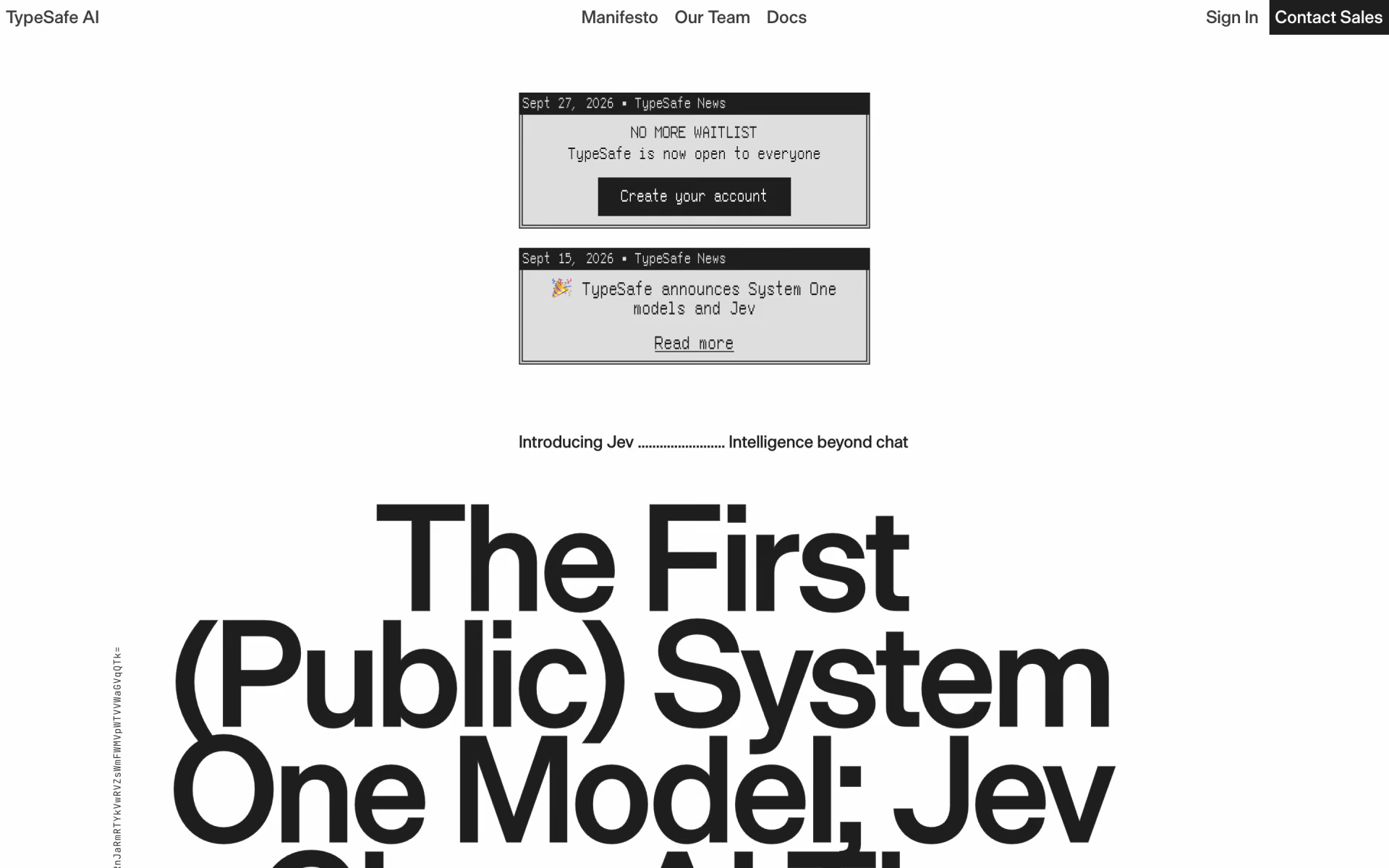
What is Jev?
Jev is the first model from TypeSafe, a lab founded by former OpenAI researcher Diogo Almeida. You send it a state, which is text or JSON, plus a set of typed questions, and it returns a choice, a score or a yes/no probability for each one, with a confidence estimate. Every question is answered in parallel, and it never writes free text or code.
That trade is what makes it cheap and fast next to an LLM for routing, scoring and checks: only input is billed, at $0.042 per million tokens. Jev 1.13 is the current and only version, sold through TypeSafe's own API, which is now open to everyone.
How is Jev different from an LLM?
Jev gives up writing text so it can return typed answers with probabilities in one parallel pass, which is why it is faster and cheaper for decisions.
- Output
- A choice, a score or a yes/no probability from options you set in advance, never free text.
- Price
- Only input is billed, at $0.042 per million tokens; output tokens are free.
- Speed
- 70 to 500 milliseconds end to end, against 3 seconds or more for frontier LLMs in TypeSafe's comparison.
- Confidence
- Choice and Score answers carry a calibrated confidence value, so code can decide when to act and when to ask a person.
- What it gives up
- Writing, code, images and exact maths; TypeSafe suggests keeping arithmetic in code and pairing Jev with an LLM for text.
Who is Jev best for?
Jev is best for developers who need fast, cheap yes/no, choice and score decisions inside their software, such as routing, moderation and checks on LLM output, rather than generated text.
Routing and classifying at volume
Each call returns a typed choice, score or yes/no answer with probabilities, so code can route tickets or documents without parsing text.
Automation with a human fallback
Choice and Score answers carry a confidence estimate, so software can act on its own when Jev is sure and send the rest to a person.
Checking LLM input and output
One request can screen messages going into and out of a chat app, or test whether a citation's source really supports the claim.
Speed-critical pipelines
TypeSafe puts response times at 70 to 500 milliseconds, and only input tokens are billed, so many small decisions stay cheap.
What's included with Jev?
Three typed question types, confidence on every answer, many questions judged in one parallel call, JSON state, SDKs with a Playground, and an agent skill for coding agents.
- Three question types
- Choice picks one option from a set, Score rates against levels you describe, and Noul returns the probability that a statement is true.
- Confidence on every answer
- Choice and Score results include per-option probabilities and a confidence value your code can set thresholds on.
- Many questions per call
- All questions in a request are judged against the same state in parallel; in TypeSafe's own test, batching 13 questions into one call was 12.2x cheaper and 10x faster than separate calls.
- Structured state and criteria
- The state, instructions and answer options can all be JSON, so records and rules go in as data rather than as a long prompt.
- SDKs and a Playground
- Python and JavaScript SDKs retry on rate limits, and a web Playground lets you test questions before writing code.
- Agent skill for coding agents
- A drop-in skill gives Claude Code, Codex and similar agents the context to write correct TypeSafe integrations.
How does Jev work?
Build the state
Put the message, record or document the decision depends on into the request as text or JSON.
Ask typed questions
Add Choice, Score or Noul questions with plain-language instructions and the exact options or levels you accept.
Read answers and confidence
Jev returns every answer at once, each with probabilities, and Choice and Score answers with a confidence value.
Branch in code
Your code acts on confident answers, combines scores with its own weights, and sends uncertain cases to a person or an LLM.
How much does Jev cost?
Jev costs $0.042 per million input tokens ($42 per billion) through TypeSafe's API, and output tokens are free; there is no free plan listed.
- Output tokens are free
- 64K-token context per request, text input only
- 250,000 tokens per second, 1,200 requests a minute
That is $42 per billion input tokens. Rate limits can change while TypeSafe adds capacity, and custom and enterprise plans with higher limits, plus zero data retention, are priced through its sales team. TypeSafe's public pages mention no free plan or trial. Full pricing on docs.typesafe.ai. We checked these prices on .
How do readers rate Jev?
No one has rated Jev yet. Be the first.
Sign in to rate. One rating per account.
Jev pros and cons
Early users praise its speed, price and typed answers, but it cannot write text, has no public benchmark scores and runs only on TypeSafe's cloud.
Pros
- Developers on Hacker News single out the speed and price: answers in milliseconds at $0.042 per million input tokens, with nothing charged for output.
- Early testers report it working well on narrow decisions, such as choosing the next click for a browser agent or labeling batches of records.
- Answers always arrive in the types you define, so there is no JSON to parse or retry, and the bill is known before the call since only input is priced.
Cons
- It cannot write text or code; testers pair it with an LLM for anything that needs words, and hard jobs must be split into small questions first.
- TypeSafe publishes no public benchmark scores, and many Hacker News readers called its 'can't hallucinate' and speed claims misleading, since a typed answer can still be wrong.
- It runs only through TypeSafe's hosted API, with no open weights or local option, which several developers said is a problem for private or offline use.
- TypeSafe's own docs list weak spots: 64K tokens of context, text-only input, English as the strongest language, and unreliable counting, maths and date comparisons.
What are the best Jev alternatives?
Three tools on Recaply do Jev's job. DeepSeek V4.1 Flash is open source, so you can run it on your own server.
 DeepSeek V4.1 FlashOpen Source
Choose it when you also need written answers or long inputs; its API costs $0.15 / $0.60 per million input / output tokens off-peak, with a 1M-token context.
 LFM2.5-350MFree
Choose it when decisions must stay on your own hardware; the 350M model runs in under 1GB of memory, Liquid AI recommends it for extraction and structured output, and it is free below $10M in yearly revenue.
 Gemini 3.1 Flash-LiteFree
Choose it when inputs include images, audio or video, or you want a free tier to start; paid use costs $0.25 / $1.50 per million input / output tokens for text.
Questions about Jev
What is Jev?
Jev is TypeSafe's first System One model: instead of writing text, it answers yes/no, choice and score questions about your data with calibrated probabilities, for software that makes many small decisions.
Who is Jev for?
Jev is best for developers who need fast, cheap yes/no, choice and score decisions inside their software, such as routing, moderation and checks on LLM output, rather than generated text.
Is Jev free?
No. Jev is a paid tool, from $0.042 per million input tokens.
How much does Jev cost?
Jev's paid plans are Jev 1.13 at $0.042 per million input tokens.
Is there an open source alternative to Jev?
Yes. DeepSeek V4.1 Flash is an open source tool that does the same job, so you can run your own.
What are the best Jev alternatives?
The closest alternatives on Recaply are DeepSeek V4.1 Flash, LFM2.5-350M and Gemini 3.1 Flash-Lite.
Can I download Jev or run it locally?
No. TypeSafe serves Jev only through its own API, SDKs and web Playground, and every account uses the same hosted weights. Teams that need decisions on their own hardware have to look at open models instead.
Can I use Jev as the model in Claude Code or Cursor?
No. TypeSafe says Jev is not a drop-in model for coding agents, because it does not write text, call tools or edit files. Use your coding agent to write software that calls Jev for decisions, with TypeSafe's agent skill to help it get the API right.
Can Jev hallucinate?
It cannot return an answer outside the types and options you define, which is what TypeSafe means by no hallucinations. It can still pick the wrong option: TypeSafe says calibration holds across many answers and does not guarantee any single one, so check confidence before acting.
How does Jev score on public benchmarks?
TypeSafe has chosen not to publish public benchmark scores for Jev. It shares its own workflow tests instead, where it claims 193.6x the speed and 444.6x lower cost than LLMs, and it tells buyers to build evals on their own tasks.
Does TypeSafe train Jev on my data?
No. TypeSafe says Jev is not trained on customer requests or responses, and the same model weights serve every account rather than being tuned on customer data. Zero data retention is available to enterprise customers.
Our verdict
Jev is worth testing if your software makes many narrow decisions, such as routing, scoring or yes/no checks, and you now pay an LLM to make them.
It returns typed answers with confidence in milliseconds at $0.042 per million input tokens with free output, far below chat model prices, and early testers report it holding up on real tasks.
- Skip it for
- Anything that needs written output, long documents, images or exact maths, and teams that need open weights or on-premises hosting.
- Check first
- Run your own evals on your own data first, since TypeSafe publishes no public benchmark scores and its speed and cost figures come from its own tests.

 Mellum2
 SWE-grep
 Composer 2.5
 Rnj-1
 Cohere Embed 5

 SWE-2