
What is Nemotron 3?
Nemotron 3 is NVIDIA's open model family for AI agents. Nano comes as a 4B edge model and a 30B model with about 3B active parameters, Super has 120B (12B active) and Ultra 550B (55B active). Nano Omni adds video, audio and image input, and Nemotron 3.5 Lightning, a 30B model built for fast agent steps, is the newest member. All use a hybrid Mamba-Transformer mixture-of-experts design tuned for NVIDIA GPUs.
Unlike most model makers, NVIDIA publishes much of the training data and the recipes alongside the weights. The family is current and still growing, though the free hosted endpoint for the original Nano 30B is now deprecated.
What changed from Nemotron 2?
A new hybrid design and large efficiency gains: NVIDIA says the Nemotron 3 models are faster and more accurate than the models they replace.
- Architecture
- A hybrid Mamba-Transformer mixture-of-experts design; Super and Ultra add LatentMoE and multi-token prediction.
- Nano
- More accurate than Nemotron 2 Nano while using less than half the active parameters per token.
- Super
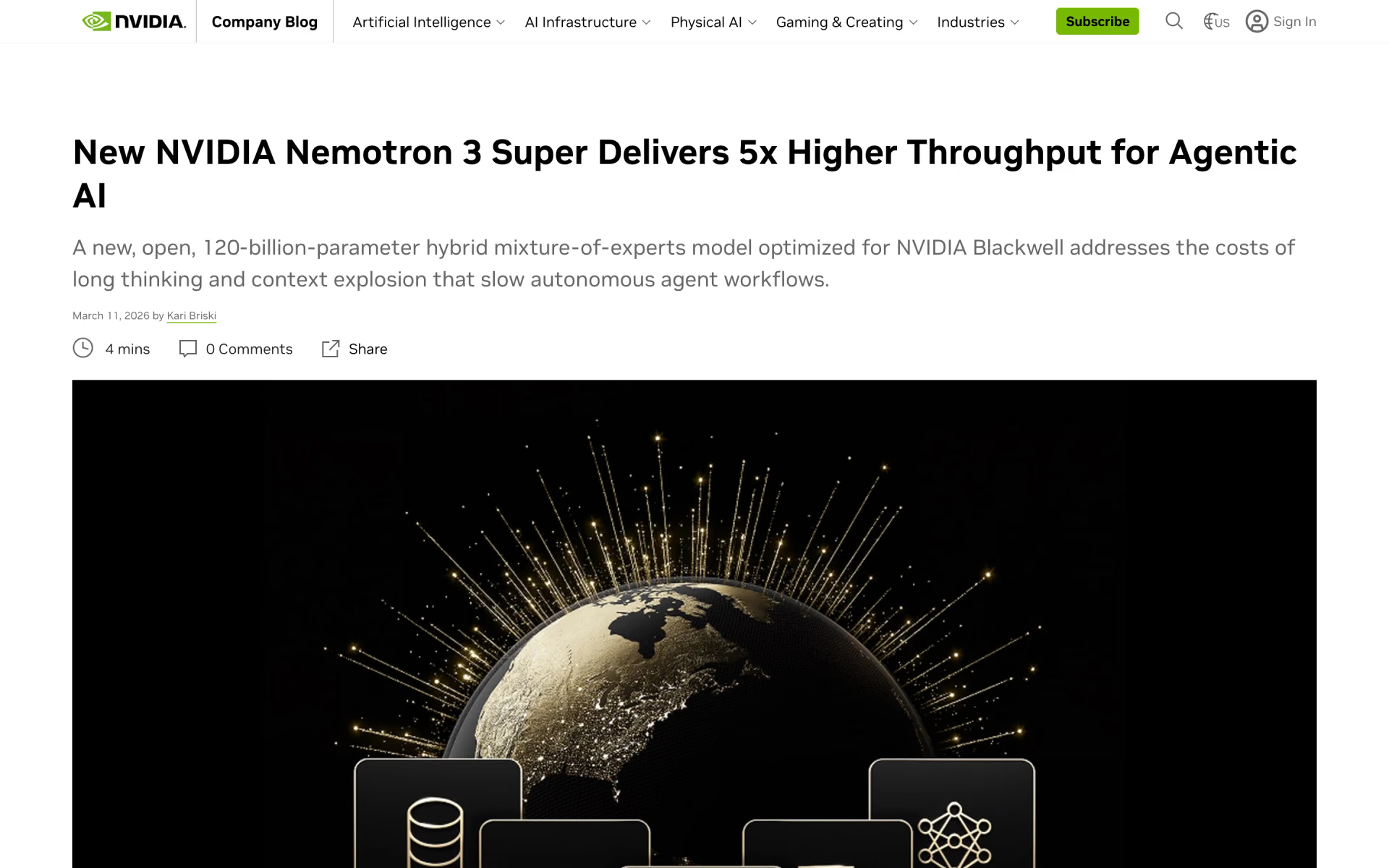
- Up to 5x the throughput and up to 2x the accuracy of the previous Nemotron Super, by NVIDIA's measure.
- Training
- Super and Ultra were pre-trained in NVIDIA's 4-bit NVFP4 format.
Who is Nemotron 3 best for?
Nemotron 3 is best for developers and companies that want open weights they can fine-tune and run commercially on their own NVIDIA hardware, from edge devices to multi-GPU servers, for agents and long-context work.
Self-hosted commercial agents
NVIDIA lets you run the weights in production for free, and every model card in the family allows commercial use.
Long documents and codebases
Nano 30B, Super and Ultra accept up to 1M tokens, and Ultra scores 95% on RULER at 1M in NVIDIA's tests.
Edge devices and workstations
Nano 4B targets Jetson, GeForce RTX and DGX Spark, and the NVFP4 build of Super runs on a single B200 or DGX Spark.
Teams that fine-tune
Published datasets, training recipes and reinforcement learning environments show what the models learned from, which helps when you tune them.
What's included with Nemotron 3?
Six open models from 4B to 550B, a hybrid Mamba-Transformer design, 1M-token context, reasoning budget control, NVFP4 builds and free trial endpoints.
- Sizes from edge to data center
- Nano 4B, Nano 30B, Nano Omni, Super 120B, Ultra 550B and Nemotron 3.5 Lightning, with BF16, FP8, NVFP4 or GGUF builds.
- Hybrid Mamba-Transformer design
- Mamba layers keep long contexts light on memory; NVIDIA measured Nano 30B at 3.3x the throughput of Qwen3-30B-A3B on one H200.
- Reasoning budget control
- You can cap how much the models think at inference time, trading accuracy for speed.
- Omni-modal Nano
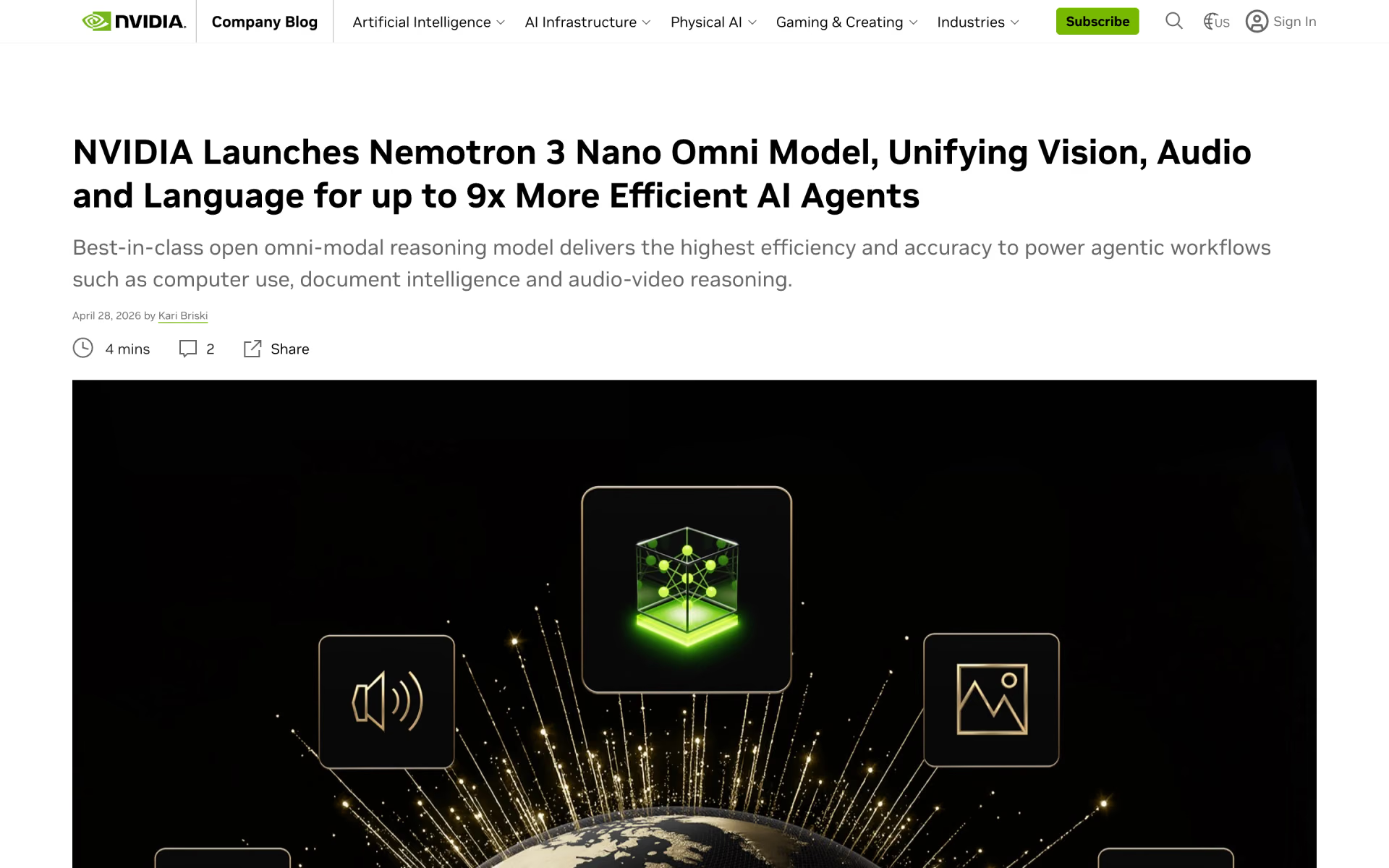
- Nano Omni reads video, audio, images and text with a 256K context, and its NVFP4 build fits one RTX 5090.
- 4-bit NVFP4 builds
- Super and Ultra were pre-trained in NVFP4, and Ultra's NVFP4 checkpoint runs on Hopper, Blackwell and Ampere GPUs.
- Free trial endpoints
- build.nvidia.com hosts Super, Ultra, Nano Omni and 3.5 Lightning behind an OpenAI-compatible API.
- On major clouds
- Super runs on Google Cloud Vertex AI and Oracle Cloud; Ultra on Amazon SageMaker JumpStart, Google Cloud and Microsoft Foundry.
How much does Nemotron 3 cost?
Nemotron 3 is free: NVIDIA lets you download the weights from Hugging Face and run them in production at no charge, and build.nvidia.com offers free trial endpoints; you pay only for GPUs, a hosting provider or NVIDIA AI Enterprise.
- Run in production at no charge, per NVIDIA
- Commercial use and fine-tuning allowed
- BF16, FP8, NVFP4 and GGUF builds
- Super, Ultra, Nano Omni and 3.5 Lightning
- Inputs and outputs are recorded under NVIDIA's API trial terms
- The Nano 30B free endpoint is deprecated
- Then priced by NVIDIA sales
- Needed to run Nemotron as NIM microservices in production
- Adds NVIDIA support and API stability
The weights cost nothing, but you pay for the GPUs that run them. Nano 4B, Nano 30B and Super use the NVIDIA Nemotron Open Model License, Ultra and 3.5 Lightning use OpenMDW 1.1, and Nano Omni uses the NVIDIA Open Model Agreement. Third-party providers such as OpenRouter, DigitalOcean and Together AI also host the models and charge per token at their own rates. Full pricing on nvidia.com. We checked these prices on .
Is Nemotron 3 still current?
Yes. NVIDIA keeps adding to the family, most recently Ultra and Nemotron 3.5 Lightning, and all the weights stay on Hugging Face.
- Newest model
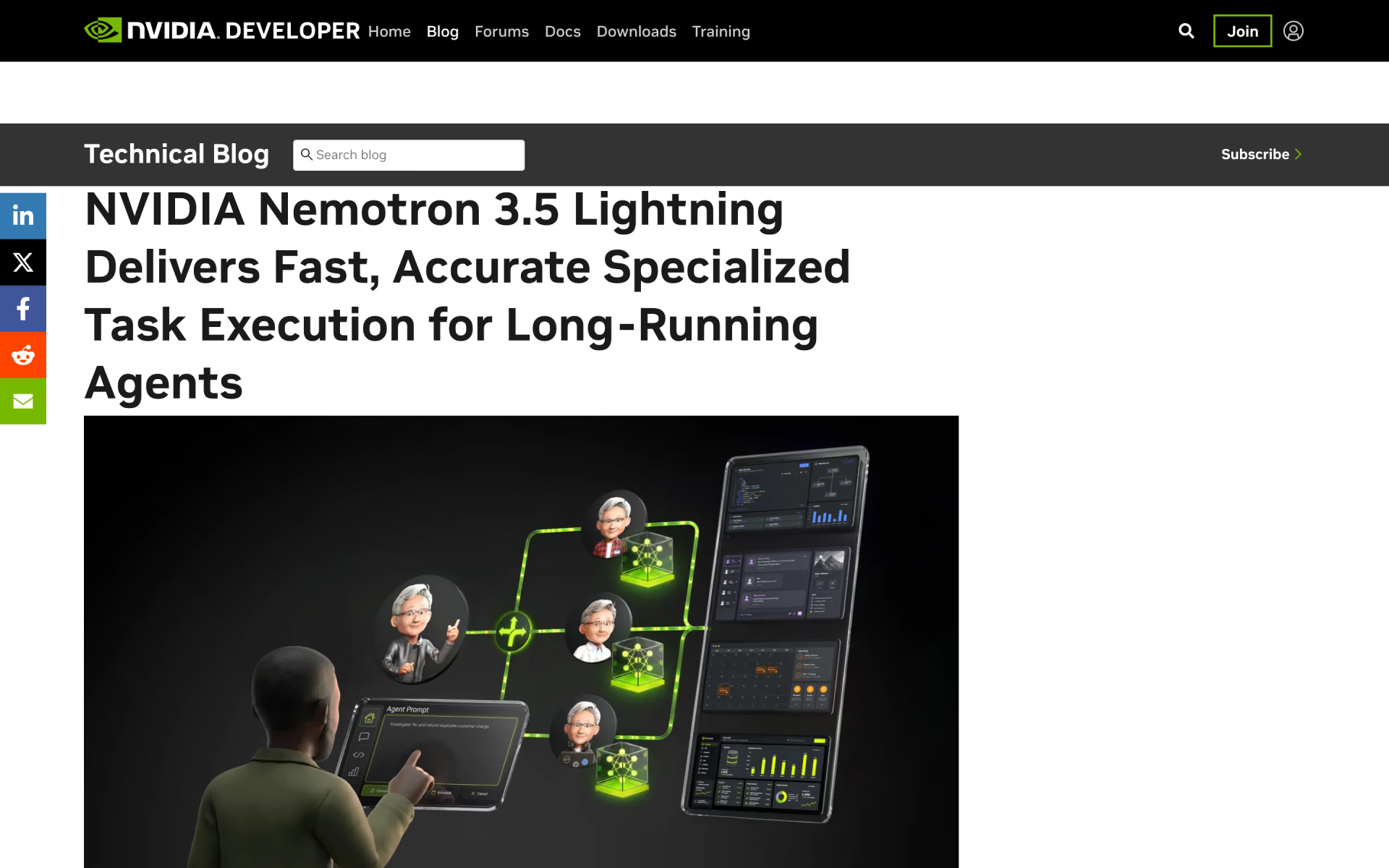
- Nemotron 3.5 Lightning, a 30B model with 3B active, built for fast, high-volume agent steps.
- Deprecated endpoint
- The free build.nvidia.com endpoint for Nano 30B is deprecated; its weights and partner endpoints remain.
- Still hosted free
- Super, Ultra, Nano Omni and 3.5 Lightning keep free trial endpoints on build.nvidia.com.
How do readers rate Nemotron 3?
No one has rated Nemotron 3 yet. Be the first.
Sign in to rate. One rating per account.
Nemotron 3 pros and cons
The models are unusually open and handle long contexts well, but many users find Qwen and Gemma better at coding, and the main models read text only.
Pros
- Long contexts stay usable: users running Nano and Super locally say speed holds past 100K tokens and that very long contexts fit in far less memory than on rival models.
- Unusually open: users praise NVIDIA for publishing training data, dataset statistics and recipes with the weights, which makes fine-tuning easier to get right.
- Reliable on narrow jobs: heavy users report high task compliance and tool-call success from the small models on well-defined tasks.
- Holds up at 1M tokens: NVIDIA's table has Ultra at 95% on RULER at 1M, where GLM 5.1 and Kimi K2.6 stop at 256K tokens.
Cons
- Qwen and Gemma often win: many Reddit and Hacker News users find Qwen3.5, Qwen3.6 and Gemma 4 better at coding and agent work, and NVIDIA's own table has Ultra at 70.7% on SWE-Bench Verified, below every other open model it lists.
- Text only, except Nano Omni: Nano, Super, Ultra and 3.5 Lightning do not read images, which users call the main trade-off against Qwen.
- Heavy for the names: users note that quantized Nemotron files run larger than rival models of the same size, and Ultra needs at least eight B200 or H200 GPUs, or 16 H100s.
- Speed claims are hard to reproduce: some users measured much smaller gains over GPT-OSS and Qwen than NVIDIA's charts show.
What are the best Nemotron 3 alternatives?
Three tools on Recaply do Nemotron 3's job. All three are open source, so you can run them on your own server.
 Qwen3.6-27BOpen Source
Choose it when coding is the main job; Alibaba reports 77.2% on SWE-bench Verified for this single 27B model, which also reads images and video.
 Gemma 4Open Source
Choose it when you need a small open model for phones or browsers that reads images and audio; its E2B and E4B models are built for mobile and edge use.
 DeepSeek V4.1 FlashOpen Source
Choose it when you want MIT-licensed weights plus a cheap hosted API; DeepSeek charges $0.30 / $1.20 per million tokens at peak for its 1M-context Flash model.
Questions about Nemotron 3
What is Nemotron 3?
Nemotron 3 is NVIDIA's family of open-weight models for AI agents, from a 4B edge model to the 550B Ultra, free to download, fine-tune and run commercially.
Who is Nemotron 3 for?
Nemotron 3 is best for developers and companies that want open weights they can fine-tune and run commercially on their own NVIDIA hardware, from edge devices to multi-GPU servers, for agents and long-context work.
Is Nemotron 3 free?
Yes. Nemotron 3 has a free Open weights plan: run in production at no charge, per NVIDIA.
Is there an open source alternative to Nemotron 3?
Yes. Qwen3.6-27B, Gemma 4 and DeepSeek V4.1 Flash are open source tools that do the same job, so you can run your own.
What are the best Nemotron 3 alternatives?
The closest alternatives on Recaply are Qwen3.6-27B, Gemma 4 and DeepSeek V4.1 Flash.
Where can I try Nemotron 3?
On its official website, huggingface.co.
Can I use Nemotron 3 commercially?
Yes. Nano and Super use the NVIDIA Nemotron Open Model License, Ultra and 3.5 Lightning use OpenMDW 1.1, and Nano Omni uses the NVIDIA Open Model Agreement; NVIDIA marks them all ready for commercial use. It says you can run them in production for free.
What hardware does Nemotron 3 need?
It depends on the size. Nano 4B runs on GeForce RTX cards, Jetson and DGX Spark; Nano Omni's NVFP4 build fits one RTX 5090; Super's NVFP4 build fits a single B200 or DGX Spark; Ultra needs at least eight B200 or H200 GPUs, or 16 H100s.
Which Nemotron 3 model should I use?
Use Nano 4B on edge devices, Nano 30B or 3.5 Lightning for fast, high-volume agent steps, and Super for multi-agent systems and high-volume work. Save Ultra for the hardest planning and reasoning, and pick Nano Omni when your inputs include video, audio or documents.
Can Nemotron 3 read images?
Only Nemotron 3 Nano Omni, which takes video, audio, images and text. Nano, Super, Ultra and 3.5 Lightning are text-in, text-out models, so pair them with Nano Omni or another vision model when screenshots or scans matter.
Is Nemotron 3 open source?
It is open weight with public recipes and much of the training data. Nano and Super use NVIDIA's own Nemotron Open Model License rather than a standard open-source licence, while Ultra and 3.5 Lightning use OpenMDW 1.1. All of them allow commercial use.
Our verdict
Nemotron 3 is the open model family to pick if you run NVIDIA GPUs and want weights and training data you can inspect, tune and ship.
The models cost nothing to license, handle long contexts well and come with unusually open data, but Qwen and Gemma models beat them on coding in several published tables and user reports.
- Skip it for
- Coding-first work, or image-heavy tasks unless you use Nano Omni.
- Check first
- Check which licence covers the size you plan to ship, since Nano and Super use a different licence from Ultra and 3.5 Lightning.

 NVIDIA Nemotron 3 Ultra
 Nemotron 3 Super
 Nemotron 3 Nano Omni
 Nemotron 3.5 Lightning
 LongCat-2.0

 Reflection Beam