PrismML's 1-bit LLMs that run on phones and laptopsAlternative to
 LFM3
 Gemini 3.5 Flash-Lite
5 open source tools do the job of GPT-5.4 mini & nano. About GPT-5.4 mini & nano
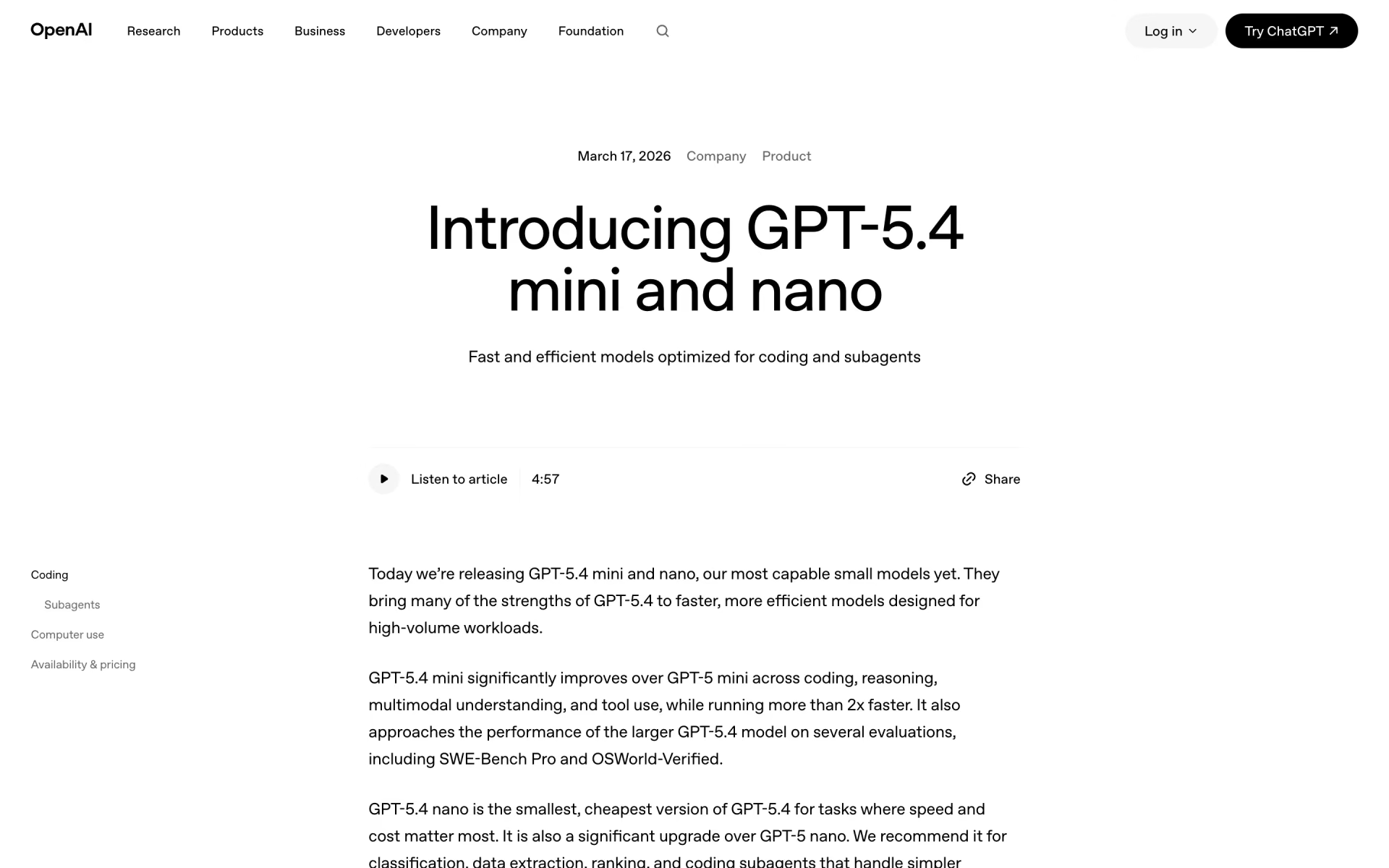
 GPT-5.4 mini & nanoPaid
 1-bit BonsaiApache 2.0Code
1-bit Bonsai is listed first. Choose 1-bit Bonsai when you need a small language model that runs offline on a phone or laptop instead of calling OpenAI's API.
Yes. The code of all 5 is public under Apache 2.0 or MIT, so you can use them with no licence fee. Running one yourself costs the server and your time to look after it, and some makers also sell a hosted plan.
Start from the job you use GPT-5.4 mini & nano for. Choose DeepSeek V4.1 Flash when price per token matters most; it costs $0.30 / $1.20 per million tokens at peak and half that off-peak, with a 1M-token context. Choose Holo3.1 when a small computer-use model must run on your own hardware, with a free API tier for testing.
All 5: 1-bit Bonsai, DeepSeek V4.1 Flash, Holo3.1, Mellum2 and Rnj-1. Each tool's page says what it needs to run.
Apache 2.0 (4), MIT (1). MIT, BSD and Apache let you change and reuse the code freely.
The hosting. GPT-5.4 mini & nano's maker runs the servers for you; with an open source tool the updates, backups, security fixes and support are yours, unless you take the maker's hosted plan. Features differ too, so check what each one imports and exports before you move your data.