
What is VOID?
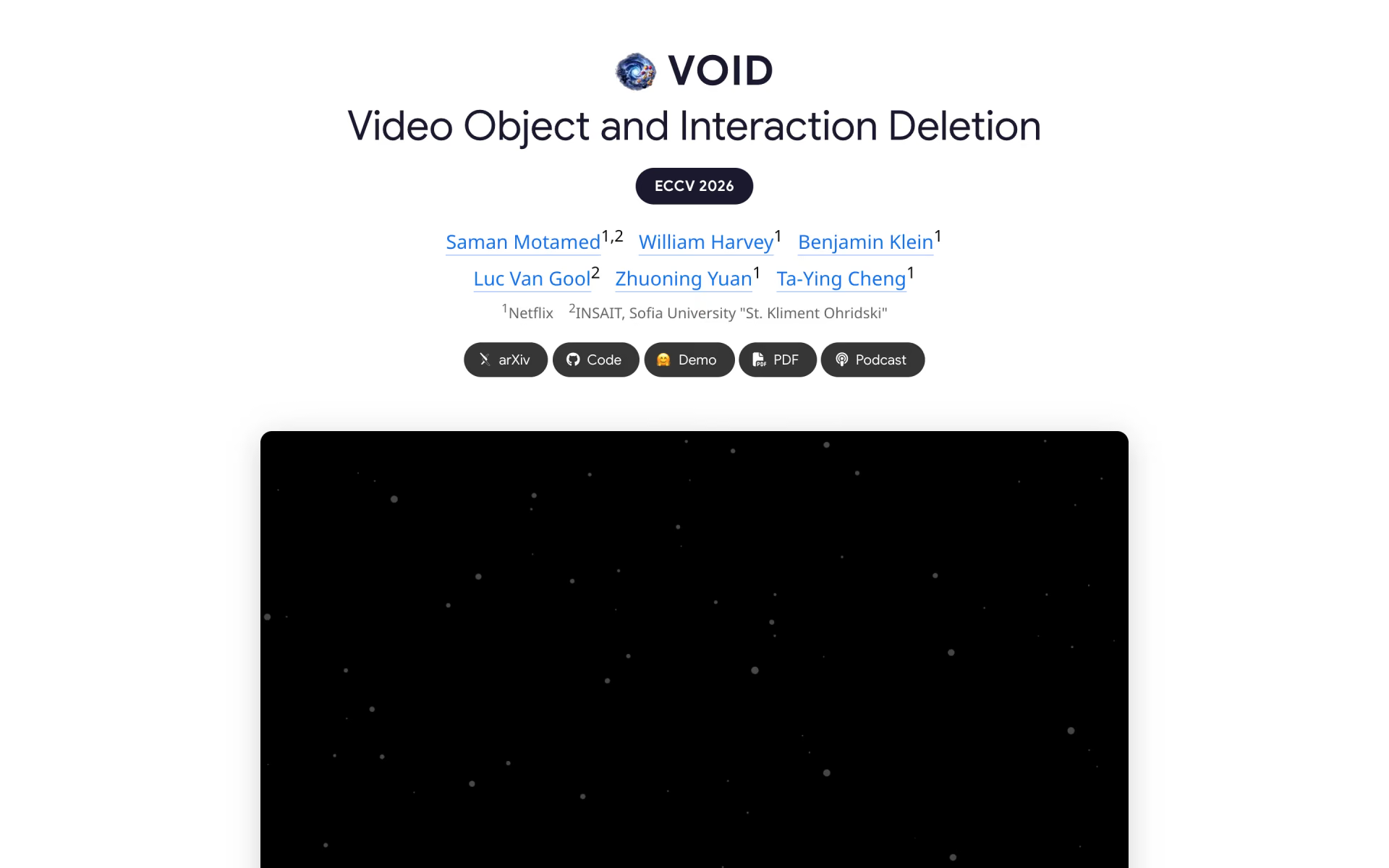
VOID, short for Video Object and Interaction Deletion, is a video inpainting model from Netflix and INSAIT at Sofia University. Most removal tools fill in the pixels behind an object and clean up its shadow; VOID also undoes what the object did, so a held guitar falls when the player is removed. SAM2 finds the object you click, Gemini (on your own API key) marks the areas it affected, and a fine-tuned CogVideoX model redraws them, with an optional second pass that stops shapes warping.
It is a free research release, not a product: there is no paid plan, hosted API or successor.
Who is VOID best for?
VOID is best for VFX and post-production teams testing physics-aware cleanup, video AI researchers, and anyone with a 40GB GPU who wants removal without per-second fees.
VFX and post-production tests
Removing crew, rigs or props where the rest of the scene has to react, such as objects someone was holding or pushing.
Video AI researchers
The code, both checkpoints and the pipeline that generates the training data are open, so you can retrain it or build on it.
Teams with a 40GB GPU
On an A100-class card it runs locally with no per-second fees, which matters when you process many shots.
Comparing removal methods
Netflix's project page shows VOID side by side with ProPainter, DiffuEraser, Runway and three other removers on the same clips.
What's included with VOID?
Interaction-aware masks, click-to-mask reasoning with SAM2 and Gemini, two inference passes, a mask editor and the full training pipeline.
- Interaction-aware masks
- A four-value quadmask separates the object, where it overlaps its effects, the area it affects, and the background to keep.
- Click-to-mask reasoning
- SAM2 segments the object you click, and Gemini works out which other parts of the scene will change once it is gone.
- Two inference passes
- Pass 1 removes the object and its effects; Pass 2 re-runs with flow-warped noise to keep shapes stable on longer clips.
- Mask editor
- A desktop editor lets you fix the generated mask frame by frame, with a grid, a brush and copy from the previous frame.
- Training pipeline
- Scripts rebuild the Kubric and HUMOTO counterfactual training videos and fine-tune both passes from the CogVideoX base.
- Colab notebook
- Sets up the models and runs a sample clip in one go, though it still needs a 40GB GPU.
How does VOID work?
Click the object
Open the clip in the point selector and click what should disappear.
Build the mask
The pipeline runs SAM2 and Gemini to mark the object and everything it affects; fix the result in the mask editor if needed.
Describe the result
Write one line describing the scene after the removal, not the removal itself.
Run the passes
Pass 1 renders the new video; run Pass 2 as well if objects start to morph.
How much does VOID cost?
VOID is free: Netflix publishes the code and weights under Apache 2.0 and there is a free Hugging Face demo, but you supply the 40GB GPU and pay Google for the Gemini calls.
- Pass 1 and Pass 2 checkpoints on Hugging Face
- Needs a GPU with 40GB+ VRAM, such as an A100
- Training and data-generation code included
- Gradio demo by the paper's first author
- Sample clips to try
- Runs on Hugging Face's shared ZeroGPU hardware
Netflix sells no paid plan or API for VOID. The mask step calls Gemini through the Google AI API, billed by Google to your own key. VOID also downloads Alibaba PAI's CogVideoX-Fun 5B base model, whose CogVideoX License is free for research but asks commercial users to register for a licence. Full pricing on github.com. We checked these prices on .
How do readers rate VOID?
No one has rated VOID yet. Be the first.
Sign in to rate. One rating per account.
VOID pros and cons
It handles the knock-on physics other removers ignore and is fully open, but it needs a big GPU, outputs small, short clips and takes real setup work.
Pros
- People who tried the examples single out the physics: objects that were held fall and blocked collisions play out, which classic inpainting tools leave untouched.
- Code and weights are open under Apache 2.0, which users call rare for a studio the size of Netflix.
- Filmmakers see a practical VFX aid for taking out crew, boom mics, rigs or missed props, work that is otherwise done frame by frame by hand.
Cons
- Needs a 40GB GPU as released; one GitHub user fit the first pass into about 6GB with CPU offloading, but each run took around five minutes.
- Output is small and short: 85 frames at 12 fps and 384 x 672 pixels by default, and users found it changes a clip's length, frame rate and aspect ratio.
- Setup is real work, with SAM2 and SAM3 installs, a Gemini API key, a mask for every clip and a 5B base model to download; testers say it is not a one-click tool.
- Results can still wobble: testers point to shapes that morph and interactions it misses, such as tops that stay upright after the hands holding them are removed.
Is VOID open source?
Yes. VOID's code is public under the Apache 2.0 licence, so you can run it on your own server.
On GitHub
2,002stars
- Last commit
- 20 Jun
- Repository age
- 8 months
- Licence
- Apache 2.0
- Self-hosted
- Yes
- Repository
- netflix/void-model
What are the best VOID alternatives?
VOID is an open source alternative to Runway Aleph and Lucy 2.5.
 Runway AlephPaid
Choose it when you want removal from a typed prompt in the browser, on clips up to 30 seconds at 1080p with no GPU to manage; it costs 140 credits per 5 seconds, on plans from $15 a month.
 Lucy 2.5Freemium
Choose it when objects have to go from live or streamed video through an API; Decart bills $0.02 a second in real time, or $0.04 per edited second at 720p.
Questions about VOID
What is VOID?
VOID is Netflix's open research model for video editors and VFX teams: it removes an object from a clip along with the effects it caused, so a guitar falls once its player is gone.
Who is VOID for?
VOID is best for VFX and post-production teams testing physics-aware cleanup, video AI researchers, and anyone with a 40GB GPU who wants removal without per-second fees.
Is VOID free?
Yes. VOID has a free Open weights plan: pass 1 and Pass 2 checkpoints on Hugging Face.
Is VOID open source?
Yes. VOID's code is public under the Apache 2.0 licence, so you can run it on your own server.
What are the best VOID alternatives?
The closest alternatives on Recaply are Runway Aleph and Lucy 2.5.
Where can I try VOID?
On its official website, void-model.github.io.
Can I use VOID for commercial work?
VOID's own code and weights are under Apache 2.0, which allows commercial use. It also needs Alibaba PAI's CogVideoX-Fun 5B base model, whose CogVideoX License is free for research but asks commercial users to register for a basic commercial licence first.
Can VOID run on a 12GB or 16GB graphics card?
Netflix recommends a GPU with 40GB or more, such as an A100. The code has CPU offload memory modes, and one user on GitHub ran the first pass in about 6GB that way, though each run took around five minutes.
Can VOID remove watermarks or subtitles?
Nobody has shown it yet. The paper's first author says VOID and the models it was compared with were never tested on static text or caption removal; it was built to remove physical objects and what they cause.
How long a video can VOID process?
By default VOID outputs 85 frames at 12 fps, about seven seconds, at 384 x 672 pixels, and it resamples your clip to fit. The config allows up to 197 frames, and the paper names longer, sharper output as future work.
Can VOID remove me but keep an object I was moving?
No. VOID is trained to drop any motion the removed object caused, so something you carried would stay put or fall. Its first author points people who want the motion kept to classic video inpainting models instead.
Our verdict
VOID is the open model to test when a removal has to change what happens in the shot, not just what is visible.
Netflix's own 25-person test picked its results 64.8% of the time, far ahead of Runway, and the code and weights are free under Apache 2.0.
- Skip it for
- Quick cleanups on a laptop, long or high-resolution footage, and anyone who wants a one-click tool.
- Check first
- Check the CogVideoX base model's licence before commercial use, and that you have a 40GB GPU.
 Vidi2
 LTX-2

 Pika H3 Flex

 NVIDIA Cosmos 3

 LTX-2.3

 HeyGen Video