
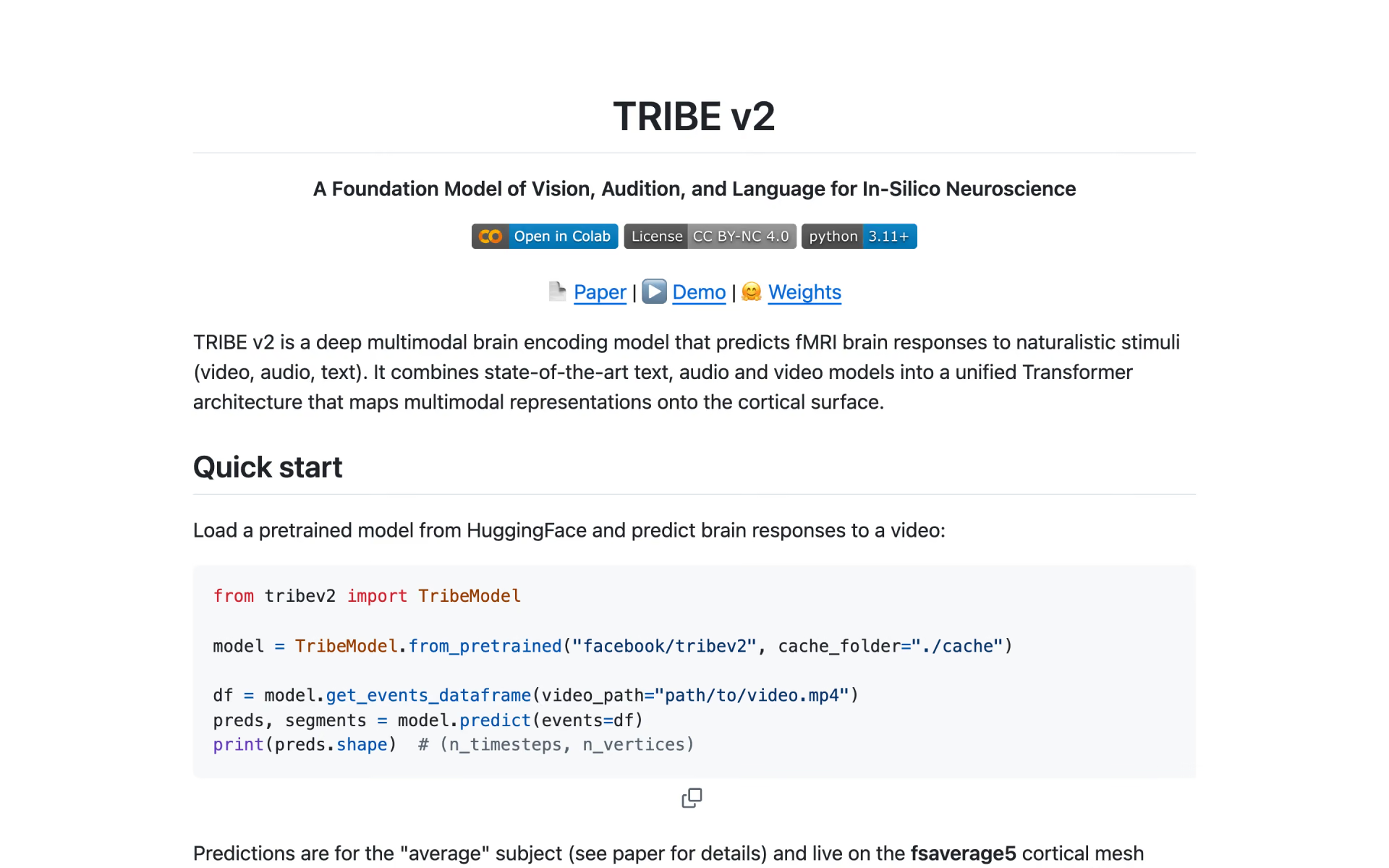
What is TRIBE v2?
TRIBE v2 is a brain encoding model from Meta's FAIR research lab. Give it a video, an audio clip or a text and it predicts the fMRI activity of an average person across about 20,000 points on the cortex, with a separate checkpoint for 8 deeper brain regions. It feeds features from Llama 3.2, V-JEPA 2 and Wav2Vec-BERT into one Transformer.
Its predecessor learned from 4 volunteers; TRIBE v2 draws on scans of 720 people, which lets it predict responses for new people, tasks and languages without retraining. It is Meta's current version. There is no paid plan or API, and the licence rules out commercial use.
What changed from TRIBE v1?
Far more data and much finer detail: it learned from 720 people instead of 4, and it predicts activity at a far higher resolution.
- Data
- Scans from 720 people, over 1,000 hours in all, instead of 4 volunteers.
- Resolution
- Meta describes whole-brain predictions across 70,000 voxels, against 1,000 cortical predictions for TRIBE v1; the public checkpoint covers about 20,000 cortical points.
- New people
- Predicts responses for people, tasks and languages it never saw, without retraining.
Who is TRIBE v2 best for?
TRIBE v2 is best for neuroscientists planning or pre-testing brain-imaging studies, researchers testing theories in simulation, and AI researchers comparing models with the brain.
Planning brain-imaging studies
Simulate the expected brain response to a stimulus before booking scanner time, and pre-screen a study design.
Testing theories in simulation
It recovers known brain areas for faces, places, bodies, speech and meaning, so you can check an idea against a simulated brain first.
Brain-inspired AI research
Meta names guiding AI design toward how the brain handles sight, sound and language as one of its main uses.
Groundwork for clinical research
Meta pitches it as a base for work on brain disorders, though it has so far learned only from healthy adults.
What's included with TRIBE v2?
Video, audio and text inputs, zero-shot predictions, fine-tuning on new people, cortex and subcortical checkpoints, plotting and training code, and a web demo.
- Three inputs
- Video, audio and text, alone or together; text is turned into speech to get word-level timing.
- Zero-shot predictions
- Predicts responses to new stimuli, tasks and people without retraining.
- Fine-tuning on new people
- The subject layer can be retrained on a new person's scans for individual predictions.
- Cortex and deeper regions
- The main checkpoint covers about 20,000 cortical points, and a separate one covers 8 subcortical regions.
- Brain plots
- Optional plotting tools draw predictions on the brain surface, with a Colab notebook to start from.
- Training code
- Scripts and configs to retrain the model on your own fMRI studies, including grids for Slurm clusters.
- Web demo
- Meta's demo plays 15 prepared clips with recorded and predicted brain activity side by side.
How does TRIBE v2 work?
Install
Clone the GitHub repository and install it with pip on Python 3.11 or newer.
Get Llama access
The text features come from Meta's gated Llama 3.2 3B, so accept its terms on Hugging Face and log in.
Load and predict
Load facebook/tribev2, pass a video, audio or text file, and get predicted activity for each time step.
Plot the results
Draw the predictions on a brain surface with the plotting extra, or compare brain regions.
How much does TRIBE v2 cost?
TRIBE v2 is free: Meta publishes the code and weights at no cost under a non-commercial licence, with no paid plan, API or commercial option.
- Code on GitHub, weights on Hugging Face
- CC BY-NC 4.0: non-commercial use only
- Runs on your own GPU or cloud account
- 15 prepared clips, recorded and predicted activity
- No uploads of your own video, audio or text
Meta lists no paid plan, API or commercial licence for TRIBE v2. The only cost is your own compute: the default settings expect an NVIDIA GPU, and the text encoder is Meta's gated Llama 3.2 3B, which needs a Hugging Face account. Full pricing on github.com. We checked these prices on .
How do readers rate TRIBE v2?
No one has rated TRIBE v2 yet. Be the first.
Sign in to rate. One rating per account.
TRIBE v2 pros and cons
It is free, open and generalises to new people and tasks, but the licence bars commercial use and setup needs a GPU and some patience.
Pros
- Code, weights, paper and a web demo are all free, so labs can run, check and retrain it themselves.
- It predicts responses for new people and tasks without retraining, and Meta reports 2 to 3x gains over standard methods on sound and vision data.
- In simulated experiments it recovers well-known brain areas for faces, places, bodies, speech and meaning.
- Meta reports that its predictions often match a group's average response better than a single real scan, which is noisy.
Cons
- The CC BY-NC licence rules out commercial uses such as ad testing, Meta lists no commercial licence, and several companies have asked for one on GitHub.
- Setup is fragile: users on GitHub report clean installs breaking on Google Colab over dependency versions, and the default settings expect an NVIDIA GPU, so Mac, CPU and Windows runs need fixes.
- The released model predicts an average brain, not a specific person, and fMRI's slow signal means it cannot show millisecond-level activity.
- It covers sight, sound and language only, learned from healthy adults, and treats people as passive viewers rather than acting or unwell.
What are the best TRIBE v2 alternatives?
Neurons for commercial ad testing, RealEye for eye tracking and facial coding with real participants, and Adsata for a free eye-tracking trial.
 NeuronsPaid
Choose it when you want to pre-test ads for a business: it scores attention, engagement and memory on ads under a paid licence, which TRIBE v2's licence rules out; prices come by quote.
 RealEyeFreemium
Choose it when you need data from real people rather than a model: it runs webcam eye-tracking, facial coding and survey studies, with education licences from $49 a month.
 AdsataFreemium
Choose it when you want to try measured attention for free: its Free plan gives 10 webcam eye-tracking sessions on preset images, and Explore costs €160 a month.
Questions about TRIBE v2
What is TRIBE v2?
TRIBE v2 is Meta FAIR's open research model that predicts how an average person's brain responds in fMRI to video, audio and text, so neuroscientists can test ideas without scanning people every time.
Who is TRIBE v2 for?
TRIBE v2 is best for neuroscientists planning or pre-testing brain-imaging studies, researchers testing theories in simulation, and AI researchers comparing models with the brain.
Is TRIBE v2 free?
Yes. TRIBE v2 has a free Open weights plan: code on GitHub, weights on Hugging Face.
What are the best TRIBE v2 alternatives?
The closest alternatives on Recaply are Neurons, RealEye and Adsata.
Where can I try TRIBE v2?
On its official website, github.com.
Can I use TRIBE v2 for commercial work or ad testing?
No. TRIBE v2 is released under CC BY-NC 4.0, which allows sharing and changes but not commercial use, and Meta lists no commercial licence. Businesses that want attention or brain-response scores for ads need a commercial product instead.
Can TRIBE v2 read my thoughts?
No. TRIBE v2 works in one direction: it predicts the brain response a video, sound or text should cause in an average person. It takes no brain recordings as input and does not decode what anyone is thinking.
What do I need to run TRIBE v2?
Python 3.11 or newer, a Hugging Face account with access to Meta's gated Llama 3.2 3B model, and, with the default settings, an NVIDIA GPU. Meta's Colab notebook walks through a first prediction with brain plots.
Can I try TRIBE v2 without installing anything?
Partly. Meta's web demo shows 15 prepared clips with recorded and predicted brain activity side by side, but it does not take your own files. To test your own video, audio or text, use the Colab notebook or install the code.
Our verdict
TRIBE v2 is worth a neuroscience lab's time, but it is a research model, not a product.
It predicts brain responses for new people and tasks from video, audio and text, with free code and weights, but the licence bars commercial use and setup takes a GPU and some patience.
- Skip it for
- Marketers and startups hoping to score ads or content, since the licence rules out commercial use.
- Check first
- Make sure your project is non-commercial and that you have a GPU and access to Llama 3.2 on Hugging Face.
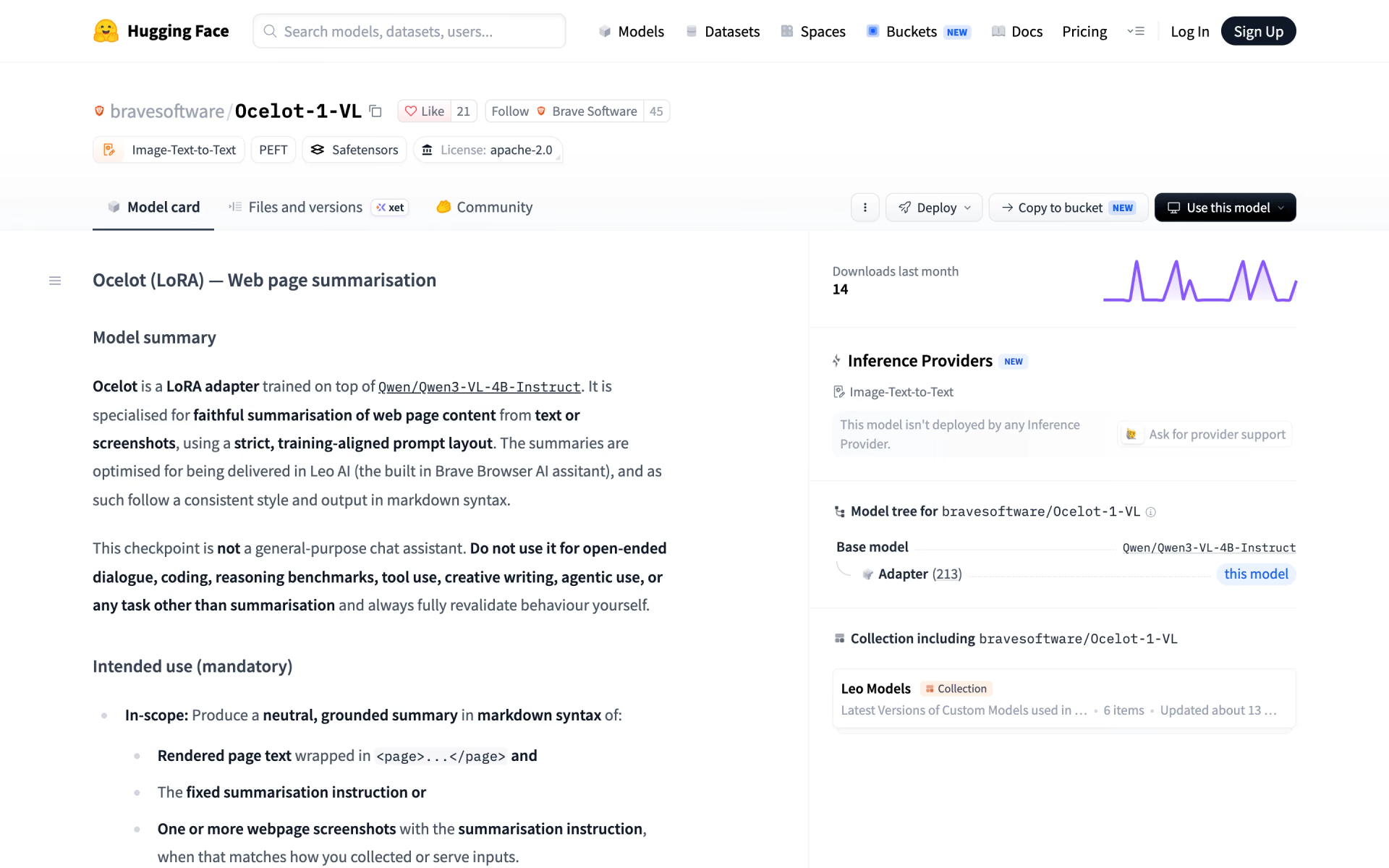
 Brave Ocelot
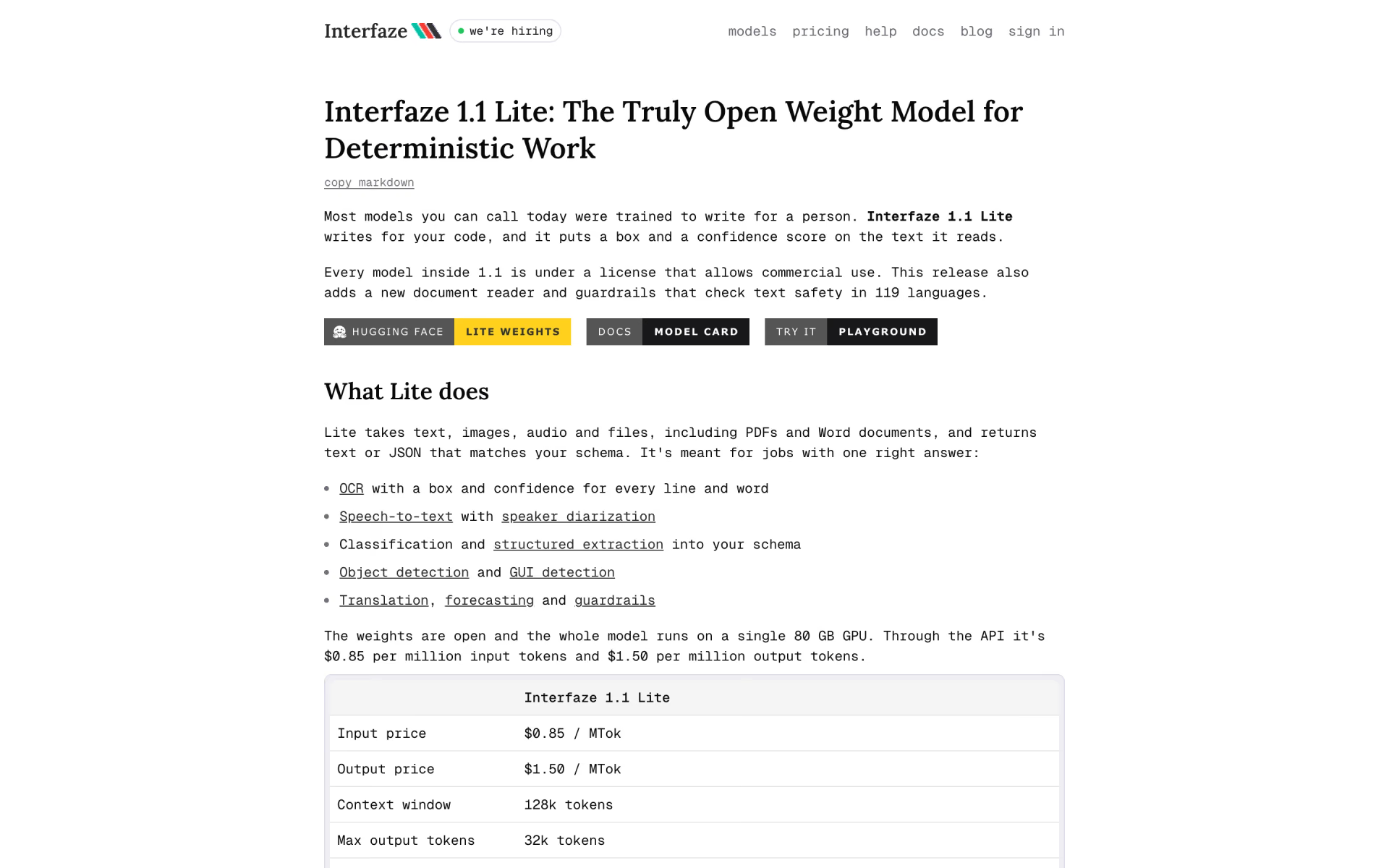
 Interfaze 1.1 Lite
 Hydrogen-1.0
 Biohub ESM

 MiroThinker

 Nomos 1