
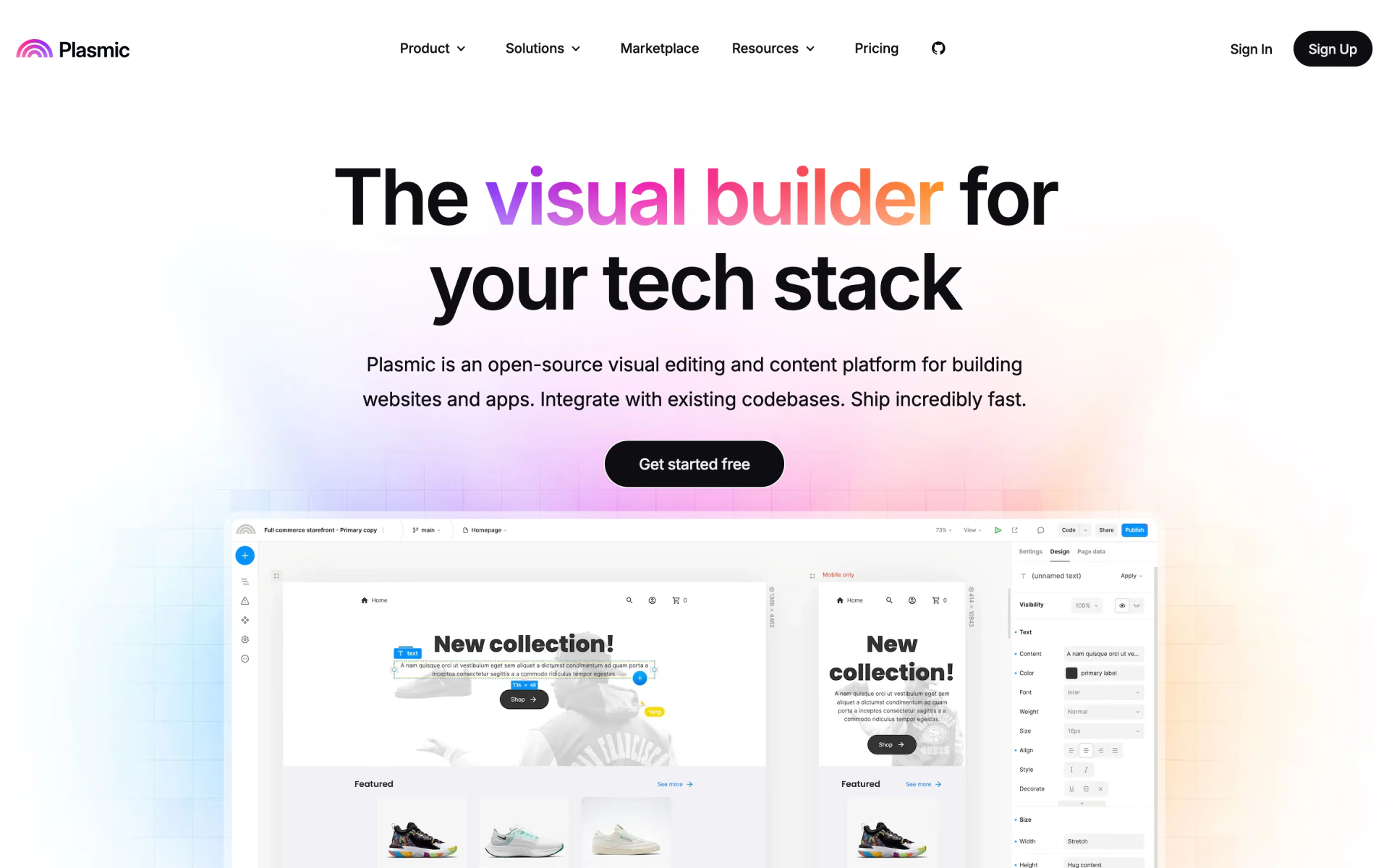
What is Plasmic?
Visual editor for websites and internal apps that drops into React and Next.js codebases.
Who is Plasmic best for?
Plasmic is best for React teams who want marketers to build pages visually from the team's own components.
Marketing pages in a React app
Marketers drag your registered React components onto the canvas to build landing pages in a Next.js site, with design guardrails.
Internal tools and portals
Developers and technical users build admin panels, client portals and business apps with data sources, roles and user permissions.
Teams coming from Figma
Figma designs import as DOM and CSS, and the editor adds components, variants, slots, multiplayer editing and branching.
Teams that want to own the platform
The Studio source is public, so it can be forked and run on your own server.
How much does Plasmic cost?
Plasmic is free to self-host and has a free hosted plan for 3 collaborators; paid plans start at $49 a month for Starter, or $39 a month billed yearly.
- Studio and codegen from the public repository
- Docker Compose with PostgreSQL
- Community forum support
- 3 collaborators, unlimited projects
- Headless CMS and custom domains
- Plasmic badge on Plasmic-hosted sites
- 3 collaborators
- No Plasmic badge, custom favicon
- AI support chat
- 4 collaborators included, up to 10
- $20 for each extra collaborator
- Priority support and Plasmic AI (beta)
Scale costs $499 a month for 8 to 30 collaborators, with content creator mode, A/B testing and scheduled content; extra collaborators are $40 each. Billed yearly, Starter is $39, Pro $103 and Scale $399 a month. Enterprise adds SSO, custom roles, white labeling and SLAs at a custom price. Full pricing on plasmic.app. We checked these prices on .
How do readers rate Plasmic?
No one has rated Plasmic yet. Be the first.
Sign in to rate. One rating per account.
Is Plasmic open source?
Yes. Plasmic's code is public under the MIT licence, so you can run it on your own server.
On GitHub
7,163stars
+65 (+0.9%) in the last 30 days
- Last commit
- 12 Nov
- Repository age
- 5 years
- Licence
- MIT
- Self-hosted
- Yes
- Repository
- plasmicapp/plasmic
What are the best Plasmic alternatives?
Plasmic is an open source alternative to Builder.io, Framer and Retool. ToolJet, Onlook and Appsmith do the same job and are open source too.
 Builder.ioFree
Lets designers, PMs and marketers change UI in a live codebase and ship it as pull requests.
 FramerFree
Responsive websites with AI layouts and a built-in CMS.
 RetoolFree
Prompt-built internal apps, agents and workflows on your data.
 ToolJetOpen Source
Internal tools built from plain language, open source.
 OnlookOpen Source
Designers editing directly in the real codebase.
 AppsmithOpen Source
Low-code builder for admin panels, dashboards and internal tools on top of your databases and APIs.
Questions about Plasmic
What is Plasmic?
Visual editor for websites and internal apps that drops into React and Next.js codebases.
Who is Plasmic for?
Plasmic is best for React teams who want marketers to build pages visually from the team's own components.
Is Plasmic free?
Yes. Plasmic has a free Self-hosted plan: studio and codegen from the public repository.
How much does Plasmic cost?
Plasmic's paid plans are Starter at $49 per month and Pro at $129 per month.
Is Plasmic open source?
Yes. Plasmic's code is public under the MIT licence, so you can run it on your own server.
What are the best Plasmic alternatives?
The closest alternatives on Recaply are Builder.io, Framer, Retool, ToolJet, Onlook and Appsmith.
Where can I try Plasmic?
On its official website, plasmic.app.
Can I self-host Plasmic Studio?
Yes. The Studio editor and codegen engine sit in the platform folder of Plasmic's public repository under AGPL-3.0, and Plasmic's setup guide runs them with Docker Compose and PostgreSQL, locally or on a remote server. Most teams use the hosted Studio and self-host only the pages it builds.
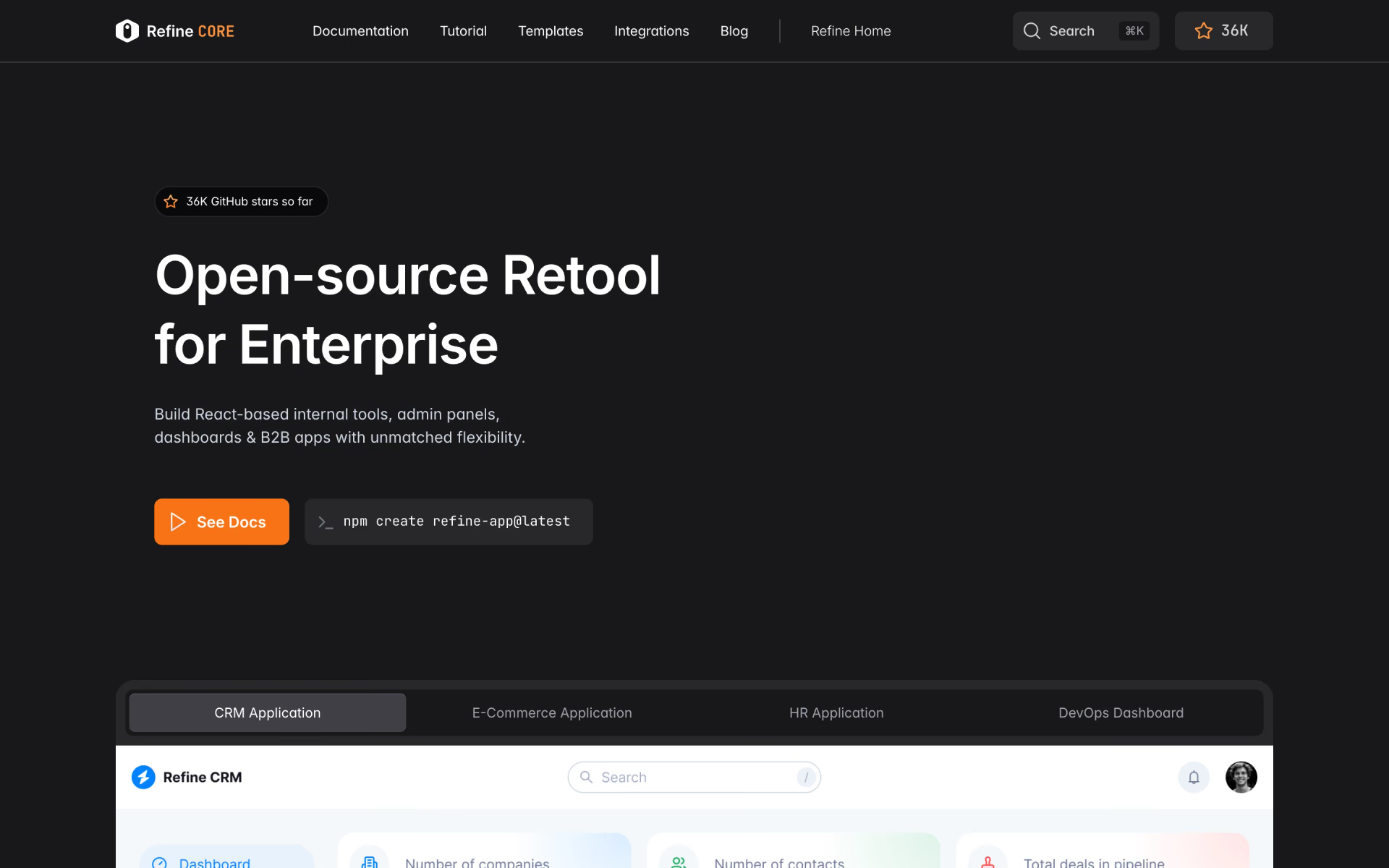
 Refine

 Nodlume

 Webstudio

 Codejet

 Creative AI

 Reflex