
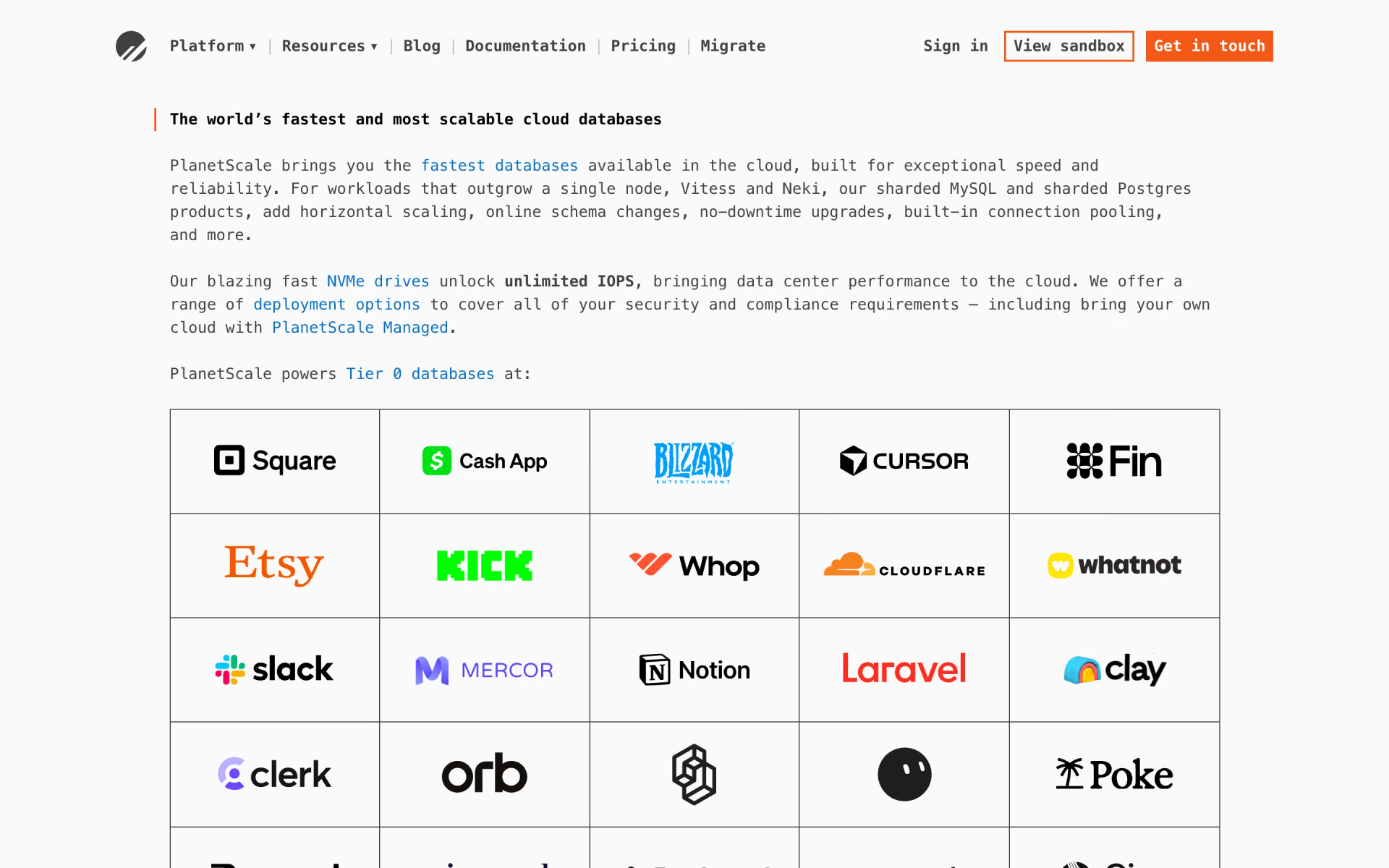
What is PlanetScale?
Database clusters for Postgres and Vitess MySQL with branching, query insights and sharding at scale.
Who is PlanetScale best for?
PlanetScale is best for engineering teams running busy production databases that need sharding, branching and fast NVMe storage.
MySQL databases that outgrow one server
Vitess, which PlanetScale's founders built at YouTube, shards MySQL across many nodes behind one connection.
Fast production Postgres
Metal clusters run on locally attached NVMe drives, with a primary and two replicas in each cluster.
Schema changes without downtime
Development branches and deploy requests let teams test a schema change and apply it online.
Finding slow queries
Insights shows how each query performs in production, and Schema Recommendations suggest changes.
How much does PlanetScale cost?
PlanetScale has no free plan; Postgres starts at $5 a month for a single node and $15 for a three-node high-availability cluster, and Vitess MySQL clusters start at $39 a month.
- Smallest size: 1/16 vCPU and 512 MiB
- No replicas; for development and light traffic
- 10 GB of storage included
- 1 primary and 2 replicas in 3 zones
- Automatic failover
- 10 GB of storage included
- MySQL-compatible cluster with 3 nodes
- 1/8 vCPU and 1 GiB per node
- 10 GB of storage included
- Postgres on local NVMe drives
- Storage comes with the size you pick
- For heavy production workloads
Prices are the smallest sizes in AWS us-east-1 and vary by cloud and region; backups, egress and extra storage are billed on top. Neki, sharded Postgres, starts at $30 a month per shard plus routers and storage. Single sign-on is $199 a month per organization. Enterprise adds bring-your-own-cloud, a shared Slack channel and custom pricing. New accounts are capped at mid-size clusters until they have paid an invoice of at least $100. Full pricing on planetscale.com. We checked these prices on .
How do readers rate PlanetScale?
No one has rated PlanetScale yet. Be the first.
Sign in to rate. One rating per account.
How do I connect PlanetScale to my AI agent?
PlanetScale MCP is PlanetScale's official MCP server. Add it to your agent once, then ask it to query PlanetScale databases and read Insights on slow queries.
Your agent can work with your PlanetScale databases and branches and read Insights, so you can check schema, run queries and find what is slowing things down.
$ claude mcp add --transport http planetscale https://mcp.pscale.dev/mcp/planetscale
Claude Code connects to PlanetScale over the web.
Run /mcp and sign in to PlanetScale in the browser.
Then ask your agent
- Runs
- On the web
- Sign-in
- OAuth
- Checked
- Answered 13 Nov
- Guide
- planetscale.com
What are the best PlanetScale alternatives?
Three tools on Recaply do PlanetScale's job. TiDB and Supabase are open source, so you can run them on your own server.
 NeonFree
Postgres service that branches like code and scales to zero, with auth and file storage alongside.
 TiDBOpen Source
MySQL-compatible distributed SQL database that scales out for transactions, analytics and AI search.
 SupabaseOpen Source
Dedicated Postgres per project, plus sign-in, file buckets, edge functions and realtime.
Questions about PlanetScale
What is PlanetScale?
Database clusters for Postgres and Vitess MySQL with branching, query insights and sharding at scale.
Who is PlanetScale for?
PlanetScale is best for engineering teams running busy production databases that need sharding, branching and fast NVMe storage.
Is PlanetScale free?
No. PlanetScale dropped its free Hobby plan, and every database needs a paid plan. The cheapest option is a single-node Postgres database from $5 a month, meant for development and low-traffic apps.
How much does PlanetScale cost?
PlanetScale's paid plans are Postgres single node at $5 per month, Postgres high availability at $15 per month, Vitess at $39 per month and Metal at $50 per month.
Does PlanetScale have an MCP server?
Yes. PlanetScale MCP is PlanetScale's official MCP server, so agents such as Claude Code, Cursor, Codex and GitHub Copilot can query PlanetScale databases and read Insights on slow queries. PlanetScale runs it on the web and you sign in with your PlanetScale account.
Is there an open source alternative to PlanetScale?
Yes. TiDB and Supabase are open source tools that do the same job, so you can run your own.
What are the best PlanetScale alternatives?
The closest alternatives on Recaply are Neon, TiDB and Supabase.
Where can I try PlanetScale?
On its official website, planetscale.com.

 Xano

 VictoriaMetrics
 Appwrite
 GreptimeDB

 Sevalla
 NeverBlink AI