
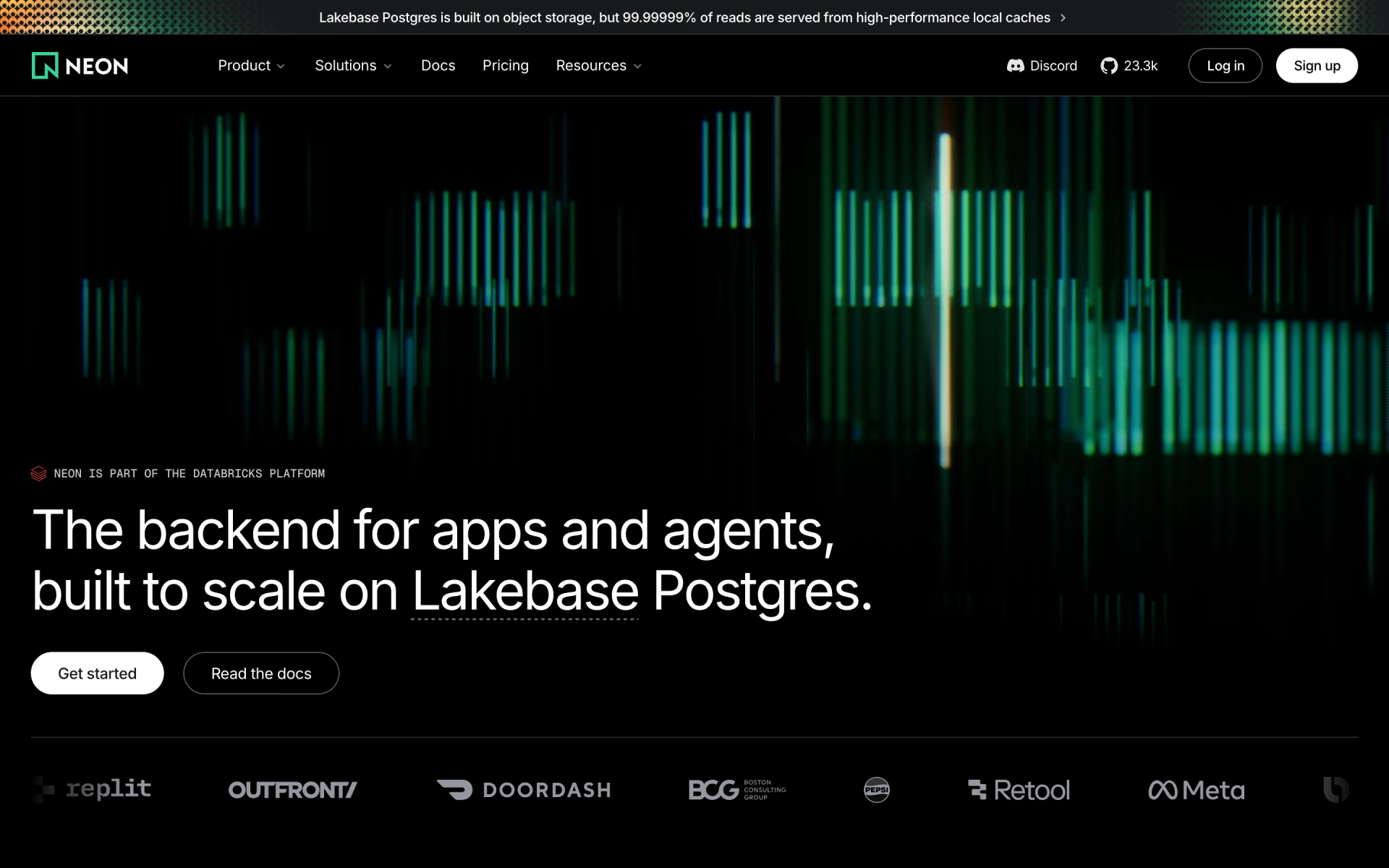
What is Neon?
Postgres service that branches like code and scales to zero, with auth and file storage alongside.
Who is Neon best for?
Neon is best for app builders and agent platforms that run many Postgres databases and branch them often.
Prototypes and side projects
The Free plan gives 100 projects with no credit card, and idle databases scale to zero instead of being paused.
Preview environments per pull request
Copy-on-write branches copy a database, with its auth users, storage buckets and functions, for tests and previews.
Platforms that generate apps
Neon runs the databases behind app-generation agents such as Replit and v0, and its Agent Plan sets custom limits for thousands of databases.
Spiky or part-time traffic
Compute autoscales with load and bills per CU-hour, so a quiet database costs little between bursts.
How much does Neon cost?
Neon has a free plan with 100 projects and 100 CU-hours of compute each a month; paid plans bill by use, at $0.106 per CU-hour on Launch and $0.222 on Scale, plus $0.35 per GB-month of storage.
- 100 projects with 100 CU-hours of compute each a month
- 1 GB of storage per project, compute up to 2 CU
- No credit card, and idle projects are never paused
- Storage at $0.35 per GB-month
- Compute up to 16 CU (64 GB RAM)
- Neon puts a small intermittent app at about $15 a month
- Storage at $0.35 per GB-month
- Compute up to 56 CU (224 GB RAM), 1,000+ projects
- SLAs, HIPAA and private networking
Launch and Scale have no fixed fee: you pay for the compute and storage you use, and compute scales to zero after 5 minutes idle. Branches beyond the 10 (Launch) or 25 (Scale) included per project cost $1.50 a branch-month, and instant restore history is $0.20 per GB-month. A free project that uses its 100 CU-hours or 5 GB of transfer is suspended until the next month. Funded startups can apply for up to $100k in credits, and platforms that create databases for their users can apply for the Agent Plan. Full pricing on neon.com. We checked these prices on .
How do readers rate Neon?
No one has rated Neon yet. Be the first.
Sign in to rate. One rating per account.
How do I connect Neon to my AI agent?
Neon MCP is Neon's official MCP server. Add it to your agent once, then ask it to create Neon Postgres databases and run SQL.
Gives your coding agent your Neon account, so it can set up projects and branches, look at tables, run queries and try schema changes on a branch before you merge them.
$ claude mcp add --transport http neon https://mcp.neon.tech/mcp
Claude Code connects to Neon over the web.
Run /mcp and sign in to Neon in the browser.
Then ask your agent
- Runs
- On the web
- Sign-in
- OAuth
- Checked
- Answered 13 Nov
- Guide
- neon.com
What are the best Neon alternatives?
Two tools on Recaply do Neon's job. Supabase is open source, so you can run it on your own server.


Questions about Neon
What is Neon?
Postgres service that branches like code and scales to zero, with auth and file storage alongside.
Who is Neon for?
Neon is best for app builders and agent platforms that run many Postgres databases and branch them often.
What happens when a Neon free project hits its limits?
Neon suspends that project's compute until the next billing month once it uses its 100 CU-hours or 5 GB of network transfer. Data is never deleted; once a project passes 1 GB of storage, writes that add data fail until you free space or upgrade.
How much does Neon cost?
Neon's paid plans are Launch at $0.106 per CU-hour and Scale at $0.222 per CU-hour.
Does Neon have an MCP server?
Yes. Neon MCP is Neon's official MCP server, so agents such as Claude Code, Cursor, Codex and GitHub Copilot can create Neon Postgres databases and run SQL. Neon runs it on the web and you sign in with your Neon account.
Is there an open source alternative to Neon?
Yes. Supabase is an open source tool that does the same job, so you can run your own.
What are the best Neon alternatives?
The closest alternatives on Recaply are PlanetScale and Supabase.
Where can I try Neon?
On its official website, neon.com.
Is Neon open source?
Neon's storage engine is published on GitHub under the Apache 2.0 licence, and its README describes running it locally for small experiments. The supported way to use Neon is the hosted service, which has been part of Databricks since May 2025.

 Better Auth
 authentik
 Appwrite

 Keycloak
 IONOS Cloud
 TiDB