
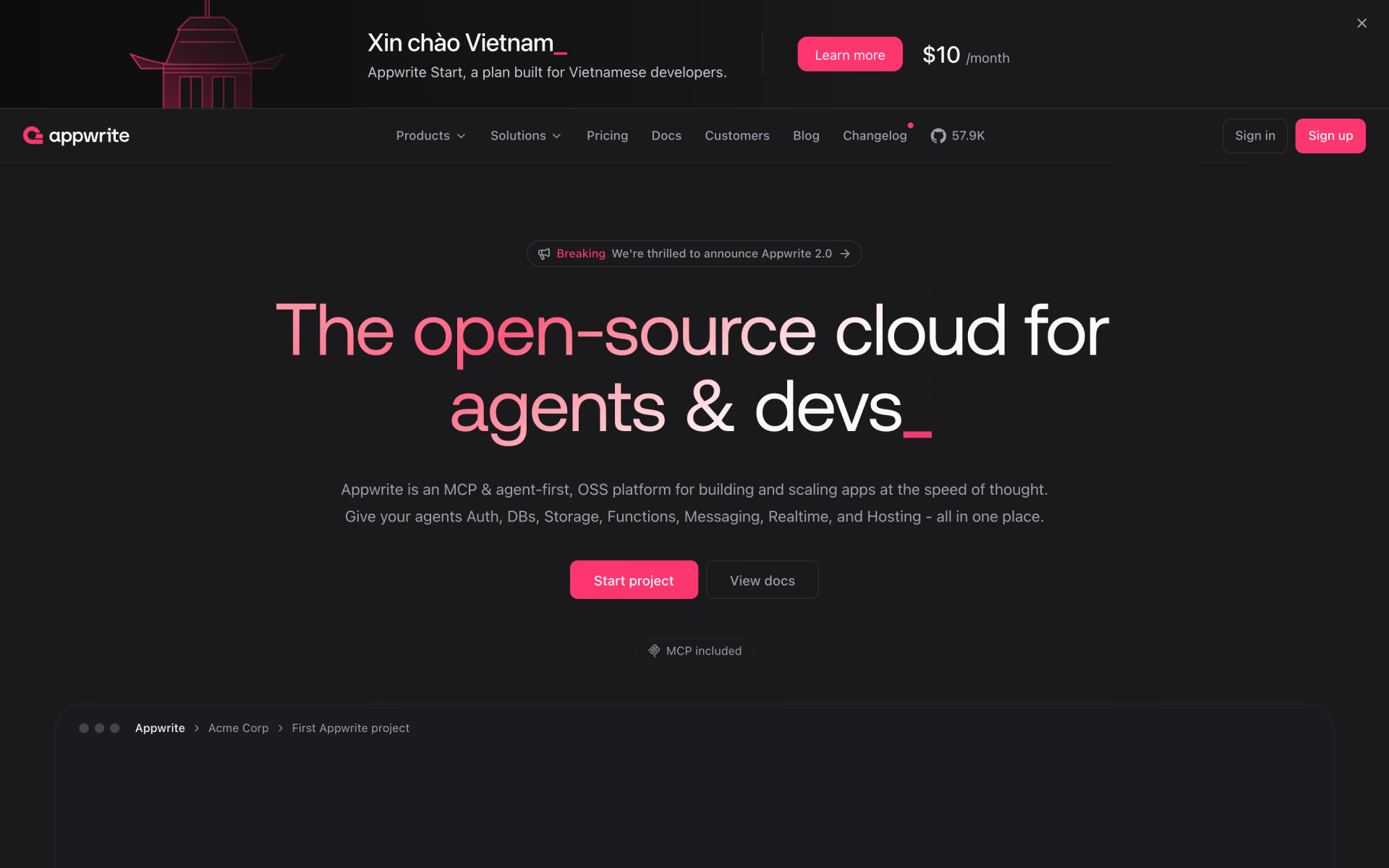
What is Appwrite?
Backend for web and mobile apps with auth, databases, storage, functions, messaging and hosting.
Who is Appwrite best for?
Appwrite is best for app developers who want auth, databases, storage and functions in one self-hostable backend.
Web and mobile apps
Auth, databases, storage, functions and realtime come from one project, with SDKs for web, Flutter, React Native, Apple and Android.
Apps that must stay on your servers
One Docker command installs the full stack, so user data stays on infrastructure you control.
Coding agents
A hosted MCP server lets Cursor, Claude Code, Codex and other agents work on a live Appwrite project.
Side projects
The Cloud Free plan covers 75K monthly active users, 2 GB of storage and 750K function executions.
How much does Appwrite cost?
Appwrite is free to self-host, Appwrite Cloud has a Free plan, and Pro starts at $25 a month with pay-as-you-go usage above its limits.
- BSD-3-Clause, same features as Cloud
- Docker or a Kubernetes Helm chart
- You run updates, backups and scaling
- 75K monthly active users, 2 GB storage
- 1 database, 1 bucket, 2 functions per project
- Paused after a week without activity
- 200K monthly active users, 150 GB storage
- Unlimited databases, functions and members
- Daily backups, pay as you go above limits
Pro includes $10 of database compute credits a month; dedicated database compute runs from $10 to $4,099 a month per database. Enterprise is priced on request and adds uptime SLAs, SSO, SOC-2, HIPAA, a BAA and bring-your-own-cloud. Full pricing on appwrite.io. We checked these prices on .
How do readers rate Appwrite?
No one has rated Appwrite yet. Be the first.
Sign in to rate. One rating per account.
Is Appwrite open source?
Yes. Appwrite's code is public under the BSD 3-Clause licence, so you can run it on your own server.
On GitHub
58,068stars
+407 (+0.7%) in the last 30 days
- Last commit
- 12 Nov
- Repository age
- 7 years
- Latest release
- 12 Nov
- Licence
- BSD 3-Clause
- Self-hosted
- Yes
- Repository
- appwrite/appwrite




What are the best Appwrite alternatives?
Appwrite is an open source alternative to Convex, Google Firebase and Vercel. Coolify and Supabase do the same job and are open source too.
 ConvexFree
TypeScript backend with real-time sync and built-in AI workflows.
 Google FirebaseFree
Google's managed backend: database, auth, hosting and AI.
 VercelFree
Builds every Git push into a preview and hosts web apps, APIs and AI agents on a global CDN.
 CoolifyOpen Source
Push-to-deploy for apps, databases and 360+ one-click services on any machine reached over SSH.
 SupabaseOpen Source
Dedicated Postgres per project, plus sign-in, file buckets, edge functions and realtime.
Questions about Appwrite
What is Appwrite?
Backend for web and mobile apps with auth, databases, storage, functions, messaging and hosting.
Who is Appwrite for?
Appwrite is best for app developers who want auth, databases, storage and functions in one self-hostable backend.
Is Appwrite free?
Yes. Appwrite has a free Self-hosted plan: BSD-3-Clause, same features as Cloud.
How much does Appwrite cost?
Appwrite's paid plans are Pro at From $25 per month.
Is Appwrite open source?
Yes. Appwrite's code is public under the BSD 3-Clause licence, so you can run it on your own server.
What are the best Appwrite alternatives?
The closest alternatives on Recaply are Convex, Google Firebase, Vercel, Coolify and Supabase.
Where can I try Appwrite?
On its official website, appwrite.io.
Is self-hosted Appwrite the same as Appwrite Cloud?
Appwrite says self-hosted instances can be set up with the same features as Appwrite Cloud. The difference is who runs it: on your own server you handle updates, scaling, backups and compliance, while Cloud manages them for you.

 Sevalla

 Expo
 IONOS Cloud

 Better Auth

 RevenueCat

 Keycloak