
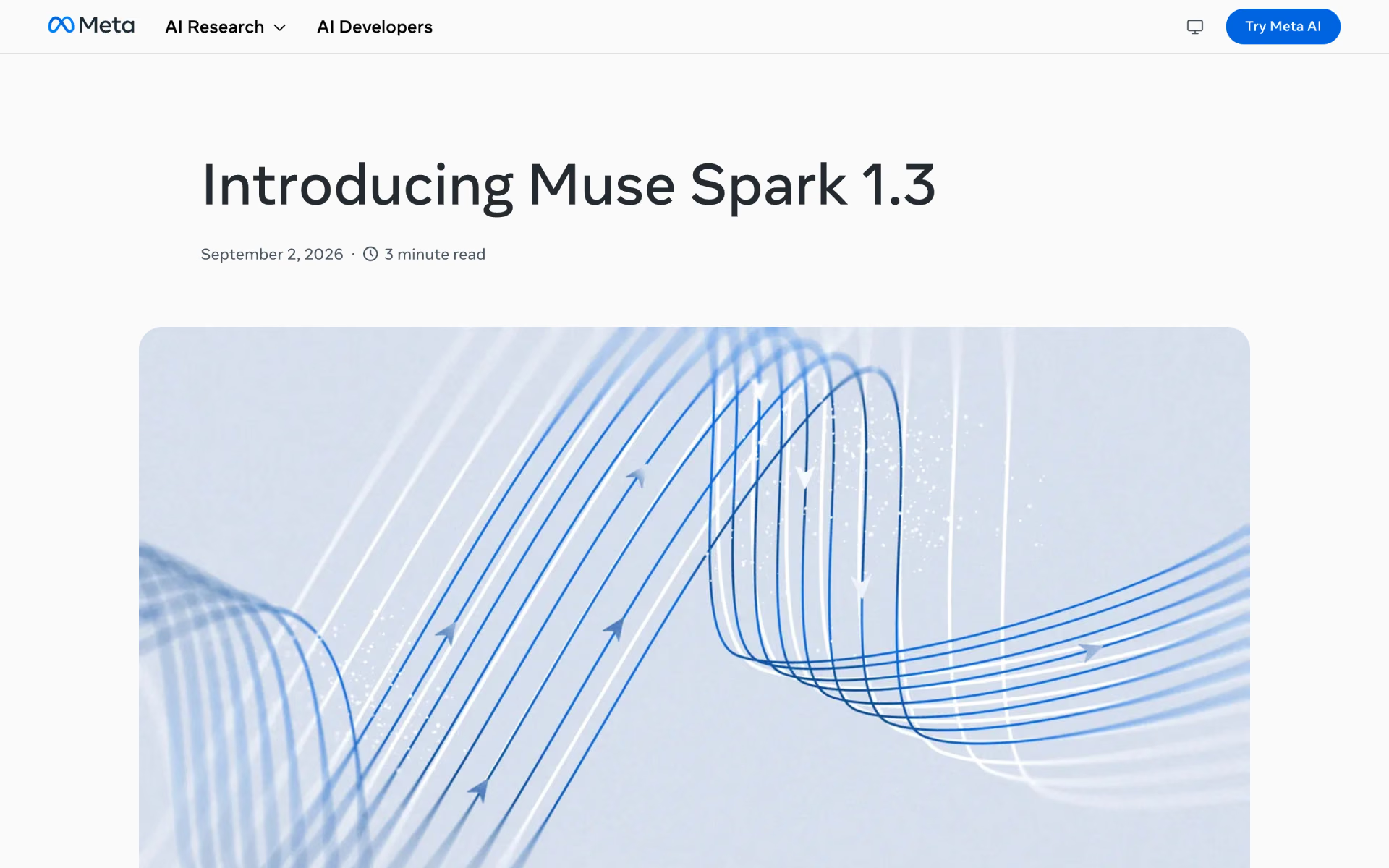
What is Muse Spark 1.3?
Muse Spark 1.3 is the newest version of Meta's closed Muse Spark model and the one Meta recommends for new work; versions 1.2 and 1.1 are still served. It reads text, images, video and PDFs, writes text, and holds just over 1M tokens of context. It always reasons, at six effort levels up to max. You reach it through the Meta Model API, which accepts OpenAI and Anthropic SDK calls, through Meta's Muse Code terminal agent, or on OpenRouter.
The twist is the price: the same model costs $1.25 / $4.25 per million tokens, or $0.10 / $0.20 if you let Meta train on your prompts and outputs.
What changed from Muse Spark 1.2?
Mostly agent behaviour and efficiency: it uses fewer tokens, adds a max reasoning level and scores far higher on long context, at the same price.
- Efficiency
- Meta engineers measured about 20% fewer tool calls and 25% fewer tokens on coding work, with shorter answers.
- Max reasoning
- A new max effort level goes beyond xhigh, on the Standard tier only.
- Agent behaviour
- It asks when a prompt is unclear, confirms before actions it cannot undo, and keeps several tasks apart in one thread.
- Long context
- It scores 98.1 on MRCR at 512K to 1M tokens, up from 55.5.
- Price
- Unchanged: both cost $1.25 / $4.25 per million tokens, or $0.10 / $0.20 on the Contributor tier.
- Audio
- Audio understanding is only partly supported in 1.3, so Meta suggests 1.2 for audio.
Who is Muse Spark 1.3 best for?
Muse Spark 1.3 is best for long agent tasks, coding in the terminal, cheap prototypes you are happy for Meta to train on, and work that needs a 1M-token context.
Long agent tasks
It is trained to track many jobs in one long thread, ask when a request is unclear and check with you before an action it cannot undo.
Coding in the terminal
Muse Code, Meta's multi-agent coding CLI, is built around it, and Meta says it uses about 20% fewer tool calls and 25% fewer tokens than version 1.2.
Cheap prototypes
The Contributor tier cuts the price to $0.10 per million input tokens if you are fine with Meta training on that traffic.
Large files and codebases
The 1,048,576-token context takes text, images, video and PDFs at one flat rate, and it scored 98.1 on Meta's MRCR test at 512K to 1M tokens.
What's included with Muse Spark 1.3?
Six reasoning levels, a cheaper Contributor tier, OpenAI and Anthropic compatible endpoints, web search, computer use and automatic prompt caching.
- Six reasoning levels
- Effort runs from minimal to max; max is only on the Standard tier, and reasoning cannot be switched off.
- Contributor tier
- The muse-spark-1.3-contributor model ID cuts token prices by more than 90% in exchange for training rights, at 100 requests a minute instead of 3,000.
- OpenAI and Anthropic formats
- The API speaks the Responses, Chat Completions and Messages formats, so Claude Code, Codex and OpenCode connect with a base URL and a key.
- Web search grounding
- A built-in web_search tool adds live results for $2.50 per 1,000 searches on top of token costs.
- Computer use
- A native computer tool on the Responses API returns mouse and keyboard actions for a browser or desktop you run yourself.
- Automatic prompt caching
- Repeated prompt prefixes are cached with no setup and billed at $0.15 per million tokens, or $0.002 on the Contributor tier.
How much does Muse Spark 1.3 cost?
Muse Spark 1.3 costs $1.25 per million input tokens and $4.25 per million output tokens on Meta Model API, or $0.10 and $0.20 if you let Meta train on your prompts, and Muse Code subscriptions start at $5 a month.
- Meta may use your prompts and outputs to train its models
- Cached input at $0.002 per million tokens
- 100 requests a minute per team
- Prompts and outputs are not used for training
- Cached input at $0.15 per million tokens
- Max reasoning level and 3,000 requests a minute
- Muse Code subscription instead of per-token billing
- 10 to 50 prompts every 5 hours, with image and video uploads
- Voice mode and web search
- Muse Code subscription
- 5 times the Everyday Usage limit
- More multimodal inputs
Power Usage is $50 a month for 20 times the Everyday Usage limit, early access to new features and bigger file uploads. Muse Code plans work only inside the Muse Code terminal agent, and Meta says their availability varies by region; any other API key is billed per token. Web search grounding adds $2.50 per 1,000 searches, and there is no extra charge for long prompts across the 1M-token context. The API has no minimum spend. Full pricing on dev.meta.ai. We checked these prices on .
How do readers rate Muse Spark 1.3?
No one has rated Muse Spark 1.3 yet. Be the first.
Sign in to rate. One rating per account.
Muse Spark 1.3 pros and cons
It scores at or near the top of Meta's own coding and long-context table at a low price, but the cheapest tier means Meta trains on your data and real-world reports are still thin.
Pros
- The Contributor tier costs $0.10 / $0.20 per million tokens with cache reads at $0.002, a price many early Hacker News and Reddit users singled out.
- Leads Meta's published table on long context and long-horizon coding: 98.1 on MRCR at 512K to 1M tokens (GPT 5.6 Sol: 73.8) and 75.4 on DeepSWE v1.1 (Opus 5: 74.0).
- Early users in OpenCode and Muse Code call it fast, and some report good results on everyday coding.
- Meta prices the privacy trade openly: the Standard tier is never used for training, and commenters welcomed the clear split.
Cons
- The low price depends on letting Meta train on your prompts and code; Standard costs 12.5 times more for input and over 20 times more for output, and several users said they would not hand Meta their code.
- Many early commenters doubt the benchmark lead holds up in real projects, and on Meta's own table it trails Opus 5 on knowledge work (GDPval-AA v2), computer use (OSWorld 2.0) and business workflows (AutomationBench).
- Audio input is only partly supported in 1.3, reasoning cannot be turned off, and the max level and higher rate limits are Standard-tier only.
- The weights are closed: Meta has promised open Muse Spark weights but not shipped them, and Muse Code plans only cover Meta's own CLI.
What are the best Muse Spark 1.3 alternatives?
Four tools on Recaply do Muse Spark 1.3's job. DeepSeek V4.1 Flash, GLM-5.3-Flash and Ornith-1.0 are open source, so you can run them on your own server.
 Gemini 3.8 FlashFree
Choose it when you want a free tier to prototype on or half-price batch jobs at $0.75 / $3.75 per million tokens; its normal paid rate of $1.50 / $7.50 is above Muse Spark's Standard tier.
 DeepSeek V4.1 FlashOpen Source
Choose it when you want MIT-licensed open weights with a 1M context, or an API at $0.30 / $1.20 per million tokens at peak and half that off-peak.
 GLM-5.3-FlashOpen Source
Choose it when you want a flat coding plan that works in Claude Code, Cline and OpenCode, from $18 a month; Muse Code plans only cover Meta's own CLI.
 Ornith-1.0Open Source
Choose it when long-running coding agents need open weights in a size that fits your hardware.
Questions about Muse Spark 1.3
What is Muse Spark 1.3?
Muse Spark 1.3 is Meta's latest model for coding and long-running agents, sold on the Meta Model API and in Muse Code, with a 1M-token context and a cheaper tier Meta trains on.
Who is Muse Spark 1.3 for?
Muse Spark 1.3 is best for long agent tasks, coding in the terminal, cheap prototypes you are happy for Meta to train on, and work that needs a 1M-token context.
Is Muse Spark 1.3 free?
No. Muse Spark 1.3 is a paid tool, from $0.10 / $0.20 per million input / output tokens.
How much does Muse Spark 1.3 cost?
Muse Spark 1.3's paid plans are Contributor at $0.10 / $0.20 per million input / output tokens, Standard at $1.25 / $4.25 per million input / output tokens, Everyday Usage at $5 per month and High Usage at $15 per month.
Is there an open source alternative to Muse Spark 1.3?
Yes. DeepSeek V4.1 Flash, GLM-5.3-Flash and Ornith-1.0 are open source tools that do the same job, so you can run your own.
What are the best Muse Spark 1.3 alternatives?
The closest alternatives on Recaply are Gemini 3.8 Flash, DeepSeek V4.1 Flash, GLM-5.3-Flash and Ornith-1.0.
Can I download Muse Spark 1.3 and run it myself?
No. Muse Spark 1.3 is only served through the Meta Model API, Muse Code and OpenRouter. Meta lists open Muse Spark weights on its roadmap; its current open model is Muse Glimmer, which is distilled from Muse Spark.
How does the Muse Spark 1.3 Contributor tier differ from Standard?
The Contributor tier of Muse Spark 1.3 costs $0.10 per million input tokens and $0.20 per million output tokens, against $1.25 and $4.25 on Standard, because Meta may train future models on your prompts and outputs. It also allows 100 requests a minute instead of 3,000 and has no max reasoning level.
Can I use Muse Spark 1.3 in Claude Code or other coding agents?
Yes. Meta Model API accepts OpenAI SDK, Anthropic SDK and OpenAI-compatible requests, so most coding agents only need the base URL https://api.meta.ai/v1, your API key and the model ID muse-spark-1.3. Claude Code connects through the Messages API.
Does Muse Spark 1.3 understand audio?
Only partly. Meta says audio understanding in Muse Spark 1.3 is not fully supported and answers that include audio may be worse, so it points audio work to Muse Spark 1.2 or its Muse Voice Transcribe model.
Our verdict
Muse Spark 1.3 is worth testing for agent and coding work that needs a long context, especially on the Contributor tier for code you do not mind Meta seeing.
Meta's own table puts it at or near the top on long-context and long-horizon coding tests, and it costs $1.25 / $4.25 per million tokens, or $0.10 / $0.20 on the Contributor tier.
- Skip it for
- Private or client code if you were counting on the Contributor price, and audio-heavy work.
- Check first
- Run it on your own tasks before you switch; early users doubt the benchmark lead holds up in real projects.
 Muse Spark Open
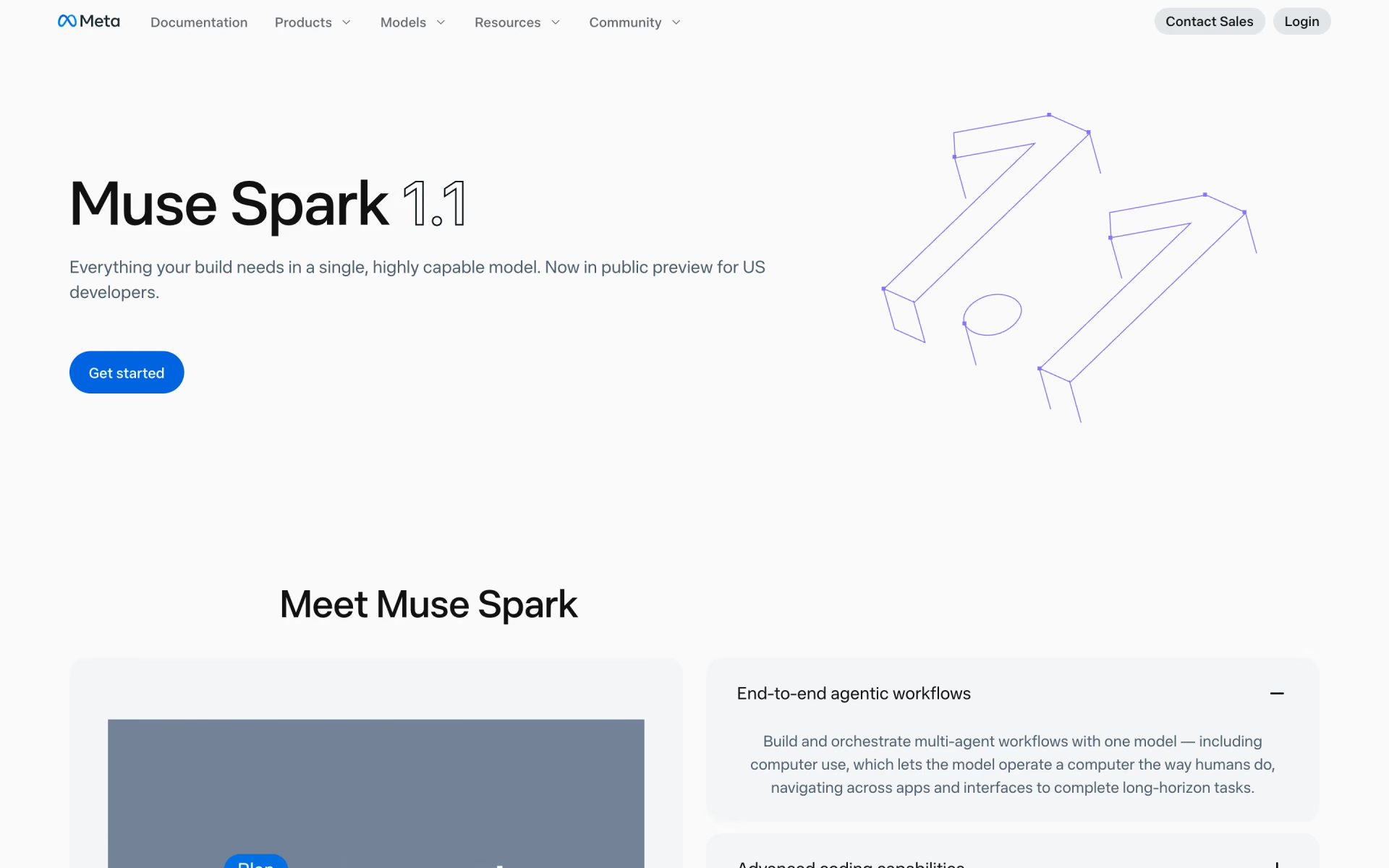
 Muse Spark 1.1

 Claude Fable 5.1

 Reflection Beam