What is Muse Spark 1.1?
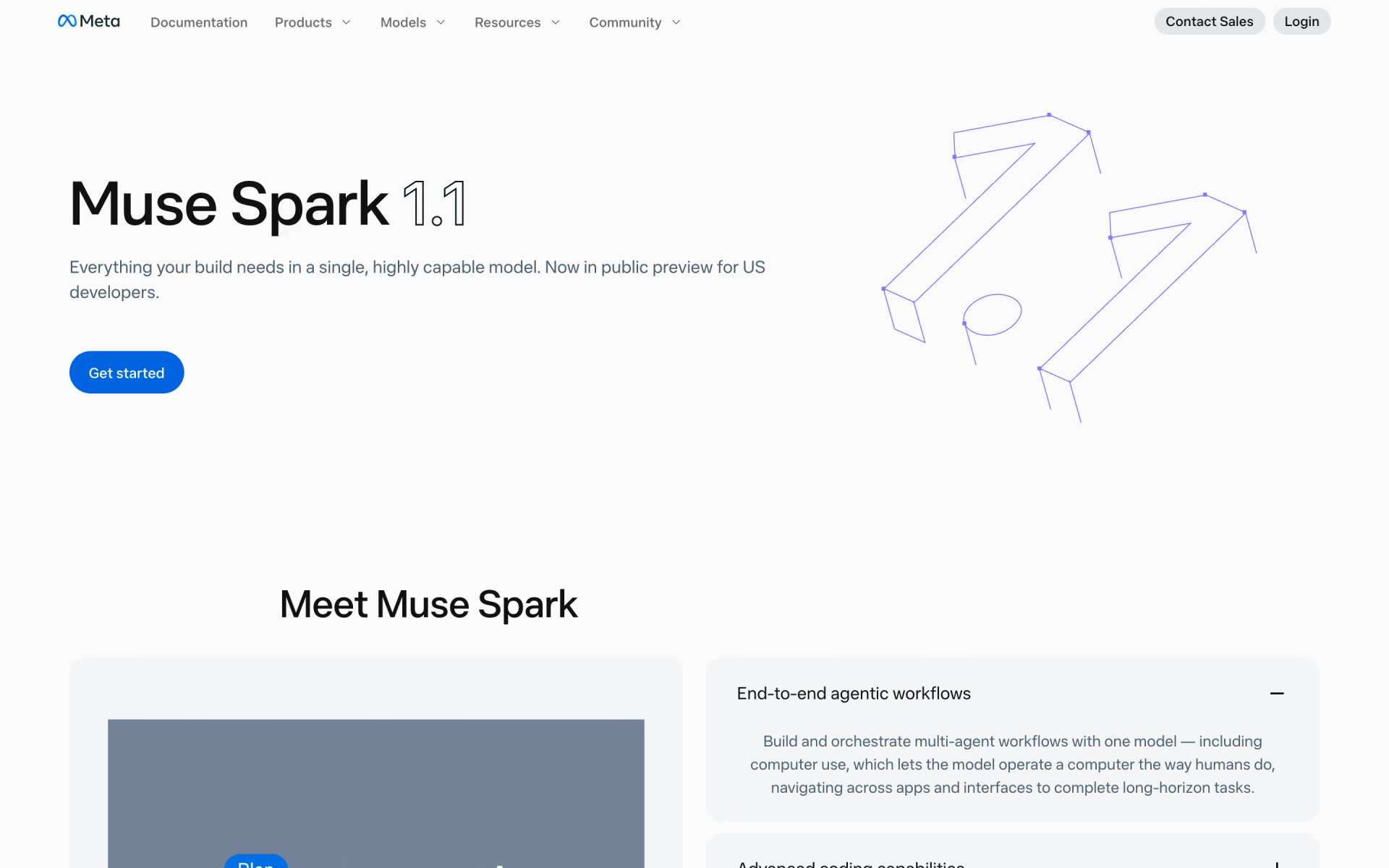
Muse Spark 1.1 is the model Meta Superintelligence Labs used to open the Meta Model API in public preview. It always reasons before it answers, at five effort levels from minimal to xhigh, and it is trained to plan long jobs, hand parts to parallel subagents and operate browsers and desktops. The API accepts OpenAI and Anthropic request formats, so existing SDKs and coding agents connect with a base URL and a key.
It is now a legacy version. Meta's docs call it the original version and recommend Muse Spark 1.3 for new work; 1.2 and 1.3 cost the same per token, and only they offer the cheaper Contributor tier.
Is Muse Spark 1.1 still available?
Yes. Meta still serves Muse Spark 1.1 on the Meta Model API at the Standard price, but its docs call it the original version and recommend Muse Spark 1.3 for new work.
- Status
- Legacy: versions 1.2 and 1.3 sit above it, and Meta's docs list no retirement for it.
- Price
- The same $1.25 / $4.25 per million tokens as 1.2 and 1.3 on the Standard tier.
- What the newer versions add
- 1.2 is a coding-focused update, 1.3 adds a max reasoning level, and both offer a Contributor tier at $0.10 / $0.20.
- Where 1.1 still fits
- Audio: Meta says 1.3 only partly supports audio input, while 1.1 and 1.2 handle it fully.
Who is Muse Spark 1.1 best for?
Muse Spark 1.1 is best for apps already tested on it, tool-heavy agents, requests that mix audio, video and documents, and teams already on OpenAI or Claude SDKs.
Apps already tested on 1.1
Meta still serves it at the same price as the newer versions, so a working pipeline keeps running while you test 1.3 on your own prompts.
Tool-heavy agents
Meta's table puts it at 88.1 on MCP Atlas and 54.7 on JobBench, ahead of Opus 4.8 and GPT 5.5 on both.
Audio, video and documents together
One request can mix text, images, video, audio and PDFs, and unlike 1.3 it fully supports audio input.
Existing OpenAI or Claude tooling
The Meta Model API accepts OpenAI Chat Completions and Responses requests and Anthropic Messages requests, so current SDKs and coding CLIs connect with a base URL and a key.
What's included with Muse Spark 1.1?
Always-on reasoning at five levels, OpenAI and Anthropic compatible endpoints, web search, computer use, automatic prompt caching and no training on your data.
- Always-on reasoning
- Five effort levels from minimal to xhigh; reasoning cannot be switched off, and its tokens are billed as output.
- OpenAI and Anthropic formats
- Responses, Chat Completions and Messages endpoints at api.meta.ai/v1, so OpenCode, Codex and Claude Code can connect.
- Web search grounding
- A built-in web_search tool on the Responses API returns answers with citations for $2.50 per 1,000 searches.
- Computer use
- A computer tool on the Responses API returns mouse and keyboard actions for a browser or desktop that you run.
- Automatic prompt caching
- Repeated prompt prefixes are cached with no setup and billed at $0.15 per million tokens.
- No training on your data
- Prompts and outputs on the Standard tier, the only tier 1.1 is sold on, are not used to train Meta's models.
How much does Muse Spark 1.1 cost?
Muse Spark 1.1 is billed per token on the Meta Model API at $1.25 per million input tokens and $4.25 per million output tokens, with cached input at $0.15 per million.
- Cached input $0.15 per million tokens
- 1M-token context; text, image, video, audio and PDF input
- Prompts and outputs are not used for training
Billing is pay-as-you-go on the Meta Model API, which is in public preview, with no minimums. Web search grounding adds $2.50 per 1,000 searches, reasoning tokens are billed as output, and long prompts cost the same per token as short ones. Muse Spark 1.2 and 1.3 cost the same on this Standard tier and also come in a Contributor tier at $0.10 input and $0.20 output per million tokens that lets Meta train on your data; 1.1 has no Contributor tier. Standard rate limits are 3,000 requests and 4M tokens a minute per team. Full pricing on dev.meta.ai. We checked these prices on .
How do readers rate Muse Spark 1.1?
No one has rated Muse Spark 1.1 yet. Be the first.
Sign in to rate. One rating per account.
Muse Spark 1.1 pros and cons
It is cheap and strong on tool use by Meta's own numbers, but Muse Spark 1.3 replaces it at the same price and it trails rivals on coding.
Pros
- Costs $1.25 / $4.25 per million tokens with cached input at $0.15, a price several Hacker News commenters singled out as low for its class.
- Leads Meta's published table on tool use: 88.1 on MCP Atlas and 54.7 on JobBench, against 82.2 and 48.4 for Opus 4.8.
- Takes text, images, video, audio and PDFs in one request across a 1M-token context, with no surcharge for long prompts.
- Standard-tier prompts are never used for training, and the API works with OpenAI and Anthropic SDKs without code changes beyond the base URL.
Cons
- Superseded at the same price: Meta recommends Muse Spark 1.3 for new work, and 1.1 gets neither the $0.10 / $0.20 Contributor tier nor the max reasoning level.
- Trails on coding in Meta's own table, with 61.5 on SWE-Bench Pro and 53.3 on DeepSWE 1.1 against 69.2 and 59.0 for Opus 4.8, and Hacker News users who tried it found it weaker than its scores suggest.
- Many Hacker News commenters said they would not trust Meta with their data, and some could not find how long paid API prompts are kept.
- The weights are closed, reasoning cannot be turned off, and log probabilities are not supported.
What are the best Muse Spark 1.1 alternatives?
Three tools on Recaply do Muse Spark 1.1's job. DeepSeek V4.1 Flash is open source, so you can run it on your own server.
 Muse Spark 1.3Paid
Choose it when you start anything new: it costs the same $1.25 / $4.25, adds a max reasoning level and offers a $0.10 / $0.20 Contributor tier if Meta may train on your data.
 DeepSeek V4.1 FlashOpen Source
Choose it when price or open weights matter most: it costs $0.30 / $1.20 per million tokens at peak and half that off-peak, with a 1M context and MIT-licensed weights.
 Gemini 3.8 FlashFree
Choose it when you want a free tier to test on with the same text, image, video, audio and PDF inputs across 1M tokens; its normal paid rate of $1.50 / $7.50 is higher.
Questions about Muse Spark 1.1
What is Muse Spark 1.1?
Muse Spark 1.1 is the original model on Meta's Model API, a reasoning model for agents, coding and computer use that takes text, images, video, audio and PDFs across a 1M-token context.
Who is Muse Spark 1.1 for?
Muse Spark 1.1 is best for apps already tested on it, tool-heavy agents, requests that mix audio, video and documents, and teams already on OpenAI or Claude SDKs.
Is Muse Spark 1.1 free?
No. Muse Spark 1.1 is a paid tool, from $1.25 / $4.25 per million input / output tokens.
How much does Muse Spark 1.1 cost?
Muse Spark 1.1's paid plans are Standard at $1.25 / $4.25 per million input / output tokens.
Is there an open source alternative to Muse Spark 1.1?
Yes. DeepSeek V4.1 Flash is an open source tool that does the same job, so you can run your own.
What are the best Muse Spark 1.1 alternatives?
The closest alternatives on Recaply are Muse Spark 1.3, DeepSeek V4.1 Flash and Gemini 3.8 Flash.
Can I download Muse Spark 1.1 and run it myself?
No. Muse Spark models are served only through Meta's API and partners such as OpenRouter. Meta's open model is Muse Glimmer, which is distilled from Muse Spark, released under Apache 2.0 and runs on your own hardware.
Can I use Muse Spark 1.1 in Claude Code or other coding agents?
Yes. The Meta Model API accepts OpenAI Chat Completions and Responses requests and Anthropic Messages requests, so most coding agents need only the base URL https://api.meta.ai/v1, an API key and the model ID muse-spark-1.1. OpenCode also has a built-in Meta provider.
Does Meta train on my Muse Spark 1.1 prompts?
No. Muse Spark 1.1 is sold only on the Standard tier, and Meta says prompts and completions on that tier are not used to train its models. The cheaper Contributor tier, which Meta can train on, exists only for versions 1.2 and 1.3.
Can I turn off reasoning in Muse Spark 1.1?
No. Muse Spark always reasons, and setting reasoning_effort to none returns an error. You can choose minimal, low, medium, high or xhigh, and the reasoning tokens are billed as output tokens.
Our verdict
Muse Spark 1.1 still works, but there is little reason to pick it for a new project.
Meta now recommends Muse Spark 1.3, which costs the same per token and adds a cheaper Contributor tier and a max reasoning level, while 1.1 trails rivals on coding in Meta's own table.
- Skip it for
- Any new build: start on Muse Spark 1.3, or on 1.2 if you depend on audio input.
- Check first
- If you already run 1.1, test 1.3 on your own prompts before switching; the price stays the same.
 Muse Spark

 Qwen3.6-Plus

 MiniMax M3

 Kimi K3