
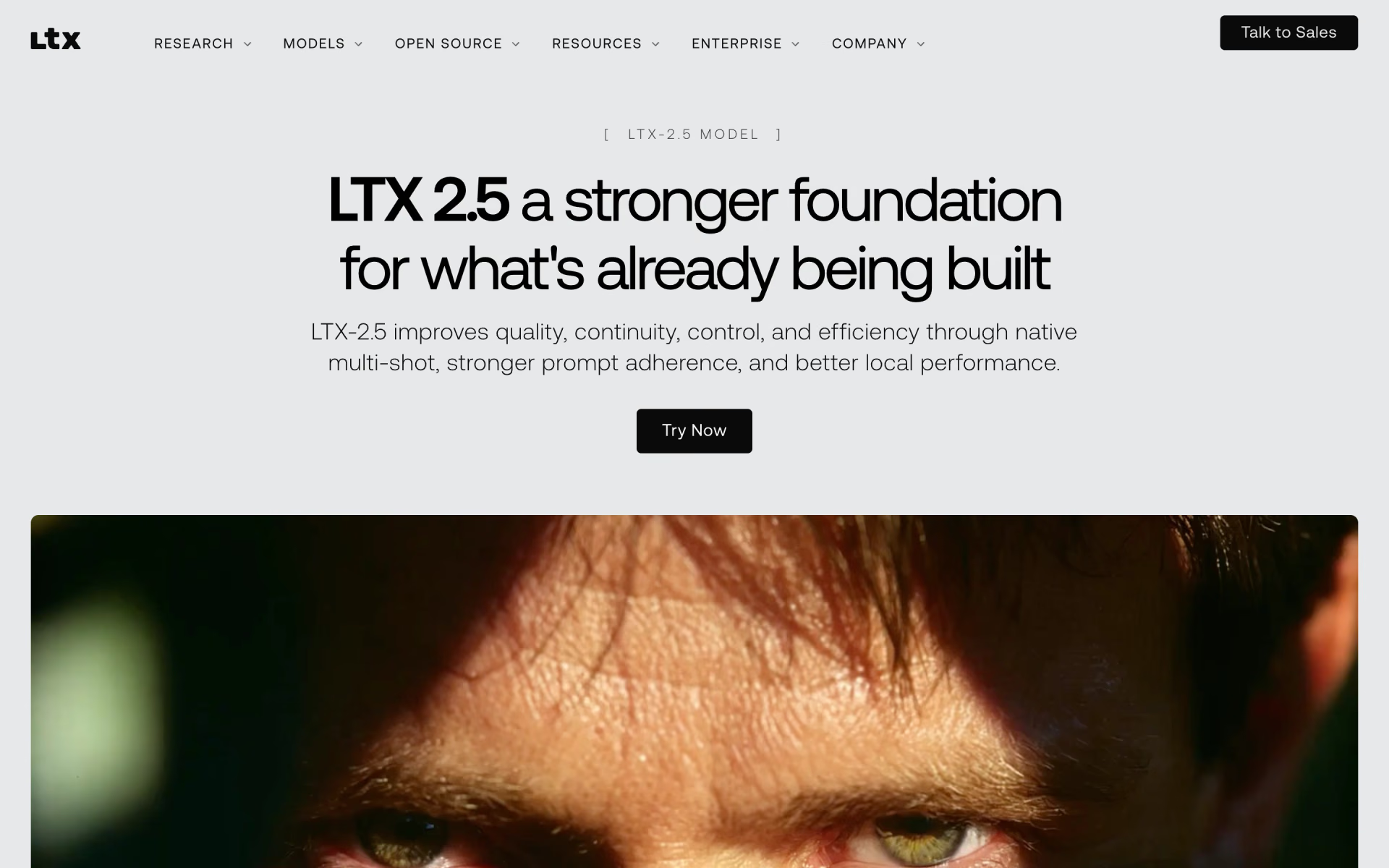
What is LTX-2.5?
LTX-2.5 is a 22-billion-parameter model from Lightricks that generates video and sound together from text, an image or an audio track, in landscape or portrait up to 4K. New in this version are multi-shot scenes that keep a character, setting and voice consistent across cuts, automatic clip length, a new diffusion video decoder and native EXR output for color grading.
It replaces LTX-2.3 as Lightricks' recommended model and is free to self-host for companies under $10 million in yearly revenue. On the API it costs three times as much as LTX-2.3 at 720p, and LTX-2.3 still handles the API's retake and extend edits.
What changed from LTX-2.3?
Multi-shot scenes, automatic clip length, a new decoder and text encoder, and native EXR, at a higher API price.
- Shots
- One generation can now cut between several connected shots; earlier versions made a single continuous shot.
- Decoder and prompts
- A diffusion video decoder replaces the VAE decode step, and a custom Gemma 4 12B encoder reads prompts.
- Clip length
- An optional duration predictor sets the length from the prompt instead of a fixed setting.
- API price
- Rates run $0.09 to $0.39 a second, against $0.03 to $0.32 for LTX-2.3.
- Licence
- The LTX-2.x Community License drops some third-party restrictions; the $10 million revenue line is unchanged.
Who is LTX-2.5 best for?
LTX-2.5 is best for multi-shot scenes, footage headed for color grading, quick drafts on a per-second API, and teams that want to fine-tune an open model on their own footage.
Multi-shot scenes
One generation can cut between wide, medium and close-up shots while keeping the character, setting, lighting and voice the same.
Footage headed for grading
Run locally, it reads and writes EXR in ACES and DaVinci Wide Gamut and makes HDR up to 4K, so clips skip the lossy 8-bit round trip.
Quick drafts on the API
The Fast tier makes clips up to 20 seconds at 720p or 1080p from $0.09 a second, and automatic duration picks a clip length from the prompt.
Teams fine-tuning their own model
Lightricks ships a base checkpoint built for fine-tuning on your own footage, free to use for companies under $10 million in revenue.
What's included with LTX-2.5?
Native multi-shot, automatic duration, EXR and HDR output, a stronger text encoder, a new video decoder, audio-to-video on both tiers and lighter local builds.
- Native multi-shot
- Several connected shots from one prompt, holding character, scene, lighting, style and voice across the cuts.
- Automatic duration
- Leave the length empty and the model picks one from the described action; you pay only for the seconds it makes.
- EXR and HDR output
- Local workflows read and write EXR and generate HDR up to 4K for grading and finishing.
- Stronger prompt handling
- A custom Gemma 4 12B text encoder reads the prompt, and an optional prompt enhancer expands short ones.
- Diffusion video decoder
- It replaces the old VAE decode step, for sharper faces, textures and on-screen text and fewer artifacts in fast motion.
- Audio-to-video on both tiers
- Fast and Pro can both time video to an input audio track, and either can make silent video instead.
- Lighter local builds
- int8 and NVFP4 versions of the model and a lighter video decoder cut memory use in ComfyUI.
How much does LTX-2.5 cost?
LTX-2.5 is free to self-host for companies under $10 million in yearly revenue; on the LTX API it costs $0.09 to $0.30 a second on Fast and $0.12 to $0.39 on Pro, depending on resolution.
- Free for companies under $10 million in yearly revenue
- 22B dev and distilled weights on Hugging Face after accepting the license
- Docs ask for an NVIDIA GPU with 32GB or more; int8 builds use less
- $0.13 at 1080p, $0.19 at 1440p, $0.30 at 4K
- Clips up to 20 seconds at 720p and 1080p
- Text, image or audio to video
- $0.17 at 1080p, $0.25 at 1440p, $0.39 at 4K
- Clips of 6, 8 or 10 seconds
- Higher detail and steadier motion for final renders
Text-to-video and image-to-video bill the length of the finished clip; audio-to-video bills the input audio, up to about 20 seconds a request. With automatic duration you pay for the length the model picks, but a prepaid balance must cover the longest possible clip until the job ends. Portrait and landscape cost the same, and there are no request fees. Retake, extend and reframe edits still run on LTX-2.3 Pro, which costs $0.04 to $0.32 a second. Companies above $10 million in yearly revenue need a commercial license, priced on request. LTX-2.5 is also in the LTX Studio app on every plan: free with 800 one-time credits for personal use, then Lite $15, Standard $35 or Pro $125 a month, or 20% less billed yearly; commercial use starts on Standard. Prices are in US dollars. Full pricing on ltx.io. We checked these prices on .
How do readers rate LTX-2.5?
No one has rated LTX-2.5 yet. Be the first.
Sign in to rate. One rating per account.
LTX-2.5 pros and cons
It runs quickly, adds multi-shot scenes and keeps most LTX-2.3 LoRAs working, but many early users rate MiniMax H3 higher and local setup can hit memory errors.
Pros
- Quick on home hardware: users report 5 to 15 second clips in one to four minutes on cards from a 4GB laptop GPU up to 16GB, at modest resolutions.
- Early testers say it looks better than LTX-2.3, and LoRAs trained for LTX-2.3 mostly work unchanged, which Lightricks confirms.
- Users single out realistic talking heads and lip sync as a strength.
- Adds multi-shot scenes, automatic clip length and native EXR output while the weights stay free to self-host under $10 million in revenue.
Cons
- Many early users rate the open MiniMax H3 higher for prompt understanding and motion, and several call LTX-2.5 only a small step up from LTX-2.3.
- Local setup can be rough: users hit out-of-memory errors at the video decode step on 12GB cards, and the optional prompt enhancer can add many minutes per clip.
- Several users still see limited or jerky motion, a plastic CGI look and face drift in image-to-video.
- On the API it costs three times LTX-2.3 at 720p, $0.09 against $0.03 a second, and retake and extend still need LTX-2.3.
What are the best LTX-2.5 alternatives?
LTX-2.3 for lower API prices and edits, MiniMax H3 Max for free daily tests, and Kling 3.0 for a flat monthly subscription.
 LTX-2.3Free
Choose it when cost or editing matters: it starts at $0.03 a second on the API and is the LTX model behind retake, extend and reframe.
 MiniMax H3 MaxFree
Choose it when you want to compare quality before paying: fal gives signed-in users five free videos a day of up to 15 seconds with audio.
 Kling 3.0Freemium
Choose it when you would rather pay a flat subscription than per second: it makes multi-shot clips of up to 15 seconds with audio, from $10 a month for 660 credits.
Questions about LTX-2.5
What is LTX-2.5?
LTX-2.5 is Lightricks' newest open-weight video model for studios and developers: it makes clips with synced sound, cuts between several shots in one pass, and runs locally or through a per-second API.
Who is LTX-2.5 for?
LTX-2.5 is best for multi-shot scenes, footage headed for color grading, quick drafts on a per-second API, and teams that want to fine-tune an open model on their own footage.
Is LTX-2.5 free?
Yes. LTX-2.5 has a free Open weights plan: free for companies under $10 million in yearly revenue.
How much does a 10-second LTX-2.5 clip cost?
A 10-second LTX-2.5 clip costs $1.30 at 1080p on the Fast tier or $1.70 on Pro, and $3.00 or $3.90 in 4K. The LTX API bills per second of finished video with no request fees, and portrait and landscape cost the same.
What are the best LTX-2.5 alternatives?
The closest alternatives on Recaply are LTX-2.3, MiniMax H3 Max and Kling 3.0.
Where can I try LTX-2.5?
On its official website, ltx.io.
Is LTX-2.5 open source?
LTX-2.5's weights are free to download from Hugging Face once you accept the LTX-2.x Community License, not a standard open-source license. Companies under $10 million in yearly revenue can self-host, fine-tune and use it commercially at no cost; larger companies need a paid commercial license from Lightricks.
What GPU do I need to run LTX-2.5 locally?
Lightricks' docs ask for an NVIDIA GPU with at least 32GB of memory, 32GB of system RAM and 100GB of disk, and recommend an A100 or H100. Its LTX Desktop app needs 24GB or more on Windows and Linux, or an Apple Silicon Mac with 48GB, and int8 builds cut memory use in ComfyUI.
Do LTX-2.3 LoRAs work with LTX-2.5?
Mostly. Lightricks says the large majority of LoRAs and IC-LoRAs trained on LTX-2.3 run on LTX-2.5 without changes, with a few exceptions, so test each adapter before production use. Keep LTX-2.3 and LTX-2.5 workflows and model files separate in ComfyUI.
Our verdict
LTX-2.5 is the LTX model to start new projects on, and the pick when you want an open model with multi-shot scenes and EXR output.
It adds multi-shot scenes, automatic duration and native EXR to weights you can self-host free under $10 million in revenue, and users say it runs quickly even on modest GPUs.
- Skip it for
- Budget API work or edits to existing clips, where LTX-2.3 costs a third as much at 720p and still runs retake and extend.
- Check first
- Test it against MiniMax H3 on your own prompts, since many early users prefer H3's results.
 Grok Imagine Video 1.5

 Pika H3 Flex
 FLUX 3 Max
 HeyGen Video

 Seedance 2.0
 Kling 2.6