
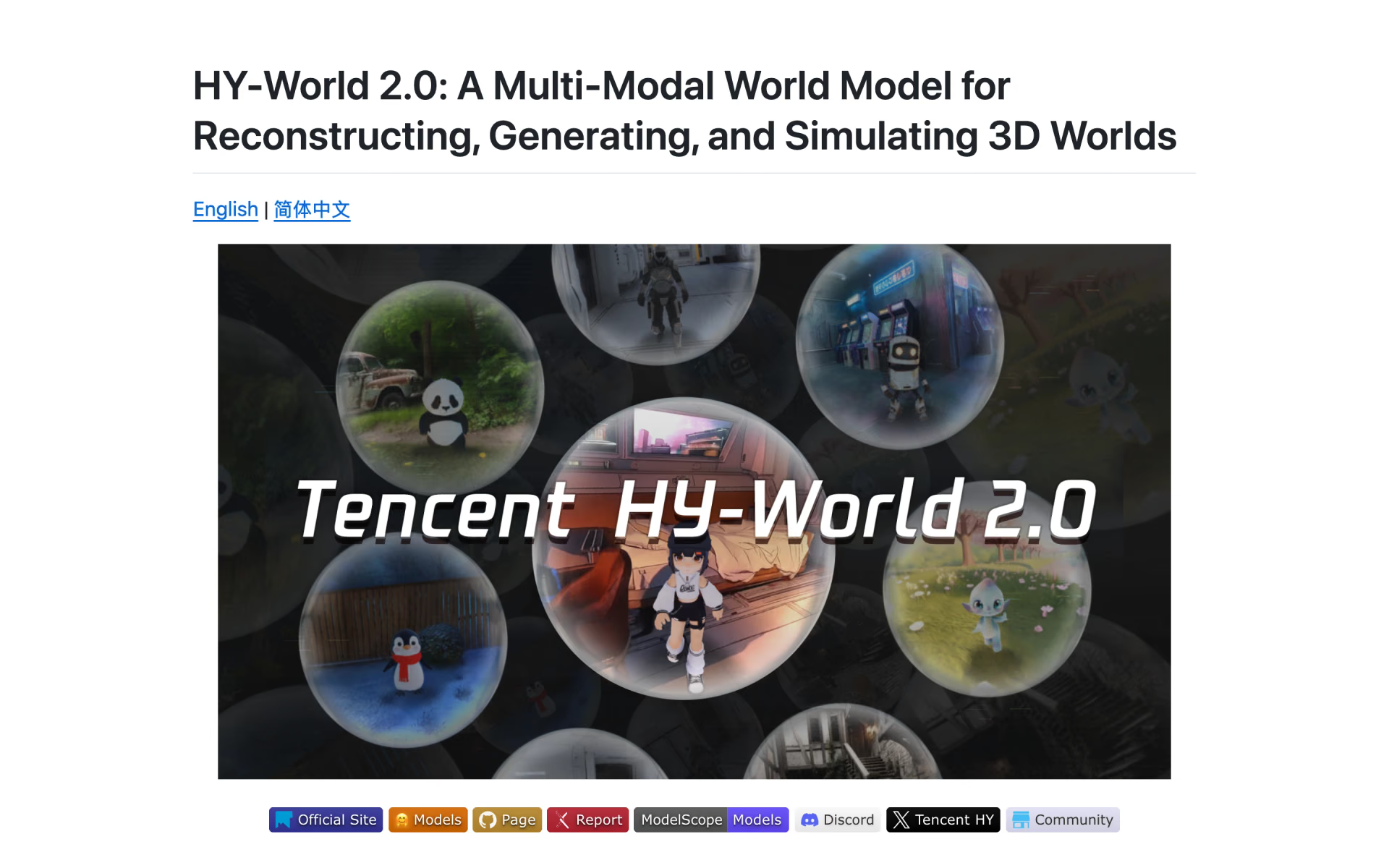
What is HY-World 2.0?
HY-World 2.0 is Tencent Hunyuan's open-weight world model. Unlike video world models such as Genie 3, it builds real 3D assets: Gaussian splats, meshes and point clouds that persist and load into game engines. World generation runs in four stages: HY-Pano 2.0 draws a 360-degree panorama from text or an image, WorldNav plans camera paths, WorldStereo 2.0 fills in new views, and WorldMirror 2.0 assembles them into a splat scene.
WorldMirror 2.0 also works alone, turning photos or a video into depth, camera poses and splats in one pass. Tencent now runs a newer HY-World 2.1 in its own app and API, but the weights you can download are still 2.0.
Is HY-World 2.0 the latest version?
Not quite: Tencent's own app and API now run HY-World 2.1, but the weights you can download are still 2.0.
- Open weights
- HY-World 2.0 on GitHub and Hugging Face, free under Tencent's community licence.
- Hosted API
- HY-World 2.1 panorama and scene models on Tencent Cloud TokenHub, at $0.77 per panorama and $12.3 per scene.
- Tencent's app
- HY-World 2.1 on Tencent's Hunyuan 3D website, which is in Chinese and needs a login.
- Before 2.0
- HY-World 1.5 made video walkthroughs; 2.0 switched to real 3D assets that persist.
Who is HY-World 2.0 best for?
HY-World 2.0 is best for game, VR and simulation teams with multi-GPU servers who want text, photos or video turned into editable 3D worlds rather than video clips.
Game and VR levels
It outputs meshes and 3D Gaussian splats that import into Blender, Unity and Unreal Engine, so a world stays editable instead of ending like a video.
Digital twins from photos or video
WorldMirror 2.0 turns several photos or a casual video into depth, surface normals, camera poses and a 3D scene in one pass, on one GPU or several.
Simulation scenes
Worlds load into Isaac Sim with physics collision, so generated streets and buildings can serve as test environments for robots and agents.
Labs with multi-GPU servers
Full world generation is built for clusters, with Tencent recommending 4 or more GPUs, so it suits research teams more than a single desktop.
What's included with HY-World 2.0?
A text-or-image to 3D world pipeline, one-pass reconstruction from photos or video, camera and depth priors, engine-ready exports, a lighter panorama option and a Gradio app.
- Text or image to 3D world
- One pipeline takes a prompt or a single picture and ends with a walkable Gaussian splat world and a mesh.
- Reconstruction in one pass
- WorldMirror 2.0 predicts depth, normals, camera parameters, point clouds and splats together, at 50K to 500K pixels per image.
- Camera and depth priors
- You can feed known camera poses and depth maps into WorldMirror 2.0 to make its reconstruction more accurate.
- Engine-ready exports
- Worlds open in Blender, Unity, Unreal Engine and Isaac Sim, with first- and third-person walking and physics collision.
- Lighter panorama option
- HY-Pano 2.0 comes as a full model of about 80B parameters or a 425M LoRA that runs on Qwen-Image-Edit.
- Gradio app
- A browser app for WorldMirror 2.0 shows splats, point clouds, depth and normal maps from the photos or video you upload.
How does HY-World 2.0 work?
Set up
Install the repo with CUDA 12.8 and Python 3.11 or newer; the pipelines download their weights from Hugging Face on first run.
Make a panorama
HY-Pano 2.0 turns a text prompt or one image into a 360-degree panorama of the scene.
Grow the world
WorldNav plans camera paths with a vision model you serve through vLLM, and WorldStereo 2.0 renders new views along them.
Export and explore
WorldMirror 2.0 and splat training assemble the scene, which you open in Blender, Unity, Unreal Engine or Isaac Sim.
How much does HY-World 2.0 cost?
HY-World 2.0 is free to download and run under Tencent's community licence; Tencent's hosted HY-World 2.1 API costs $0.77 per panorama and $12.3 per 3D scene.
- World generation and reconstruction models, with code on GitHub
- Runs on your own GPUs; 4 or more recommended for world generation
- Licence does not cover the EU, UK or South Korea
- Hosted on Tencent Cloud TokenHub
- Text or one image in
- Billed at $1.6 per million tokens after use
- Walkable splat and mesh scene with physics collision
- Text or one image in
- Billed at $1.6 per million tokens after use
Running the open weights costs only your own hardware or rented GPU time. The hosted API runs the newer HY-World 2.1, not 2.0, on Tencent Cloud's international TokenHub and is billed after use; Tencent's China site lists it at 5 yuan per panorama and 80 yuan per scene. Companies whose products had more than 1 million monthly active users at release must ask Tencent for a separate licence. Tencent's own HY World app is in Chinese, needs a login and shows no public prices. Full pricing on tencentcloud.com. We checked these prices on .
How do readers rate HY-World 2.0?
No one has rated HY-World 2.0 yet. Be the first.
Sign in to rate. One rating per account.
HY-World 2.0 pros and cons
It makes real, editable 3D worlds for free, but the licence has limits, full generation needs server GPUs, and users say results trail the demos.
Pros
- It builds real splats and meshes that load into Blender, Unity and Unreal Engine, where video world models only give you a clip; early users single this out most.
- The weights are free, and Tencent's own tests put WorldStereo 2.0 ahead of NVIDIA's Lyra on Tanks-and-Temples and MipNeRF360 reconstruction scores.
- The reconstruction side is light: WorldMirror 2.0 has about 1.2B parameters, and users report running it on a single 16 GB graphics card, or with the panorama LoRA in about 21 GB.
Cons
- The licence is not open source in the usual sense: it does not cover the EU, UK or South Korea, bars using outputs to improve other AI models, and very large companies need Tencent's permission.
- Full world generation needs a server, with Tencent recommending 4 or more GPUs plus a separate vision model, and users describe setup as slow going, from building old gsplat wheels to hours spent getting it to run.
- Users say results fall short of Tencent's demos, with low mesh and texture resolution, stray splat blobs, and one merged scene rather than separate objects you can move.
- The newer HY-World 2.1 is only in Tencent's hosted app and API, and users find the app hard to use because it is in Chinese.
What are the best HY-World 2.0 alternatives?
World Labs Marble for worlds without GPUs, Lyra 2.0 for single-GPU research, and Polycam for scanning real spaces with a phone.
 World Labs MarbleFree
Choose it when you want worlds from a browser without your own GPUs: the free plan makes up to 4 worlds, splat export starts at $20 a month and commercial rights at $35.
 Lyra 2.0Free
Choose it when you want to draw the camera path yourself and run on a single H100 for research; NVIDIA licenses its weights for internal, non-production research only.
 PolycamFree
Choose it when you want to scan a real room or object with your phone instead of running GPUs; the free plan covers limited captures and Basic adds unlimited Gaussian splats.
Questions about HY-World 2.0
What is HY-World 2.0?
HY-World 2.0 is Tencent Hunyuan's open-weight model for game, VR and simulation teams that turns text, photos or video into 3D worlds you can open in Unity, Unreal Engine or Blender.
Who is HY-World 2.0 for?
HY-World 2.0 is best for game, VR and simulation teams with multi-GPU servers who want text, photos or video turned into editable 3D worlds rather than video clips.
Is HY-World 2.0 free?
Yes. HY-World 2.0 has a free Open weights plan: world generation and reconstruction models, with code on GitHub.
How much does HY-World 2.0 cost?
HY-World 2.0's paid plans are HY-World 2.1 panorama API at $0.77 per 360-degree panorama and HY-World 2.1 scene API at $12.3 per 3D scene.
What are the best HY-World 2.0 alternatives?
The closest alternatives on Recaply are World Labs Marble, Lyra 2.0 and Polycam.
Where can I try HY-World 2.0?
On its official website, github.com.
Can I use HY-World 2.0 commercially?
Yes, within limits. The Tencent HY-World 2.0 Community License is royalty-free and Tencent claims no rights in your outputs, but it does not apply in the EU, UK or South Korea, you may not use outputs to improve other AI models, and companies with more than 1 million monthly active users need Tencent's approval.
What hardware does HY-World 2.0 need?
World generation is heavy: Tencent recommends 4 or more GPUs and tested on 8 NVIDIA H20s, plus a separate vLLM server running a vision model such as Qwen3-VL-8B for camera planning. It needs CUDA 12.8 and Python 3.11 or newer. WorldMirror 2.0 reconstruction can run on a single GPU.
HY-World 2.0 vs World Labs Marble: which is better?
Tencent's own comparison says HY-World 2.0 matches Marble's quality and follows the input image more closely, but that is Tencent's test. Marble runs in a browser with a free plan and paid exports; HY-World costs nothing to download but needs your own GPUs.
Is there a hosted HY-World API?
Yes, but it runs HY-World 2.1 rather than 2.0. Developers can call it on Tencent Cloud TokenHub at $0.77 per panorama and $12.3 per 3D scene, billed after use, and Tencent's Hunyuan 3D website offers it in Chinese behind a login.
Our verdict
HY-World 2.0 is worth it for teams with multi-GPU servers who want editable 3D worlds without paying per scene.
It outputs real splats and meshes that load into game engines, the weights cost nothing, and Tencent's tests put it ahead of Lyra and level with Marble.
- Skip it for
- Solo creators on one consumer GPU, anyone in the EU, UK or South Korea, and studios that need clean, game-ready meshes.
- Check first
- Read the licence, then test WorldMirror 2.0 in its Gradio app on your own photos before building on the full pipeline.
 Agora-2
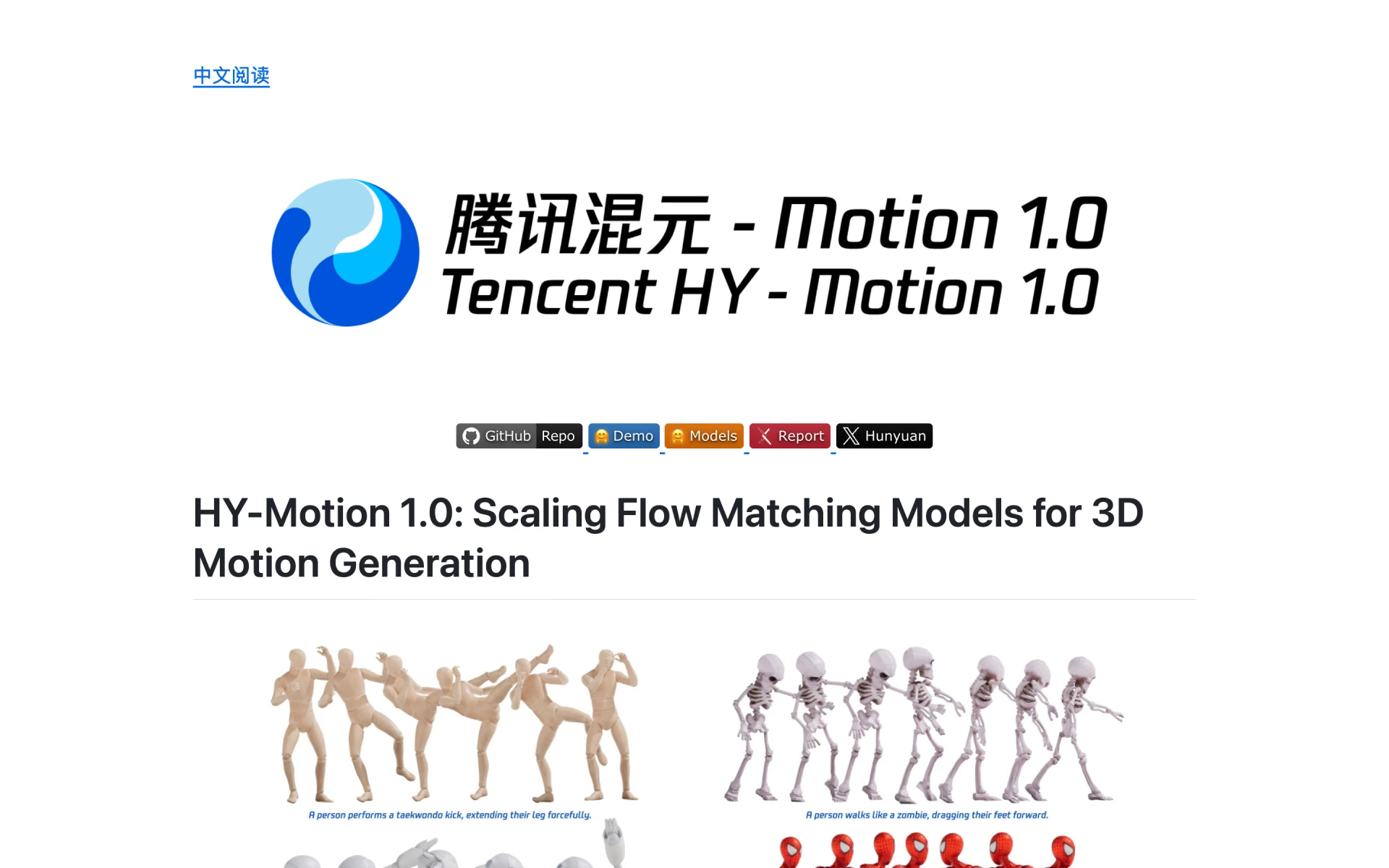
 HY-Motion 1.0
 SAM 3D

 WildDet3D
 World API

 Project Genie