
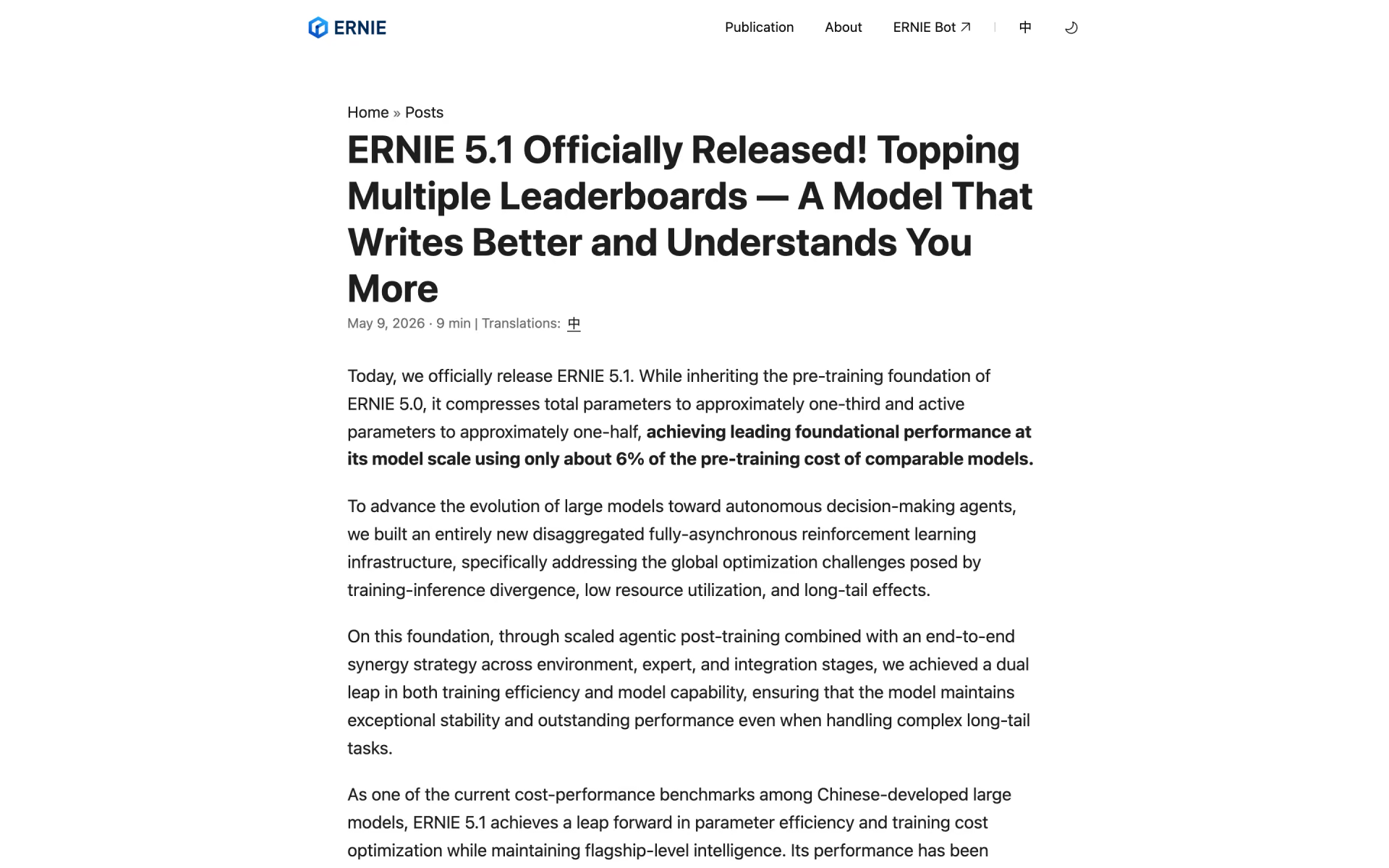
What is ERNIE 5.1?
ERNIE 5.1 is the current top model in Baidu's ERNIE line. Baidu cut it out of ERNIE 5.0, its 2.4-trillion-parameter multimodal model, keeping about a third of the parameters, then retrained it for tool use, search and long writing tasks.
It runs only as a hosted model: developers call it on Baidu's Qianfan platform, priced in yuan, and Baidu has not released its weights. Qianfan lists it as a text model, so image, audio and video input stay with ERNIE 5.0. Compared with DeepSeek-V4-Pro on the same platform, it has a smaller context but Baidu reports better agent scores.
What changed from ERNIE 5.0?
It is smaller and cheaper, retrained for agents and search, and on Qianfan it handles text only.
- Size
- About a third of ERNIE 5.0's total parameters and about half its active ones, cut from the same pre-trained model.
- Price
- ¥4 / ¥18 per million tokens for short prompts, against ¥6 / ¥24 for ERNIE 5.0; long prompts drop from ¥10 / ¥40 to ¥6 / ¥22.
- Training
- New reinforcement learning and agent post-training, which Baidu says lifted agent, knowledge, reasoning and search results.
- Modalities
- ERNIE 5.0 stays Baidu's model for image, audio and video input; Qianfan lists 5.1 as a text model.
Who is ERNIE 5.1 best for?
ERNIE 5.1 suits developers on Baidu's Qianfan platform who build Chinese-language agents, search tools and long-form writing apps, and teams moving off the pricier ERNIE 5.0.
Agents that chain tools
Baidu trained it for multi-step agent work and reports higher scores than DeepSeek-V4-Pro on the τ³-bench and SpreadsheetBench-Verified agent tests.
Fiction and long-form writing
Baidu tuned it for creative writing and long narratives, and more than ten creative platforms, including ISEKAI ZERO and Storymaster, are adding it.
Long inputs and long answers
A 128K-token context and up to 65,536 output tokens let it read long files and write long replies in a single call.
Cutting cost from ERNIE 5.0
It has about a third of ERNIE 5.0's parameters, and its output tokens cost ¥18 per million against ¥24 for 5.0 on prompts up to 32K.
What's included with ERNIE 5.1?
Function calling, built-in web search, a thinking budget, a 128K context with up to 65,536 output tokens, and a browser playground on Baidu AI Studio.
- Function calling
- Qianfan lists ernie-5.1 among the models that take tool definitions and call your functions.
- Built-in web search
- A search option on the chat API lets it pull in live web results before it answers.
- Thinking budget
- The thinking_budget setting caps how many tokens it spends reasoning before it starts the answer.
- Long output
- Up to 65,536 tokens in one reply, from up to 119K tokens of input.
- Browser playground
- Baidu AI Studio's playground opens on ERNIE-5.1, with web search and MCP tools you can switch on.
How much does ERNIE 5.1 cost?
ERNIE 5.1 costs ¥4 per million input tokens and ¥18 per million output tokens on Baidu's Qianfan API for prompts up to 32K tokens, and ¥6 / ¥22 for longer prompts up to 128K.
- Pay as you go on Baidu Qianfan, billed after use
- Model ID ernie-5.1
- ERNIE 5.0 costs ¥6 / ¥24 at this length
- Up to 119K input and 65,536 output tokens
- Default limit of 60 requests a minute
- ERNIE 5.0 costs ¥10 / ¥40 at this length
Baidu lists ERNIE 5.1 prices only in Chinese yuan on its Qianfan cloud platform, where the page quotes them per thousand tokens (¥0.004 and ¥0.018 for short prompts); its own pages give no US dollar price. There is no batch price for ERNIE 5.1. The default rate limit is 60 requests and 150,000 tokens a minute. Web search is priced separately under Qianfan's built-in tool prices. Full pricing on cloud.baidu.com. We checked these prices on .
How do readers rate ERNIE 5.1?
No one has rated ERNIE 5.1 yet. Be the first.
Sign in to rate. One rating per account.
ERNIE 5.1 pros and cons
It is cheaper than ERNIE 5.0 and supports tools and search, but it is billed in yuan, closed-weight, text-only on the API, and has little independent testing so far.
Pros
- Costs less than ERNIE 5.0 at both prompt lengths on Qianfan: ¥4 / ¥18 per million tokens against ¥6 / ¥24 for short prompts.
- Function calling, built-in web search and a thinking budget all work with it on the Qianfan API.
- Writes long replies, up to 65,536 tokens in one call.
- Baidu's published tests put it ahead of DeepSeek-V4-Pro on the τ³-bench and SpreadsheetBench-Verified agent tasks.
Cons
- Priced only in yuan on Baidu's Qianfan cloud; Baidu's pages list no US dollar price.
- No open weights: Baidu has not posted ERNIE 5.1 on Hugging Face, where its ERNIE 4.5 models are available to download.
- Text only on the API, and its 128K context is small next to the 1M tokens DeepSeek-V4-Pro offers on the same platform.
- Few hands-on reports from users so far, and the Reddit comments we found doubt that Baidu's benchmark wins hold up in real work.
What are the best ERNIE 5.1 alternatives?
DeepSeek for a 1M-token context and US dollar prices, Qwen3.7-Max for Alibaba Cloud's international regions, and GLM-5.3 for coding agents.
 DeepSeekFree
Choose it when you need a 1M-token context and US dollar billing; DeepSeek-V4-Pro costs $1.32 / $3.96 per million input / output tokens at peak hours and half that off-peak.
 Qwen3.7-MaxFreemium
Choose it when you want a 1M-token context in Alibaba Cloud regions such as Singapore, Frankfurt or US (Virginia), with up to 131,072 output tokens.
 GLM-5.3Free
Choose it when your agents mostly write and fix code; Z.ai built it for software engineering, and it reads up to 1M tokens and writes up to 128K.
Questions about ERNIE 5.1
What is ERNIE 5.1?
ERNIE 5.1 is Baidu's newest flagship model, a slimmer version of ERNIE 5.0 tuned for agents, search and writing, sold per token on Baidu's Qianfan cloud platform.
Who is ERNIE 5.1 for?
ERNIE 5.1 suits developers on Baidu's Qianfan platform who build Chinese-language agents, search tools and long-form writing apps, and teams moving off the pricier ERNIE 5.0.
Is ERNIE 5.1 free?
Not on the API: Qianfan bills ERNIE 5.1 per token, pay as you go, and lists no free tier for it. Baidu also offers an ERNIE 5.1 playground on AI Studio and a chat link on its ERNIE site, but its pages do not give a price for either.
Is ERNIE 5.1 priced in US dollars?
No. Baidu lists ERNIE 5.1 only in Chinese yuan on its Qianfan platform: ¥4 per million input tokens and ¥18 per million output tokens for prompts up to 32K. Its own pages show no dollar price, so check your exchange rate and Qianfan account terms first.
What are the best ERNIE 5.1 alternatives?
The closest alternatives on Recaply are DeepSeek, Qwen3.7-Max and GLM-5.3.
Where can I try ERNIE 5.1?
On its official website, ernie.baidu.com.
Is ERNIE 5.1 open source?
No. ERNIE 5.1 is a hosted model that Baidu offers through its Qianfan API, its AI Studio playground and the chat link on its ERNIE site. Baidu has not posted its weights on Hugging Face, where the earlier ERNIE 4.5 models are available to download.
Can ERNIE 5.1 read images?
Not on the Qianfan API as Baidu lists it: ERNIE 5.1 appears only under text generation, while ERNIE 5.0 also appears under vision understanding. For image, audio or video input on Qianfan, use ERNIE 5.0 or ERNIE 4.5 Turbo VL instead.
Our verdict
ERNIE 5.1 is a sensible upgrade for teams already building on Baidu's Qianfan platform.
It costs less than ERNIE 5.0 per token, supports function calling and web search, and Baidu reports agent scores above DeepSeek-V4-Pro.
- Skip it for
- Work that needs US dollar billing, open weights, image input or more than 128K tokens of context.
- Check first
- Run it on your own tasks before trusting the benchmark claims, since there are few hands-on reports from users so far.

 Kimi K3
 Qwen3.8-Flash

 Qwen3.6-Plus

 MiniMax M3

 Grok 4.3
 Muse Spark 1.1