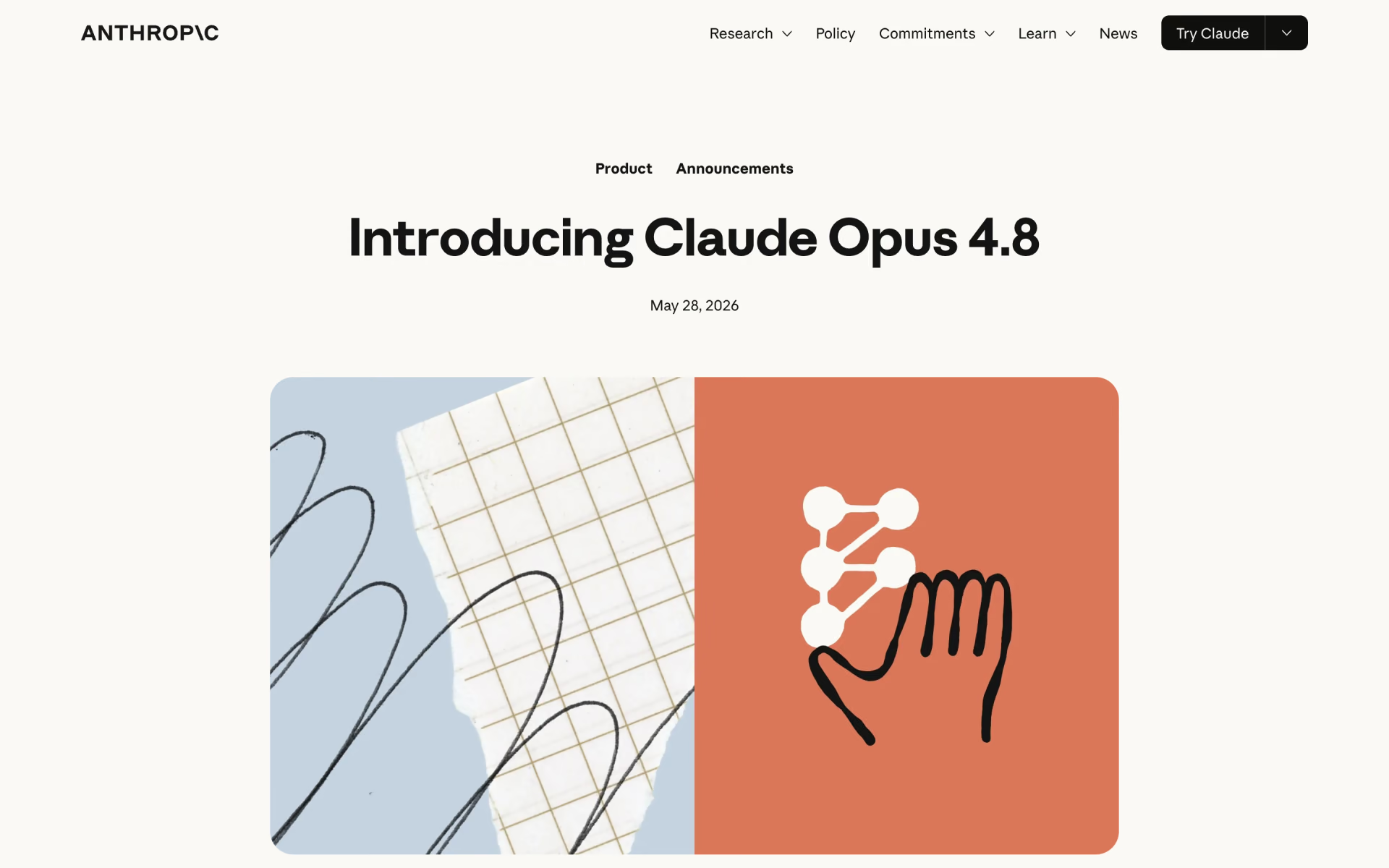
What is Claude Opus 4.8?
Opus 4.8 followed Opus 4.7 at the same price, and Anthropic itself called it a modest step up: higher coding and agent scores, and more willing to admit doubts about its own work. It reads text and images, writes text, and works across a 1M-token context with up to 128K tokens of output; its knowledge stops at January 2026.
Anthropic now lists it as a legacy model. Opus 5 and then Opus 5.5 came after it, and Anthropic suggests moving to Opus 5.5, which costs less. Opus 4.8 still has two jobs: Opus 5 and Opus 5.5 hand flagged offensive security requests to it, and it is the newest Opus with Priority Tier.
Is Claude Opus 4.8 still available?
Yes, as a legacy model: Anthropic still serves it but no longer updates it, and it suggests moving to Opus 5.5.
- API and clouds
- Still on the Claude API, Amazon Bedrock, Google Cloud, Microsoft Foundry and Claude Platform on AWS as claude-opus-4-8.
- Claude apps
- Paid plans can still use it, with a 500K-token context in chat and 1M in Claude Code.
- Safety fallback
- Opus 5 and Opus 5.5 hand requests their cyber classifiers flag over to Opus 4.8.
- How long
- Anthropic will not retire it sooner than a year after its release, and gives at least 60 days' notice before retiring a model.
Who is Claude Opus 4.8 best for?
Claude Opus 4.8 is best for teams that run it on Priority Tier, code that turns thinking off or forces tool use, and coding work tuned on it while they test Opus 5.5.
Priority Tier customers
It is the newest Opus that supports Priority Tier, which targets 99.5% uptime; Opus 5 and Opus 5.5 do not.
Code that switches thinking off
It still accepts requests with thinking disabled or a forced tool choice, both of which Opus 5.5 rejects.
Coding with fewer silent errors
Anthropic's tests found it about four times less likely than Opus 4.7 to let flaws in its own code pass without comment.
Apps tuned for this model
Teams whose prompts were tuned on Opus 4.8 can keep its model ID while they test a move to Opus 5.5.
What's included with Claude Opus 4.8?
Fast mode, mid-task system messages, five effort levels, optional thinking, Priority Tier, half-price batch jobs and every major cloud.
- Fast mode
- Up to 2.5x faster output on the Claude API for $10 / $50 per million tokens, a third of what fast mode cost on earlier Opus models.
- Mid-task system messages
- The API accepts system entries inside the message list, so an agent's instructions can change without breaking the prompt cache.
- Effort levels
- Low, medium, high, xhigh and max; high is the default, and Anthropic suggests xhigh for coding and agent work.
- Optional thinking
- Thinking stays off unless you turn on adaptive thinking, and requests that force a tool call still work.
- Priority Tier
- Committed capacity with a 99.5% uptime target, which Opus 5 and Opus 5.5 do not offer.
- Batch API
- Half-price input and output for jobs that can wait, with up to 300K output tokens under a beta header.
- Runs on every major cloud
- Available on the Claude API, Amazon Bedrock, Google Cloud, Microsoft Foundry and Claude Platform on AWS.
What changed from Opus 4.7?
The same price, somewhat higher scores, fast mode, and fewer unflagged mistakes in its own code.
- Coding
- SWE-Bench Pro rose to 69.2% from 64.3%, and Terminal-Bench 2.1 to 74.6% from 66.1%, in Anthropic's tests.
- Honesty
- About four times less likely to let flaws in code it wrote pass without comment.
- Fast mode
- Available at $10 / $50 per million tokens; Opus 4.7 has no fast mode.
- API
- System entries can sit inside the message list, so instructions change mid-task without breaking the cache.
How much does Claude Opus 4.8 cost?
Claude Opus 4.8 costs $5 per million input tokens and $25 per million output tokens on the API, $10 / $50 in fast mode, and it is included in Claude Pro from $20 a month; it is not on the Free plan.
- Cache reads $0.50, 5-minute cache writes $6.25, 1-hour writes $10
- Batch API: $2.50 / $12.50, half the standard rate
- 1M-token context, up to 128K output tokens
- Up to 2.5 times faster output, in research preview
- Claude API only; not on Claude Platform on AWS or partner clouds
- Not available with the Batch API
- Opus models and Claude Code included
- 500K-token context in chat, 1M in Claude Code
- Usage limits apply
- 5x or 20x Pro usage
- Higher output limits
- Priority access at busy times
Anthropic lists Opus 4.8 as a legacy model; the current Opus 5.5 costs $4 / $20 per million input / output tokens, and $8 / $40 in fast mode. Opus models are not on Claude's Free plan. Paying yearly brings Pro to $17 a month ($200 up front); Max is billed monthly only. Team seats cost $25 a month (standard) or $125 (premium), or $20 and $100 billed yearly. US-only inference costs 1.1x the standard API rates. It is also sold on Amazon Bedrock, Google Cloud and Microsoft Foundry at those clouds' own prices. Full pricing on claude.com. We checked these prices on .
How do readers rate Claude Opus 4.8?
No one has rated Claude Opus 4.8 yet. Be the first.
Sign in to rate. One rating per account.
Claude Opus 4.8 pros and cons
It finds hard bugs and flags its own mistakes better than Opus 4.7, but it costs more than Opus 5.5 and users say it slips in very long sessions.
Pros
- Leads Anthropic's launch table against Opus 4.7, GPT-5.5 and Gemini 3.1 Pro on SWE-Bench Pro (69.2%), OSWorld-Verified (83.4%) and GDPval-AA (1890).
- Hacker News users said it tracked down hard bugs that Opus 4.7 or GPT-5.5 had missed, including a rare concurrency bug that took more than ten failed tries on Opus 4.7.
- Anthropic's tests found it about four times less likely than Opus 4.7 to let flaws in its own code pass without comment.
- Several Reddit users found it easier on their Claude plan limits than Opus 4.7, and some went back to it after trying Opus 5.
Cons
- Costs more than Opus 5.5 per token ($5 / $25 against $4 / $20), and its fast mode costs more too ($10 / $50 against $8 / $40).
- Reddit users said its work gets worse once a session passes about 500K tokens, well short of the 1M limit.
- Users quickly tired of its 'I need to be honest with you' phrasing and found it wordy.
- GPT-5.5 beat it on Terminal-Bench 2.1 in Anthropic's own table (78.2% to 74.6%), and some users found GPT-5.5 better value or steadier on long, large-codebase runs.
What are the best Claude Opus 4.8 alternatives?
Opus 5.5 for a lower price, Sonnet 5 for the lowest cost, and GPT-5.5 for terminal-heavy agents.
 Claude Opus 5.5Paid
Choose it when you start new work or can move to always-on thinking; it costs $4 / $20 per million tokens, and its fast mode costs $8 / $40.
 Claude Sonnet 5Free
Choose it when price matters more than peak quality; it costs $2 / $10 per million tokens with the same 1M context and the same January 2026 knowledge cutoff.
 GPT-5.5Paid
Choose it when terminal-heavy agent work matters most; it beat Opus 4.8 on Terminal-Bench 2.1 in Anthropic's own table (78.2% to 74.6%), though output costs $30 per million tokens against $25.
Questions about Claude Opus 4.8
What is Claude Opus 4.8?
Claude Opus 4.8 is a legacy Anthropic model for coding and agents at $5 / $25 per million tokens, now replaced by Opus 5.5, which costs less and is Anthropic's default.
Who is Claude Opus 4.8 for?
Claude Opus 4.8 is best for teams that run it on Priority Tier, code that turns thinking off or forces tool use, and coding work tuned on it while they test Opus 5.5.
Is Claude Opus 4.8 free?
No. Claude Opus 4.8 is a paid tool, from $5 / $25 per million input / output tokens.
How much does Claude Opus 4.8 cost?
Claude Opus 4.8's paid plans are API at $5 / $25 per million input / output tokens, Fast mode at $10 / $50 per million input / output tokens, Claude Pro at $20 per month and Claude Max at From $100 per month.
What are the best Claude Opus 4.8 alternatives?
The closest alternatives on Recaply are Claude Opus 5.5, Claude Sonnet 5 and GPT-5.5.
Where can I try Claude Opus 4.8?
On its official website, anthropic.com.
Is Claude Opus 4.8 cheaper than Claude Opus 5.5?
No. Opus 4.8 costs $5 per million input tokens and $25 per million output tokens, while Opus 5.5 costs $4 and $20, and Anthropic suggests moving to Opus 5.5. Opus 4.8 stays available as a legacy model for at least a year after its release.
How does fast mode work on Claude Opus 4.8?
Fast mode is a research preview that makes Opus 4.8 produce output up to 2.5 times faster at double the price: $10 per million input tokens and $50 per million output tokens. It works only on Anthropic's own API and not with the Batch API.
Why did my Opus 5.5 conversation switch to Opus 4.8?
Anthropic's cyber classifiers flagged the request as possible offensive security work, so Claude re-ran it on Opus 4.8. Files, memory and search results can trigger the switch, not only what you type. You can turn automatic switching off in Claude's settings.
Does Claude Opus 4.8 support Priority Tier?
Yes. Priority Tier, which targets 99.5% uptime on committed capacity, works on Opus 4.8 but not on Opus 5, Opus 5.5 or Sonnet 5. Teams with a Priority Tier commitment need to plan capacity separately before they move to Opus 5.5.
Can I still use Claude Opus 4.8 in Claude Code?
Yes. On a paid plan, pick it with /model claude-opus-4-8 or start Claude Code with --model claude-opus-4-8. It gets a 1M-token context in Claude Code, against 500K tokens in the Claude chat apps.
Our verdict
Opus 4.8 is a legacy model worth keeping only for Priority Tier, code that relies on its older API behaviour, or prompts tuned on it.
Opus 5.5 costs less per token and is Anthropic's current default, but it always thinks, rejects forced tool use and has no Priority Tier.
- Skip it for
- New projects, which should start on Opus 5.5 or, on a budget, Sonnet 5.
- Check first
- Check your Priority Tier commitment and any code that turns thinking off before you plan the move.
 Claude Opus 4.5
 Claude Opus 4.7

 Claude Fable 5

 Claude Fable 5.1

 Claude Sonnet 4.6