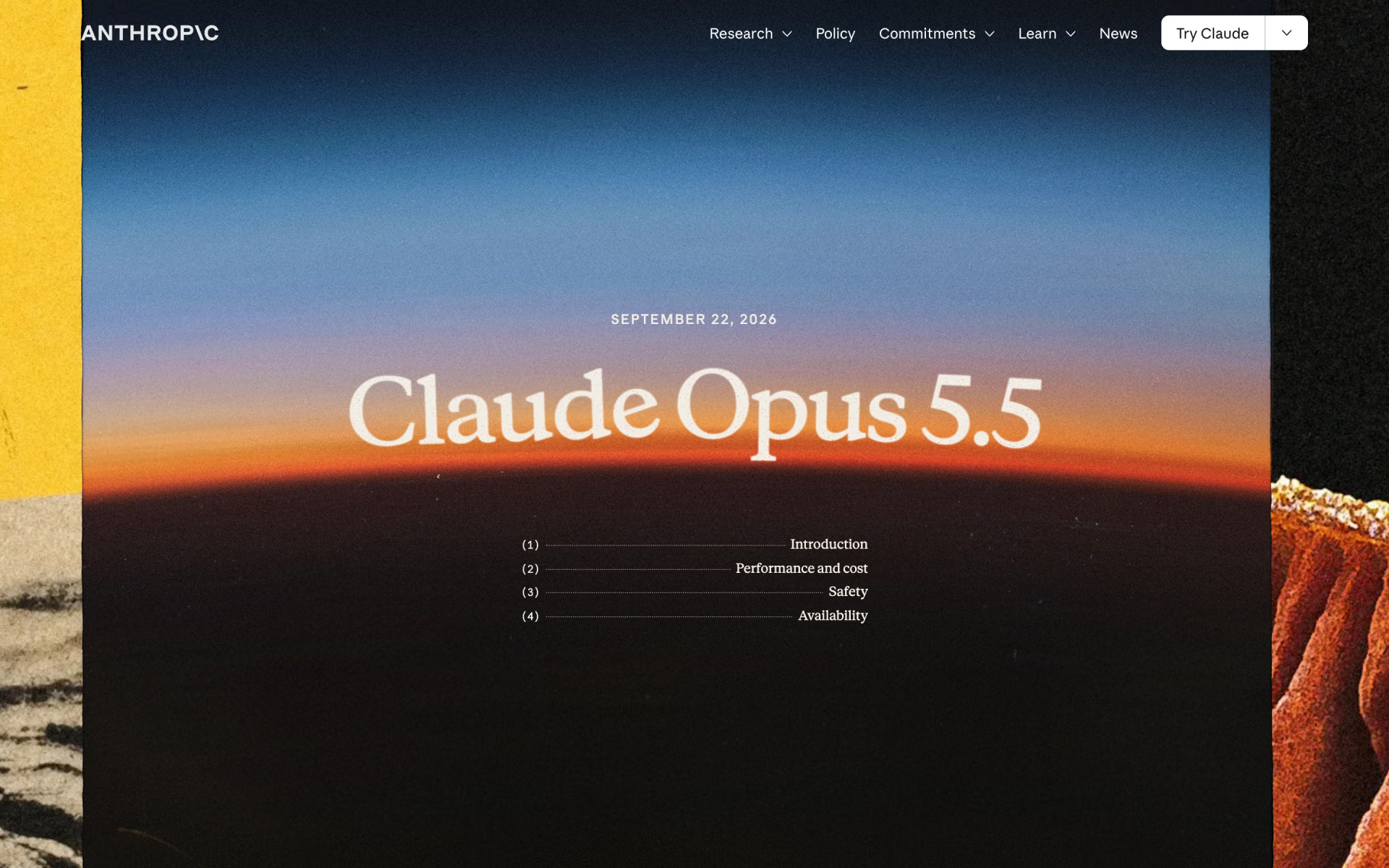
What is Claude Opus 5.5?
Opus 5.5 is the first model in Anthropic's Claude 5.5 family. It reads text and images, writes text, and works across a 1M-token context with up to 128K tokens of output. Anthropic now tells developers to start with Opus 5.5 for most workloads and move up to Fable 5.1 only when their own tests at higher effort still fall short.
What changed from Opus 5?
Mostly cost and tone: it is cheaper per token, needs fewer tokens per task, and Anthropic reworked how it writes.
- Price
- Input and output prices dropped 20%, and cache reads dropped 60%.
- Cost per task
- Anthropic says it needs fewer tokens per task, which adds up to about 40% lower cost on typical work.
- Thinking
- Always on. You set its depth with an effort level that defaults to medium.
- Writing
- Reworked after users said Opus 5 was hard to read.
Who is Claude Opus 5.5 best for?
Long coding jobs, agents billed by the token, research and financial analysis, and anyone already paying for Claude Pro, Max or Team.
Long coding jobs
Codebase-wide migrations, audits and refactors that run for hours; one early tester audited and fixed a 200,000-line codebase in under three hours.
Agents billed by the token
Cache reads cost $0.20 per million tokens, and cached context is most of the bill in long agent loops.
Research and financial analysis
It scored 1846 Elo on GDPval-AA v2.1, a test of real work across 44 occupations, ahead of Fable 5.1 and Opus 5.
Claude Pro, Max and Team subscribers
It is included from the $17-a-month Pro plan, and Anthropic raised five-hour usage limits on paid plans at launch.
What's included with Claude Opus 5.5?
Five effort levels, a faster output mode, half-price batch jobs, every major cloud, and zero data retention.
- Effort levels
- Five settings from low to max trade answer depth against speed and cost; medium is the default.
- Fast mode
- Up to 2.5x faster output in Claude Code and on the Claude Platform, at $8 / $40 per million tokens.
- Batch API
- Half-price input and output for jobs that can wait, with up to 300K output tokens under a beta header.
- Runs on every major cloud
- Available on the Claude API, Amazon Bedrock, Google Cloud, Microsoft Foundry and Claude Platform on AWS.
- Zero data retention
- Like earlier Opus models, it can be used under a zero data retention agreement.
How much does Claude Opus 5.5 cost?
$4 per million input tokens and $20 per million output tokens on the API, or included from $20 a month on Claude Pro ($17 a month billed yearly). It is not on the Free plan.
- Cache reads $0.20, 5-minute cache writes $5, 1-hour writes $8
- Batch API: 50% off input and output
- Fast mode: $8 / $40
- Opus models included
- Claude Code included
- 5x or 20x Pro usage
- Priority access at busy times
- Premium seats with 5x usage: $125 a month
- For teams of 2 to 150
Opus models are not on the Free plan. Paying yearly brings Pro to $17 a month ($200 up front) and Team seats to $20 (standard) or $100 (premium) a month. Every plan has usage limits that reset on a rolling five-hour window. Full pricing on claude.com. We checked these prices on .
How do readers rate Claude Opus 5.5?
No one has rated Claude Opus 5.5 yet. Be the first.
Sign in to rate. One rating per account.
Claude Opus 5.5 pros and cons
It costs less than Opus 5 and leads Anthropic's agentic coding table, but safety rerouting and breaking API changes need planning.
Pros
- Costs less than Opus 5 per token and, by Anthropic's measure, about 40% less per task at default settings.
- Tops Anthropic's published agentic coding table: 66.4% on Terminal-Bench 4.0, against 55.8% for Fable 5.1 and 57.9% for GPT-6 Astra.
- Ties Fable 5.1 for the lowest prompt injection success rate in Gray Swan's benchmark.
- Runs 1M tokens of context at less than half the price of Fable 5.1.
Cons
- Safety classifiers reroute some requests: offensive security work falls back to Opus 4.8, and dual-use biology and some frontier model development work falls back to Opus 5. Files, memory and search results can trigger a switch, not only what you type.
- Code written for Opus 5 can break: thinking cannot be turned off, forced tool use returns an error, and the older computer_20251124 tool is rejected on the Claude API and Google Cloud.
- Not on the Free plan, and not yet in Anthropic's Cyber Verification Program.
- Most early Reddit and Hacker News users say it reads far more plainly than Opus 5, but some still find it verbose or say it ignores rules they set, and at max effort it can use more tokens than Opus 5.
What are the best Claude Opus 5.5 alternatives?
Four tools on Recaply do Claude Opus 5.5's job. DeepSeek V4 Pro is open source, so you can run it on your own server.
 Claude Fable 5.1Paid
Choose it when Opus 5.5 at high effort still misses on your hardest reasoning or longest agent runs; it costs $10 / $50 per million tokens.
 Claude Sonnet 5Free
Choose it when speed and price matter more than peak quality; it is half the price at $2 / $10 with the same 1M context, but its knowledge stops at January 2026.
 Claude Opus 4.8Paid
Choose it when you do security testing under the Cyber Verification Program, since Opus 5.5 is not in the program and sends that work to Opus 4.8 anyway.
 DeepSeek V4 ProOpen Source
Choose it when you want an MIT-licensed 1.6T model for coding and agents with a 1M-token context you can self-host.
Questions about Claude Opus 5.5
What is Claude Opus 5.5?
It is Anthropic's model for long-running coding and knowledge work. It is the first Claude 5.5 model and the one Anthropic recommends starting with for most tasks.
Who is Claude Opus 5.5 for?
Claude Opus 5.5 is best for long coding jobs, agents billed by the token, research and financial analysis, and anyone already paying for Claude Pro, Max or Team.
Is Claude Opus 5.5 free?
No. Opus models are not available on Claude's Free plan; you need Pro, Max, Team or Enterprise, or API credits.
How much does Claude Opus 5.5 cost?
On the API it costs $4 per million input tokens and $20 per million output tokens, with cache reads at $0.20. In the Claude apps it is included from the Pro plan at $17 a month billed annually, or $20 monthly.
Is there an open source alternative to Claude Opus 5.5?
Yes. DeepSeek V4 Pro is an open source tool that does the same job, so you can run your own.
What are the best Claude Opus 5.5 alternatives?
The closest alternatives on Recaply are Claude Fable 5.1, Claude Sonnet 5, Claude Opus 4.8 and DeepSeek V4 Pro.
Where can I try Claude Opus 5.5?
On its official website, anthropic.com.
Is Fable 5.1 still worth it now that Opus 5.5 is out?
For most work, no: Opus 5.5 scores higher on Anthropic's published coding and knowledge-work benchmarks at less than half the price. Anthropic still points to Fable 5.1 for the most demanding reasoning and long-horizon agent work, so test both on your hardest tasks before paying for it.
Why did Claude switch models in my Opus 5.5 conversation?
A safety classifier flagged the request, usually offensive security or dual-use biology, and Claude re-ran it on Opus 4.8 or Opus 5. You can turn automatic switching off in Settings, then Capabilities.
What changes when I move from Opus 5 to Opus 5.5 on the API?
Change the model ID to claude-opus-5-5, remove any thinking settings and use effort instead, and replace forced tool_choice with auto plus strict tool use. Computer use needs the newer computer_toolset_20260801.
Our verdict
Opus 5.5 is the model most Claude users and API builders should default to now.
It matches or beats Fable 5.1 on Anthropic's own coding and knowledge-work tests at well under half the price, and it is cheaper than the Opus 5 it replaces.
- Skip it for
- Offensive security or dual-use biology work, where the safeguards send requests elsewhere.
- Check first
- If you run Opus 5 code, check the breaking changes before you switch.
 Claude Opus 4.5
 Claude Opus 4.7

 Claude Sonnet 4.6

 Claude Fable 5