 fast.ai
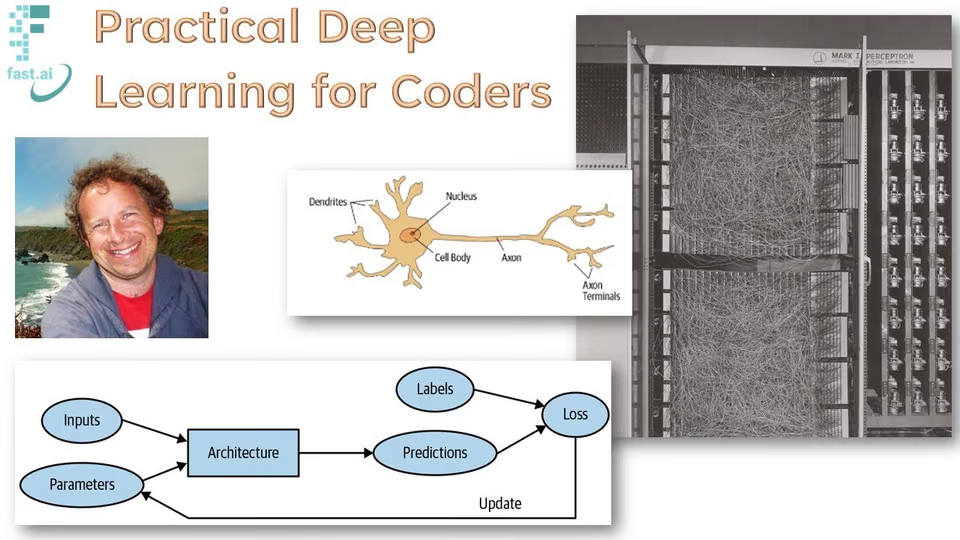
Practical Deep Learning for Coders
Train and use deep learning models for images, text and tables, for people who can already write code.
Taught by Jeremy Howard at fast.aiFreeVerified
- From Getting started to Convolutions (CNNs)
- 9 lessons
- What it uses
- PyTorch and fastai
- Before you startKnow how to code (a year of experience is enough), preferably in Python, and high school math.
- Beginner level
- 9 lessons of about 90 minutes each
- Self-paced
What you’ll learn
- Train models for computer vision, natural language, tabular data and collaborative filtering.
- Create random forests and regression models.
- Turn your models into web apps and deploy them.
- Learn why deep learning works, and use that to make models more accurate, faster and more reliable.
- Write stochastic gradient descent and a full training loop from scratch.
Skills you’ll gain
Tools it uses
PyTorch and fastai.
Details to know
- No certificatefast.ai lists none
- Free to takeNo fee on course.fast.ai
- Taught in EnglishNo other languages listed
- VerifiedOct 2026
Lessons
9 lessons of about 90 minutes each
A free course from fast.ai, taught by Jeremy Howard, on training and deploying deep learning models for practical problems. It starts with complete, working models and only then digs into how they work, down to writing the training loop yourself.
This is the 2022 part 1, recorded at the University of Queensland: nine video lessons of about 90 minutes each. Each lesson pairs with chapters of the fast.ai book, which is also written as Jupyter notebooks, and you do the work in Kaggle or Paperspace notebooks.
What each lesson covers:
- 1: Getting started, 2: Deployment: Train an image classifier in minutes, then gather your own data, train a model and put it on the web.
- 3: Neural net foundations: Learn how stochastic gradient descent fits layered linear functions and ReLUs, partly in a spreadsheet.
- 4: Natural Language (NLP): Fine-tune a Hugging Face Transformers model to score how similar phrases in US patents are.
- 5: From-scratch model: Write a linear model, a neural net and a deep model, plus their training loop, in PyTorch.
- 6: Random forests: Build decision trees and a random forest from scratch and read what they say about your data.
- 7: Collaborative filtering: Build recommendation models that fill gaps in a ratings matrix, with linear algebra and with deep learning.
- 8: Convolutions (CNNs): Look closely at embeddings, then open up convolutional networks: convolutions, pooling and dropout.
- Bonus: Data ethics: Weigh the effects of your models through case studies, in a 2020 lesson by Dr Rachel Thomas.
Applied learning project
Every lesson comes with notebooks to run, and the course expects you to work through them.
- Lesson notebooks: Run each lesson's notebooks on Kaggle or Paperspace Gradient, alongside the matching book chapter.
- Your own deployed model: By the end of lesson 2, collect your own data, train a model on it and deploy it as a web app.
- Kaggle practice: Work on real Kaggle data, from the Titanic dataset to the Road to the top notebook series.
- Book questions: Answer each chapter's questionnaire and check yourself against the posted solutions.
By the end you can train, improve and deploy models for images, text, tables and recommendations, and write a training loop from scratch.
Getting startedLesson 1 • 1 h 30 minLesson details
What you’ll learn
- Watch a full example of training and using an image model in the first few minutes.
- Build 'Is it a bird?', a classifier trained on photos you download yourself.
- Set up Kaggle and learn the Jupyter Notebook basics used through the course.
DeploymentLesson 2 • 1 h 30 minLesson details
What you’ll learn
- Plan your own project, collect a dataset and train a model on it.
- Deploy the model as a web app on Hugging Face Spaces with Gradio.
- Build a browser front end for the model in JavaScript.
Neural net foundationsLesson 3 • 1 h 30 minLesson details
What you’ll learn
- Learn how stochastic gradient descent fits a model's parameters.
- See why linear functions layered with ReLU activations are so flexible.
- Compare image models to pick a better one for a pet breed classifier.
- Build a simple model of the Titanic data in a spreadsheet.
Natural Language (NLP)Lesson 4 • 1 h 30 minLesson details
What you’ll learn
- Fine-tune a pretrained Hugging Face Transformers model to score how similar US patent phrases are.
- Turn text into subword tokens and a Hugging Face Dataset ready for training.
- Set up good validation and test sets, and tell metrics apart from loss functions.
From-scratch modelLesson 5 • 1 h 30 minLesson details
What you’ll learn
- Build a linear model, then a neural net with one hidden layer, then a deep model, in PyTorch.
- Write the training loop that updates the weights.
- Use sigmoid for binary classification and pick metrics to judge the model.
Random forestsLesson 6 • 1 h 30 minLesson details
What you’ll learn
- Build a decision tree and then a random forest from scratch.
- Interpret a random forest to see which features drive its predictions.
- Meet gradient boosting and start the Road to the top Kaggle notebooks.
Collaborative filteringLesson 7 • 1 h 30 minLesson details
What you’ll learn
- Learn how recommendation systems guess what people will like from their past behavior.
- Build collaborative filtering two ways: with classic linear algebra and with deep learning.
- Work through softmax and cross-entropy in a spreadsheet.
Convolutions (CNNs)Lesson 8 • 1 h 30 minLesson details
What you’ll learn
- Build embeddings from scratch and interpret what they learn.
- Open up convolutional neural networks and learn how convolutions work.
- Learn what pooling and dropout do inside a CNN.
Data ethicsLesson 9 • 1 h 30 min • BonusLesson details
What you’ll learn
- Work through case studies that show how data and models affect people.
- Read chapter 3 of the book alongside the 2020 recording by Dr Rachel Thomas.
FAQs
Do I get a certificate?
No. fast.ai does not list a certificate for this course.
What do I need before I start?
Know how to code (a year of experience is enough), preferably in Python, and high school math.
Which tools does it teach?
PyTorch and fastai.
Who makes it?
Taught by Jeremy Howard at fast.ai. Recaply lists 1 course from fast.ai.
More courses
See all
 Hugging FaceHugging Face LLM CourseIntermediate · 13 chapters · CertificateFree
 Gradio
 MITMIT 6.S191: Introduction to Deep LearningBeginner · 14 sessionsFreeAndrej KarpathyNeural Networks: Zero to Hero8 videosFree
 Harvard University (CS50)CS50's Introduction to Artificial Intelligence with PythonIntermediate · 7 weeks · CertificateFree