 MIT
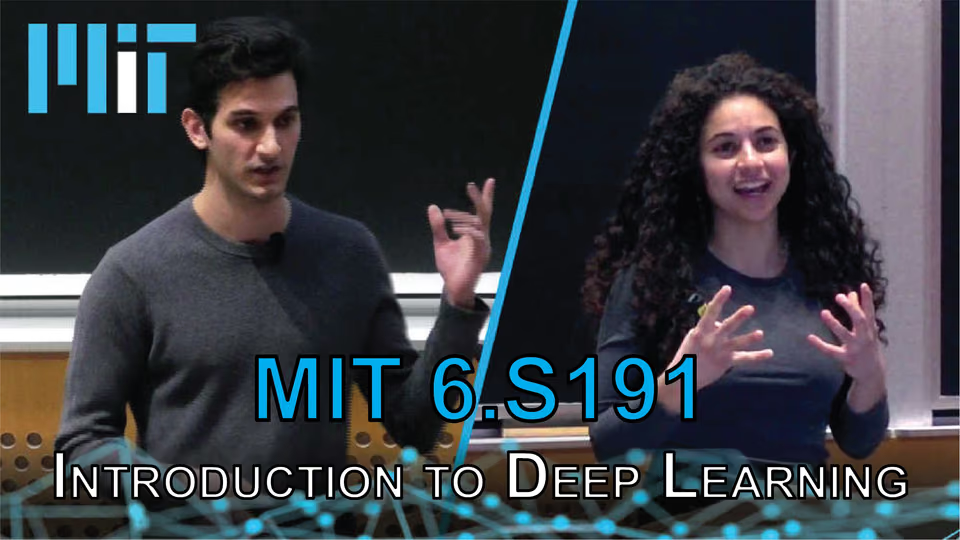
MIT 6.S191: Introduction to Deep Learning
Learn the foundations of deep learning through lectures and Python software labs, for beginners with basic calculus and linear algebra.
Taught by Alexander Amini, Ava Amini and 2 more at MITFreeVerified
- From Intro to Deep Learning to Pitch your ideas, awards, and celebration!
- 14 sessions
- What it uses
- TensorFlow and PyTorch
- Before you startCalculus (taking derivatives) and linear algebra (matrix multiplication); Python helpful but not necessary.
- Beginner level
- 9 lectures and 3 software labs (2026 edition)
- Self-paced
What you’ll learn
- Learn the basics of deep learning and how neural networks are trained.
- Work with sequences, images and generated data using sequence models, computer vision and generative models.
- Learn deep reinforcement learning and newer topics such as large language models and generative AI.
- Build neural networks in Python in three labs: music generation, facial detection and fine-tuning an LLM.
- Hear guest talks on AI safety rules, AI for science and training models across thousands of GPUs.
Skills you’ll gain
Tools it uses
TensorFlow and PyTorch.
Details to know
- No certificateMIT lists none
- Assessments3 labs and a final project
- Taught in EnglishNo other languages listed
- Last updatedMarch 2026
Lessons
14 sessions · 9 lectures and 3 software labs (2026 edition)
MIT 6.S191 is MIT's introductory course on deep learning, led by Alexander Amini and Ava Amini. It runs at MIT as a short, intensive bootcamp, and the lectures, slides and code labs are then released free online for anyone to follow.
Six core lectures take you from the basics of neural networks through sequence models, computer vision, generative models and reinforcement learning to large language models. Three guest lectures follow, alongside three Python labs in Google Colab, and the MIT edition ends with project pitches.
Across 9 lectures and 3 software labs, you will:
- Intro to Deep Learning: Build a neural network from perceptrons and train it with gradient descent and backpropagation.
- Deep Sequence Modeling: Model sequences with recurrent networks, then move on to self-attention and transformers.
- Deep Computer Vision: Use convolutional networks to classify images, detect objects and segment scenes.
- Deep Generative Modeling: Create new data with autoencoders, variational autoencoders and GANs.
- Deep Reinforcement Learning: Train agents with deep Q-networks and policy gradients, from Atari games to Go.
- New Frontiers: See where neural networks fail, then how diffusion models and large language models work.
- Lectures 7 to 9: Hear guest talks on safety rules for AI, AI for science and training on thousands of GPUs.
- Software Labs: Code music generation, a fairer face detector and an LLM fine-tune in Python.
Applied learning project
The three software labs are Colab notebooks where you fill in the missing code, and each ends with instructions for entering that lab's competition. The MIT edition closes with a project proposal competition, with feedback from course staff and a panel of industry sponsors.
- Music generation: Learn TensorFlow or PyTorch basics, then train a recurrent network that writes new Irish folk tunes.
- Facial detection: Classify handwritten digits, then train a face detector and reduce its bias with a debiasing VAE.
- LLM fine-tuning: Fine-tune a large language model to answer in a set style, then score it with a judge model.
- Project pitch: Present a new deep learning research idea or application in a short, timed talk to a panel of judges.
By the end, you can build and train the main kinds of deep neural networks in Python and follow current work on generative AI and large language models.
Intro to Deep LearningSession 1Session details
What you’ll learn
- Build a perceptron, then stack perceptrons into dense layers and deep networks.
- Measure error with loss functions such as binary cross entropy and mean squared error.
- Train networks with gradient descent, backpropagation, adaptive learning rates and mini-batches.
- Prevent overfitting with dropout and early stopping.
Deep Sequence ModelingSession 2Session details
What you’ll learn
- Model sequences with recurrent neural networks and backpropagation through time.
- See why gradients vanish or explode in RNNs, and how gated cells help.
- Build intuition for self-attention and multiple attention heads, the core of transformers.
Deep Learning in Python; Music GenerationSession 3 • 2 lessons • LabSession details
What you’ll learn
- Practice tensors, layers and automatic differentiation in TensorFlow or PyTorch.
- Train a character-level RNN on folk songs and generate a new tune.
Lessons
- 3.1Part 1: Intro to Deep Learning in Python: TensorFlow and PyTorch
- 3.2Part 2: Music Generation with RNNs
Deep Computer VisionSession 4Session details
What you’ll learn
- Learn how convolution, filters and pooling pick out features in an image.
- Build a convolutional neural network for image classification.
- Apply CNNs to object detection, semantic segmentation and steering a car from camera input.
Deep Generative ModelingSession 5Session details
What you’ll learn
- Compare supervised and unsupervised learning, and see what generative models are used for.
- Encode data into a latent space with autoencoders and variational autoencoders.
- Train generative adversarial networks, including CycleGAN for turning one domain into another.
Facial Detection SystemsSession 6 • 2 lessons • LabSession details
What you’ll learn
- Classify handwritten digits with a dense network and then a CNN.
- Train a face detector, then reduce its bias with a debiasing variational autoencoder.
Lessons
- 6.1Part 1: MNIST Digit Classification
- 6.2Part 2: Debiasing Facial Detection Systems
Deep Reinforcement LearningSession 7Session details
What you’ll learn
- Define agents, states, actions and rewards, and the Q-function that scores each action.
- Train deep Q-networks and policy gradient models.
- See reinforcement learning at work in self-driving simulation and AlphaGo.
New FrontiersSession 8Session details
What you’ll learn
- Explore where neural networks fail: uncertainty, adversarial attacks and algorithmic bias.
- Learn how diffusion models build images out of noise, including from text prompts.
- Find out how large language models predict the next token, and where they fall short.
Fine-Tune an LLM, You Must!Session 9 • 2 lessons • LabSession details
What you’ll learn
- Fine-tune a large language model to answer in a chosen style.
- Score its answers with a judge model and track the results with Opik.
Lessons
- 9.1Part 1: Fine-tuning an LLM for style
- 9.2Part 2: Evaluating a style-tuned LLM
The Three Laws of AI (guest: Douglas Blank)Session 10Session details
What you’ll learn
- Revisit Asimov's three laws of robotics and why safety layers for AI matter now.
- Test today's deep learning safety methods in live demos, and weigh three new laws for AI.
AI for Science (guest: Chris Bishop)Session 11Session details
What you’ll learn
- See how deep learning is being built into the process of scientific discovery.
- Look at examples from atmospheric modeling, materials design and drug discovery.
Work on final projectsSession 12 • ProjectSession details
What you’ll learn
- Work with your group on a deep learning research idea or application for the final pitch.
Secrets to Massively Parallel Training (guest: Mathias Lechner)Session 13Session details
What you’ll learn
- Learn why large-scale training needs GPUs and how to cut its memory use.
- Compare data, tensor, pipeline and sequence parallelism, plus sharding with DeepSpeed ZeRO and FSDP.
- Follow a case study of how these methods came together to train LFM2.
Pitch your ideas, awards, and celebration!Session 14 • ProjectSession details
What you’ll learn
- Pitch your project idea to a panel of judges in a short, timed talk.
- Hear the competition results and awards.
FAQs
Do I get a certificate?
No. MIT does not list a certificate for this course.
What do I need before I start?
Calculus (taking derivatives) and linear algebra (matrix multiplication); Python helpful but not necessary.
How long is it?
9 lectures and 3 software labs (2026 edition); you take it at your own pace.
See the lessonsWhich tools does it teach?
TensorFlow and PyTorch.
Who makes it?
Taught by Alexander Amini, Ava Amini, Douglas Blank and Chris Bishop at MIT. Recaply lists 1 course from MIT.
More courses
See all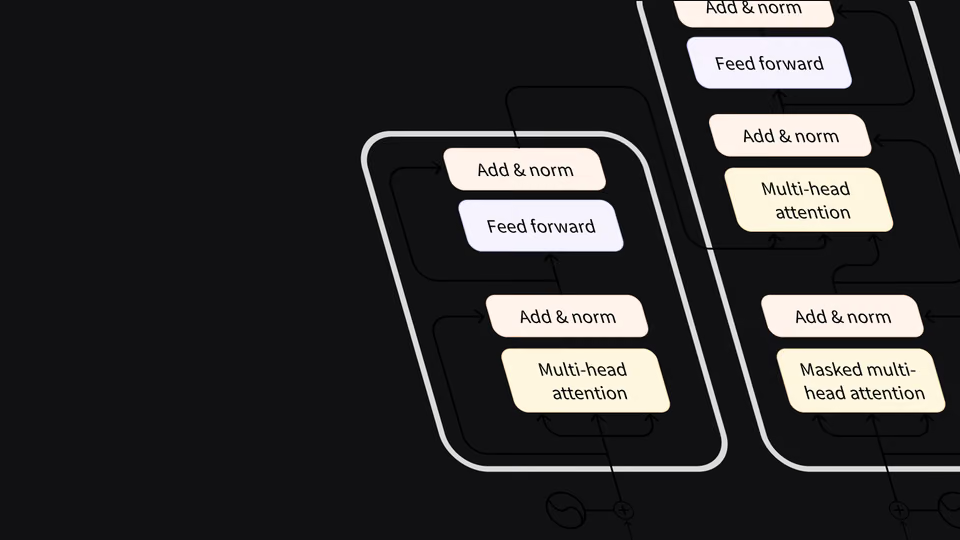
 Hugging FaceHugging Face LLM CourseIntermediate · 13 chapters · CertificateFree
 GradioAndrej KarpathyNeural Networks: Zero to Hero8 videosFree
 fast.aiPractical Deep Learning for CodersBeginner · 9 lessonsFree
 Harvard University (CS50)CS50's Introduction to Artificial Intelligence with PythonIntermediate · 7 weeks · CertificateFree