The best AI detectors in 2026, and what they catch and miss
The best AI detector for most people is Originality.ai, with AI and plagiarism checks in one scan. Eight compared on price, languages and false positives.
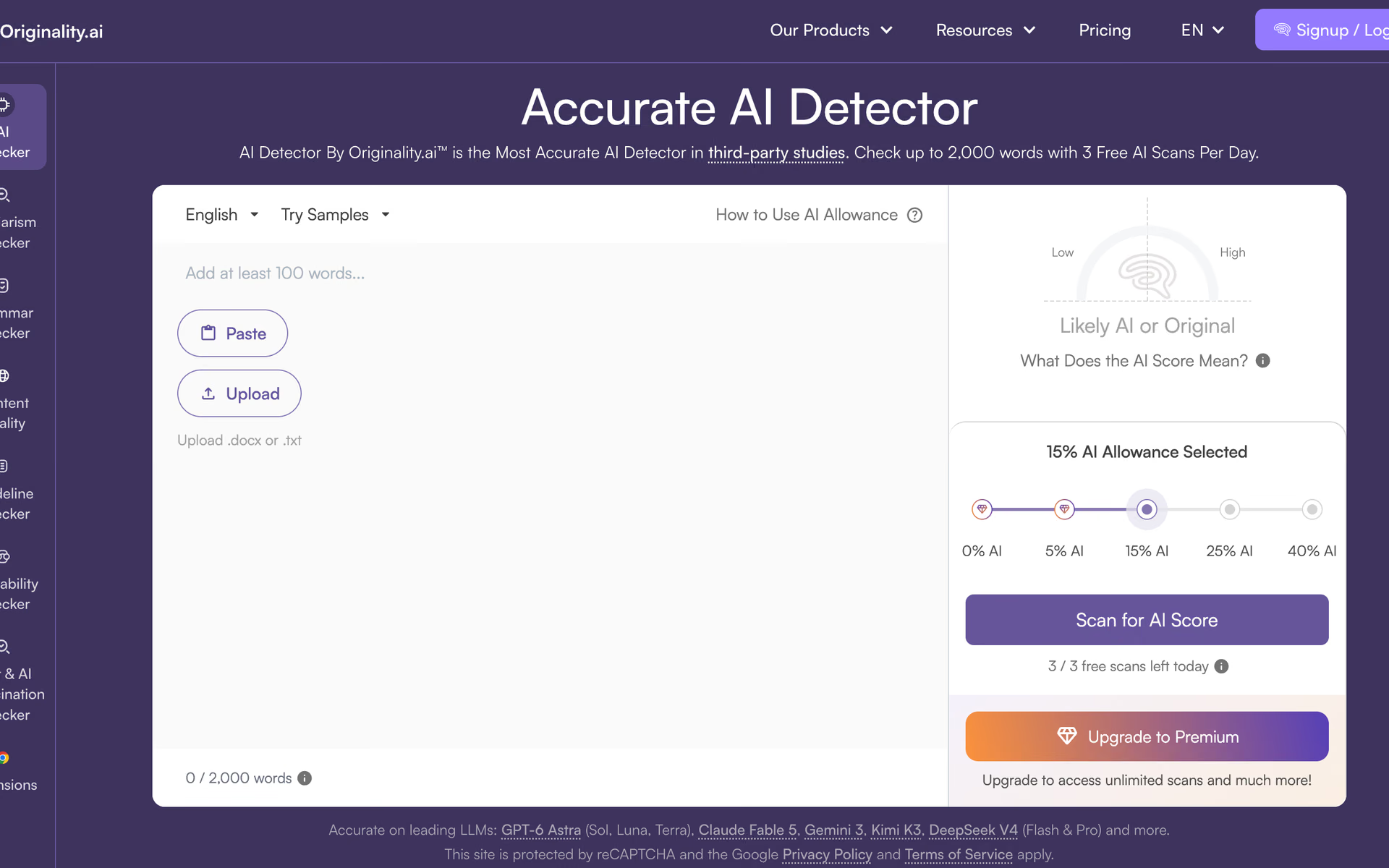
Originality.ai is the best AI detector for most editors and teachers: one scan checks AI and plagiarism in 31 languages, for $14.95 a month. Schools that already license Turnitin should use it, and QuillBot is the best free choice. No detector is proof, and every maker here warns that detectors can flag human writing.


How an AI detector works
An AI detector estimates how likely it is that a chatbot wrote a piece of text. It looks for patterns that AI writing tends to share, such as predictable word choices and sentences of similar length and shape. The result is a percentage, often with the suspect sentences highlighted.
That percentage is a likelihood, not proof, because a detector can't see how the text was written. A plain, formulaic essay can look like AI, and edited AI text can look human. Most tools also need a minimum length: QuillBot asks for 80 words, Originality.ai for 100 and Turnitin for 300.
A plagiarism checker does a different job: it compares your text with web pages, papers and books to find copied passages. Every tool here does both, some only on paid plans.
Detectors are trained on text from chatbots such as ChatGPT, Claude and Gemini, and we explain how those three compare. Students who want study help rather than checks can start with our guide to the best AI tools for students.
The best AI detectors at a glance
Prices are per person per month, billed monthly, from each maker's own pages on Nov 8, 2026. Languages are the ones each maker says its AI check reads.
| Tool | Free use | Paid from | Plagiarism check | AI check languages | Best for |
|---|---|---|---|---|---|
 Originality | 100 credits once (10,000 words) | $14.95 | Yes | 31 | Editors and publishers |
 Turnitin | No | Schools only | Yes | 7 | Schools that license it |
 QuillBot | 1,200 words a scan, 6 a day | $19.95 | Yes | 20+ | Free checks |
 GPTZero | 10,000 words a month | $23.99 | Yes | English plus 20+ | Teachers buying their own |
 Copyleaks | 25,000 characters a scan, no account | $16.99 | Yes | 30+ | Many languages |
 Winston AI | 2,000 words for 14 days | $18 | From $29 | 9 | Scanned and handwritten work |
 Grammarly | A score for each scan | $30 | On Pro | Not listed | Students checking their own work |
 Quetext | 1,000 words | $7.99 | Yes | 17 or 25 (pages differ) | AI and plagiarism on a budget |
The eight best, one by one
1. Originality.ai: best overall
Originality.ai is built for publishers, editors and agencies that buy writing. One scan checks for AI and plagiarism, and the same account adds fact, readability and grammar checks. Its Chrome extension can also replay how a Google Doc was typed.
The free plan gives 100 credits once, and one credit covers 100 words. Pro costs $14.95 a month for 2,000 credits, about 200,000 words, with file uploads and shared reports. Originality.ai says its 5.0 model, released in October 2026, is more than 99% accurate.
Good
- AI, plagiarism and fact checks in one account
- AI checks in 31 languages
- Writing replay to prove your work
Watch for
- A 2025 Chicago Booth working paper found it missed 10% to 40% of AI text, depending on the model
- Monthly credits expire at the end of each month
2. Turnitin: best for schools
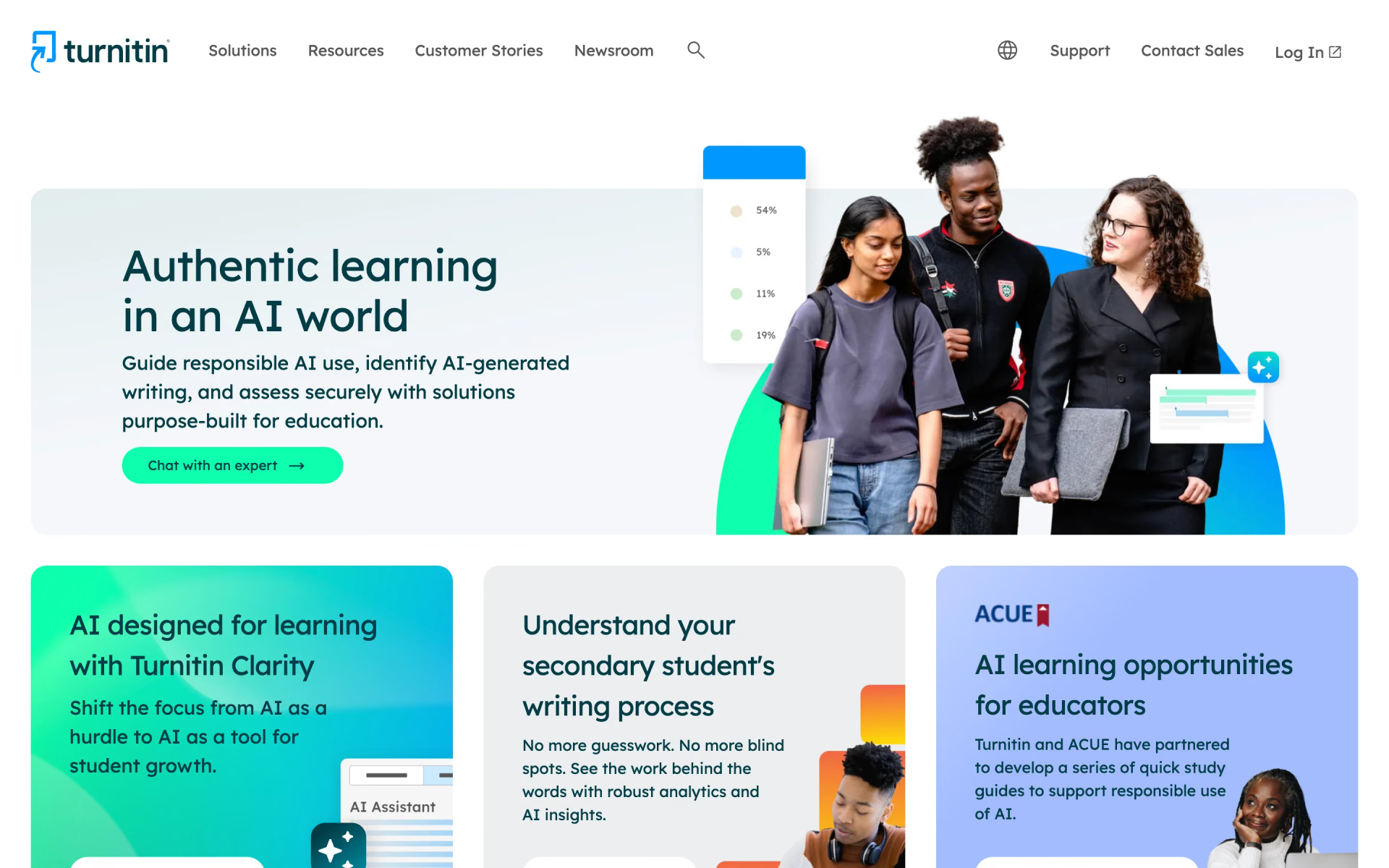
Turnitin is the detector many schools and universities already pay for. Its AI writing report sits beside the similarity report in your school's learning platform. In English, it also flags AI text that went through a paraphraser or a humanizer.
You can't buy it yourself: AI detection comes only with a school's Turnitin Originality license, and prices aren't public. A file needs 300 to 30,000 words of prose. Scores from 1% to 19% show only as an asterisk, because Turnitin says low scores produce more false positives.
Good
- Built into the tools schools already use
- Hides low scores, where false flags are more common
- Spots paraphrased and humanized AI text in English
Watch for
- Schools only, with no public price
- Skips bullet points, tables, poems and code
3. QuillBot: best free AI detector
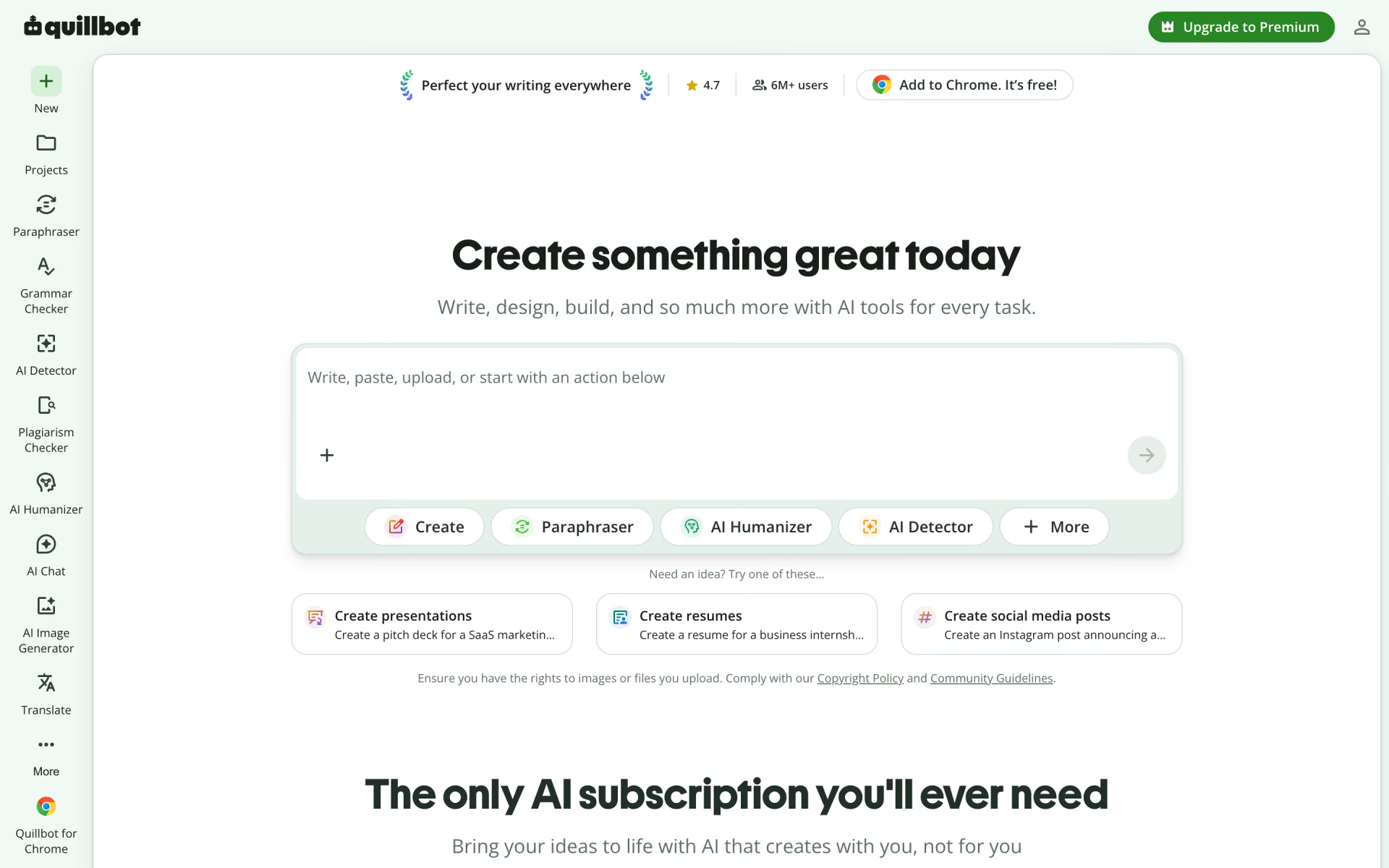
QuillBot offers free scans of up to 1,200 words each, six times a day, with no paid plan needed. Each scan gives a 0 to 100% score with sentence highlights, and it separates AI-written text from human writing polished with AI.
Premium costs $19.95 a month, or $99.95 a year, and removes the limits and adds downloadable reports. QuillBot says its detector reads more than 20 languages and leans toward "human" when a result is unclear, to cut false flags.
Good
- 1,200 words a scan, six scans a day, free
- Separates fully AI text from AI-polished human text
- Leans toward "human" when unsure
Watch for
- Also sells a humanizer that rewrites AI text
- Texts under 80 words can't be scanned
4. GPTZero: best for teachers buying their own
GPTZero is built mainly for teachers, and the American Federation of Teachers names it its official AI detector partner. It marks sentences that look AI-written and flags text run through paraphrasers and bypass tools. In Google Docs, it can replay a document being written.
The free plan checks 10,000 words a month, while Premium, at $23.99 a month, covers 300,000 words and adds more than 20 languages. Professional costs $45.99 a month, with uploads of up to 250 files and links to Canvas and Google Classroom. GPTZero says it is 99.9% accurate.

Good
- 10,000 free words a month
- Writing replay inside Google Docs
- Class uploads and LMS links on Professional
Watch for
- Other languages need a paid plan
- Free scans stop at 10,000 characters each
5. Copyleaks: best for many languages
Copyleaks checks AI writing in more than 30 languages and plagiarism in more than 100, in one report. You can scan up to 25,000 characters free without an account. It can also read photos of handwritten work and check images for AI.
Personal costs $16.99 a month for 100 credits, and one credit covers 250 words, so about 25,000 words. Pro costs $99.99 a month for 1,000 credits and 25 users. Schools pay per student and get links to Canvas, Moodle and Blackboard. Copyleaks says it is over 99% accurate, with a 0.03% false-positive rate.

Good
- Free scans up to 25,000 characters, no account
- AI checks in 30+ languages, plagiarism in 100+
- Reads handwritten work from photos
Watch for
- Personal covers only about 25,000 words a month
- Switching plans wipes unused credits
6. Winston AI: best for scanned and handwritten work
Winston AI reads scanned pages and photos of handwriting, so teachers can check work done on paper. It also checks images for signs of AI and deepfakes.
The free trial gives 2,000 credits for 14 days, and an AI scan uses one credit per word. Essential costs $18 a month for 100,000 credits. Plagiarism checks start with Advanced at $29 a month, at two credits per word. Winston says its 5.0 model was 99.87% accurate on 12,000 English documents in its own test.
Good
- Reads handwriting and scanned pages
- Checks images and deepfakes too
- Shareable PDF reports
Watch for
- The free trial ends after 14 days
- Needs at least 500 characters per scan
7. Grammarly: best for checking your own work
Grammarly is aimed at the writer rather than the grader. Its free detector gives a percentage score for pasted text or an uploaded file. Grammarly Authorship records which parts of a document you typed, pasted or wrote with AI, so you can show your process.
Pro, at $30 a month or $12 billed yearly, adds a plagiarism check and an AI detector agent that marks suspect phrases. Grammarly says its detector is 99% accurate, but also that no detector is 100% accurate.
Good
- A free AI score, with file upload
- Authorship shows how a document was written
- Plagiarism check in the same Pro plan
Watch for
- Doesn't list which languages its detector reads
- Phrase-by-phrase highlights need Pro
8. Quetext: best for AI and plagiarism on a budget
Quetext pairs an AI detector with a plagiarism checker it calls DeepSearch. The free plan checks up to 1,000 words for each, with results shown line by line.
AI checks alone cost $7.99 a month, while Essential, at $14.99, covers 100,000 words of AI and plagiarism checks and 20-file uploads. Professional starts at $29.98 a month for 200,000 words and unlimited users. Quetext publishes no accuracy figure.
Good
- AI and plagiarism checks on the free plan
- A low price for AI checks alone
- Bulk uploads for a whole class
Watch for
- Also sells a humanizer that rewrites AI text
- An unclear language list
Are AI detectors accurate?
AI detectors are often right about long AI text that nobody edited, but none is accurate enough to prove anything on its own. Every accuracy figure in this guide comes from the maker, and most claim 99% or more. Turnitin says it aims to wrongly flag fewer than 1 in 100 fully human documents.
Independent research is less kind: in a 2023 Stanford study published in the journal Patterns, seven detectors were near perfect on essays by U.S. eighth-graders. But they labeled 61% of essays by non-native English writers as AI, and at least one detector flagged 97% of those essays.
A peer-reviewed 2023 test of 14 tools, including Turnitin, called them "neither accurate nor reliable", and paraphrasing made the results worse. A 2024 study of six detectors saw accuracy fall from 39.5% to 17.4% after simple tricks, such as adding spelling errors.
Newer paid tools seem to do better. In a 2025 Chicago Booth working paper, three paid detectors, including GPTZero and Originality.ai, wrongly flagged about 2% or less of human writing. All three lost some accuracy on passages under 50 words, though GPTZero stayed at 96%.
The makers share these warnings, and OpenAI, which makes ChatGPT, says detectors have not worked in its experience. Its own test detector labeled Shakespeare and the Declaration of Independence as AI writing. Turnitin, Originality.ai and QuillBot all say a score should never be the only basis for a decision.
Small error rates add up across a school, which is one reason Vanderbilt University turned off Turnitin's AI detector in 2023. It noted that a 1% false-positive rate on the 75,000 papers it submitted in 2022 could have wrongly flagged about 750 of them.
Do AI detectors work in other languages?
Some do, but coverage varies a lot, so check that your language is listed before you trust a score.
- Copyleaks reads more than 30 languages, and Originality.ai reads 31.
- GPTZero reads English plus more than 20 others on its paid plans, and QuillBot says it covers more than 20.
- Winston AI reads nine, including simplified Chinese, Polish and Ukrainian.
- Turnitin reads seven: English, Spanish, Japanese, Arabic, Dutch, German and Turkish. Its paraphrase and humanizer checks work in English only.
- Quetext lists 17 languages on one page and 25 on another, and Grammarly doesn't list any.
Translation is a weak spot: in the 2023 test of 14 tools, human essays machine-translated into English were classed correctly about 20% less often. The authors warn that students who translate their own work risk false accusations.
What to do if a detector flags your writing
If a detector flags work you wrote yourself, gather your evidence before you reply, since even the makers call a score an estimate.
- Show your process. Version history in Google Docs or Word shows the document growing over time. Grammarly Authorship and Originality.ai's writing replay record the typing itself.
- Ask for the report. Students don't see Turnitin's AI report unless a teacher shares it.
- Quote the maker. Turnitin says its score shouldn't be the only basis for action against a student.
Teachers should treat a high score as a reason to talk, not as a verdict. Vanderbilt suggests comparing the work with the student's earlier writing and checking for made-up sources. Where AI use is allowed, OpenAI suggests asking students to share their chatbot conversations.
Which one should you pick?
- You check freelance writing and want AI and plagiarism in one scanOriginality
- Your school already licenses Turnitin and you grade in its learning platformTurnitin
- You want a free checker for the occasional essayQuillBot
- You teach and want class uploads and writing replayGPTZero
- You check writing in many languagesCopyleaks
- You need to check handwritten or scanned workWinston AI
- You're a student who wants to check a draft and show how you wrote itGrammarly
- You want AI and plagiarism checks for a class on a small budgetQuetext
How we picked
We started from the AI text detectors on Recaply and kept those that teachers, editors and students can get, alone or through a school. We read each maker's pricing pages, help centres and accuracy notes on Nov 8, 2026.
We have not run our own detection tests, so accuracy numbers are the makers' own claims unless we name an outside study. We left out tools whose main product rewrites AI text to slip past detectors.
No maker paid to appear in this list or saw it before publication. If a price changes, we update this page and its date.
Questions people ask
Do AI detectors work?
Sometimes, but not well enough to prove anything on their own. OpenAI says they haven't worked in its experience, and peer-reviewed studies found them unreliable on edited, translated or non-native writing. Newer paid tools do better on long text that nobody edited.
Is there a free AI detector?
Yes, several: QuillBot checks up to 1,200 words a scan, six times a day, for free. Copyleaks scans up to 25,000 characters without an account, and GPTZero's free plan covers 10,000 words a month.
Is Turnitin's AI detector free for students?
No, because Turnitin sells AI detection only to schools that license Turnitin Originality, so students can't buy it on their own. Students also don't see the AI report unless a teacher shares it.
What is the most accurate AI detector?
No one can say for sure, because almost every accuracy figure comes from the maker. A 2025 Chicago Booth working paper found that paid detectors did well on longer texts but struggled under 50 words.
Does Grammarly get flagged as AI?
Spelling and grammar fixes usually don't, according to Turnitin's own tests. But text written by Grammarly's generative features, such as rewrites and paraphrasing, will likely be flagged.
How can you prove you didn't use AI?
Show how the work was made. Version history, drafts, notes and sources all help, and Grammarly Authorship and Originality.ai's writing replay record how a document was typed.