
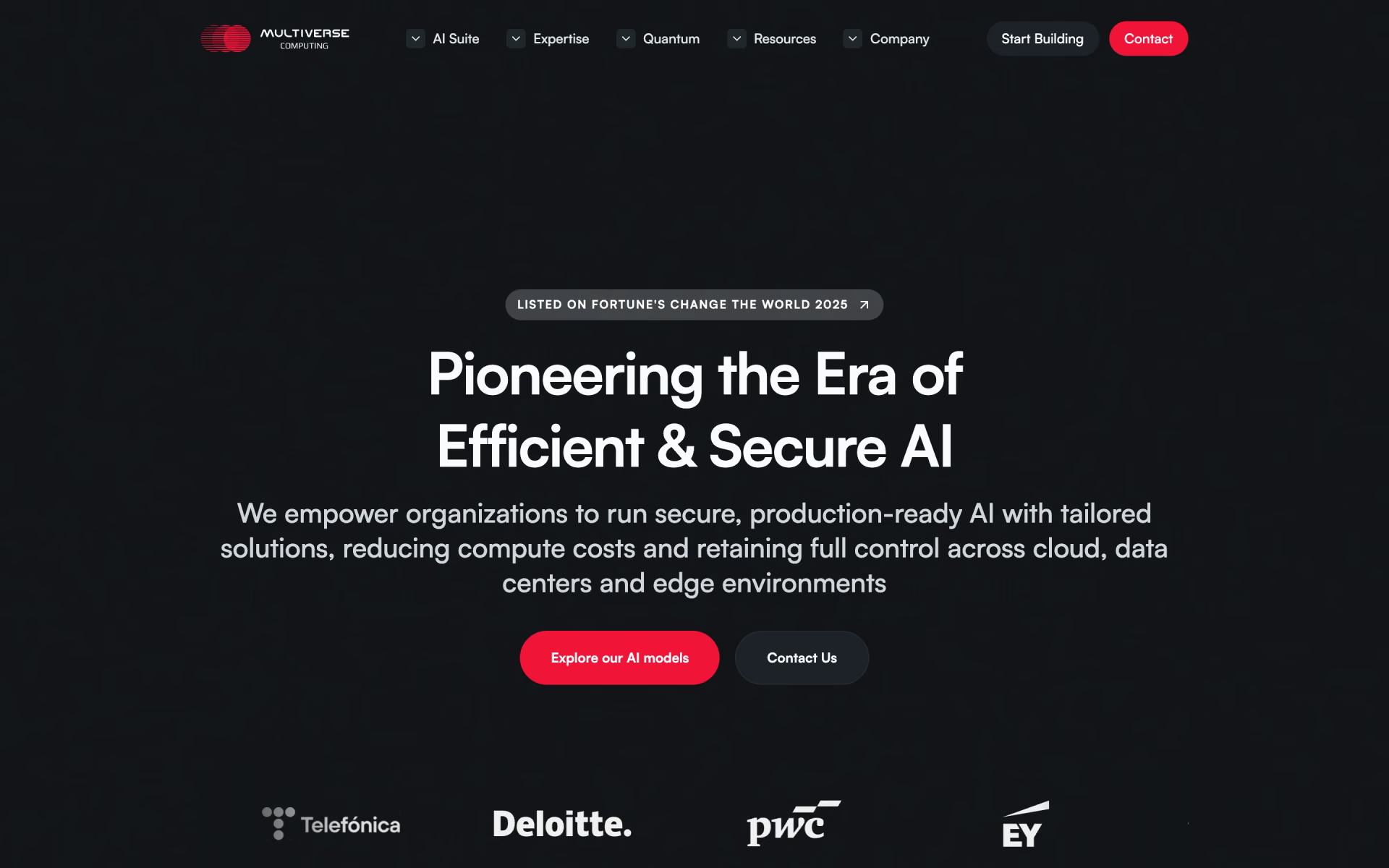
What is Multiverse Computing?
Compressed models that cut AI costs across cloud and edge.
Who is Multiverse Computing best for?
Multiverse Computing is best for teams cutting LLM costs with an API or on-premise models.
Cheaper API inference
The CompactifAI API serves Multiverse's compressed models and a few open models through an OpenAI-compatible endpoint, starting at $0.04 per million input tokens.
Private or on-premise AI
Compressed models can run in your own cloud, data centre or on edge devices, for teams that cannot send data to a shared API.
Coding tools on a budget
The docs show how to point Claude Code, Cursor, GitHub Copilot and OpenCode at CompactifAI models instead of pricier defaults.
Teams that need EU data handling
A regional EU endpoint keeps requests in Europe, and the API does not store prompts or completions.
How much does Multiverse Computing cost?
Multiverse Computing sells its CompactifAI API pay as you go, from $0.04 per million input tokens and $0.14 per million output tokens for Hypernova 60B up to $1.10 and $3.50 for GLM 5.3, with no monthly fee.
- Compressed with Multiverse's CompactifAI
- Cheapest text model in the catalog
- Compressed with Multiverse's CompactifAI
- Reasoning always on, with low, medium and high effort
- Multiverse's largest model, 438B parameters
- Tool calling and structured output
- Reasoning always on, at high or max effort
- Third-party model from Z.ai
- GLM 5.2 costs the same
Other models per million input / output tokens: Mistral Small 3.1 $0.11 / $0.17, Nemotron 3 Nano Omni $0.20 / $0.80 and Qwen 3.8 27B $0.40 / $2.00. Whisper Large V3 Turbo Slim transcribes audio for $0.01 an hour. There is no monthly fee or minimum spend; usage is billed once a month. The same models are sold through AWS Marketplace, and private endpoints, on-premise deployment and enterprise plans are priced on request. Full pricing on multiversecomputing.com. We checked these prices on .
How do readers rate Multiverse Computing?
No one has rated Multiverse Computing yet. Be the first.
Sign in to rate. One rating per account.
Questions about Multiverse Computing
What is Multiverse Computing?
Compressed models that cut AI costs across cloud and edge.
Who is Multiverse Computing for?
Multiverse Computing is best for teams cutting LLM costs with an API or on-premise models.
Is Multiverse Computing free?
No, Multiverse Computing has no free plan for its CompactifAI API. You pay per million tokens for the model you call, from $0.04 for input on Hypernova 60B, with no monthly fee or minimum spend, and usage is billed once a month.
How much does Multiverse Computing cost?
Multiverse Computing's paid plans are Hypernova 60B at $0.04 / $0.14 per million input / output tokens, Carina 60B at $0.05 / $0.20 per million input / output tokens, Quasar 438B at $0.60 / $1.80 per million input / output tokens and GLM 5.3 at $1.10 / $3.50 per million input / output tokens.
Where can I try Multiverse Computing?
On its official website, multiversecomputing.com.
Does Multiverse Computing train on my API data?
No. Multiverse Computing says CompactifAI API prompts and completions are never used for training and are not stored. It keeps only anonymised request logs, deleted after 30 days, and basic billing data such as the model used and token counts.

 Cloudverse
 IONOS Cloud
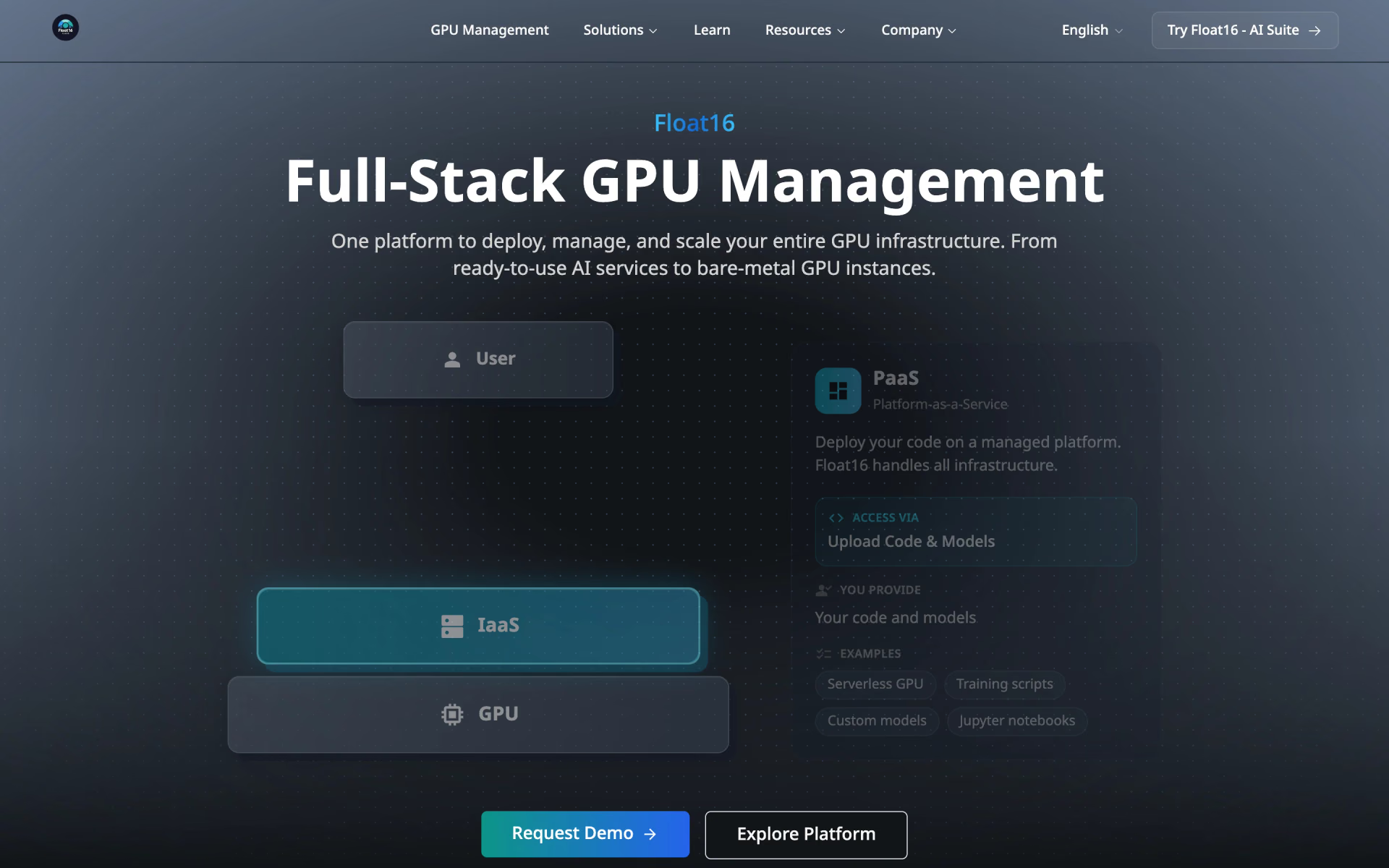
 Float16.cloud

 Luxand.cloud

 Saturn Cloud
 Cloudflare