
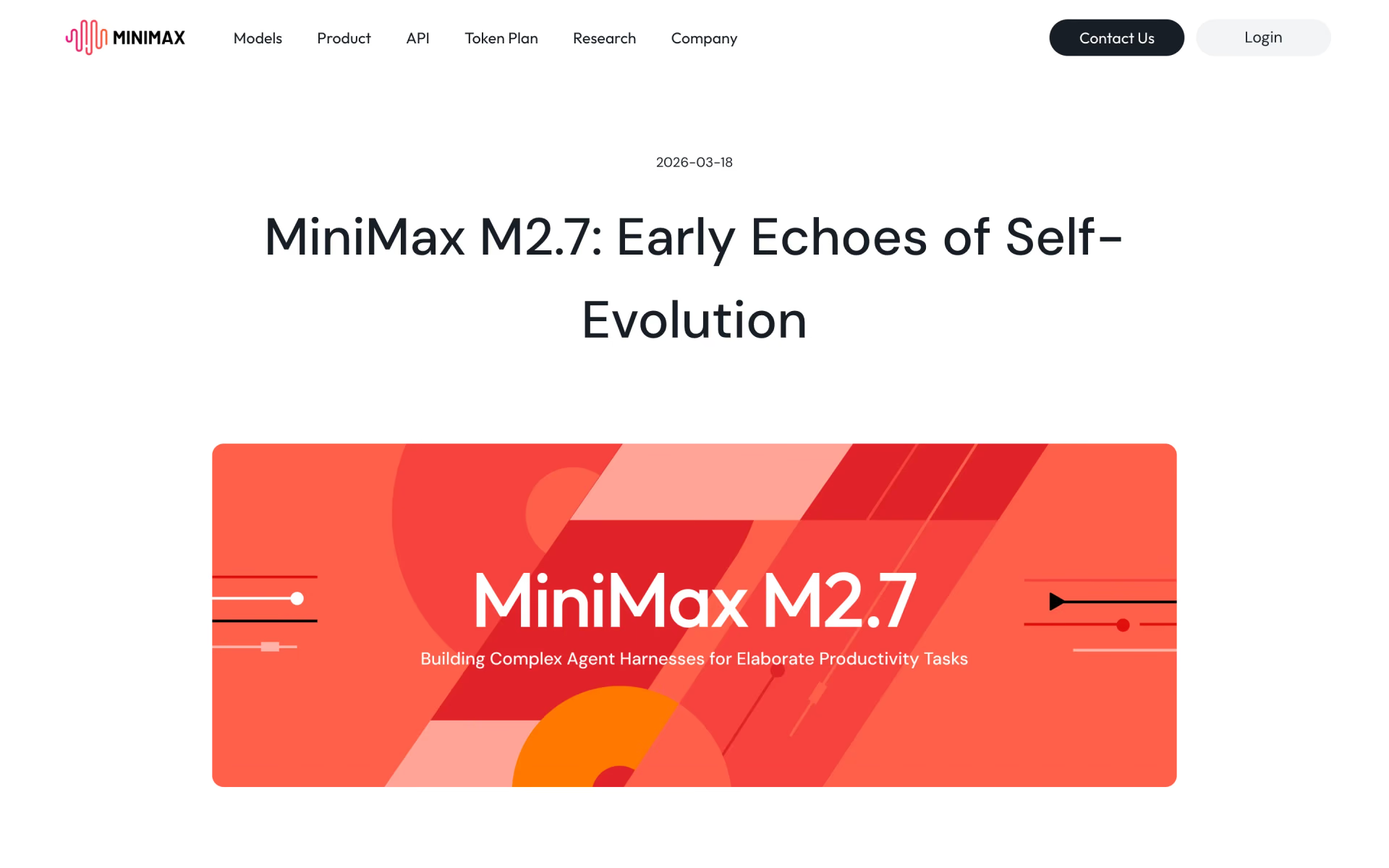
What is MiniMax M2.7?
MiniMax M2.7 is a large language model from MiniMax, trained for coding, tool use, office documents and setups where several agents split a job. It reads and writes text only, with a 204,800-token context on MiniMax's API, which accepts both Anthropic-style and OpenAI-style requests. The weights are on Hugging Face, free for personal and research use but not for business use without permission.
It is no longer MiniMax's flagship. MiniMax M3 added a 1M-token context and image and video input, and MiniMax's coding-tool guides now default to it. MiniMax still lists M2.7 as a current model rather than a legacy one.
Is MiniMax M2.7 still available?
Yes. MiniMax still serves M2.7 and lists it as a current model, but MiniMax M3 is now its flagship.
- API
- MiniMax-M2.7 and MiniMax-M2.7-highspeed are still on MiniMax's API at $0.30 / $1.20 and $0.60 / $2.40 per million tokens.
- Token Plan
- Every Token Plan covers M2.7 alongside M3, image and speech models from one shared quota.
- Weights
- The weights stay on Hugging Face and ModelScope under the same non-commercial licence.
- Newer and older models
- MiniMax M3 and M3.1-Flash-Preview are newer; M2.5, M2.1 and M2 are the ones MiniMax lists as legacy.
Who is MiniMax M2.7 best for?
MiniMax M2.7 is best for developers running coding and tool-using agents on a tight token budget, multi-agent harnesses, office document work, and teams already built around M2.7.
Coding agents on a budget
MiniMax reports 56.22% on SWE-Pro and 57.0% on Terminal Bench 2, at $0.30 / $1.20 per million input / output tokens.
Multi-agent harnesses
MiniMax trained it for Agent Teams, long skills and dynamic tool search, and reports 97% skill adherence across 40 skills of over 2,000 tokens each.
Office document work
It handles multi-round edits to Excel, PowerPoint and Word files, and MiniMax reports a GDPval-AA Elo of 1495.
Existing M2.7 setups
Teams whose prompts and harnesses are tuned to M2.7 can keep calling it by API, and the weights stay free for personal, research and non-profit use.
What's included with MiniMax M2.7?
Two API speeds, automatic prompt caching, Anthropic- and OpenAI-compatible endpoints, reasoning with tool calls, Agent Teams training and downloadable weights.
- Two API speeds
- MiniMax-M2.7 runs at about 60 tokens a second and MiniMax-M2.7-highspeed at about 100, with the same results.
- Automatic prompt caching
- Caching needs no setup; cache reads cost $0.06 per million tokens and cache writes $0.375.
- Anthropic- and OpenAI-compatible API
- Works in Claude Code, Cursor, Codex and other tools that accept a custom endpoint, with the model set to MiniMax-M2.7.
- Reasoning and tool calls
- Returns its reasoning along with structured tool calls, and MiniMax publishes a tool-calling guide.
- Agent Teams
- Trained to keep a stable role and question teammates' reasoning when several agents work together.
- Downloadable weights
- Available on Hugging Face and ModelScope with SGLang, vLLM and Transformers guides; NVIDIA also hosts it as a NIM endpoint.
How much does MiniMax M2.7 cost?
MiniMax M2.7 costs $0.30 per million input tokens and $1.20 per million output tokens on MiniMax's API, or comes with a Token Plan from $22 a month; its weights are free only for non-commercial use.
- Cache reads $0.06 and cache writes $0.375 per million tokens
- M2.7-highspeed: $0.60 / $2.40 per million tokens
- Paid from a prepaid account balance
- One quota shared across M3, M2.7, image and speech models
- 5-hour rolling and weekly usage windows
- Sized for 3 to 4 agents
- For daily coding with agents and multimodal work
- 5-hour rolling and weekly usage windows
- Sized for 4 to 5 agents
- For heavy agent workflows and long sessions
- 5-hour rolling and weekly usage windows
- Sized for 6 to 7 agents
Paying yearly for a Token Plan costs $220, $550 or $1,320, which MiniMax counts as two months free. The M2.7 weights are free to download for personal, research and non-profit use; commercial use needs written permission from MiniMax. Credit packs cost $5, $25 or $100 at 1,000 credits per dollar, are charged at pay-as-you-go rates, last 365 days and are used only after Token Plan quota runs out. Team plans are sold separately. MiniMax estimates 1,000 tokens at about 750 English words. Full pricing on platform.minimax.io. We checked these prices on .
How do readers rate MiniMax M2.7?
No one has rated MiniMax M2.7 yet. Be the first.
Sign in to rate. One rating per account.
MiniMax M2.7 pros and cons
It codes well for its low price and some users still prefer it to M3, but it needs steering, reads text only, and its licence blocks business use without approval.
Pros
- Cheap for what it scores: $0.30 / $1.20 per million tokens, with MiniMax reporting 56.22% on SWE-Pro and 57.0% on Terminal Bench 2.
- Several developers say its coding feels close to Claude Sonnet, and some still prefer it to the newer M3 for agentic coding.
- Open weights you can run yourself: users run quantized versions on multi-GPU home rigs, and MiniMax publishes SGLang, vLLM and Transformers guides.
- Drops into Claude Code and other agent tools through an Anthropic-compatible endpoint, and the $22 Token Plan covers it alongside M3.
Cons
- Needs more steering than Claude: several users say it skips parts of multi-step instructions and needs reminders to finish them.
- The licence bars commercial use, including fine-tuned versions and paid APIs built on it, unless MiniMax approves in writing; the newer M3 licence is looser.
- Text only, with a 204,800-token context, while MiniMax M3 reads images and video across 1M tokens.
- Heavy to self-host: MiniMax's vLLM guide needs about 220GB of GPU memory for the weights alone, plus 240GB per million tokens of context.
What are the best MiniMax M2.7 alternatives?
Three tools on Recaply do MiniMax M2.7's job. GLM-5.1 and DeepSeek V4.1 Flash are open source, so you can run them on your own server.
 MiniMax M3Free
Choose it when you need a 1M-token context, image or video input, or weights you can ship commercially: products earning under $20 million a year need only a one-time notice to MiniMax and a "Built with MiniMax M3" credit.
 GLM-5.1Open Source
Choose it when you need MIT-licensed weights you can use commercially without asking; Z.ai's API costs more, at $1.4 / $4.4 per million input / output tokens.
 DeepSeek V4.1 FlashOpen Source
Choose it when you want the same $0.30 / $1.20 peak API price with a 1M-token context, image input and MIT-licensed weights; off-peak hours cost half.
Questions about MiniMax M2.7
What is MiniMax M2.7?
MiniMax M2.7 is MiniMax's text-only open-weight model for coding and tool-using agents, priced at $0.30 per million input tokens and still sold alongside its newer flagship, MiniMax M3.
Who is MiniMax M2.7 for?
MiniMax M2.7 is best for developers running coding and tool-using agents on a tight token budget, multi-agent harnesses, office document work, and teams already built around M2.7.
Is MiniMax M2.7 free?
MiniMax M2.7 is free to download and run yourself for personal, research and non-profit use. Using it through MiniMax's API costs $0.30 per million input tokens and $1.20 per million output tokens, or a Token Plan from $22 a month.
How much does MiniMax M2.7 cost?
MiniMax M2.7's paid plans are Pay as you go at $0.30 / $1.20 per million input / output tokens, Token Plan Plus at $22 per month, Token Plan Max at $55 per month and Token Plan Ultra at $132 per month.
Is there an open source alternative to MiniMax M2.7?
Yes. GLM-5.1 and DeepSeek V4.1 Flash are open source tools that do the same job, so you can run your own.
What are the best MiniMax M2.7 alternatives?
The closest alternatives on Recaply are MiniMax M3, GLM-5.1 and DeepSeek V4.1 Flash.
Where can I try MiniMax M2.7?
On its official website, minimax.io.
Can I use MiniMax M2.7 for commercial work?
Not on the open weights without permission. MiniMax M2.7's licence treats selling a product or service built on the model, or on a fine-tuned version, as commercial use that needs written approval from MiniMax. Using MiniMax's paid API is the simpler route.
MiniMax M2.7 or MiniMax M3: which should I use?
Start new work on M3 if you need a 1M-token context, image or video input, or commercial rights to the weights. MiniMax describes M2.7 for existing M2.7 workflows, so keep it if your prompts and agent setup are already tuned to it.
Can I use MiniMax M2.7 in Claude Code?
Yes. MiniMax's API has an Anthropic-compatible endpoint at api.minimax.io/anthropic, so Claude Code can use it with a MiniMax key. MiniMax's setup guide now defaults to M3, so set the model name to MiniMax-M2.7 yourself.
What hardware do I need to run MiniMax M2.7 myself?
MiniMax's vLLM guide asks for about 220GB of GPU memory for the weights plus 240GB per million tokens of context, and suggests four 96GB GPUs, which hold about 400K tokens of cache in total. Self-hosted, one request can use up to 196K tokens.
Our verdict
MiniMax M2.7 is still a cheap, capable coding model, but new projects should start with MiniMax M3.
It scores 56.22% on SWE-Pro at $0.30 / $1.20 per million tokens and some users still prefer it for agentic coding, yet M3 adds a 1M context, image and video input and a looser licence.
- Skip it for
- Businesses that want to self-host commercially, and anyone who needs images, long context or strict instruction-following.
- Check first
- If you plan to self-host, read the licence and budget about 220GB of GPU memory before you download.

 MiniMax M2.5
 Muse Spark Open

 Mistral Medium 3.5
 Step 3.7 Flash
 Kimi K2.6
 DeepSeek V4 Pro