
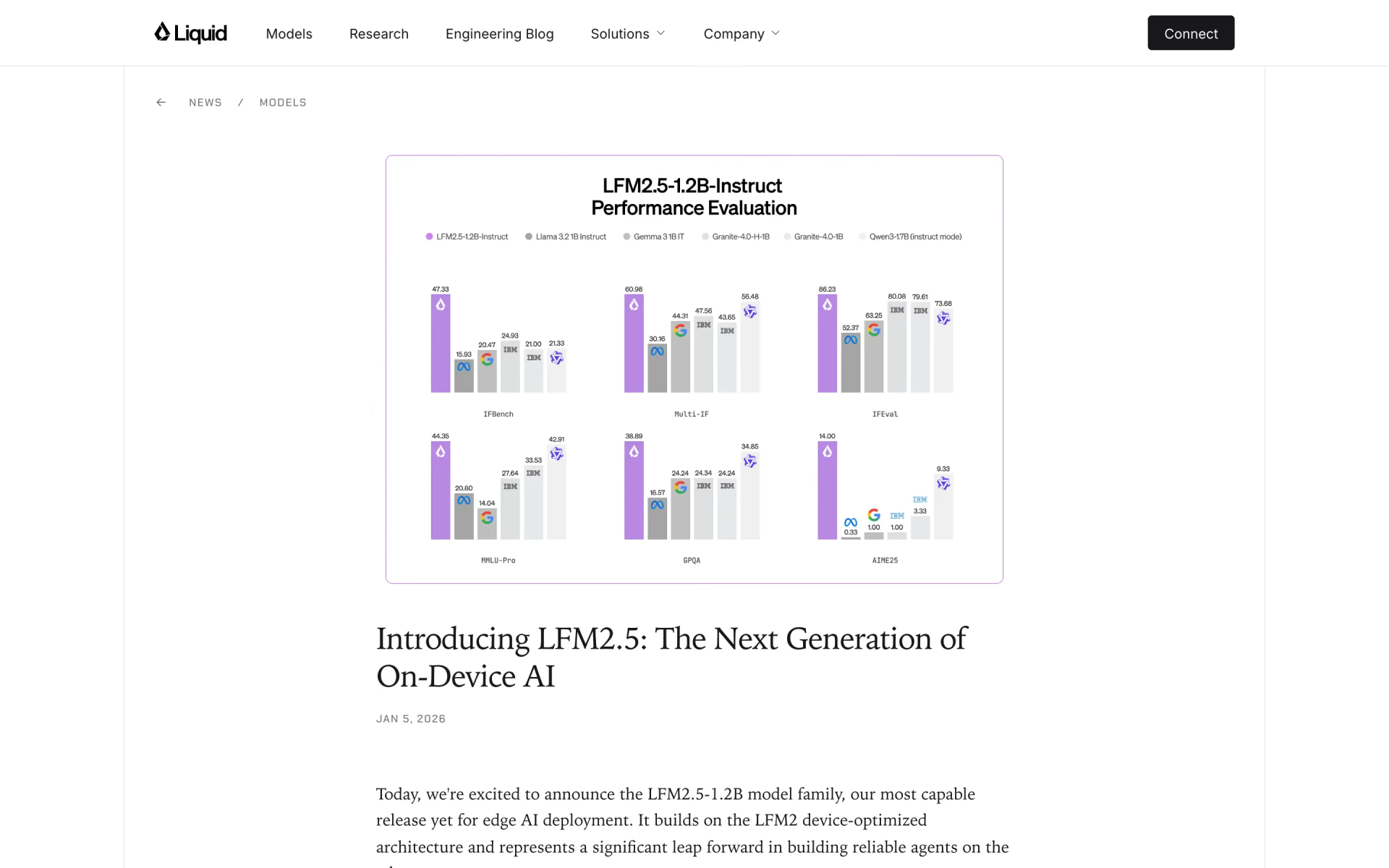
What is LFM 2.5?
LFM 2.5 is Liquid AI's current model family, built on its own hybrid LFM2 architecture to run on phones, laptops, cars and other devices. It covers text models from 230M to 8B parameters (the 8B is a mixture-of-experts with 1.5B active), vision models from 450M to 3B, a 1.5B audio model, and small embedding and extraction models.
It replaces LFM2, which Liquid now marks as deprecated. Weights come as GGUF, MLX and ONNX files for llama.cpp, MLX, vLLM and SGLang. Liquid tunes it for speed, instruction following and tool calling, and says it is not the model for coding or knowledge-heavy work.
What changed from LFM2?
More training data, longer context and a bigger vocabulary; the LFM2 models it replaces are now deprecated.
- Training data
- The 1.2B models trained on 28T tokens instead of 10T, and the 8B-A1B on 38T instead of 12T.
- Context
- The 8B-A1B grew from 32,768 to 128,000 tokens, and the new 2.6B also reads 128K.
- Vocabulary
- Doubled to 128,000 tokens, so Hindi, Thai, Arabic and other non-Latin scripts take fewer tokens.
- Reasoning
- The 8B-A1B now always writes out its reasoning before the answer; LFM2-8B-A1B did not.
- LFM2
- Still downloadable, but Liquid no longer updates it and names an LFM 2.5 replacement for each model.
Who is LFM 2.5 best for?
LFM 2.5 is best for developers who need a model on the device itself: phone and laptop assistants, offline tool-calling agents, extraction and RAG, and voice or vision at the edge.
On-device assistants
LFM2.5-2.6B decodes about 30 tokens a second on a phone in Liquid's tests, so replies stay quick without a network.
Offline agents that call tools
Liquid trained LFM2.5-2.6B inside agent harnesses such as Hermes Agent and OpenClaw, with native tool calling and a 128K context.
Extraction, RAG and summaries
Liquid recommends it for data extraction, RAG and long-context work, and testers say it summarises long transcripts well for its size.
Voice and vision at the edge
The family has a 1.5B audio model for speech recognition, speech output and voice chat, plus vision models from 450M to 3B.
What's included with LFM 2.5?
Text models from 230M to 8B, up to 128K context, native tool calling, vision and audio models, DSpark speed-ups, and files for llama.cpp, MLX, vLLM, SGLang and ONNX.
- Sizes from 230M to 8B
- Text models at 230M, 350M, 1.2B, 2.6B and 8B, with 1.2B versions for step-by-step reasoning and for Japanese.
- Long context
- 128K tokens on the 2.6B and 8B-A1B models, and 32K on the 1.2B Instruct.
- Native tool calling
- The text models call functions out of the box, and the 2.6B works inside harnesses like Hermes Agent, OpenClaw and Pi.
- Vision and audio models
- Vision models from 450M to 3B read images, screens and documents; Audio-1.5B handles speech in and out.
- Common local runtimes
- GGUF, MLX and ONNX files for llama.cpp on iOS and Android, MLX on Apple silicon, and vLLM or SGLang on GPUs.
- DSpark speed-ups
- Optional draft models for the 1.2B, 2.6B and 8B-A1B speed up decoding by up to 3.2x with the same output.
- Fine-tuning
- Every LFM 2.5 model can be fine-tuned, for example with TRL or Unsloth, and the licence lets you keep the result private.
How does LFM 2.5 work?
Pick a size
Match the model to your hardware, from 230M for tiny devices to the 8B-A1B, which Liquid says fits on an entry-level laptop.
Download the weights
Get the GGUF, MLX or ONNX files from Liquid's Hugging Face page.
Serve it locally
Run it with llama.cpp, MLX, vLLM or SGLang behind an OpenAI-compatible endpoint.
Connect your app
Point your app or an agent harness such as Hermes Agent or OpenClaw at that endpoint.
How much does LFM 2.5 cost?
LFM 2.5 is free to download, run and fine-tune, including in commercial products, until your company passes $10 million in yearly revenue; above that, Liquid AI sells a commercial license priced on request.
- Download, run and fine-tune every open LFM, including in products you sell
- Keep fine-tuned models private; no copyleft
- Research, education and non-profit use free at any revenue
Liquid AI charges nothing per token: the models run on your own phones, laptops, servers or edge devices, so the only running cost is your hardware. Companies earning more than $10 million a year need Liquid's Enterprise commercial license, priced through sales by deployment scale and support needs, which also covers bespoke model work, OEM and on-prem help and SLAs. The LFM Open License is based on Apache 2.0 and asks you to keep Liquid's copyright and license notices when you share a model. Weights are on Hugging Face in GGUF, MLX and ONNX formats. Full pricing on liquid.ai. We checked these prices on .
How do readers rate LFM 2.5?
No one has rated LFM 2.5 yet. Be the first.
Sign in to rate. One rating per account.
LFM 2.5 pros and cons
It is fast and free for most teams, but tool calls are uneven in coding agents, it is weak at coding and knowledge, and larger companies need a paid licence.
Pros
- Fast on modest hardware: testers report quick replies on laptop CPUs, older GPUs and phones, in line with Liquid's figure of about 30 tokens a second on a phone.
- Handles summaries and fact extraction well for its size, according to testers on Hacker News and Reddit.
- Free for commercial use below $10M in yearly revenue, with no copyleft, so fine-tuned versions can stay private.
- The 3B vision model reads screenshots and documents well in about 3 GB of memory, early testers say, though one found it dropped words on a dense page.
Cons
- Tool calling is uneven in coding harnesses: several people who ran the 8B-A1B model in OpenCode and similar agents say it failed to call tools or made calls up.
- Weak at coding and world knowledge: Liquid says the 2.6B is not for agentic coding or knowledge-heavy tasks, and one tester's bug-fix run put the 8B-A1B far behind a small Qwen coding model.
- Not fully open: companies above $10M in yearly revenue need a paid licence, which users say the launch posts' 'without restrictions' wording glosses over.
- New releases can need setup work: users saw thinking tags in the output and broken tool calls until llama.cpp support landed and the chat template was right.
What are the best LFM 2.5 alternatives?
Three tools on Recaply do LFM 2.5's job. All three are open source, so you can run them on your own server.
 Gemma 4Open Source
Choose it when you want one small model that also takes images and audio; Google's E2B has a 128K context and needs about 1.1 GB of memory on mobile.
 Qwen3.5 SmallOpen Source
Choose it when you need an Apache 2.0 licence with no revenue cap or video input; the 4B model reads 262,144 tokens natively.
 Mistral 3Open Source
Choose it when you want Apache 2.0 edge models from a maker that also hosts them; Ministral 3 comes in 3B, 8B and 14B, each with image input.
Questions about LFM 2.5
What is LFM 2.5?
LFM 2.5 is Liquid AI's family of small open-weight models, from 230M to 8B parameters, built to run chat, tool-calling agents, vision and voice on phones, laptops and other devices.
Who is LFM 2.5 for?
LFM 2.5 is best for developers who need a model on the device itself: phone and laptop assistants, offline tool-calling agents, extraction and RAG, and voice or vision at the edge.
Is LFM 2.5 free?
Yes. LFM 2.5 has a free plan: download, run and fine-tune every open LFM, including in products you sell.
Is there an open source alternative to LFM 2.5?
Yes. Gemma 4, Qwen3.5 Small and Mistral 3 are open source tools that do the same job, so you can run your own.
What are the best LFM 2.5 alternatives?
The closest alternatives on Recaply are Gemma 4, Qwen3.5 Small and Mistral 3.
Where can I try LFM 2.5?
On its official website, liquid.ai.
What sizes does LFM 2.5 come in?
Text models come in 230M, 350M, 1.2B, 2.6B and an 8B mixture-of-experts with 1.5B active parameters, plus 1.2B Thinking and Japanese versions. The family also has vision models from 450M to 3B, a 1.5B audio model, and small encoder, embedding and extraction models.
Does LFM 2.5 cost anything per token?
No. Liquid AI does not meter LFM 2.5 per token or per request; you run it on your own hardware, so the only running cost is your compute. Companies earning more than $10 million a year need a paid commercial license instead.
Can LFM 2.5 run on a phone?
Yes. Liquid runs its models on iOS and Android through llama.cpp with quantized GGUF files, and measured LFM2.5-2.6B at about 30 tokens a second on a phone. The 230M and 350M models are the smallest, meant for low-latency edge use.
Is LFM 2.5 good for coding?
Not really. Liquid says LFM2.5-2.6B is not recommended for agentic coding or knowledge-heavy tasks, and its own table shows Qwen3.5-9B ahead on LiveCodeBench. Use it for tool calls, extraction and RAG, and send coding work to a larger model.
Is there a hosted LFM 2.5 API?
Liquid's own plans do not charge per token, since the models are meant to run on your hardware. Its docs link to OpenRouter for hosted API access and to Liquid Playground for trying the models in a browser.
Our verdict
LFM 2.5 is one of the quickest ways to put a tool-calling model on a phone or laptop, and it costs nothing for most teams.
Liquid measures about 30 tokens a second on a phone for the 2.6B model, users confirm it is fast on modest hardware, and the family also covers vision and voice.
- Skip it for
- Coding agents and knowledge-heavy questions, where Liquid itself points you to larger models.
- Check first
- Test tool calls in your own harness with the right chat template, and read the licence if your company is close to $10M in revenue.

 GLM-4.6V

 LFM3

 Nemotron 3

 LFM2.5-350M
 Olmo 3
 Nemotron 3.5 Lightning