
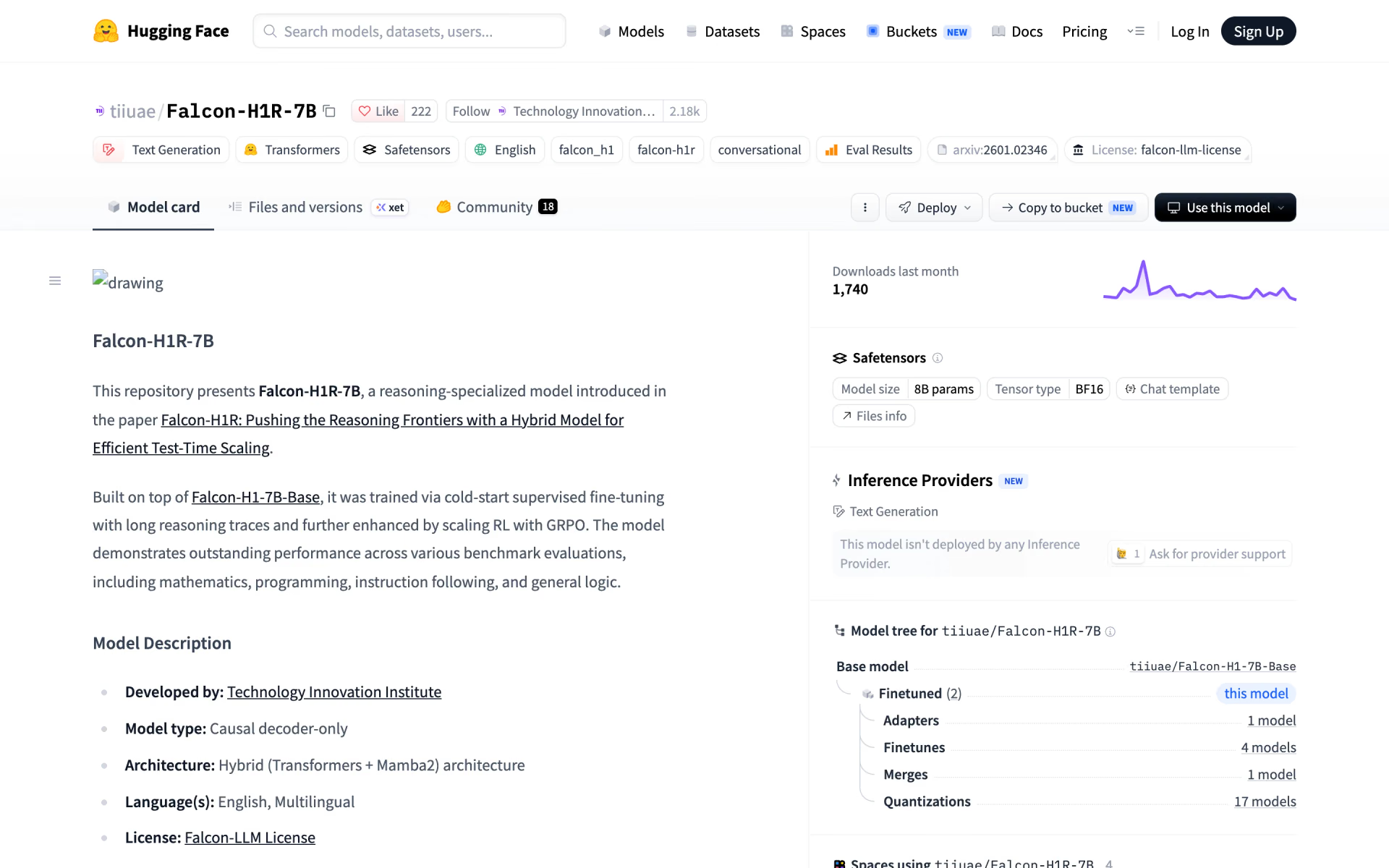
What is Falcon H1R 7B?
Falcon H1R 7B is the reasoning version of TII's Falcon-H1-7B base model, trained on long maths, coding and science solutions and then with reinforcement learning. It mixes Transformer attention with Mamba2 state-space layers, which TII says keeps speed up on long answers and large batches. It reads and writes text only and thinks in a visible block before it answers.
It is still TII's current reasoning model; TII has not released a successor. There is no hosted API: you download the free weights from Hugging Face and run them with Transformers, vLLM, SGLang or llama.cpp.
Who is Falcon H1R 7B best for?
Falcon H1R 7B is best for maths and science problem solving, reasoning on a single local GPU, and high-volume batch jobs where throughput per GPU matters.
Maths and science problems
TII reports 83.1% on AIME 2025 and 64.9% on HMMT 2025, ahead of Qwen3-32B, a model more than four times its size.
Reasoning on a single local GPU
The full weights take about 15 GB, the FP8 version 7.9 GB, and TII's GGUF files for llama.cpp start at 4.6 GB for Q4_K_M.
High-volume batch reasoning
TII measured about 1,500 tokens a second per GPU at batch 64, roughly double Qwen3 8B on the same long-answer workload.
What's included with Falcon H1R 7B?
A hybrid Transformer and Mamba2 design, visible reasoning, DeepConf test-time scaling, support for common inference engines, an FP8 version and a free playground.
- Hybrid Transformer and Mamba2 design
- Mamba2 state-space layers work alongside attention, which TII credits for faster inference and lower memory use on long answers and large batches.
- Visible reasoning
- It writes its thinking inside think tags before the answer; TII suggests temperature 0.6, top-p 0.95 and up to 65,536 new tokens.
- DeepConf test-time scaling
- Sampling many answers and keeping the confident ones lifted it to 96.7% on AIME 2024 and AIME 2025 in TII's tests.
- Common inference engines
- It runs on Transformers, vLLM 0.11.0 or later and SGLang, and TII publishes GGUF files for llama.cpp.
- FP8 version
- TII's FP8 build nearly halves weight memory to 7.9 GB and serves 1.2 to 1.5 times faster, for a drop of under one point on AIME 2025.
- Free playground
- TII's Falcon H1R Playground on Hugging Face lets you chat with it after signing in, with nothing to install.
How much does Falcon H1R 7B cost?
Falcon H1R 7B is free: TII releases the weights at no charge under the Falcon LLM License and sells no API or paid plan, so your only cost is the hardware you run it on.
- BF16 weights on Hugging Face, about 15 GB
- GGUF files from 4.6 GB and an FP8 version
- Royalty free, under TII's acceptable use policy
TII sells no API, subscription or paid tier for Falcon H1R 7B, and no Hugging Face inference provider serves it, so running it means your own hardware or a rented GPU. TII's free playground on Hugging Face needs a Hugging Face account. Full pricing on huggingface.co. We checked these prices on .
How do readers rate Falcon H1R 7B?
No one has rated Falcon H1R 7B yet. Be the first.
Sign in to rate. One rating per account.
Falcon H1R 7B pros and cons
It punches above its size on maths and runs on one consumer GPU, but it overthinks, is weak at agent work and non-English text, and comes with a custom licence.
Pros
- Strong on maths and science for its size: users report it solving thermodynamics problems and small coding tasks that larger local models got wrong or took twice as long on.
- Runs on one consumer GPU: users serve it on a single RTX 4090 with vLLM and as an 8 GB GGUF in llama.cpp with the full 256K context.
- Free to use, change and share with no royalties, with TII's training recipe and technical report public.
Cons
- It overthinks: users report long reasoning and looping even on simple prompts, and TII acknowledges it uses more output tokens on agent-style tests because it was not tuned for them.
- Weak at planning and agent work: TII's own table shows 4.9% on Terminal-Bench Hard and 25.4% on the τ²-Bench Telecom agent test, and one detailed user test found it skipping steps on longer tasks.
- Text only, and users found its Italian and German weaker than other models of the same size.
- The Falcon LLM License is not a standard open-source licence: you must follow TII's acceptable use policy, which TII can change, and pass its rules on when you share the model.
What are the best Falcon H1R 7B alternatives?
Three tools on Recaply do Falcon H1R 7B's job. All three are open source, so you can run them on your own server.
 Qwen3.5 SmallOpen Source
Choose it when you need image or video input or thinking you can switch off; the 9B model has the same 256K context under Apache 2.0.
 Olmo 3Open Source
Choose it when you want a 7B reasoning model under plain Apache 2.0 with its training data and code published, and can accept lower maths scores (64.6% on AIME 2025 by Ai2's count).
 Gemma 4Open Source
Choose it when you want a hosted API as well as local weights; Google serves it free on the Gemini API, though those prompts help improve Google's products.
Questions about Falcon H1R 7B
What is Falcon H1R 7B?
Falcon H1R 7B is a free, open-weight reasoning model from Abu Dhabi's Technology Innovation Institute, tuned for maths, code and science and small enough to run on your own hardware.
Who is Falcon H1R 7B for?
Falcon H1R 7B is best for maths and science problem solving, reasoning on a single local GPU, and high-volume batch jobs where throughput per GPU matters.
Is Falcon H1R 7B free?
Yes. Falcon H1R 7B has a free Open weights plan: BF16 weights on Hugging Face, about 15 GB.
Is there an open source alternative to Falcon H1R 7B?
Yes. Qwen3.5 Small, Olmo 3 and Gemma 4 are open source tools that do the same job, so you can run your own.
What are the best Falcon H1R 7B alternatives?
The closest alternatives on Recaply are Qwen3.5 Small, Olmo 3 and Gemma 4.
Where can I try Falcon H1R 7B?
On its official website, huggingface.co.
Can I use Falcon H1R 7B for commercial work?
Yes, within limits. The Falcon LLM License lets you use, change and redistribute it royalty free, but you must follow TII's acceptable use policy, which TII can update, and include those rules when you share the model or a fine-tune.
Can I turn off Falcon H1R 7B's thinking?
Not according to TII's documentation. The model card describes no switch to skip reasoning and no effort levels, only sampling settings, and the model always writes a think block before answering. If you need short, direct replies, a model with a no-thinking mode fits better.
What hardware do I need to run Falcon H1R 7B?
The full BF16 weights take about 15 GB and the FP8 version 7.9 GB, while TII's GGUF files for llama.cpp run from about 3.3 GB to 8 GB. For long reasoning with many requests at once, TII recommends splitting the model across two GPUs.
Is there an API for Falcon H1R 7B?
Not from TII. TII sells no hosted API for it and no Hugging Face inference provider serves it, so you run the weights yourself, rent a GPU, or try TII's free playground on Hugging Face.
How does Falcon H1R 7B compare with Qwen3-8B?
In TII's own tests Falcon H1R 7B leads Qwen3-8B on maths (83.1% against 65.8% on AIME 2025) and code (68.6% against 53.0% on LiveCodeBench v5 to v6), ties on GPQA Diamond, and trails slightly on the τ²-Bench Telecom agent test.
Our verdict
Falcon H1R 7B, still TII's current reasoning model, is a good free pick for maths and science reasoning on one GPU, and a poor one for agent work.
TII's tests put it ahead of Qwen3-32B on AIME and LiveCodeBench at about a quarter of the size, and users confirm it handles hard maths well, but it overthinks and trails on tool and agent tasks.
- Skip it for
- Coding agents, multi-step tool use, image input, and work mainly in languages other than English.
- Check first
- Test it on your own prompts with a token limit, since its long reasoning can make even simple replies slow.

 SubQ

 Qwen3-Max-Thinking
 Muse Spark

 Ring-2.6-1T
 GPT-5.6

 DeepSeek-V3.2-Speciale