
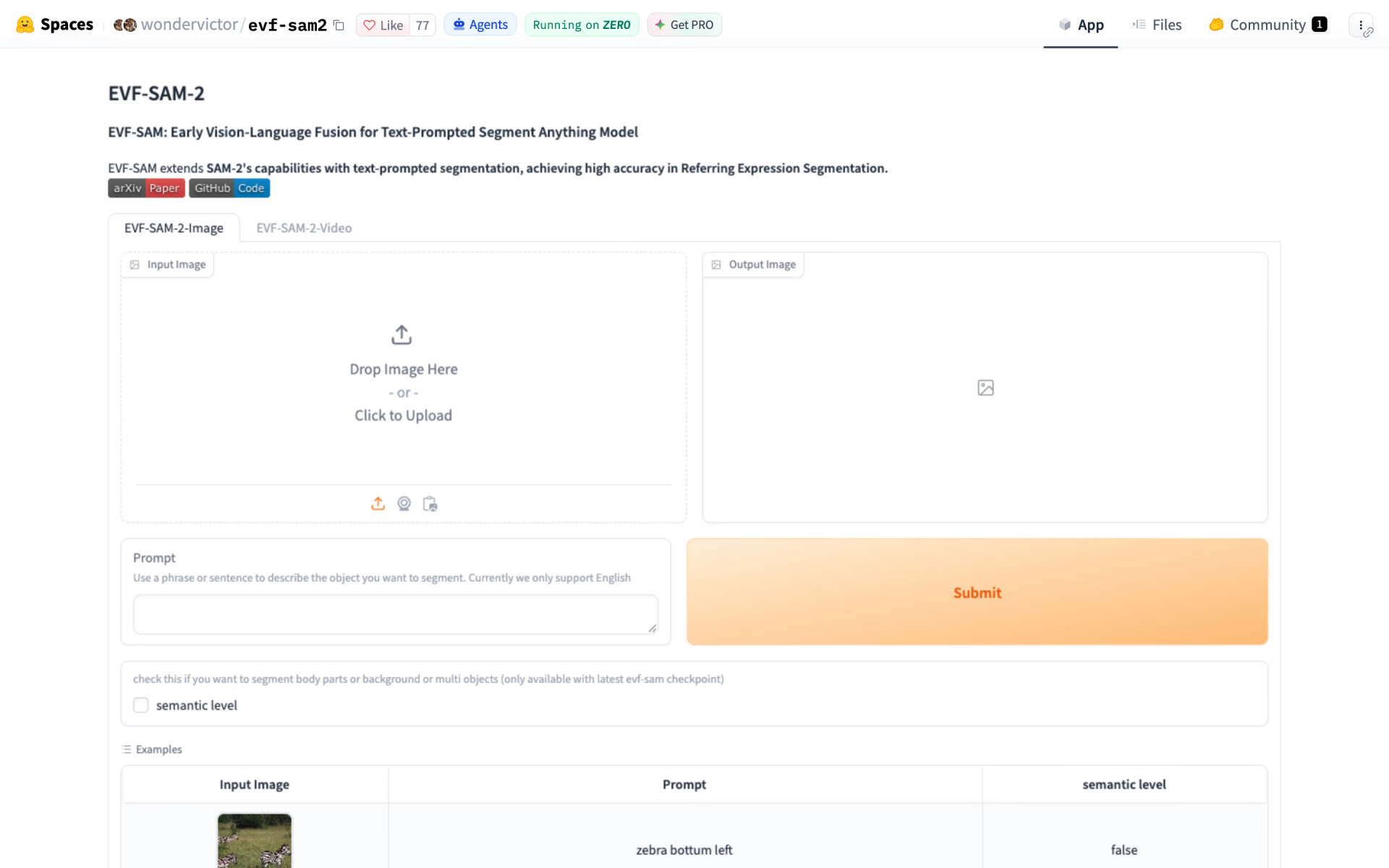
What is EVF-SAM-2?
EVF-SAM-2 puts a BEIT-3 vision-language model in front of Meta's SAM 2. BEIT-3 reads your image and your sentence together and turns them into a prompt SAM 2 understands, so "the left lemon slice" replaces clicks and boxes. It was trained only on still images, yet follows a described object through video.
It is still online, not withdrawn, but the project has stalled: the EVF-SAM v2 its authors previewed never shipped, and the training code is withheld. Meta's SAM 3 now takes short text prompts on its own, though its checkpoints need an access request and come under Meta's SAM License rather than Apache 2.0.
Is EVF-SAM-2 still available?
Yes. The weights, code and Hugging Face demo are all still online under Apache 2.0, but development has stalled.
- Weights
- Both checkpoints still download from Hugging Face without an access request.
- Demo
- The Hugging Face demo is running on free shared GPUs.
- Next version
- The authors previewed an EVF-SAM v2 for salient objects and mattes, and it has not been released.
- Training code
- Still withheld; the maker cites company policy.
Who is EVF-SAM-2 best for?
EVF-SAM-2 is best for developers and researchers who need object masks in images or video from a plain English description, and who can run an open model on their own GPU.
Masks from a sentence
You describe the object, such as "zebra bottom left", instead of clicking points or drawing boxes.
Text-prompted video masks
Built on SAM 2, it follows the object you describe across video frames without any video training.
Editing and compositing pipelines
The multitask checkpoint returns masks for hair, sky, background and other regions that feed straight into image edits.
Referring segmentation research
Open weights, evaluation scripts and RefCOCO dataset setup make results easy to reproduce and compare.
What's included with EVF-SAM-2?
Text, point and box prompts, semantic masks for parts and backgrounds, video tracking, low-precision loading and a free online demo.
- Text prompts
- Describe the object in English, in a few words or a full sentence, and get its mask.
- Point and box prompts
- SAM 2 is left unchanged inside, so clicks and boxes still work as they do in SAM 2.
- Semantic masks
- Start a prompt with "[semantic]" on the multitask checkpoint to mask body parts, background areas such as sky, or several objects at once.
- Video segmentation
- Split a clip into frames and it tracks the described object from the first frame onward.
- 8-bit and 4-bit loading
- Optional low-precision loading cuts GPU memory for smaller cards.
- Free online demo
- A Hugging Face demo has separate image and video tabs, so you can test prompts before installing anything.
How does EVF-SAM-2 work?
Install
Clone the GitHub repo and install PyTorch 2.0 or newer for your CUDA version.
Pick a checkpoint
Download evf-sam2 for plain text prompts, or evf-sam2-multitask for parts, background and semantic masks.
Prompt an image
Run the inference script with an image and a sentence; it saves the mask over the image.
Run a video
Split the clip into frames with ffmpeg, run the video script, then join the masked frames back into a video.
How much does EVF-SAM-2 cost?
EVF-SAM-2 is free: its code and weights are open source under the Apache 2.0 license, and a free Hugging Face demo runs it on images and video within a small daily GPU allowance.
- 898M parameters: SAM-2-L with a BEIT-3-L encoder
- Segments objects in images and video from a text prompt
- Weights on Hugging Face, code on GitHub
- Adds body parts, background areas and semantic-level masks
- Put "[semantic]" before a prompt to use them
- The checkpoint the online demo runs
- Separate image and video tabs
- English prompts only
- 2 minutes of GPU time a day without login, 5 with a free account
Researchers at Huazhong University of Science and Technology and vivo AI Lab built it. The code is on GitHub (hustvl/EVF-SAM) and the weights download from Hugging Face (YxZhang/evf-sam2 and YxZhang/evf-sam2-multitask). Running it yourself needs an NVIDIA GPU with PyTorch 2.0 or newer, with optional 8-bit or 4-bit loading. The demo runs on Hugging Face's shared ZeroGPU hardware, where Hugging Face PRO accounts get 40 minutes of GPU time a day. The same repo also holds the older EVF-SAM models built on the original SAM. Full pricing on github.com. We checked these prices on .
How do readers rate EVF-SAM-2?
No one has rated EVF-SAM-2 yet. Be the first.
Sign in to rate. One rating per account.
EVF-SAM-2 pros and cons
It is free, permissive and accurate on benchmarks for its size, but fine detail, first-frame-only video tracking and a stalled project hold it back.
Pros
- Free and permissive: code and weights are under Apache 2.0, so commercial use is allowed.
- Accurate for its size: the paper puts it at 78.8 average cIoU on RefCOCO-family tests, ahead of far larger models such as LISA-7B at 67.9 and GLaMM at 75.6, and a Reddit user looking for such models called it one of the best on benchmarks.
- Keeps SAM 2's point and box prompts: the maker says they still work, and a user confirmed they behave the same as in SAM 2.
- You can try it in the browser first, on a free Hugging Face demo with image and video tabs.
Cons
- Masks can miss fine parts: users report faces bleeding and animal legs or tails cut off, and the maker says it aims at general tasks rather than precise masks.
- Video tracking fails when the object is missing from the first frame, and one user's run crashed on thousands of frames; the maker puts video speed at about 3 frames per second.
- The training code is withheld, and several users have asked for it or tried to rebuild it, so fine-tuning on your own data means writing your own training loop.
- Local results can fall short of the demo: users got whole-body masks for "[semantic] hair" until they switched to the multitask checkpoint, and prompts are English only.
Is EVF-SAM-2 open source?
Yes. EVF-SAM-2's code is public under the Apache 2.0 licence, so you can run it on your own server.
On GitHub
510stars
- Last commit
- 17 Mar 2025
- Repository age
- 2 years
- Licence
- Apache 2.0
- Self-hosted
- Yes
- Repository
- hustvl/EVF-SAM
Questions about EVF-SAM-2
What is EVF-SAM-2?
EVF-SAM-2 is an open model from Huazhong University of Science and Technology and vivo AI Lab that lets developers mask objects in images and video by describing them in English.
Who is EVF-SAM-2 for?
EVF-SAM-2 is best for developers and researchers who need object masks in images or video from a plain English description, and who can run an open model on their own GPU.
Is EVF-SAM-2 free?
Yes. EVF-SAM-2 has a free EVF-SAM2 plan: 898M parameters: SAM-2-L with a BEIT-3-L encoder.
Is EVF-SAM-2 open source?
Yes. EVF-SAM-2's code is public under the Apache 2.0 licence, so you can run it on your own server.
Which EVF-SAM-2 checkpoint should I download?
Use evf-sam2-multitask if you want body parts, background areas such as sky, or several objects in one mask, since "[semantic]" prompts only work there; it is also what the online demo runs. The plain evf-sam2 checkpoint handles ordinary object descriptions.
Can I use EVF-SAM-2 commercially?
Yes. EVF-SAM-2's code on GitHub and its weights on Hugging Face are published under the Apache 2.0 license, which allows commercial use, changes and redistribution as long as you keep the license notice and mark any files you change.
How is EVF-SAM-2 different from SAM 2?
EVF-SAM-2 adds text prompts to Meta's SAM 2, which on its own is prompted with clicks or boxes. A BEIT-3 vision-language model reads your image and your sentence together and turns them into a prompt for SAM 2, so you can type "zebra top left" instead of marking the object.
Is EVF-SAM-2 still maintained?
Barely. The weights, code and demo are all still online, but the repo has seen no new model since the multitask checkpoints, the EVF-SAM v2 its authors previewed has not been released, and some recent issues have no reply.
Our verdict
EVF-SAM-2 is a solid free way to turn a sentence into a mask, as long as rough edges are fine for your job.
It is Apache 2.0, runs on a single GPU, and beats much larger language-model segmenters on the paper's RefCOCO tests, while keeping SAM 2's clicks and boxes.
- Skip it for
- Precise masks of faces, hair or thin parts, video where the object appears after the first frame, and anyone who needs an actively maintained project.
- Check first
- Test your own images in the free demo with the multitask checkpoint before you build on it.

 ChatGPT Images 2.5

 Canva Craft

 GPT Image 2
 ChatGPT Images 2.6

 Hunyuan Image 3.0