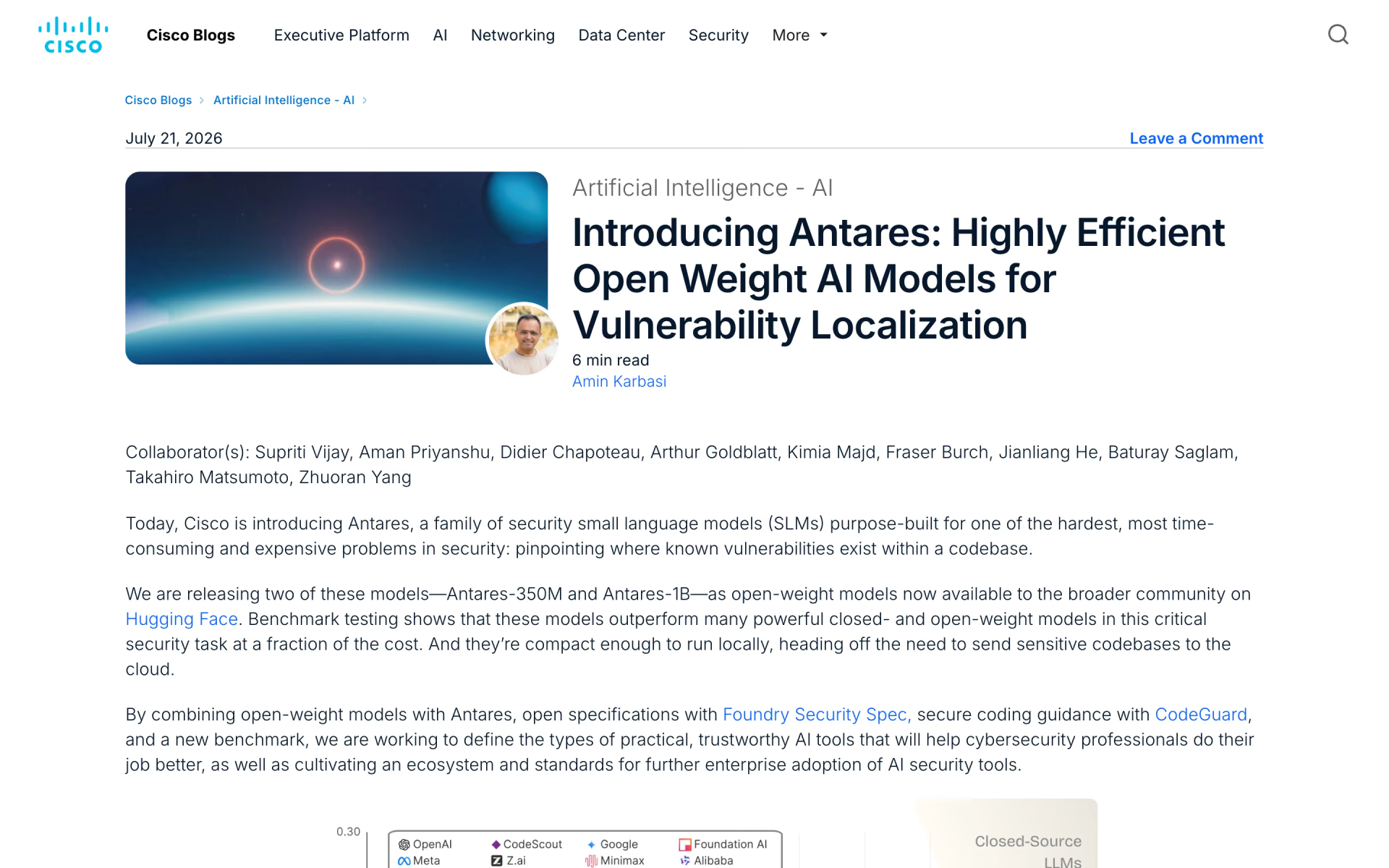
What is Antares?
Antares comes in two sizes, Antares-350M and Antares-1B, both built on IBM's Granite 4.0 and trained by Cisco Foundation AI. You give it a weakness category (a CWE) and a repository; it works like an analyst at a terminal, running grep, find and cat up to 15 times, then returns a ranked list of files to review. It does not write fixes, explain the flaw or point to lines.
Unlike a rule-based scanner, it needs to be told what to look for; unlike a frontier model, it runs on a laptop or a single GPU, so code never leaves your machines. Cisco lists scores for a 3B version, but only the two smaller models are out.
Which Antares model should I use?
Antares-1B for most work; Antares-350M only for small devices or to speed up the 1B.
- Antares-1B
- 128K-token context and a File F1 of 0.209; Cisco aims it at laptops and workstations, and the CLI ships with it.
- Antares-350M
- 32K-token context and a File F1 of 0.135; aimed at edge devices, or as a draft model that speeds up the 1B.
Who is Antares best for?
Antares is best for security teams that want a small model to point analysts at the source files most likely to hold a known weakness, running on their own machines so the code never leaves them.
Advisory and CWE triage
Given a weakness category, it searches a repository with grep, find and cat and returns a ranked list of files to review first.
Code that must stay in-house
Both models are small enough to run on-premises, so proprietary source code never goes to a cloud API.
Security checks in pipelines
The 1B model runs on one GPU and its CLI writes JSON or SARIF, so results can feed a CI/CD step.
Security teams on small budgets
Cisco built it for universities, public-sector bodies and smaller teams that cannot pay for token-heavy frontier models on every scan.
What's included with Antares?
Two model sizes, a ready-made CLI with JSON and SARIF output, a terminal agent with no retrieval setup, and standard open-source serving.
- Two sizes
- Antares-350M for small devices or as a draft model that speeds up the 1B, and Antares-1B for laptops and workstations.
- Antares CLI
- Ships in the 1B repository, runs the full agent loop over a read-only copy of your code, and writes plain text, JSON or SARIF.
- Targeted checks or sweeps
- Look for one CWE at a time or sweep a whole repository across many categories.
- Terminal agent
- Explores code with standard Unix commands, with no vector database or retrieval system to set up.
- Standard serving
- Loads in Transformers, serves through vLLM or SGLang, and the CLI talks to any OpenAI-compatible endpoint.
How much does Antares cost?
Antares is free: Cisco releases Antares-350M and Antares-1B as open weights under the Apache 2.0 licence on Hugging Face, so the only cost is the hardware you run them on.
- 350M parameters, 32K-token context
- Full 500-task benchmark in about 11 minutes on one H100
- Can act as a draft model to speed up the 1B
- 1B parameters, 128K-token context
- Runs on a single GPU, suited to CI/CD checks
- Comes with the Antares CLI (JSON or SARIF output)
Both models download from Cisco Foundation AI's Hugging Face page (fdtn-ai), but only after you share your contact details and accept Cisco's conditions; each request is reviewed by hand. They run on your own hardware through Transformers, vLLM or SGLang, and the CLI connects to any OpenAI-compatible endpoint. Cisco lists no hosted API or paid plan, and no inference provider hosts them on Hugging Face. Full pricing on huggingface.co. We checked these prices on .
How do readers rate Antares?
No one has rated Antares yet. Be the first.
Sign in to rate. One rating per account.
Antares pros and cons
It is free, small and matched Cisco's published scores in independent tests, but it cannot say a repository is clean and struggles with flaws that need real reasoning.
Pros
- Independent testers reproduced Cisco's published scores on their own hardware, within a few thousandths of a point.
- Runs on modest machines: users report it on a 24GB MacBook at about 70 tokens a second, at 4-bit on Apple Silicon, and on a single small GPU box.
- Strong on weaknesses with a searchable signature, such as timing comparisons, credential handling or type confusion, where one tester saw it pick the right files most of the time.
- Free under Apache 2.0, and on Cisco's benchmark the 1B model beats far larger models such as GLM-5.2 (0.186) and Gemini 3 Pro (0.152).
Cons
- It almost never says a repository is clean: two testers found it names files even in patched code, and Cisco agrees it should not be used to confirm a fix.
- Weak on flaws that need an understanding of behaviour, such as missing access checks, permissions, locking or memory leaks; one tester's score fell to about 0.02 on an access-control-heavy app.
- Loses its way in big codebases: Cisco says results drop on repositories over 10MB and on bugs spread across 5 or more files, and it names files, not lines.
- Setup takes work: each download request is approved by hand and needs an access token, and users report trouble running it locally, from a CLI that would not reach a llama.cpp server to MLX runs that ended early.
Is Antares open source?
Yes. Antares's code is public under the Apache 2.0 licence, so you can run it on your own server.
What are the best Antares alternatives?
Antares is an open source alternative to Claude Security, GPT-5.5-Cyber and OpenAI Daybreak.
 Claude SecurityPaid
Choose it when you want flaws found without a hint, checked and given a suggested patch; it scans with Claude Mythos 5.1 and is in public beta for Claude Enterprise.
 GPT-5.5-CyberPaid
OpenAI's more permissive GPT-5.5 for vetted security teams doing red teaming and vulnerability work.
 OpenAI DaybreakPaid
OpenAI's approval-based cyber models for vulnerability discovery, secure code review and patch validation.
 SnykFree
Choose it when you want a scanner that needs no hint and also covers open-source dependencies, infrastructure code and containers; its free plan covers 5 projects and 100 code tests a month.
 GLM-5.3Free
Choose it when you want an open-weight model that hunts for unknown flaws; Z.ai reports 84.5 on CyberGym, but at 753B parameters it is far heavier to run yourself, and Z.ai's API costs $1.40 / $4.40 per million tokens.
Questions about Antares
What is Antares?
Antares is Cisco's pair of small open-weight models that search a code repository for the files most likely to hold a known vulnerability, built for security teams that keep their code in-house.
Who is Antares for?
Antares is best for security teams that want a small model to point analysts at the source files most likely to hold a known weakness, running on their own machines so the code never leaves them.
Is Antares free?
Yes. Antares has a free Antares-350M plan: 350M parameters, 32K-token context.
Is Antares open source?
Yes. Antares's code is public under the Apache 2.0 licence, so you can run it on your own server.
What are the best Antares alternatives?
The closest alternatives on Recaply are Claude Security, GPT-5.5-Cyber, OpenAI Daybreak, Snyk and GLM-5.3.
Where can I try Antares?
On its official website, blogs.cisco.com.
Can I use Antares in a commercial product?
Yes. Cisco releases both Antares models under the Apache 2.0 licence, which allows commercial use, changes and redistribution at no charge as long as the licence travels with them. You still need to share your contact details on Hugging Face and have your access request approved before downloading.
What kinds of vulnerabilities does Antares miss?
Antares does best on weaknesses with distinctive, searchable code patterns, such as type confusion or prototype pollution, and poorly on ones that need a reading of behaviour, such as wrong permissions, locking bugs or memory leaks. It also slips on repositories over 10MB, since it gets only 15 terminal commands per task.
Can Antares confirm that a fix worked?
No. Antares answers where a known flaw is most likely to sit, so it names files even in code that has already been patched. Cisco says it was not built to verify fixes and should not gate a release on its own, so keep a person or another test for that step.
Is there an Antares-3B?
Not yet. Cisco's model card lists benchmark scores for a 3B version and Cisco says it is coming, but only Antares-350M and Antares-1B can be downloaded from Hugging Face so far.
How current is Antares's security knowledge?
Its knowledge stops at April 2025, so it may not recognise vulnerability patterns published after that. Cisco suggests feeding it up-to-date advisories and vulnerability databases alongside the model.
Our verdict
Antares is worth a try for security teams that already know which weakness to look for and must keep code in-house.
The 1B model comes close to GPT-5.5 on Cisco's own localization benchmark, both models run on a laptop or one GPU, and independent testers matched Cisco's numbers.
- Skip it for
- Hunting unknown bugs, confirming fixes or scanning large monorepos, where it names files even in clean code and loses its way.
- Check first
- Request Hugging Face access early, since each download request is reviewed by hand.
 Ornith-1.0
 OpenAI Privacy Filter
 GLM-5.2

 Qwen3.6-27B
 Qwen3-Coder-Next

 GLM-5.1