Skip to content

DirectorySkills

Run 1Card row in front of the speaker“In talk.mp4 put 12 people, 1 hour and every Monday as a card row in front of me.”
Runs in
  • Claude Code
  • Codex
  • Cursor
  • Gemini CLI
  • GitHub Copilot
  • OpenCode
Generates with
Your agent's model
Tested with
Claude Code 2.1.322Claude Sonnet 5.51 real run, 9 Nov
Needs
Node 22+Chromeffmpeg
Licence
Recaply licence

Card Row in Front of the Speaker

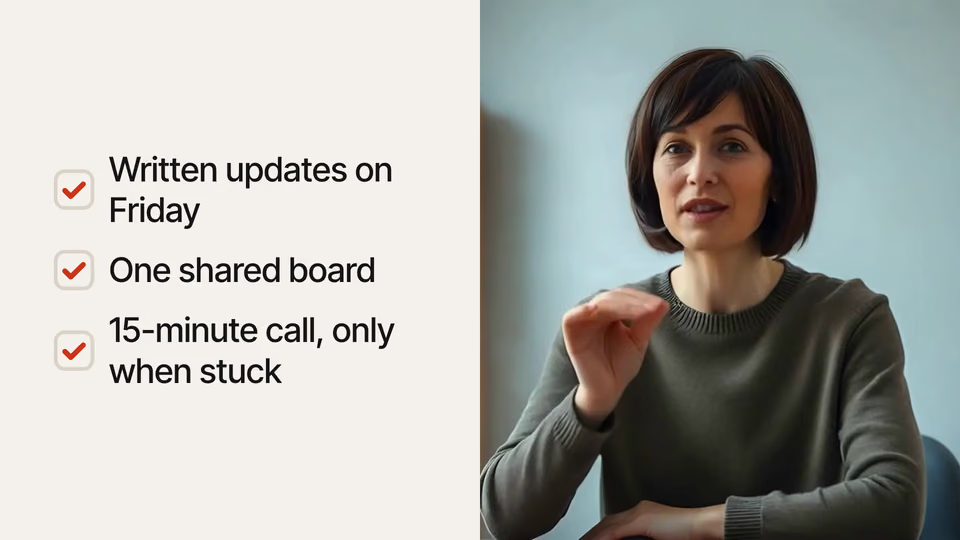
A row of cards rises across the bottom of the frame while the speaker stays in view.

$9.99once, yours to keep

Adds a row of cards across the bottom of a talking-head video, in front of the speaker, while they stay in view: figures without leaving the face. Timed to the words they say, on their own footage, with their sound kept; 16:9, 9:16, 1:1 or 4:5. Renders locally with Chrome and ffmpeg: no video model, no key and no cost. Use when someone gives a few figures or options and wants to stay on camera while they show.

By RecaplyUpdated 11 Nov

Install Card Row in Front of the Speaker

After the download, ask your agent to add it, or run the line yourself.

Read https://recaply.co/skills/foreground-cards-overlay/install.md and follow it to install the foreground-cards-overlay skill from foreground-cards-overlay.zip.

Paste it into your agent. It reads our install steps, finds the ZIP you downloaded and adds the skill for you.

New to skills? How to install a skill

Similar skills

All 735 skills

Who Card Row in Front of the Speaker is for

What you get

  • Your video with the overlay timed to the words, sound kept
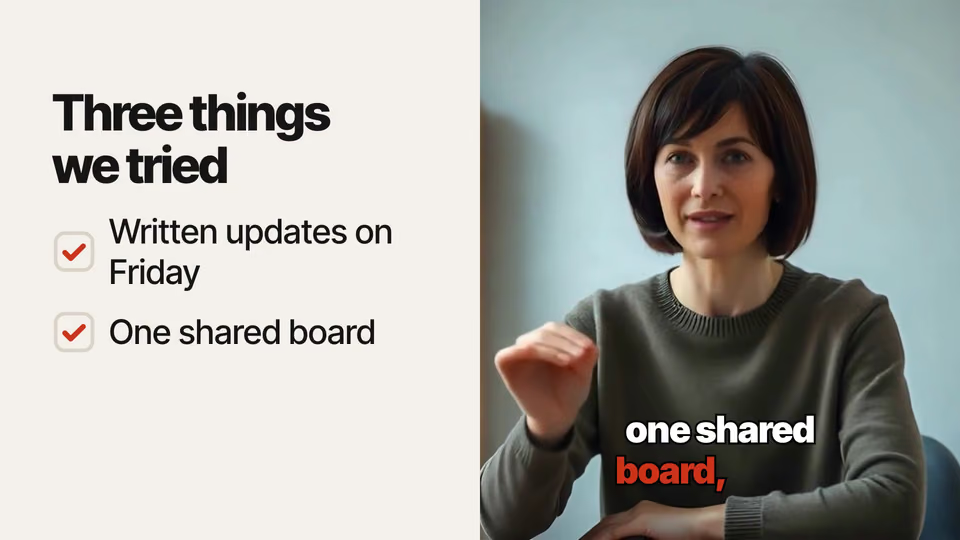
  • Cards rise into a row along the bottom of the frame, over the video, one as each is said; the speaker stays on screen above them
  • 16:9, 9:16, 1:1 or 4:5

Good fit

  • When someone gives a few figures or options and wants to stay on camera while they show

Not for

  • Footage with nobody speaking
  • Cutting or re-editing the video itself

About this skill

You say

In talk.mp4 put 12 people, 1 hour and every Monday as a card row in front of me.

It said back

The video is rendered: talk-graphics.mp4 in the working folder. It is 1920x1080, 24.3 s, 30 fps, 13 MB.

  • Cards: three cards sit in a row along the bottom, in front of her: People 12, Length 1 hour and When Every Monday. They are timed to "12 people, 1 hour, every Monday" at 3.5 s, and they are on screen from 4.9 to 8.1 s.
  • Face: her face stays clear above the cards. I set the face position to [50, 30].
  • Look and captions: I used the paper look (warm off-white panels, black type). Captions are off for this beat, because the cards sit where captions would go.
  • Sound: her original audio is untouched.
  • Checks: the layout check reported no warnings, and I looked at the check frame before rendering.
Show more

What it did in run 1

  1. foreground-cards-overlay
  2. ls -la && S=.claude/skills/foreground-cards-overlay/scripts && node $S/check.mjs
  3. ls -la && node .claude/skills/foreground-cards-overlay/scripts/check.mjs
  4. echo '{"video":"talk.mp4","transcript":"talk.json"}' > overlay.json && node .claude/skills/foreground-cards-overlay/scripts/overlay.mjs overlay.json --words
  5. S=.claude/skills/foreground-cards-overlay/scripts/overlay.mjs && node $S overlay.json --face 5
  6. ./face-check.png
  7. node .claude/skills/foreground-cards-overlay/scripts/overlay.mjs overlay.json --face 5
  8. ./face-check.png
  9. cat > overlay.json <<'E' { "video": "talk.mp4", "transcript": "talk.json", "look": "paper", "face": [50, 30], "beats": [ { "beat": "cards", "cue": "12 people", "place": "over", "pos": "b", "cards": [{ "label": "People", "value": "12" }, { "label": "Length", "value": "1 hour" }, { "label": "When", "value": "Every Monday" }], "captions": false, "until": "every Monday" } ] } E node .claude/skills/foreground-cards-overlay/scripts/overlay.mjs overlay.json --check
  10. ./overlay.json
  11. node .claude/skills/foreground-cards-overlay/scripts/overlay.mjs overlay.json --check
  12. ./overlay-check.png
  13. node .claude/skills/foreground-cards-overlay/scripts/overlay.mjs overlay.json && ls -la talk-graphics.mp4
  14. Done

9 Nov 2026 · Claude Code 2.1.322 with Claude Sonnet 5.5 · 1 min 38 s · $0.13 of API use

Questions

Is Card Row in Front of the Speaker free?

No. Card Row in Front of the Speaker costs $9.99 once and stays in your Recaply account, or it comes with the Recaply plan ($19.99 a month), which opens every premium skill and prompt.

Which agents can use Card Row in Front of the Speaker?

Claude Code, Codex, Cursor, Gemini CLI, GitHub Copilot and OpenCode.

What do I get when I buy Card Row in Front of the Speaker?

A ZIP of the whole skill folder (105 KB): the SKILL.md your agent follows and its 12 other files, the references, templates and scripts it uses. You download it from this page whenever you need it, and install it in Claude Code, Codex, Cursor, Gemini CLI, GitHub Copilot and OpenCode. The Recaply plan opens it too, with every other premium skill and prompt.

How do I install Card Row in Front of the Speaker?

Buy it, then download the ZIP from this page. For Claude Code, unzip it into .claude/skills/ in your project. For Codex, Cursor and Gemini CLI, unzip it and run npx skills add ./foreground-cards-overlay with your agent's flag.

What do I get from Card Row in Front of the Speaker?

Your video with the overlay timed to the words, sound kept. Cards rise into a row along the bottom of the frame, over the video, one as each is said; the speaker stays on screen above them. 16:9, 9:16, 1:1 or 4:5.

What does Card Row in Front of the Speaker need?

Node 22+, Chrome and ffmpeg, and no API key. Each use costs nothing beyond your agent.

How big is Card Row in Front of the Speaker?

13 files, about 79,964 tokens in all. The SKILL.md is about 2,301 tokens, and your agent reads it only when the job fits.

What does a run cost?

Our 1 runs took 1 min 38 s to 1 min 38 s and $0.13 to $0.13 of API use each, in Claude Code with claude-sonnet-5-5. On a Claude plan, a run counts toward your usage instead.

Do I have to name Card Row in Front of the Speaker to use it?

Type /foreground-cards-overlay first to make sure it loads. Without it, Claude Code may judge a small job simple enough to do without the skill.