 Video2 views, 0 downloads
Presenter Overlays


 Graphics timed to what you say
Claude CodeCodexCursor Gemini CLI
 GitHub Copilot
 OpenCode
A bar chart takes over the frame while they talk, then the speaker returns.
$9.99once, yours to keep
Payments are non-refundable. See our Terms of service.
Yours. Download it, then add it to your agent.
Adds a full-frame bar chart to a talking-head video: the chart takes over while they talk through the numbers, then the speaker comes back. Timed to the words they say, on their own footage, with their sound kept; 16:9, 9:16, 1:1 or 4:5. Renders locally with Chrome and ffmpeg: no video model, no key and no cost. Use when someone talks through numbers that need the whole screen to read.
By RecaplyUpdated 11 Nov
Video2 views, 0 downloads
Graphics timed to what you say
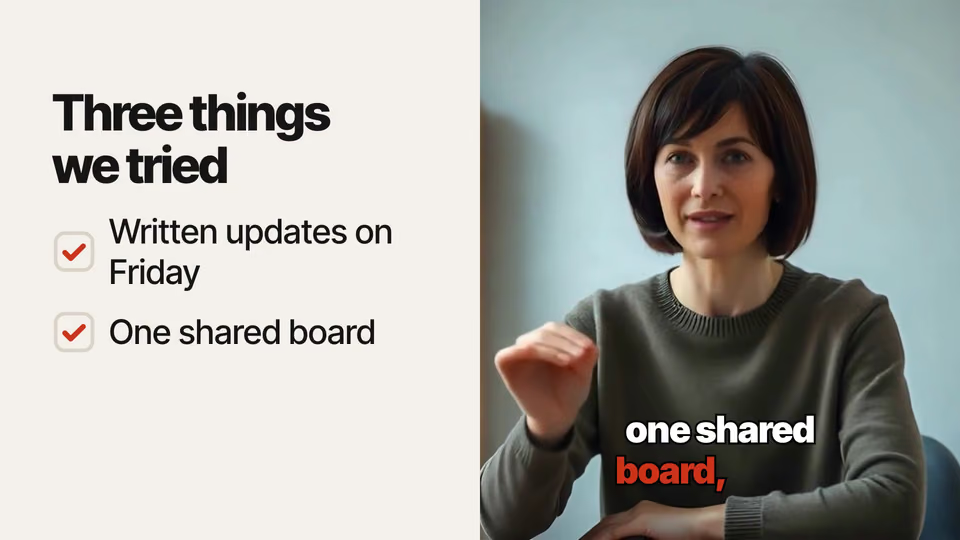
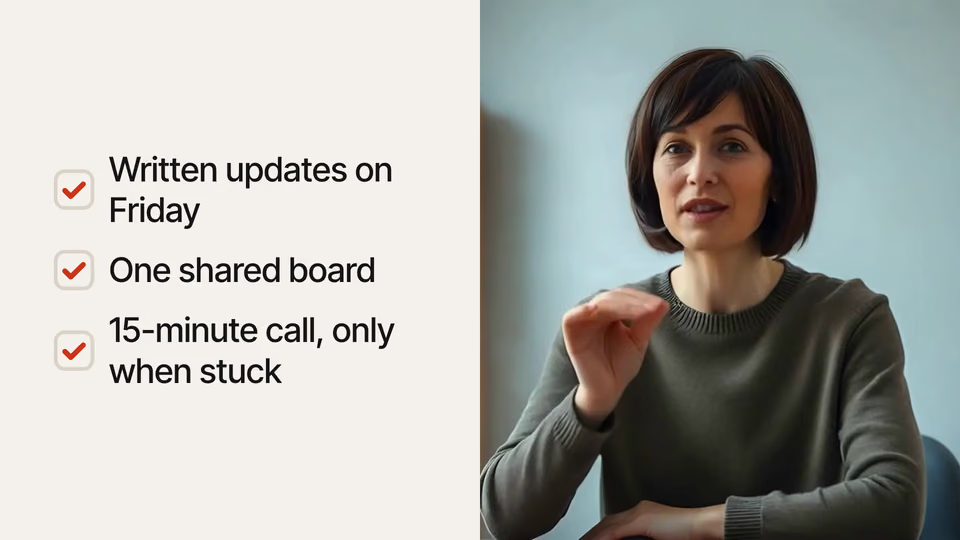 Video
Ticking checklist on video
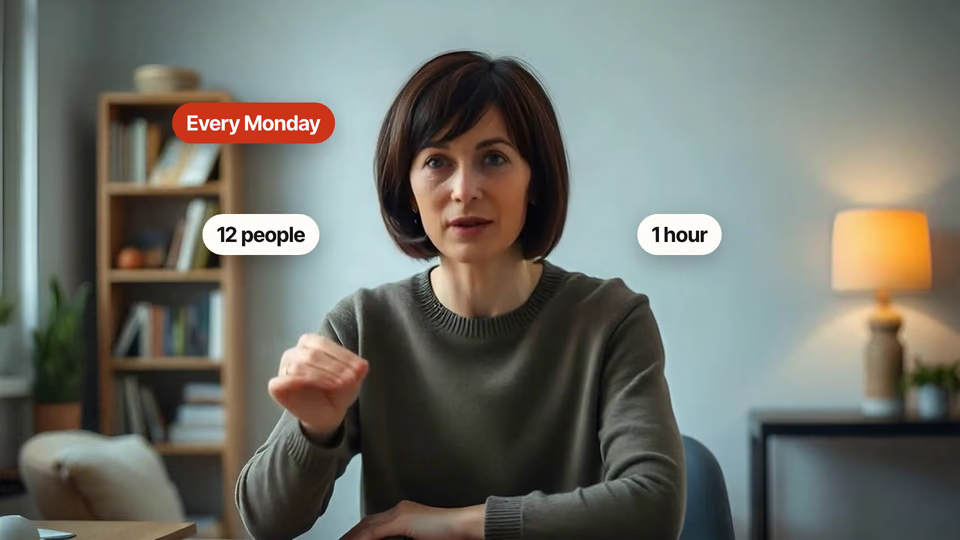 Video
Pop-up labels around the head
 Video1 view, 0 downloads
Thought bubble that pauses video
You say
Take over the frame in talk.mp4 with a chart of 600 hours before and 360 after.
It said back
The chart now takes over the frame with 600 h before and 360 h after, and the speaker comes back at the end. I rendered it and ran the layout check, which found no problems. I looked at the chart frame in the check sheet but haven't watched the full render.
talk-graphics.mp4 in the work folder. It is 1920x1080, 24.3 s, 30 fps, and the sound is the speaker's, unchanged.paper, titled "Meeting hours per year", with the After bar highlighted.What it did in run 1
No. Chart Takes the Frame costs $9.99 once and stays in your Recaply account, or it comes with the Recaply plan ($19.99 a month), which opens every premium skill and prompt.
Claude Code, Codex, Cursor, Gemini CLI, GitHub Copilot and OpenCode.
A ZIP of the whole skill folder (105 KB): the SKILL.md your agent follows and its 12 other files, the references, templates and scripts it uses. You download it from this page whenever you need it, and install it in Claude Code, Codex, Cursor, Gemini CLI, GitHub Copilot and OpenCode. The Recaply plan opens it too, with every other premium skill and prompt.
Buy it, then download the ZIP from this page. For Claude Code, unzip it into .claude/skills/ in your project. For Codex, Cursor and Gemini CLI, unzip it and run npx skills add ./chart-swap-overlay with your agent's flag.
Your video with the overlay timed to the words, sound kept. The frame swaps to a clean chart; bars grow one after another as each is said, values counting up. 16:9, 9:16, 1:1 or 4:5.
Node 22+, Chrome and ffmpeg, and no API key. Each use costs nothing beyond your agent.
13 files, about 79,968 tokens in all. The SKILL.md is about 2,306 tokens, and your agent reads it only when the job fits.
Our 1 runs took 1 min 36 s to 1 min 36 s and $0.11 to $0.11 of API use each, in Claude Code with claude-sonnet-5-5. On a Claude plan, a run counts toward your usage instead.
Type /chart-swap-overlay first to make sure it loads. Without it, Claude Code may judge a small job simple enough to do without the skill.