
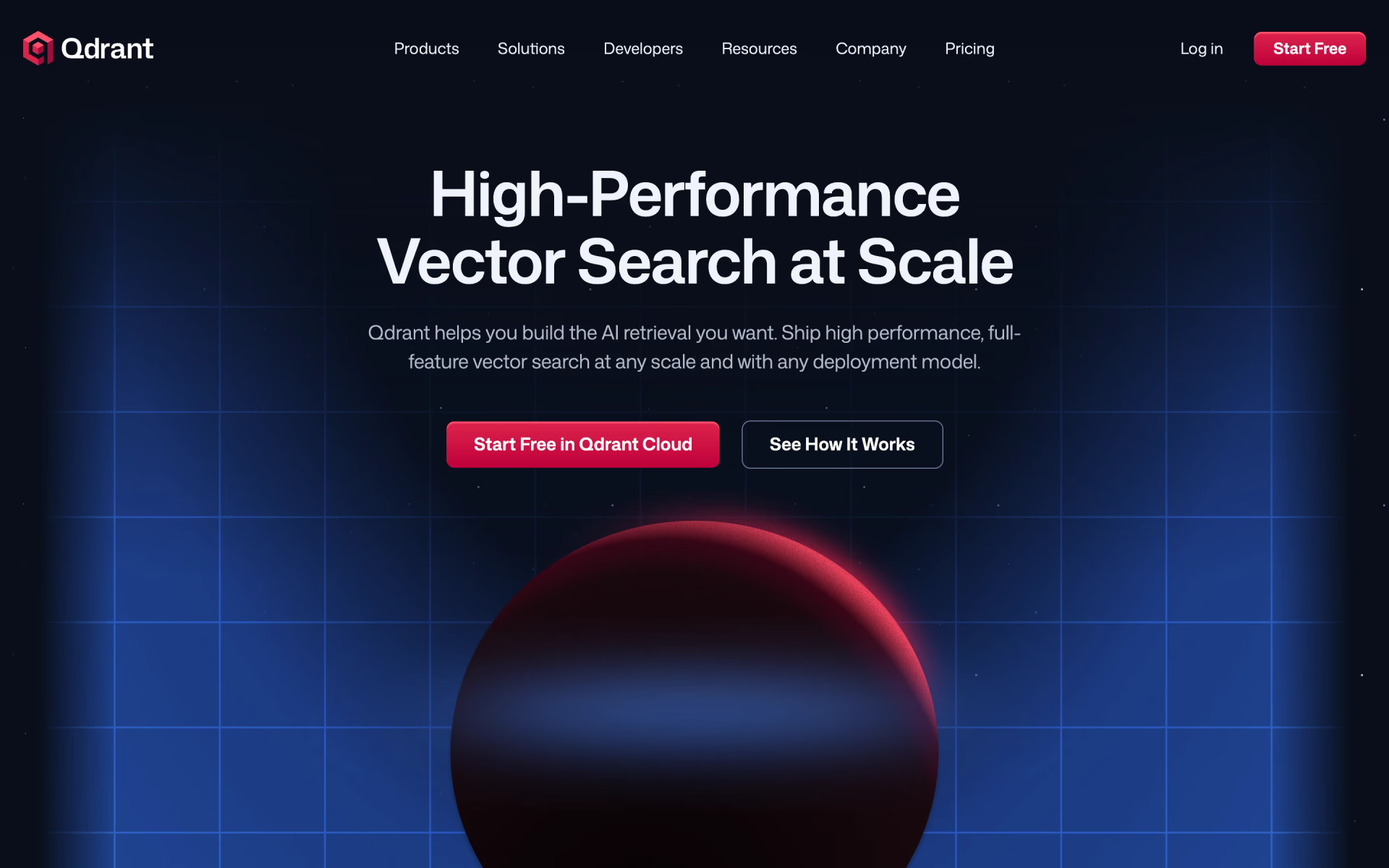
What is Qdrant?
Open-source vector search with real-time indexing.
Who is Qdrant best for?
Qdrant is best for developers building RAG or semantic search who want a fast vector database they can run themselves.
RAG and AI search
Dense and sparse vectors, keyword scoring and metadata filters work in one query, which helps retrieval hand the right chunks to a language model.
Teams that want to self-host
The engine is open source under Apache 2.0, so it can run on your own servers, on your own Kubernetes through Hybrid Cloud, or fully isolated in Private Cloud.
Recommendations that change often
New vectors are indexed in real time without rebuilding the index, so fresh items show up in similarity results as soon as they are added.
Large collections on a budget
Scalar, binary and asymmetric quantization cut memory use by up to 64 times, and cloud bills follow the memory and compute a cluster uses.
How much does Qdrant cost?
Qdrant is free to self-host and has a free cloud tier with one small cluster (1 GB RAM, 4 GB disk), while paid Qdrant Cloud clusters are billed by the hour for the compute, memory and storage they use.
- One node with 0.5 vCPU, 1 GB RAM and 4 GB disk
- About 1 million vectors of 768 dimensions
- No credit card; suspended after 1 week unused
- Dedicated resources with vertical and horizontal scaling
- High availability, backups and disaster recovery
- 99.5% uptime SLA
- SSO and private VPC links
- 99.9% uptime SLA
- Extra support
Standard Tier bills vCPU, memory, disk, backup storage and paid inference tokens by the hour, charged each month by card or through the AWS, GCP or Azure Marketplace at the same prices. Qdrant's pricing calculator gives an estimate for your workload: for 1 million vectors of 1,536 dimensions on AWS in N. Virginia, with no replication or quantization, it shows about $102.51 a month. Premium's minimum spend is not published, and Hybrid Cloud (your own Kubernetes) and Private Cloud are priced on request. The open-source engine is free under the Apache 2.0 license. Full pricing on qdrant.tech. We checked these prices on .
How do readers rate Qdrant?
No one has rated Qdrant yet. Be the first.
Sign in to rate. One rating per account.
Is Qdrant open source?
Yes. Qdrant's code is public under the Apache 2.0 licence, so you can run it on your own server.
On GitHub
35,528stars
+469 (+1.3%) in the last 30 days
- Last commit
- 12 Nov
- Repository age
- 6 years
- Latest release
- 22 Oct
- Licence
- Apache 2.0
- Self-hosted
- Yes
- Repository
- qdrant/qdrant



What are the best Qdrant alternatives?
Qdrant is an open source alternative to Pinecone. Milvus, Supavec, Deeplake and HelixDB do the same job and are open source too.
 PineconeFree
Managed vector database for search, RAG and agents.
 MilvusOpen Source
Vector database for RAG and semantic search that runs on a laptop, a server or a Kubernetes cluster.
 SupavecOpen Source
Open-source RAG for your own data.
 DeeplakeOpen Source
Database for AI data that keeps vectors with images, video and text, plus search and versioning.
 HelixDBOpen Source
Graph database with built-in vector and full-text search, made for AI agent memory and retrieval.
Questions about Qdrant
What is Qdrant?
Open-source vector search with real-time indexing.
Who is Qdrant for?
Qdrant is best for developers building RAG or semantic search who want a fast vector database they can run themselves.
Is Qdrant free?
Yes. Qdrant's open-source engine is free to self-host, and Qdrant Cloud's Free Tier gives one cluster with 1 GB RAM and 4 GB disk without a credit card. Unused free clusters are suspended after 1 week and deleted after 4 weeks if not reactivated.
Is Qdrant open source?
Yes. Qdrant's code is public under the Apache 2.0 licence, so you can run it on your own server.
What are the best Qdrant alternatives?
The closest alternatives on Recaply are Pinecone, Milvus, Supavec, Deeplake and HelixDB.
Where can I try Qdrant?
On its official website, qdrant.tech.
Can I pay for Qdrant Cloud through AWS, Google Cloud or Azure?
Yes. Qdrant Cloud takes a credit card or a subscription through the AWS, GCP or Azure Marketplace, at the same prices either way, billed at the start of each month for the month before. Paying through a marketplace limits new paid clusters to that provider's regions.

 MemPalace
 Vectorize

 Open Memory Protocol

 deepclaude

 Herdr
 Omnigent