
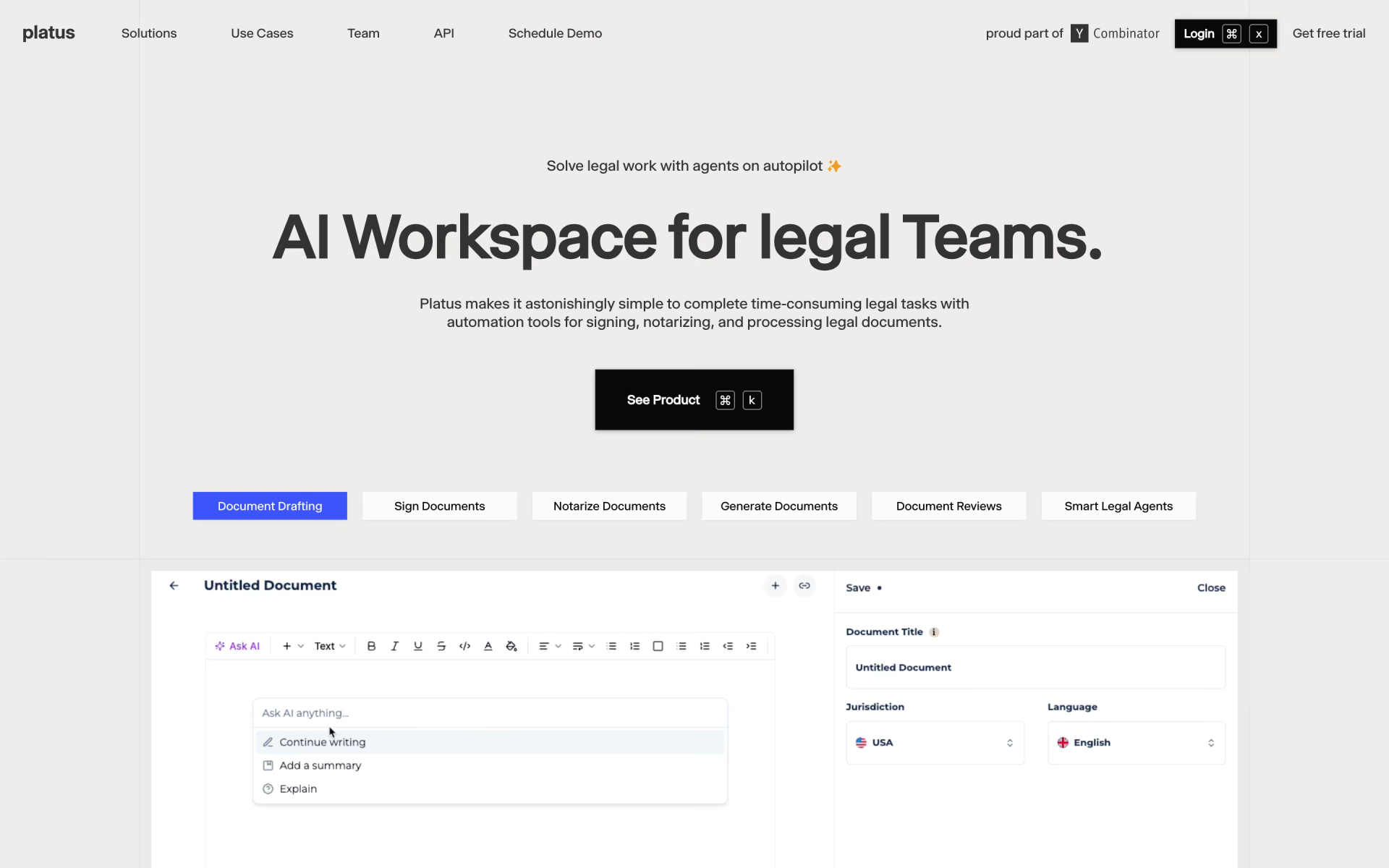
What is Platus?
Contracts drafted, signed and notarised.
Who is Platus best for?
Platus is best for law firms and in-house legal teams that draft, sign and notarise many similar contracts.
In-house legal teams
Agents draft NDAs and other standard contracts from templates, fill in the variables and leave a final check to a lawyer through an approval step.
Law firms filling documents at scale
It fills the same agreement for many parties from stored data, such as documents for dozens of investors in a funding round.
High-volume notarisation
It automates signing and online notarisation for businesses that process large numbers of documents such as powers of attorney.
Developers and no-code teams
Technical teams can call its notarisation and signing API, while others use shareable links without writing code.
How much does Platus cost?
Platus does not publish prices: it is sold through an intro call or demo, and the maker offers a free trial that you request with your name, email and company.
Platus has no pricing page and shows no plans or prices. You can book an intro call, email the founders, or request a free trial through a short form; the site does not say how long the trial lasts. Plans and current prices are on platus.com.
How do readers rate Platus?
No one has rated Platus yet. Be the first.
Sign in to rate. One rating per account.
What are the best Platus alternatives?
Two tools on Recaply do Platus's job.


Questions about Platus
What is Platus?
Contracts drafted, signed and notarised.
Who is Platus for?
Platus is best for law firms and in-house legal teams that draft, sign and notarise many similar contracts.
Is Platus free?
You can try Platus free before paying.
What are the best Platus alternatives?
The closest alternatives on Recaply are Agreements.ai and fynk.
Where does Platus store its data?
Platus says it hosts data on servers in Frankfurt, Germany (region FRA1), encrypts it to current standards and is built for GDPR compliance. Its site does not say whether other hosting regions are available.
 Spellbook
 Crosby

 Cloud Contracts 365
 ContractPower
 Erayaha
 Contractify